THE RAISING OF LAZARUS

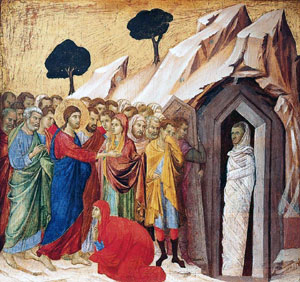
This Saturday, March 31, the Armenian Church commemorates the Raising of Lazarus as told in the Gospel of John, Chapter 11.

       Lazarus and his sisters Mary and Martha were good friends of Jesus. Their home in Bethany (near Jerusalem) was Jesus’ home whenever he was in Jerusalem. Lazarus’s sudden death threw his sisters into deep mourning. Jesus also wept for his friend. John’s gospel accountimage emphasizes the fact that Lazarus was indeed dead by pointing out that his body was in the tomb. Jesus’ raising of Lazarus convinced many people of his unique powers, and according to John, the authorities took steps to try to silence him.

       Lazarus personifies the whole of humankind and Bethany represents the whole world. Lazarus Saturday is the real beginning of the Cross. Its major themes are the forthcoming victory of Christ over death, the supreme sacrifice of love, and the resurrection as the ultimate triumph of love.

       A hymn traditionally sung on Saturday evening (eve of Palm Sunday) says: “With the raising of Lazarus by which the dead were given hope, the descendants of Adam were also raised….” Thus, as the Lenten period comes to an end, we are greeted by the hope of Christ’s promise of the resurrection of humankind.

       The forty days of Great Lent (Medz Bahk) come to an end with Vespers on the Friday prior to the commemoration of the Raising of Lazarus. A new fasting period for Holy Week begins on Monday and continues through Holy Saturday.

Posted from Armenian Prelacy’s (Easter) E-Newsletter.

During Great Lent, saint days are commemorated only on Saturdays. During the remainder of the year saints can be honored on Mondays, Tuesdays, Thursdays, or Saturdays. Never on Wednesdays or Fridays, these being fasting days.

       This Saturday, March 24, the Armenian Church celebrates one of the three days in its liturgical calendar devoted to St. Gregory the Illuminator, the patron saint of the Armenian Church. The three days are: Entrance into the Pit; Emergence from the Pit; and Discovery of his remains. This Saturday is the commemoration of his commitment to the Deep Pit (Khor Virab). image

       Gregory maintained his faith and refused to renounce Christ. As a result he endured many tortures and his final punishment was banishment into a deep pit where he remained for a period of thirteen or more years. Miraculously he survived, thanks to his faith and a woman (identity unknown) who lowered food and water into the pit.

       The Monastery of Khor Virab is a popular destination for tourists and pilgrims who visit Armenia. The monastery was built on the exact location where St. Gregory was imprisoned. The pit is accessible and it is possible for visitors to climb down the ladder (27 steep steps) into the pit. The church, named Sourp Asdvadzadsin, dates to the 17th century. The area is one of the most beautiful in Armenia and provides the absolute best view of Ararat from anywhere! The area surrounding Khor Virab is the site of the ancient Armenian capital, Ardashad, founded by King Ardashes I about 180 BC.

Come, let us exalt on this day the spreader of the spiritual light to us who sat in darkness, the holy patriarch Gregory. Come, you children instructed by him, exalt on this day the distributor to the sons of Torkom of the undefiled gifts of the Holy Spirit who gave us a new birth as sons of the light. Come, you children instructed by him, exalt on this day the interpreter of the divine word in the land of Armenia. On this day the Church and her children sing with the angels, on this day of memory of the enlightener ascribing glory to God in the highest.


(Canon to St. Gregory the Illuminator, Commitment to the Pit, from the Liturgical Canons of the Armenian Church)

Posted from Armenian Prelacy’s (Eastern) weekly E-Newsletter

FORTY MARTYRS OF SEBASTIA

     This Saturday, March 17, the Armenian Church commemorates the Forty Martyrs of Sebastia. Although the backgrounds and identities of the forty young soldiers are not certain, it is believed they came from Lesser Armenia and served in the Roman army. According to St. Basil of Caesarea, forty Christian soldiers refused to worship the Roman emperor while stationed in Sebastia in Armenia in 320. They remained faithful to their Christian faith. The soldiers were tried and condemned to death by stoning. Miraculously, when the sentence was being carried out, the stones would not reach the condemned soldiers, but would instead come back striking those throwing the stones. The soldiers were then thrown into a frozen lake and forced to stay there, unless they renounced their faith. Warm baths were prepared for anyone who would recant. Of the forty, only one gave up. When he did, another soldier, moved by the example of the suffering Christians, declared himself a Christian and took the apostate’s place. All forty died. 
       Some of our great Church Fathers like Basil, Gregory of Nyssa, Ephraim the Assyrian, and Sisian of Sebastia, wrote panegyrics about the forty martyrs, who are remembered each year during Lent on the Saturday following the median day of Lent. The Armenians have built and named churches in memory of the Forty Martyrs in various parts of the world.

SUNDAY OF THE JUDGE

 
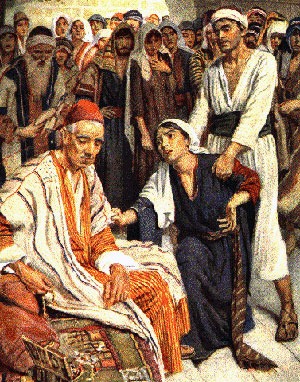
We are not more than half-way through Great Lent (yesterday was Michink, the median day of Lent). This Sunday, March 18, is the “Sunday of the Judge” (Tadavori Giragi). The Gospel reading for this day is the UnjustJudgeparable told by Jesus about a widow and a judge (see Bible reading above). The judge in the parable is seen as hard-hearted and without principles, fear of God, or regard for people. A widow in the same town has been ill-treated and she has come to the judge for justice. Although her cause is just, the judge does not pay attention to her case. However, she is persistent and she makes the same appeal again and again until at last the judge decides to see that she receives justice. He does this not because he cares about justice, but because he wants to be rid of the widow.
The message of this parable is that we must persevere and pursue righteousness and justice relentlessly with the confidence that perseverance (especially in prayer) will be rewarded.

FOUR CANDLES

By Author Unknown

The Four Candles burned slowly. Their ambiance was so soft you could hear them speak…

The first candle said, “I Am Peace but these days nobody wants to keep me lit.”

Then Peace’s flame slowly diminished and went out completely.

The second candle said, “I Am Faith but these days I am no longer indispensable.”

Then Faith’s flame slowly diminished and went out completely.

Sadly the third candle spoke, “I Am Love and I haven’t the strength to stay lit any longer. People put me aside and don’t understand my importance. They even forget to love those who are nearest to them.”
And waiting no longer Love’s flame went out completely.

Suddenly a child entered the room and saw the three candles no longer burning.
The child began to cry, “Why are you not burning? You are supposed to stay lit until the end.”

Then the Fourth Candle spoke gently to the little boy, “Don’t be afraid for I Am Hope and while I still burn, we can re-light the other candles.”

With Shining eyes the child took the Candle of Hope and lit the other three candles.
Never let the Flame of Hope go out of your life.

With Hope no matter how bad things look and are…Peace, Faith and Love can Shine Brightly in our lives.

       This Saturday, March 10, the Armenian Church celebrates the lives of the following four saints: 

       St. John, Patriarch of Jerusalem, succeeded St. Cyril as Patriarch of Jerusalem (386-417). He grew up with the monks at the monastery of Nitria (Egypt) where he learned about Christianity and the teachings of Origen. He was noted for his keen intellect and is said to have delivered inspiring and eloquent sermons. 

       Hovhan Odznetsi (St. John of Odzoon) was catholicos from 717 to 728, which was a period when Armenia was under Arab rule. He defended Armenians from forced conversion and was successful in securing the right of worship for Armenian Christians. He was also successful in securing tax-exempt status for the church. He was highly admired and respected. 

       Hovhan Vorodnetsi (St. John of Orodni) was born in 1315. Following his ordination he served at the monasteries of Klatzor and Datev. He dedicated most of his efforts toward the preservation of the orthodox faith, and against the attempt to merge the Armenian Church with the Latin Church. He wrote commentaries on the Gospel of John and the epistles of St. Paul. 

       Krikor Datevatsi (St. Gregory of Datev), born in 1346 in the province of Vayots Tsor, is perhaps the best known of the four. He was a student of John of Orodni and a great defender of the character of the Armenian Church. He was a brilliant scholar; he knew Latin fluently and had studied the Greek philosophers extensively. He is regarded to be the greatest teacher of the Armenian Church. His most famous work is the Book of Questions (Kirk Hartsmants), which examines questions of faith. He is also credited with setting a high standard for preaching. He is often referred to as “the second Gregory the Illuminator.” 


SUNDAY OF THE STEWARD

       This Sunday, March 11, the fourth Sunday of Lent, is the Sunday of the Steward (Dendesi Giragi, Տնտեսի Կիրակի). The parable of The Unrighteous Steward is in the Gospel of Luke, Chapter 16, verses 1 to 8. This parable is about a rich man and his steward. The steward was one who looked out for his own personal benefit and through his cunning arrangements he made deals with those who were in debt to his master. Jesus used this parable not to condone the behavior of the steward but rather as an illustration of qualities that have a necessary place in the life of true disciples. Since we are stewards of the world, we are accountable to our Lord for the talents we have and the things that have been entrusted to our care.

       Throughout his ministry, Jesus used parables as a teaching tool. His parables were common stories, usually short and always interesting. Generally, the stories were used to convey important moral and ethical messages. Some of the parables are simple and easy to comprehend. Others are complex and more challenging.

      By your power you created the world above of intelligent creatures and set up in it as stewards the leaders of the fiery spirits; we bless your might which word cannot express. You are the rich One by nature, you fashioned the new sensible world and in Paradise in Eden, you placed the first man as steward; we bless your might which word cannot express. With deep and mysterious thought you built your Church and appointed in it as stewards the proclaimers of the word of truth; we bless your power which word cannot express. Tabernacle of the uncontainable One, bearer of him who bears all that exists, you gave birth in the flesh to God begotten of the Father without flesh, intercede for us, Mary, Mother of God.

 From the Liturgical Canons of the Armenian Church for the fourth Sunday of Lent, Sunday of the Steward. 

 From Crossroads, Eastern Prelacy’s E-Newsletter

ST. THEODORE THE WARRIOR

This Saturday, February 25, the Armenian Church commemorates the life ofimage Theodore the Warrior, a captain in the Roman army during the reign of emperor Licinius. Theodore was born into a Christian family and was educated in the teaching of Christianity. He was noted for his bravery, and was noted for killing a serpent that was terrorizing people and animals. Theodore armed himself with a sword, and with a prayer to the Lord vanquished the serpent and became a heroic figure. He was appointed commander of Heraclea where he combined his military duties with the preaching of the Gospel. Soon nearly all of Heraclea had accepted Christianity. Emperor Licinius began a campaign against the Christians. Theodore was a main target. He was arrested and given an opportunity to renounce his Christian religion, which he refused to do. He was martyred in 319 A.D. in Heraclea, Thrace.

Posted from Armenian Eastern Prelacy’s Crossroads E-Newsletter.

By David Luhrssen


One hundred and twenty people crowded the Culture Hall at St. John the Baptist Armenian Church for this year’s Milwaukee-area Poon Paregentan celebration. The featured attraction at the big party before the beginning of Great Lent was MidEast Beat, a band from Racine, WI. Although its members are all Armenian American, the group drew from a traditional repertoire common to Anatolia and the Eastern Mediterranean. “Sometimes the lines get blurred in this part of the world and you will find songs recorded in Greek, Armenian,

Arabic, and not know where the origin is,” explained guitarist and singer Kai Kazarian. “Think about an Armenian writing a song in English in this country. Is it Armenian? We have these questions all the time.”

The band, whose core members include Jim Hardy on clarinet, Vahan Kamalian on oud and Michael Kamalian on dumbeg, picked up the music by hearing it performed at Armenian picnics and by rummaging through old 78 rpm recordings at their grandparents’ homes. There was no sheet music and no study guides when MidEast Beat first organized in the early 1980s. Discovering and learning the old music was hard work that has paid off for the band, whose Feb. 18 performance at St. John’s Poon Paregentan event filled the dance floor and entertained an appreciative audience of listeners.

A catered buffet dinner was including in the event along with desserts prepared by the members of St. John’s.

On January 13, the Armenian Church celebrates the Feast of the Naming of our Lord Jesus Christ, in accordance with the Hebrew custom. The commemoration of this event (see Matthew 1:20-23; Luke 1:30-32; Luke 2:21) comes seven days after the Feast of Theophany, which is the eighth day of the octave of Theophany. This event of the naming and circumcision of our Lord resulted in the tradition for newborn children of Christians to be baptized eight days after birth—a tradition that is rarely followed in modern times.