http://www.huffingtonpost.com/courtney-cachet/armenian-genocide-anniversary_b_1448315.html

Courtney Cachet
Designer, TV Personality, Style Slave, Writer, Ninja

April 24th marks the 97th anniversary of the Armenian Genocide. Armenians mark this date in 1915, when several hundred Armenian leaders were rounded up, arrested and later executed as the start of the Armenian genocide and it is generally said to have extended to 1917. In total, over 1.5 million Armenians were massacred by the Turks in what is known as the Armenian Genocide. It was the first Holocaust of the 20th century. This, the world knows for sure. Turkey still denies this and whenever another country — as so many have — stands up and recognizes what happened to the Armenians as a genocide, they flex their political muscle and governments cave.

The reasons for their denial are simple. They want to be members of the European Union. The reasons governments such as the U.S. always promise the Armenians they will do something and never do is equally political. They are a key NATO ally, they are in a strategic geographic location for the U.S. and we have a military base there.

The thing is, Turkey can deny what they did over and over again but there are men and women who survived the reprehensible atrocities they inflicted on the Armenian people. They’ve told their stories.

We know them and we know what you did.

One such person was my grandfather, whom I knew as Marcel Cachat. Let me tell you about his life as it was told to me by him.

I can’t tell you when he was born, because when he lost his entire family in the infamous death marches. He was just a little boy. After all, who else could survive countless days without food or water marching into the Syrian desert? Only young, strong children. He was rescued by Greek missionaries who raised him in an orphanage in Greece. As a young man, he made his way on a boat and went to the South of France where many Armenians had gone. There, he went to work for a farm family because that is what he knew how to do. He needed to learn the language. As a a kid, I visited that farm family with him and my father. Soon after his arrival, local authorities got wind of his presence and he was called down to the local office. The French naturalized him, but suggested he change his name, as to assimilate into French society a little easier.

His name was changed from Missak Kachadurian to Marcel Cachat. Date of birth: unknown.

Eventually, through the Armenian community in Marseille, he met my grandmother Ardemis Tashjian. They married, started a little business and had my father, Marc.

During World War II, my grandfather fought for the French army and was captured right away without ever firing his gun. He was kept a German prisoner of war for several years while my grandmother raised my father back in France. Till the day he died, the very little English he spoke was with a heavy German accent. Not only did he speak fluent German, but he spoke fluent Turkish, Armenian, Greek, French and enough English later in life to hold a job in New York.

My father came to New York as a young man and started his life here in America. After my grandmother passed away in 1969, he followed him to New York, as well. He never knew his birthday and he had no known blood relatives besides us. He told me he remembered lots of people in his home growing up, but the memories were sketchy, at best.

I remember him as kind man who possessed a level of intelligence that was mind boggling, given his obvious lack of formal education. He was generous, too. He would buy us frivolous gifts and cook us wonderful dinners on Sundays. My mother told me he used to send donations in to PBS because he appreciated the educational shows they aired. He was a painter and had a garden that would make people stop their cars and ask him who his gardener was. He was humble, hard-working and very funny.

Pepe Marcel eventually went back to Marseille after several years in New York. He was happiest there, I believe. After all, it was practically his country. He raised his family there and most of my cousins still live there today. He remained active, walking four miles a day on the Corniche, one of the most beautiful streets in Marseille. He ended every day with a glass of red wine, how very French. He was very French, but he was always an Armenian man. With no roots, very little memories of a childhood and no place to go back home. Nevertheless, he married an Armenian woman, remained active in the Armenian community and raised his family in the Armenian Church. My husband is also Armenian and we will raise our children with the same values instilled in most Armenians. We work hard, we value family, education and are widely considered as high achievers in business. And no matter what happens to us, we will endure as my grandfather did.

 A famous quote comes to mind today:

 I should like to see any power of the world destroy this race, this small tribe of unimportant people, whose wars have all been fought and lost, whose structures have crumbled, literature is unread, music is unheard, and prayers are no more answered. Go ahead, destroy Armenia. See if you can do it. Send them into the desert without bread or water. Burn their homes and churches. Then see if they will not laugh, sing and pray again. For when two of them meet anywhere in the world, see if they will not create a New Armenia. — William Saroyan

So to anyone who denies the Armenian Genocide ever happened I say only this. We know you did it and the world does, too. It will always be the stain you cannot remove from your history, no matter how hard you try to silence the truth.

More importantly, the survivors like Missak Kachadurian know you did it.

À la mémoire de mon Grand-Père Missak “Marcel” Cachat.

We will always remember.
 

Rabbi Shapiro a…

Rabbi Shapiro at Milwaukee Martyrs Day
Jewish Leader Speaks on the Genocide and the Holocaust

By David Luhrssen

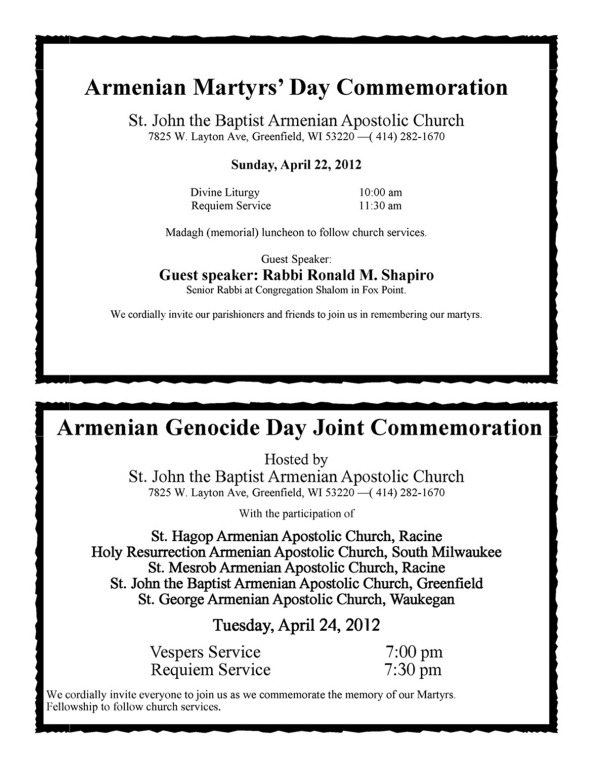
Milwaukee, WI- As part of its remembrance of the Armenian Genocide, St. John the Baptist Armenian Church has long hosted a madagh dinner followed by a speaker on the Sunday closest to Martyrs Day. This year, on April 22, the suburban Milwaukee parish invited a prominent local rabbi, Ronald Shapiro, to give a presentation after dinner. Aside from his work at Milwaukee’s Congregation Shalom, Rabbi Shapiro teaches contemporary Jewish studies at Cardinal Stritch University and is active in the city’s interfaith movement.

In his remarks, Shapiro spoke of the great similarity between the cultures and traditions of the Armenian and Jewish peoples. He surprised even the most knowledgeable in attendance by referencing a 4th century Persian persecution of both groups, living as neighbors, involving the sort of deportations common to both the Genocide and the Holocaust in the 20th century. He also spoke of the coincidence between the late 19th century pogroms of Eastern Europe and the massacres in the Ottoman Empire that drove significant populations of Jews and Armenians to refuge in other lands, including the U.S. During many dark centuries both groups looked forward to the reestablishment of homelands where their cultures could be nurtured. “We have been victims of others who believed they had the absolute view of what every human being must be,” he said. “Armenians and Jews have often been at the receiving end of that hatred.”

Shapiro also spoke of Mount Ararat as a common symbol of rebirth for both nations. “Noah was not Jewish,” he began, “and Adam was not Jewish,” he continued. “Adam in Hebrew simply means human being—not just man or woman but human being. No one can say we are better than anyone else by virtue of lineage. We have so much in common as humans created in God’s image.”

The rabbi praised the St. John congregation for its many young members and extolled the value of passing traditions on from one generation to the next. An example was the talk given by St. John’s Nicole Kashian, 18, as a preface to Shapiro’s presentation. She reiterated the facts of the Armenian Genocide and focused on its denial, pointing out that the Genocide was better known in World War I than in the 21st century. As evidence, she cited the New York Times, which published no less than 145 articles during the Genocide and called the murder “systematic” and “authorized.” Yet, unctuous U.S. and European Union officials continue to waffle and the Turkish government continues to encourage Genocide denial. “We cannot forget,” she concluded. “We will always remember.”

St. John was also host of a joint Martyrs Day commemoration on the evening of April 24, with a vespers and requiem service, with clergy from St John Armenian Church of Greenfield, Holy Resurrection Armenian Church in South Milwaukee and St. Mesrob and St. Hagop Armenian Churches in Racine, WI, participating. During the service, Greenfield Alderwoman Shirley Saryan presented the Martyrs’ Day Proclamation from the Mayor of the City of Greenfield to Der Nareg.

“I CALL UPON OUR PEOPLE TO DEMAND
THEIR STOLEN RIGHTS FROM TURKEY”, Said His Holiness Aram I

The summary of the message of His Holiness Aram I delivered on 24th April 2012 in Antelias to thousands of Armenian people who were gathered to commemorate the Armenian Genocide.

We are gathered today in front of the Martyrs Chapel, where the remains of some of the victims of the Armenian Genocide were buried in 1935 when the Catholicosate of Cilicia finally settled in Antelias.

We are here to recommit ourselves to the legacy we inherited from our martyrs, irrespective of the changing political conditions around us. Our martyrs also want us to make our voice heard by the leadership in the Arab world and Europe.

Turkey is seeking to expand its political and economic influence in the Arab World, Europe and Africa. Claiming to be a defender of minorities and a champion of democratic principles and human rights, Turkey is presenting itself as a peace-builder in the Arab World.

Can a nation that fills its prisons with human rights advocates and journalists lecture others on the imperative to champion democratic principles and human rights? Can a nation that systematically killed a million and a half members of one of its minority peoples and today denies that act demand that others defend their minorities?

The Prime Minister of Turkey has cynically stated that if there really was a genocide we should be able to show them where the graves of the victims are. We can tell them that the graves are in places that the Turks have renamed in order to attempt to erase historical memories: the Turkish towns and villages in Western Armenia, Cilicia and in Der Zor, the Syrian Desert.

In a cynical attempt to appear reasonable, Turkish authorities suggest that historians should sit down together and attempt to determine what really happened in Turkey in 1915. Neutral historians have long ago determined what happened by having read the internationally accepted and verified Western Diplomatic, Armenian and Turkish sources that document the horrors that the Turkish government foisted upon the Armenians in 1915.

We hold the present Republic of Turkey, in its capacity as the legitimate successor of the Ottoman Empire, accountable for its crimes against our people. We demand our rights to compensation for the confiscated Church, community and individually owned properties not only since 1936, as the August 2011 decision stipulated, but also those confiscated from1915 to 1920.

During the international conference that we organized last February, here in Antelias, we said that recognition and compensation are inseparable. Therefore, and in consultation with the government of Armenia, the Catholicosate of Cilicia will work together with the Armenian Catholic and Evangelical communities to obtain the legal rights to confiscated properties.

On the eve of our 100th anniversary, I call upon our people in Armenia, Karabagh and the diaspora to renew their commitment to the legacy of the martyrs of the 1915 Genocide.

  Easter Sunday is followed by a period of fifty days (Hinants) during which there are no fasting days and no saints days. This period from the Resurrection to Pentecost (Hokekaloost) is dedicated to the glorification of the Resurrections. Each of the seven Sundays of Hinants has a special name. Last Sunday, the first Sunday after Easter, was “New Sunday.”
      This Sunday, April 22, is “Green Sunday” (Ganach Giragi), also known as Sunday of the World Church (Ashkharhamadoor). The concept of Green Sunday most probably comes from an ancient folk holiday celebrating spring. Our forefathers, seeing mother earth bloom after long winter months, glorified the Creator with an act of thanksgiving and celebrated by decorating the church and themselves with greenery. The reawakening of nature is also symbolic of the Resurrection. Green is the color of life, freshness and promise. After a barren winter we are filled with hope, life, and love. 
     Green Sunday is also an appropriate time for us to remember our obligations to be good stewards of the earth and the gifts that have been given to us by God. With this in mind, 19 years ago, on May 12, 1993, the Clergy Conference at the National Representative Assembly [Armenian Prelacy] that took place at Soorp Khatch Church, Bethesda, Maryland, issued a strong statement on the environment and recommended that every year, “Green Sunday, the second Sunday following Easter, be declared a day when all the members of the Church observe the sanctity of God’s creation and the purity of the environment.”

MartyrsDay2012email

Turkish Nationalism and the Armenian Genocide
Facing History: Denial and the Turkish National Security Concept

Monday, April 23rd   4:00 pm …  Holton 241

Sponsored by University of Wisconsin, Milwaukee, the Department of History, Ethnic Studies Program, InternationalStudies Program, Religious Studies Program, and Center for International Education

Professor Taner Akçam is the Chair in Armenian Genocide Studies, Department of History, Clark University. Born in Turkey, his research areas include political violence and torture in late Ottoman and early Republican Turkey and, most recently, Turkish nationalism and the Armenian Genocide.

By Krikor Tertsagian

"Aztag" Newspaper, Beirut Lebanon


I am not a churchgoer every Sunday without fail. I have not mastered our thousand year old church’s sometimes golden, but often tragic history.

From Gregory the Illuminator to Movses of Khoren, passing by Gregory of Nareg, all the way to the details of our centuries old pair of Catholicates – I am far from mastering these!

I have not read the Nareg. I also confess that I haven’t finished reading the Holy Gospels from cover to cover.

I am familiar only in general with our wonderful Holy Divine Liturgy.

But..

Every time I enter the Armenian Church, my body turns into an electrified current; my head quickly yields to my heart, and my heart in turn yields to my soul.

The enticement at the entrance of the church, is it the half melted candles? Is it our church’s altars with their starkly recognizable and mystical letter "eh?" Is it the faith and devotion of the Armenian clergyman, the singing of the choir, the bishop’s throne? I wonder, is it the history of the Armenians summarized in a few sharagans, or Jesus’ crucifixion, rendered sublimely by a talented artist? The answer to all these things is not even important.

I know that the church wields over me a hypnotic and indescribable influence, ponderous and deep with its thousand year old weightiness.

The choir sings, “Christ in our midst has been revealed, he who is God…” In a flash my soul is awakened, my eyes are filled and my inner world is turned upside down, even more than the cauldron of newly prepared Holy Muron. “Father, have you begun to cry again?” my son, Alex, whispers in my ear. “No, my son, I am not crying, I am only slightly emotional.”

“Don’t start again!” says my other son, Sevan. “It’s nothing,” I answer, “Nothing.”

Why did it happen? I don’t know, what did happen? Those hypnotic “what happened” I do not know, nor am I able to explain.

“Faith” and “reverence toward the Church” are words and phrases that are not easily explainable. Open any dictionary and look up the definition of “faith.” I assure you that all definitions and answers are lacking and insufficient.

Feelings have always been stronger yet than mere strings of words.

Yes, “faith” is an indescribable human feeling.

But “faith of the Armenian Church” becomes more complex, pressing but at the same time healing and satisfying.

I am sure that one day my two boys will understand and feel all these things.


Translated by Fr. Stephan Baljian

       Easter is the holiest of holidays for Christendom. Since the time of the early church, determining the date of Easter has been a matter of argument. The date of Easter is calculated to be on the Sunday immediately following the Paschal Full Moon of the year. The date of the Paschal Full Moon is determined from historical tables, and does not correspond to lunar events. Most of Christendom, including the Armenian Church (except in Jerusalem), follows the Gregorian calendar. Eastern Orthodox churches still use the Julian calendar (for calculating the date of Easter). This is partly why the dates are rarely the same. The date for Easter in the Armenian Church can range from March 22 to April 25.

       There have been a number of attempts to unify the Easter dates. In 1965 the World Council of Churches (WCC) began a discussion on the topic that continued for a number of years. In 1997 the WCC and the Middle East Council of Churches hosted a meeting in Aleppo, Syria, and they came up with a suggestion not for a fixed date, but a fixed formula. The churches could not come to an agreement. And although it is generally agreed that the Last Supper was the Passover meal, Passover and Easter do not always coincide, because the date for Passover is calculated according to the Hebrew calendar.

Posted from Eastern Prelacy’s weekly Crossroads E-Newsletter

ԳՐԻԳՈՐ ԴԵՐՁԱԿԵԱՆ

Ամէն կիրակի անպայմանօրէն եկեղեցի գացողը չեմ:

Չեմ տիրապետեր մեր հազարամեայ եկեղեցւոյ մերթ ոսկեայ եւ յաճախ ողբերգական պատմութեան:

Գրիգոր Լուսաւորիչէն Մովսէս Խորենացի, անցնելով Գրիգոր  Նարեկացիէն, մինչեւ մեր դարաւոր զոյգ կաթողիկոսութեանց մանրամասնութիւններուն տիրապետելէ շատ հեռու եմ:

Չեմ կարդացած «Նարեկ»-ը: Կը խոստովանիմ նաեւ, որ կողքէ կողք չեմ լրացուցած Սուրբ Աւետարանի ընթերցումը:

Մեր սքանչելի սուրբ պատարագին ծանօթ եմ իր ընդհանրականութեան մէջ միայն:

Սակայն

Ամէն անգամ որ կը մտնեմ հայկական եկեղեցի, մարմինս կը վերածուի ելեկտրականացած մէկ զանգուածի մը, գլուխս արագօրէն տեղի կու տայ սրտիս, եւ սիրտս իր կարգին տեղի կու տայ հոգւոյս:

Եկեղեցւոյ մուտքին պլպլացող, կիսահալ մոմե՞րն են միթէ: Մեր եկեղեցիներուն խորաննե՞րն են իրենց խիստ նշանակելի եւ խորհրդաւոր «Է» տառով: Հայ կղերականին հաւատքն ու նուիրո՞ւմը, դպրաց դասին երգեցողութի՞ւնը, առաջնորդին գա՞հը: Արդեօք հայոց պատմութի՞ւնն է խտացուած քանի մը շարականներու մէջ, թէ Յիսուսի խաչելութիւնը` գծուած միջակօրէն տաղանդաւոր արուեստագէտի մը կողմէ: Այս բոլորին պատասխանը կարեւոր ալ չէ:

Գիտեմ, որ եկեղեցին իմ վրաս կը բանեցնէ կախարդական եւ անբացատրելի ազդեցութիւն մը` խոհուն, խորհրդաւոր իր հազարամեայ ծանրութեամբ:

Դպրաց դասը կ՛երգէ. «Քրիստոս ի մէջ մեր յայտնեցաւ որպէս Աստուած…»: Ակնթարթի մը մէջ արդէն հոգիս սաւառնած է, աչքերս լեցուած են ու ներաշխարհս աւելի իրար անցած է, քան` նոր պատրաստուող եւ օծուող սուրբ միւռոնի կաթսան:  «Պապա, նորէ՞ն սկսար լալ», ականջիս կը փսփսայ մանչս` Ալեքսը: «Չէ, տղա՛ս, չեմ լար, քիչ մը յուզուած եմ միայն»:

«Նորէն մի՛ սկսիր», կ՛ըսէ միւս մանչս` Սեւանը, «Ոչի՛նչ»,- կը պատասխանեմ,- ոչի՛նչ»:

Ի՞նչ եղաւ: Չեմ գիտեր` ի՞նչ եղաւ: Այդ կախարդական «ի՞նչ եղաւ»-ները ո՛չ գիտեմ, ո՛չ ալ կրնամ բացատրել:

«Հաւատք» եւ «Եկեղեցւոյ հանդէպ յարգանք» դիւրապէս բացատրելի բառեր եւ թեմաներ չեն:

Բացէ՛ք որեւէ բառարան եւ կարդացէ՛ք «հաւատք» բառին բացատրութիւնները: Կը վստահեցնեմ, որ բոլոր բացատրութիւններն ու պատասխանները թերի են ու չգոհացնող:

Զգացումները միշտ ալ եղած են աւելի զօրաւոր, քան` լոկ բառերու շարանները:

Այո, «հաւատք»-ը մարդկային անբացատրելի զգացում մըն է:

Իսկ «Հայ եկեղեցւոյ հաւատք»-ը կը դառնայ աւելի բարդ, ճնշիչ եւ միաժամանակ բուժիչ ու գոհացնող:

Վստահ եմ, որ օր մը երկու մանչերս պիտի հասկնան եւ զգան այս բոլորը:


http://www.aztagdaily.com/archives/47074

PALM SUNDAY

       This Sunday, April 1, is Palm Sunday commemorating Jesus’ triumphal entry into Jerusalem and the beginning of Holy Week. The Church is joyful after forty days of repentance. Christ is coming into the city of Jerusalem. He is coming in the name of the Lord in fulfillment of the prophecy (Zechariah 9:9-16), in the imagewords of the Introit of Palm Sunday, “Rejoice, O Jerusalem, and adorn your bridal chamber, O Sion, for behold your King Christ, seated on the new colt, shows meekness and comes to enter into your chamber. … Cry aloud, Hosanna, blessed is he that comes in the name of the Lord, who has great mercy.”

KING, YOU CAME TO THIS WORLD
By Catholicos Sahag Bartev 


King, you came to this world
By way of the city of Jerusalem,
Riding the ordinary donkey, close to the soil,
and called the pagans to reverence.


The old with branches of the olive,
The young with branches of palm, came.
And flock by flock, choruses sang:
Hosanna, blessed is your coming, Lord!


All of the kingdoms of Zion rejoiced.
All of the holy churches were enthralled.
With elation they welcomed the blessings
of your coming, savior of this world.