THIS WEEK IN ARMENIAN HISTORY
(Prepared by the Armenian National Education Committee [ANEC])


Completion of the first printing of the Armenian Bible

(October 13, 1668)


After more than two and half years of work, the printing of the first edition of the Armenian Bible was finished in Amsterdam (Netherlands) in 1668. The tenacious efforts of Voskan Yerevantsi, a bishop of the Armenian Church, had finally achieved an elusive target that had been pursued for several decades.

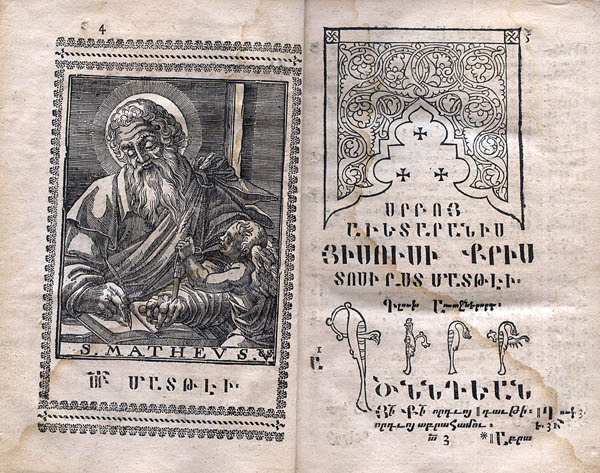
The first page of the Gospel of Matthew from the first printed Armenian Bible of 1668.

The first page of the Gospel of Matthew from the first printed Armenian Bible of 1668.

Voskan (1614-1674) was the son of parents from Yerevan, who had been part of the deportation of Armenians from Eastern Armenia to Persia ordered by Shah Abbas I in 1604 and settled in New Julfa (Nor Jugha), the Armenian suburb of Ispahan founded by the Persian ruler.  He studied at the monastery of All Saviors and, against the wishes of his parents, he was consecrated a celibate priest.  After a few years of further study in Holy Etchmiadzin and Yerevan, he returned to New Julfa. Invited to Etchmiadzin by Catholicos Pilipos I Aghbaketsi in 1634, he was appointed abbot of the monastery of St. Sargis in Ushi, where he took classes in Latin, philosophy, geometry, and astronomy from the learned Dominican monk Paulo Piromalli, a Catholic missionary in Armenia, and taught Armenian to him.

In 1655 Catholicos Hakob IV Jughayetsi (1655-1680) sent his secretary, Movses Tzaretsi, to Europe with the aim of establishing a print shop. He did not find support in Italy and went to Amsterdam, where conditions were more favorable for printing, as the Netherlands were outside the sphere of influence of the Catholic Church. He was able to establish a print shop, but his attempt at printing the Armenian Bible ended in failure. Before his death in 1661, he asked his friend, the merchant Avetis from Jugha, to take over the print shop and continue his work. Avetis, at his turn, asked his brother, Voskan Yerevantsi, to come to Amsterdam. The latter had already been consecrated as bishop and was commissioned by the Catholicos to continue the task.

Bishop Voskan arrived in the Dutch port in 1664 and took over the direction of the “Holy Etchmiadzin and St. Sargis” print shop. Between 1664 and 1669, he printed 14 Armenian books, including the first printed book by a living Armenian historian, the Book of Histories by Arakel of Tabriz (1669). He and his disciples Karapet Andrianatsi and Ohan Yerevantsi started the printing of the Armenian Bible on March 11, 1666, which would result in a beautifully illustrated edition of 21 x 26 cm. (8.27 x 10.23 inches) and 1464 pages. This achievement would become enough to give Voskan Yerevantsi a place of honor in the history of Armenian printing, following the first printer of Armenian books, Hakob Meghapart.

Voskan moved his print shop to Livorno, Italy, in 1669, and three years later to Marseilles, France. He would print eight more books, including the first mathematical textbook, which was also the first printing in Modern Armenian, entitled Art of Calculus (Արհեստ համարողութեան, 1675). He died on February 4, 1674, before the printing of the textbook was complete. His print shop remained active until 1686 and a total of 40 books were printed.

The original text of the Armenian Bible has had ten editions since 1666 (the last one was printed in Vienna by the Mekhitarist fathers in 1929). Very Rev. Hovhannes Zohrabian’s edition, printed in Venice in 1805, is regarded as the most valuable by Biblical scholars.

COUNCIL OF CALCEDON

THIS WEEK IN ARMENIAN HISTORY
(Prepared by the Armenian National Education Committee [ANEC])


Opening of the Council of Chalcedon
(October 8, 451)


The fourth ecumenical council that convened in Chalcedon became a turning point in the history of the Armenian Church, even though the Armenian Church was not represented at Chalcedon.


The first ecumenical council at Nicea (325) determined that Jesus Christ was God, “consubstantial” with the Father. This meant that God (Father, Son, and Holy Spirit) are “of one being” in that the Son is “born” or “begotten” “before all ages” or “eternally of the Father’s own being, from which the Spirit also eternally “proceeds.” The confession of Nicea, recited in every Holy Mass of the Armenian Church, states: “We believe (…) in one Lord Jesus Christ, the Son of God, begotten of God the Father, only-begotten, that is of the substance of the Father (…) who for us men and for our salvation came down from heaven, took body, became man, was born perfectly of the holy Virgin Mary by the Holy Spirit. By whom he took body, soul and mind and everything that is in man, truly and not in semblance.”


This was reaffirmed at the first council of Constantinople (381) and the council of Ephesus (431). One of the fathers of the Church, Cyril of Alexandria (d. 444) taught that “There is only one nature (physis), since it is the Incarnation, of God the Word,” which was held as orthodoxy.


In 446, an aged monk from Constantinople named Eutyches started teaching a subtle variation of this doctrine. His teachings were considered heretical, but he was rehabilitated in a council marred with scandal, held again at Ephesus (449) and supported by Byzantine emperor Theodosius II (408-450) where he publicly professed that while Christ had two natures before the incarnation, the two natures had merged to form a single nature after the incarnation. Pope Leo I denounced the council as a “synod of robbers” and refused to accept its decisions.


The threat of a schism led the new Byzantine emperor, Marcian (450-457), to hold a new council at Chalcedon (451) from October 8 – November 1, 451, which condemned the work of the council of 449 and professed the doctrine of the incarnation presented in Leo’s Tome, a document prepared by the Pope, which confessed that Christ had two natures, and was not of or from two natures. A special committee appointed by the Council decided unanimously in favor of the orthodoxy of Leo’s Tome, and determined that it was compatible with the teachings of Cyril of Alexandria. The confession of Chalcedon stated: “We, then, following the holy Fathers, all with one consent, teach people to confess (…) one and the same Christ, Son, Lord, only begotten, to be acknowledged in two natures, inconfusedly, unchangeably, indivisibly, inseparably.”


The formula on the nature of Christ adopted by the Council of Chalcedon was severely criticized by various Oriental sees. Many local councils rejected that doctrine. Resistance reached the point that Byzantine emperor Zeno I (474-491) issued a document called Henotikon in 482, which considered the doctrinal resolutions of the first three councils (Nicea, Constantinople, and Ephesus), while the Council of Chalcedon and Leo’s Tome were not mentioned at all.


At the time of the Council of Chalcedon, Armenia was in crisis. A few months before, in May 451, the battle of Avarair had been fought, and the Armenian Church was in no position to have its say on the issue. The situation changed after the Treaty of Nvarsak (484), when the situation stabilized with Persian Armenia under the government of Vahan Mamikonian. The Armenian Church adopted the doctrine of the Henotikon, and this position was officially confirmed by the Council of Dvin (506).


The followers of the Council of Chalcedon have frequently accused the Armenian Church of monophysitism, but this is not true: the Armenian Church follows the doctrine of Cyril of Alexandria established at the third ecumenical Council of Ephesus (431) that reaffirmed the decisions of the Councils of Nicea and Ephesus.


THIS WEEK IN ARMENIAN HISTORY
(Prepared by the Armenian National Education Committee [ANEC])

Execution of the 26 Baku Commissars
(September 20, 1918)

In the history and the mythology of the October Revolution and the Soviet civil war, the 26 Baku Commissars have played a role similar to the 300 Spartans in the history of ancient Greece. Their death would be immortalized in Soviet times through movies, books, artwork, stamps, and public works, and even cities and towns would be named after some of them.

After the Bolshevik revolution of October/November 1917, a Soviet (council) of workers, villagers, and soldiers was created in Baku. This council came to power from April 13 to July 25, 1918 and created an executive organ, the Council of Popular Commissars, formed by an alliance of Bolsheviks and leftist Socialist Revolutionaries, and presided by a famous Bolshevik revolutionary, the Armenian Stepan Shahumian. It was known as the Commune of Baku.

Isaak Brodsky's The Execution of the Twenty Six Baku Commissars (1925) depicting the Soviet view of the execution

Isaak Brodsky’s The Execution of the Twenty Six Baku Commissars (1925) depicting the Soviet view of the execution.

The Commune faced various problems, from the shortage of food and supplies to the threat posed by the invading Turks. The Red Army units hurriedly organized by the Commune were defeated by the Islamic Army of the Caucasus, an Ottoman army unit organized by order of Minister of War Enver Pasha on the basis of the local Tatar (Azerbaijani) population, and retreated to Baku in July 1918.

The military defeat provoked the rise of a coalition of rightist Socialist Revolutionaries, Social Democrats, and Armenian Revolutionary Federation members, which asked help from British forces stationed in Persia to counterbalance the Ottoman advance. The Commune transferred power to the new provisional government formed by the coalition, called the Centro-Caspian Dictatorship, and left Baku for Astrakhan, which was under Bolshevik control. However, the new authorities arrested the members of the Commune under charges of embezzlement and treason.

However, a new attack of the Ottoman forces over Baku prevented the trial of the military tribunal, and, according to Soviet historiography, on 14 September 1918, during the fall of Baku to the Turks, Red Army soldiers broke into their prison and freed the 26 prisoners; they then boarded a ship to Astrakhan, which changed its destination to Krasnovodsk, on the other side of the Caspian Sea. They were promptly arrested by local authorities of the Transcaspian provisional government, also anti-Soviet, on September 17, and three days later executed by a firing squad between the stations of Pereval and Akhcha-Kuyma on the Transcaspian Railway, apparently under British pressure.

Although they have been named as “commissars,” not all of them were officials and not all of them were Bolsheviks. Among the executed men, there were Russians, Jews, Armenians, Georgians, Azerbaijanis, Greeks, and Latvians.

Along with Shahumian, there were five other Armenians: Baghdasar Avagian, military commander of Baku; Aram Kostandian, deputy commissar for Agriculture; Suren Osipian, chief editor of the newspaper Izvestia of the Baku Commune; Arsen Amirian, chief editor of the newspaper Bakinski rabochi; and Tadeos Amirian, commander of a cavalry unit. Arsen and Tadeos Amirian were brothers, and this explains why the latter, a member of the Armenian Revolutionary Federation, had fought on the side of the Commune.

After the establishment of the Soviet regime, the authorities of Azerbaijan exhumed the bodies of the 26 victims and reburied them in Baku, at the square named after them, where a pantheon was built in 1968. The anti-Armenian hysteria in Azerbaijan has reached the point that, in January 2009 the pantheon was demolished, since the activity of the Baku Commune is considered an “Armenian conspiracy,” and the remnants were reburied at the Hovsan cemetery, reportedly “with the participation of Muslim, Christian, and Jewish clergy, and the corresponding rituals” (ironically, most of the commissars were atheists). Monuments and streets devoted to the commissars, whether Armenian, Russian, Georgian, or Azerbaijani, have also been demolished or renamed.

Meanwhile, the cities of Stepanakert (in Gharabagh) and Stepanavan (in Lori) continue to carry the name of Stepan Shahumian, whose statue in the proximities of Republic Square, in Yerevan, has been maintained. Amirian Street, an important street originating from the same square, has also kept its name.

Monday, September 21 is the 24th anniversary of the independent Republic of Armenia. Less than three years after the massive public demonstrations in Yerevan calling for the return of Nagorno Karabakh, and the devastating earthquake in northern Armenia, Armenia declared itself free and independent on September 21, 1991. It was a remarkable event, especially for those of us who grew up with the dream of a free Armenia, and were never permitted by our elders to doubt that it could and would happen someday. Six months after the declaration of independence, on March 2, 1992, Armenia was admitted into the United Nations and the red, blue, and orange tri-color flag was raised joining the flags of the other nations of the world.

The flag of the Republic of Armenia is raised at the United Nations.

MOVSES SILIKIAN

THIS WEEK IN ARMENIAN HISTORY
(Prepared by the Armenian National Education Committee [ANEC])


Birth of Movses Silikian

(September 14, 1862)


The battle of Sartarabad, from May 21-28, 1918, symbolized the defining moment in Armenian life. It is quite likely that, following an Armenian defeat, the Turkish armies would have had a free pass to occupy Eastern Armenia and liquidate its population, completing the process of annihilation that had been taken place with Western Armenians from 1915-1916. The victory had a military hero, General Movses Silikian.

Silikian

General Movses Silikian

Silikian was born on September 14, 1862, in the village of Vartashen, in the province of Nukhi (currently Azerbaijan). He was not an ethnic Armenian, but belonged to the Udi minority (an ethnicity descending from the Caucasian Albanians, with a distinctive Northern Caucasian language), although he was a faithful of the Armenian Apostolic Church. He graduated from the Moscow Military Gymnasium (1882-1884) and the Alexander III Military School.

Silikian entered the military service in 1884 and was assigned to the military region of the Caucasus. After serving as company and battalion commander, he was awarded with the degree of colonel in 1914. He became adjutant to the military commander of Yerevan in 1915, commander of the Eighth Regiment in 1915, and commander of the Army Group of Van in 1916. He participated in the liberation of Mush and Bitlis, and became military commander of Erzerum after the occupation of the city. He was awarded the order of St. George in 1916 and rose to the degree of major general in August 1917.

After the Russian Revolution of 1917 and the retreat of the Russian forces, Silikian was designated commander of the second rifle division of the Armenian army in January 1918, and afterwards, commander of the Army Group of Yerevan. He managed to organize a regular army in a short time, and by order of Aram Manukian, who had taken the leadership of the Province of Yerevan, Silikian led the Armenian troops in Sartarabad, where their victory stopped the advance of the Turkish army towards Yerevan.

After the independence of Armenia, Silikian, promoted to general commandant in 1919, became commander of the front of Nor Bayazid (nowadays Gavar) in the same year and was designated general commander of the front of Kars-Alexandropol (nowadays Gumri) in the fall of 1920.

The veteran soldier was exiled in January 1921 to Riazan after the establishment of the Soviet regime in Armenia. He returned in May 1921 to Armenia and settled in Yerevan. He was exiled once again, this time to Rostov-on-Don, and returned again to Yerevan. He worked at the Alexandropol branch of the Swedish “Baltic” company from 1921-1923, and from 1923-1929 or 1930 at the Armenian branch of the Near East Relief.

Silikian was arrested once again during the Stalinist purges of 1937 (he had been previously arrested in 1927 and 1935), and charged within the frame of the “Tukhachevsky case” (a fabricated case against Marshal Mikhail Tukhachevsky and other prominent Soviet military leaders), to which he bore no relation. As many other victims of the purges, he was executed in the gorge of Nork, together with General Kristapor Araratian and other heroes of Sartarabad, on November 22, 1937. He was rehabilitated fifty years later, on November 10, 1987.  A neighborhood in Yerevan has been named after him, as well as a medal of the Ministry of Defense of the Republic of Armenia.


THIS WEEK IN ARMENIAN HISTORY
(Prepared by the Armenian National Education Committee [ANEC])


Foundation of the Mekhitarist Congregation
(September 8, 1701)


mEHITAROFSepastia

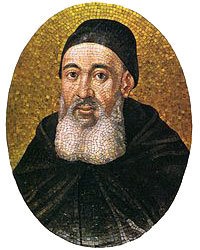
Mekhitar of Sebastia

Since its inception, the educational and cultural activities of the Mekhitarist Congregation had a very important role in Armenian history. After becoming a priest at the age of 20, Mekhitar of Sebastia (1676-1749) decided to find a congregation in order to work collectively to increase the spiritual, moral and intellectual levels of the Armenian people. He was consecrated celibate priest in 1699 and soon converted to Catholicism. However, he did not renege his Armenian ancestry and identity.

On September 8, 1701, on the feast of the birth of the Virgin Mary, Mekhitar and a group of sympathizers founded the congregation of St. Anthony the Abbot in Constantinople. The congregation initially had twelve members, including four celibate priests. The conflict between the Armenian Apostolic and Catholic communities in the Ottoman capital took a bloody turnaround. Mekhitar and his sympathizers fled the Ottoman persecution and moved to the Peninsula of Morea (Peloponessus), in Greece, which was under the domination of the Republic of Venice, and settled in the fortress of Methon.

MekhitaristMOnestary

The Mekhitarist Monastery on the island of San Lazarro in the Venetian Grotto.

An assembly held in 1705 prepared the draft bylaws of the Congregation, based on the bylaws of the Benedictine Congregation and extracted from the canons of the life of St. Anthony the Abbot. He sent two of his students to Rome with the draft, and letters to Pope Clement XI and the governor of the Propaganda Fide. The assembly of the Propaganda Fide, since the canons of St. Anthony were incomplete, suggested Mekhitar to choose from the canons of St. Basil, St. Augustine, or St. Benedict. The Armenian priest chose the canons of St. Benedict and presented the new draft of bylaws to the Pope on May 12, 1711. The bylaws were approved by Clement XI in 1717, who bestowed the title of Abbot upon Mekhitar.

MekhitaristLinrary

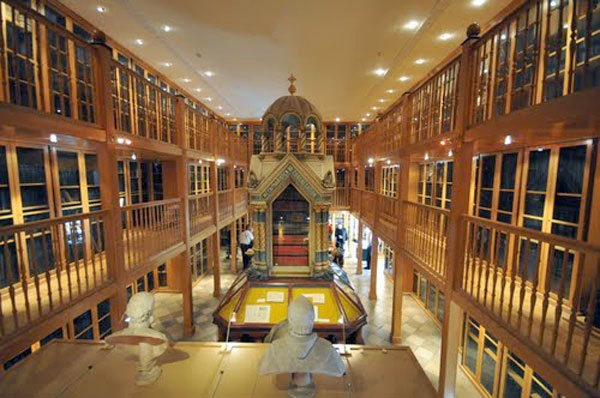
The library inside the Mekhitarist Monastery in Vienna, Austria.

Meanwhile, a war started between the Ottoman Empire and Venice in December 1714. Mekhitar and most of the congregation members fled Methon and moved to Venice. However, they needed a cloister and a monastery to carry on their plans. The Venetian Senate had just approved a law that forbade the establishment of any new religious congregation in the city. Nevertheless, the highest body took Mekhitar’s request into consideration and proposed that he find a place outside the city. Mekhitar chose the island of San Lazzaro, which belonged to the order of the Mendicants. On August 26, 1717, the Senate of Venice conceded the island to the congregation with right of permanent residence, and Mekhitar and his followers, a total of sixteen, settled there on September 8, the anniversary of the foundation of the congregation. The renovation work at the church was completed in 1723, and Mekhitar started the construction of a new monastery, which was finished in 1740, including a library and a refectory. Mekhitar passed away on April 27, 1749, and was buried before the main altar of the island.  On his death, he had already achieved the publication of some twenty books, including the first volume of the Haigazian Dictionary, which his disciples would complete twenty years later. After his passing, the Congregation was named after him.


THIS WEEK IN ARMENIAN HISTORY
(Prepared by the Armenian National Education Committee [ANEC])


Occupation of the Ottoman Bank
(August 14, 1896)

The occupation of the Ottoman Bank of Constantinople, organized by the Armenian Revolutionary Federation in 1896, was an audacious attempt to attract the attention of the European great powers towards the Armenian Question.

ArmenGaro

Armen Garo (Karekin Bastermadjian

Europe was the guarantor of article 61 of the Treaty of Berlin (1878), which obligated the Ottoman Empire to carry out reforms to improve the situation of Armenians living in their historical territories. The May 1895 plan presented by the European powers to Sultan Abdul Hamid II was never executed. Instead, Abdul Hamid perpetrated a massacre of its Armenian subjects with an estimated 200,000 to 300,000 victims in 1895-1896.

The Central Committee of the A.R.F. in Constantinople organized the strike against the bank, which was a joint venture of Ottoman, British, and French capitals, in order to have the reforms executed. The action was also intended to show the sultan that Armenians were not ready to give up on their rights.

The preparations to occupy the bank started in February 1896. The idea had been conceived by 23-year old Papken Siuni (Bedros Parian), who would lead the operation. Hrach (Haig) Tiryakian, 25-years old, was his lieutenant, and Armen Garo (Karekin Bastermadjian), also 23, would take care of maintaining order in the bank and among the staff. Armen Garo wrote in his memoirs: “We transported close to 400 empty bombs during eight days from our secret foundry in Scutari to our workshop of Pera, in the house of Miss Iskouhi. After filling those bombs there, we transported them to various neighborhoods of Constantinople. We were only 10-15 trustworthy comrades to all this, teachers and students, twenty- to twenty-five-year-old young people, including three young ladies.”

After several changes of date, the operation was finally carried on August 14. At noon, a discharge of guns and the thunder of bombs started the occupation. The group of militants included 28 people. The attacking group killed the guards, although four Armenians were also slain and another five were wounded. A very important loss was that of the head of the operation, Papken Siuni, who was wounded and the bombs on his body exploded when he fell.

Armen Garo took the command of the group and the fight started between the occupiers and the Ottoman forces. Meanwhile, a Turkish mob had started to kill innocent Armenians throughout the city. The A.R.F. militants sent a note with their demands to the European embassies: a) 1. To stop the massacre of innocent Armenians; b) To stop the attack against the bank, otherwise the building would be blown; c) To give written guarantees about the reforms to be carried in the Armenian provinces; d) To liberate all Armenian political prisoners.

At 1 a.m., Russian consul Maximov arrived in the bank and proposed to evacuate it, guaranteeing safe passage for Armen Garo and his companions. The young Armenian answered Maximov: “Mr. Ambassador, we didn’t enter here so you take the trouble of saving us from here…” He meant that he had clear demands, which they expected to be accomplished by the diplomatic representatives and the Sultan. Maximov answered back that the massacre and the attack had stopped; the ambassadors promised to do their best to ensure the reforms and he promised to have the jailed Armenians freed. After long negotiations, the revolutionaries agreed to leave the bank, receiving guarantees about their demands.

After 14 hours of occupation, the seventeen surviving revolutionaries came out of the bank at daybreak. To Maximov’s question of why the others were not coming out, Armen Garo answered that there was no one else; the Turks had convinced Maximov that 200 Armenians had occupied the building. The group, still armed, passed through the Turkish troops, led by Maximov, and was taken to the French ship “Gironde.”

The young Armenians were disarmed and taken to Marseilles, where they stayed 17 days in prison. Afterwards, Armen Garo and Hrach were sent to Switzerland, while the French government promised to send the others to New York. The remaining fifteen revolutionaries were sent to America; however, their destination was South America. They were dispatched to Buenos Aires, Argentina, where they stayed until November 1896, when they were able to catch a British ship that took them to London.

The takeover of the Ottoman Bank, with its extraordinary circumstances, was widely reported in the international press. However, the act did not have any positive consequence, since the reforms were not implemented and Armenians would continue to be in dire straits under Ottoman rule. Nevertheless, the action reinforced the determination of the Armenian revolutionaries to continue their struggle in order to achieve political and social freedom for their people.

bankotomansurvivors

The surviving members of the Ottoman Bank takeover after arriving in Marseilles, France


FALL OF ARDZEVASHEN

THIS WEEK IN ARMENIAN HISTORY
(Prepared by the Armenian National Education Committee [ANEC])

Fall of Ardzevashen
 (August 8, 1992)


The Soviet policy of “divide and rule” created ethnic enclaves (piece of land surrounded by foreign territory) under various pretexts, such as the incorporation in Azerbaijan of the highlands of the historically Armenian region of Karapagh as an autonomous region (the lowlands were directly annexed to that country). It also created exclaves (piece of land politically attached to a larger piece, but surrounded by foreign territory), such as Ardzevashen, part of the Kegharkounik province of Armenia.

The village of Ardzevashen was founded in 1854 with the name of Bashkend by Armenians from Shamshadin, although an inscription on the St. Hovhannes church of the village, dated to 1607, attests to an earlier Armenian presence on the site.

The population of the village was entirely of Armenian origin. It had a surrounding territory of 40 square kilometers (15.5 square miles) and enjoyed a town status in the 1980s, managing four factories. This included a branch of Haykork, the Armenian state carpet company.

In May 1991, during the last months of the Soviet Union, when the conflict for Karapagh had already started, the inhabitants of the village surrendered their weapons to Soviet military units to avert an imminent occupation.

Indeed, Azerbaijan was prone to occupy those portions of Armenian territory that were completely landlocked, and one of them was Ardzevashen. After a four-day resistance headed by the unit 016 of motorized artillery of Vanatsor, Ardzevashen was surrendered to Azerbaijani armed forces on August 8, 1992. According to The New York Times, Azerbaijan announced the “liberation” of the town, destroying enemy tanks and weaponry, and killing 300 Armenian “brigands,” while Armenian reports did not mention any dead, but said that 29 people were “missing without trace.” The bodies of 12 Armenian soldiers were later delivered; one of the Azerbaijani colonels declared: “They fought until the last bullet. They are the pride of your nation.”

The Armenian population was given one hour to evacuate the village. According to the Regional Administration of Kegharkounik, 719 families (around 2,800 people) were displaced after its occupation. A total of 664 families resettled in the towns of Chambarak and nearby villages, and the rest went to other provinces. The migrants were not considered a separate commune, but the government of the Republic decided to create a separate working staff, financed by the national budget. This staff takes care of problems related to documents and workbooks of displaced people, as well as claims of property rights and improvement of living conditions.

KILLING OF ENVER PASHA

THIS WEEK IN ARMENIAN HISTORY
(Prepared by the Armenian National Education Committee [ANEC])

 Killing of Enver Pasha
(August 4, 1922)

EnverPasha

Enver Pasha

The Russian revolution of November 1917 that set the grounds for the Soviet Union was followed by a civil war. Bolshevik troops were sent into Central Asia to establish Soviet power in 1919-1920. A local movement headed by Muslim elements, known as the Basmachi revolt (the Turkic word basmachi originally meant “bandit”), took advantage of the blunders of the Soviet government in Tashkent (the current capital of Uzbekistan) to challenge its authority and set a movement of national liberation.

Enver Pasha, former Ministry of War of the Ottoman Empire and one of the main perpetrators of the Armenian Genocide, had become a fugitive of justice after his condemnation to death in absentia by the Ottoman court-martial in July 1919. He had first left Constantinople for Berlin in late 1918 and in 1919 had gone to Moscow, where he engaged in pro-Turkish activities among the Bolsheviks. After participating in the Congress of Eastern Peoples of Baku (September 1920), he tried to reenter Anatolia in 1921, but was rejected by Mustafa Kemal.

HagopMelkoumian

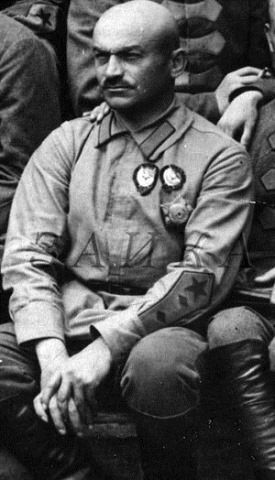
Hakob Melkumian

Enver decided to return to Moscow and won over the trust of Soviet authorities. Lenin sent him to Bukhara, in Soviet Turkestan, to help suppress the Basmachi Revolt. He arrived on November 8, 1921. Instead of carrying his mission, he made secret contacts with some rebel leaders and defected along with a small number of followers. He aimed at uniting the numerous rebel groups under his own command and taking the offensive against the Bolsheviks. He managed to turn the disorganized rebel forces into a small well-drilled army and establish himself as its supreme commander. However, David Fromkin has written, “he was a vain, strutting man who loved uniforms, medals and titles. For use in stamping official documents, he ordered a golden seal that described him as ‘Commander-in-Chief of all the Armies of Islam, Son-in-Law of the Caliph and Representative of the Prophet.’ Soon he was calling himself Emir of Turkestan, a practice not conducive to good relations with the Emir whose cause he served. At some point in the first half of 1922, the Emir of Bukhara broke off relations with him, depriving him of troops and much-needed financial support. The Emir of Afghanistan also failed to march to his aid.”

Operation Nemesis had succeeded in the liquidation of several of Enver’s colleagues in European capitals. An Armenian group assassinated Ahmed Djemal Pasha on July 25, 1922, in Tiflis under the very sight of the Cheka, the Soviet secret police. Ten days later, Enver would find his own Armenian nemesis in Central Asia.

Yakov Melkumov (Hakob Melkumian), born in Shushi (Gharabagh) in 1885, was a decorated career officer who had participated in World War I and after the revolution had entered the Red Army. After fighting in Bielorrusia (Belarus) in 1918, he became a cavalry brigade commander in Turkestan in late 1919, and from 1920-1923 he was involved in the suppression of the Basmachi revolt.

On August 4, 1922 Melkumian’s brigade launched a surprise attack while Enver had allowed his troops to celebrate the Kurban Bayrami holiday, retaining a 30-men guard at his headquarters near the village of Ab-i-Derya, near Dushanbe. Some Turkish sources claimed that Enver and his men charged the approaching troops, and the Turkish leader was killed by machine-gun fire. Melkumian published his memoirs in 1960, where he stated that Enver had managed to escape on horseback and hid for four days in the village of Chaghan. A Red Army officer infiltrated the village in disguise and located his hideout, after which the troops stormed Chaghan, and Melkumian himself killed Enver in the ensuing combat.

After seven decades in Ab-i-Derya, Enver’s remains were taken to Turkey in 1996 and buried at the Monument of Liberty cemetery in Istanbul. Melkumian was decorated with the second order of the Red Army for killing Enver and defeating his forces. The Armenian officer continued his military career until 1937 in Central Asia. He was arrested in June 1937, during the heyday of the Stalinist purges, and charged with participated in the “military-fascist conspiracy.” He was sentenced to 15 years in prison and 5 years of deprivation of civil rights. After the death of Stalin, he was freed in 1954 and rehabilitated. He died in Moscow in 1962.


IVAN AIVAZOVSKY

THIS WEEK IN ARMENIAN HISTORY
(Prepared by the Armenian National Education Committee [ANEC])


Birth of Ivan Aivazovsky
(July 29, 1817)

Ivan Aivazovsky is considered one of the greatest marine painters in history. Famous Russian story writer Anton Chekhov popularized the winger word “worthy of Aivazovsky’s brush,” used for “describing something ineffably lovely.”

aivazovskySelfPortrait

Self Portrait, 1874

Aivazovsky was born Hovhannes Aivazian on July 29, 1817, in Feodosia, a port on the Black Sea in Crimea. He received parochial education at the local St. Sargis Armenian Church and was taught drawing by a local architect. He attended the Russian gymnasium of Simferopol from 1830-1833 and then studied at the Imperial Academy of Arts from 1833-1837, graduating with gold medal two years in advance.

The promising painter was sent by the Academy in 1840 to study in Europe. He first traveled to Venice, where his brother Gabriel was a member of the Mekhitarist Congregation (he would leave the congregation and return to the Armenian Apostolic Church in the 1850s). Aivazovsky studied Armenian manuscripts and became familiar with Armenian art. After a four year sojourn in Italy and France, with visits to half a dozen European countries and prolific exhibitions, he returned to Russia in 1844.

American Shipping off the Rock of Gibraltar1873

American Shipping off the Rock of Gibraltar, 1873

Upon his return, he was appointed academician of the Imperial Academy of Arts, from where he had graduated seven years before, and appointed the official artist of the Russian Navy. After traveling to the Aegean Sea and Constantinople in 1845, he settled in his hometown, Feodosia. The Academy gave him a title of professor of seascape painting in 1847, while the Royal Netherlands Academy of Arts and Sciences elected him a member in the same year.

He married English governess Julia Graves in 1848 and had four daughters. They separated in 1860 and divorced in 1877 with permission from the Armenian Church, since Graves was a Lutheran.

Aivazovsky would receive many honors throughout his life: first non-French artist to receive the Legion d’Honneur in France (1857), Order of the Medjidie (Ottoman Empire, 1857), honorary member of the Moscow Art Society (1857), Order of the Redeemer (Greece, 1859), Order of St. Vladimir (Russia, 1865), Order of Osmanieh (Ottoman Empire, 1874), member of the Academy of Arts of Florence (Italy, 1876), honorary member of the Royal Academy of Fine Arts of Stuttgart (Germany, 1878), and others. He held fifty-five solo exhibitions over the course of his career in the Russian Empire, Europe, and the United States (New York, Chicago, and San Francisco, 1893), and participated in many collective exhibitions. He was one of the most prolific artists of his time: he created around 6,000 paintings during his almost sixty-year career. The vast majority of his works are seascapes, but he often depicted battle scenes, Armenian themes, and portraiture. He never painted his pictures from nature, but from memory. His artistic memory was legendary, The Ninth Wave (1850, State Russian Museum, St. Petersburg) is generally considered his masterpiece.

Aivazovsky visited Russian Armenia for the first time in 1868. The next year, he participated in the opening ceremony of the Suez Canal in Egypt, and became the first artist to paint the Canal. He continued his travels abroad during the next three decades, including a trip to the United States in 1892. In 1880, he opened an art gallery in his Feodosia house, which became the third museum in the Russian Empire, after the Hermitage Museum of St. Petersburg and the Tretyakov Gallery of Moscow. Two years later, he remarried to a young Armenian widow, Anna Burnazian. He said that he “became closer to [his] nation” by marrying her. His career across the civil ranks of Russian government reached its highest position in 1896 when, at the age of 79, he was promoted to the rank of full privy councillor.

Aivazovsky was deeply affected by the Hamidian massacres of 1894 and 1896. He painted a number of works on the subject. More symbolically, he threw the medals given to him by the Ottoman Sultan into the sea and told the Turkish consul in Feodosia: “Tell your bloodthirsty master that I’ve thrown away all the medals given to me, here are their ribbons, send it to him and if he wants, he can throw them into the seas painted by me.” He spent his last years in his hometown, to which he contributed many efforts to its improvement.

Aivazovsky passed away on May 2, 1900, in Feodosia and was buried in the courtyard of the St. Sarkis Church. A quote in Classical Armenian from Movses Khorenatsi’s History of Armenia is engraved on his tombstone: “Born as a mortal, left an immortal memory of himself.