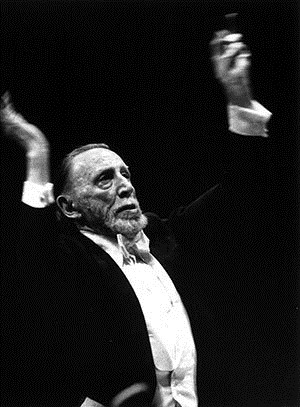
VAHRAM PAPAZIAN

THIS WEEK IN ARMENIAN HISTORY
(Prepared by the Armenian National Education Committee)

[ANEC]


Death of Vahram Papazian

(June 5, 1968)

From Constantinople to Yerevan and from Paris to Moscow, Vahram Papazian would become the most accomplished Shakespearean actor of the Armenian scene worldwide for half a century.


He was born in Constantinople on January 6, 1888, in a middle-class family. He graduated from the Esayan School (1902) and the lyceum of Kadikoy (1902-1904), and had his debut on the stage in 1904. Then he went to the Murad-Raphaelian School of the Mekhitarist Congregation, in Venice, where he studied from 1905-1907.


In 1907 he departed for Paris and then for Baku, where he performed with an Armenian theater group for a few months. After this experience, he returned to Italy and studied at the Art Academy of Milan from 1908-1911. Famed actress Eleonora Duse was among his teachers. During his student years, he performed with Italian itinerant groups and gradually perfected his roles (Othello, Romeo, and Hamlet, among them). He returned to Constantinople in 1908 and his performances of Othello, at the age of 20, earned him the applause of Armenian audiences and the press. He went to Paris in the early 1910s to study the different currents of theater and become closely acquainted with acting techniques. As a professional actor, he performed from 1910-1913 in Constantinople and Smyrna, and from 1913-1917, in Baku and Tiflis. He enriched his repertory with a roster of roles in Armenian and non-Armenian plays.

Papazian played in fifteen Russian silent movies from 1917-1918 with the pseudonym of Ernesto Vahram, and would later play in three more films in 1922-1923. In 1920 he returned to Constantinople, where he performed until 1922. After the occupation of the city by the Kemalist forces, he settled in Soviet Armenia. He would perform and direct in Yerevan, Baku, and Tiflis between 1922 and 1927. He moved to Moscow in 1928 and then performed in Leningrad (now St. Petersburg) from 1929-1931. In 1932 he played in Lithuania, Letonia, and Estonia, and in the same year he left for Paris, where he played Othello with the Odeon Theater group; his performances were singled out by the French press. In 1933 he visited Berlin, where he met the famous director Max Reinhardt and studied closely the German school of acting.


Thereafter, he returned to the Soviet Union and was distinguished as People’s Artist of Armenia and Georgia in 1933, and People’s Artist of Azerbaijan in 1935. He toured the cities of the three countries in 1934-1935, and continued his tour through Russia and Ukraine from 1936-1941. He played in Moscow in 1941 and settled in Leningrad from 1941-1944, where he survived the German blockade.

After years of new presentations in Russia, Ukraine, Central Asia, and Transcaucasia, from 1946-1954, Papazian finally settled back in Yerevan as a member of the Sundukian Academic Theater, and he also directed plays in Yerevan and Leninakan (now Gumri). He returned to cinema in four films from 1953-1964, and in 1956 he was given the title of People’s Artist of the Soviet Union. In the last fifteen years of his life, the actor revealed himself to be an accomplished writer with his two-volume memoir, Retrospective Regard (1956-1957). He also wrote his reminiscences on Western Armenian actors, My Heart’s Duty (1959), and several books on performance analysis about the roles of Hamlet, Othello, and King Lear.


His art belonged to the classical school, enriched by elements of neo-romanticism and psychological realism. His performances of Shakespearean roles were grounded on the traditions of ancient tragedy and the Renaissance, as well as his own Armenian viewpoint.


Vahram Papazian passed away in Leningrad on June 5, 1968, and was buried in the Pantheon of Yerevan. The State Theater of Stepanakert (Karabagh) carries his name.

THIS WEEK IN ARMENIAN HISTORY
(Prepared by the Armenian National Education Committee)

[ANEC]


Declaration of United ARMENIA
(May 28, 1919)

At the time of the independence of the first Republic of Armenia (May 1918), its population also included a mass of refugees from Western Armenia who had survived the genocide.


The first congress of Western Armenians, held in the spring of 1917, tried to establish a semblance of organization for the mass of refugees. Some of them had temporarily resettled back in their homes in 1916-1917, when part of Western Armenia had been occupied by Russia. However, the breakdown of the Caucasian front after the Russian Revolution and the advance of the Turkish Ottoman forces had displaced them once again to the east. These events had crippled the organization established in 1917.


In view of the political changes, an interparty council of Western Armenians named a special commission in December 1918 to arrange for a second general conference. The Second Conference of Western Armenians met in Yerevan from February 6-13, 1919.


The conference adopted a resolution on February 12, 1919 that read in part:

“The Second Congress of Western Armenians, having studied the current situation of the Armenian people:


1. Sincerely hails and extols the independence of Free and United Armenia; (. . .)


3. Proclaims its firm determination and will to have one political and governmental entity through the confluence of the lands and people of all Armenia;(. . .)


5. Directs the elected ‘Executive Body’ to work actively, at the same time, with the cabinet and the legislature of the Araratian [Yerevan] Republic to declare the independence of United, Free Armenia and, in order to effect the all-national union, to participate in the administrative and legislative institutions. (…).”


The nine-person Executive Body was instructed to implement the decision of the Congress and to function until the creation of a combined government of united Armenia. Its petition was approved by the coalition government of the Republic, formed by the Armenian Revolutionary Federation and the Populist Party, on February 25, 1919.


The cabinet of ministers adopted the text of the declaration on Armenia’s unification on May 26, 1919, and a day later, another cabinet resolution authorized the Executive Body of the Western Armenians to select twelve deputies to enter the Parliament of united Armenia.


On 28 May 1919, on the first anniversary of the Republic of Armenia, acting Prime Minister Alexander Khatisian read the text of the declaration in a solemn ceremony held at the Parliament:


“To restore the integrity of Armenia and to secure the complete freedom and prosperity of its people, the Government of Armenia, abiding by the solid will and desire of the entire Armenian people, declares that from this day forward the separated parts of Armenia are everlastingly combined as an independent political entity.


(. . .) Now in promulgating this act of unification and independence of the ancestral Armenian lands located in Transcaucasia and the Ottoman Empire, the Government of Armenia declares that the political system of United Armenia is a democratic republic and that it has become the Government of the United Republic of Armenia.


Thus, the people of Armenia are henceforth the supreme lord and master of their consolidated fatherland, and the Parliament and Government of Armenia stand as the supreme legislative and executive authority conjoining the free people of United Armenia. (. . .)”


After the ovation that followed the reading, Khatisian invited the twelve newly designated Western Armenian deputies to take their places within the legislature. On their behalf, Vahagn Krmoyan pledged active Western Armenian participation in the governing bodies of the Republic.


After the messages by Avetik Sahakian, president of the Parliament, and Catholicos Gevorg V, and congratulations by the representatives of Georgia, Azerbaijan, Karabagh, Armenian Americans, and others, Khatisian proceeded to the balcony of the Parliament and read again the declaration to the mass of people gathered on the street.


The declaration, intended to cement the unity of the Armenian people and establish its political will towards the restoration of the country over its historical borders, had the contrary effect. Historian Richard Hovannisian has aptly summarized it: “The proclamation that had been intended as an expression of unity actually aggravated the discord between Russian Armenians and Turkish Armenians and between Dashnakist and anti-Dashnakist leaders. A startling about-face by the Populist Party in the days following the celebration in Erevan administered the coup de grace to the coalition cabinet.”


Although the declaration of United Armenia was never carried on the ground (the Treaty of Sevres, which would become its instrument in August 1920, remained on paper), its symbolic force was an expression and an inspiration for the political dreams of the Armenian people.


THIS WEEK IN ARMENIAN HISTORY
(Prepared by the Armenian National Education Committee)

[ANEC]


Opening of the Monument of Sartarabad
(May 25, 1968)

Sartarabad, located 25 miles to the west of Yerevan, became the last Armenian stance against the advance of the invading Third Ottoman Army in May 1918. A defeat would not only open the door for their penetration to the rest of Eastern Armenia, but also the follow-up to the genocide of 1915-1916. Major General Otto von Lossow, German delegate to the Caucasus, had reported to his government on May 15, 1918 that the Ottomans intended to advance the border further to the east, monopolize the economy of the region, and bring about “the total extermination of the Armenians in Transcaucasia also.” Two days before his departure from Tiflis, on May 23, he wrote in his final report: “The aim of Turkish policy is, as I have always reiterated, the taking of possession of Armenian districts and the extermination of the Armenians.”


The Armenian victory in Sartarabad, from May 22-28, 1918, became the cornerstone of the foundation of the first Republic of Armenia. However, the victories of May 1918 and the first republic remained taboo issues in Soviet Armenia until the national awakening of the 1960s that led to the commemoration of the fiftieth anniversary of the genocide in 1965. Afterwards, there would be a historical reassessment, although within the ideological constraints imposed by the regime.

 Sartarabad

Part of that reassessment would be the construction of the monument dedicated to the battle, inaugurated on May 25, 1968. Its author was talented architect Raphael Israelian (1908-1973), who had already built popular memorials such as the arch of Charents (1957) on the road to Garni and the first monument to the genocide, built in the courtyard of Holy Echmiadzin (1965). Other projects would be completed during his lifetime and posthumously.

The entrance of the impressive complex, which extends over some 50 acres, is guarded by gigantic winged bulls, which symbolize the victory obtained by the people. The steps take the visitor to a wide square, dominated by the 115-foot high bell tower. The nine-bell structure, built from red-orange tufa stone, is the focus of the monumental complex. It reflects the critical moment that the entire country lived and that called the people to the fight. As it is well known, Catholicos Kevork V ordered all church bells in Armenia to sound day and night in the days of the three battles of Sartarabad, Gharakilise, and Pash Abaran. The bells sound every year on the day of the victory.


The bell tower square marks the beginning of the avenue, flanked by a series of eagles, leading to the 180-foot long Victory wall, which depicts the images of the battle, sculpted by Ara Harutunian and other artists. In 1978 the State Ethnographic Museum of Armenia was built on the end side of the complex, with an impressive collection. It also includes a section dedicated to the first Republic.


As the refrain of the famous song written by poet Baruyr Sevag exhorts, “Generations, know yourself in Sartarabad.” The monument to the battle is one of those mirrors that have helped know history for almost half a century.


This Sunday, May 2, 2015, the Armenian Church commemorates the Feast of the Apparition of the Cross (Yerevoumun Sourp Khatchi). The Apparition of the Holy Cross is the first feast dedicated to the Holy Cross in the Armenian liturgical calendar. It is celebrated in remembrance of the appearance of the sign of the cross over the city of Jerusalem in 351 that remained in the sky for several hours. The apparition extended from Golgotha to the Mount of Olives (about two miles), and was brighter than the sun and was seen by everyone in Jerusalem. The Patriarch of Jerusalem, Cyril, used this occasion to remind Emperor Constantius of Byzantium of his father’s (Constantine the Great) orthodox faith. Cyril said the Apparition was further reason to return to orthodoxy.

Traditionally, the Armenian translation of Cyril’s message is read on this feast day during the Antasdan prior to the Gospel lection. This event is celebrated by the Armenian and Greek churches. The Greeks observe it on the fixed date of May 7, while the Armenian date is moveable depending on the date of Easter. It is celebrated on the fifth Sunday of Easter, which is the fourth Sunday after Easter.

Cyril is a revered Doctor of the Church and he is remembered in the Armenian Church’s liturgical calendar. This year he was honored on Saturday, March 3.

 Here is a short excerpt from Cyril’s letter about the apparition:

 “In those holy days of the Easter season, on 7 May at about the third hour, a huge cross made of light appeared in the sky above holy Golgotha extending as far as the holy Mount of Olives. It was not revealed to one or two people alone, but it appeared unmistakably to everyone in the city. It was not as if one might conclude that one had suffered a momentary optical illusion; it was visible to the human eye above the earth for several hours. The flashes it emitted outshone the rays of the sun, which would have outshone and obscured it themselves if it had not presented the watchers with a more powerful illumination than the sun. It prompted the whole populace at once to run together into the holy church, overcome both with fear and joy at the divine vision. Young and old, men and women of every age, even young girls confined to their rooms at home, natives and foreigners, Christians and pagans visiting from abroad, all together as if with a single voice raised a hymn of praise to God’s Only-Begotten Son the wonder-worker. They had the evidence of their own senses that the holy faith of Christians is not based on the persuasive arguments of philosophy but on the revelation of the Spirit and power; it is not proclaimed by mere human beings but testified from heaven by God Himself.”

Posted from Armenian Eastern Prelacy weekly E-Newsletter

THIS WEEK IN ARMENIAN HISTORY
(Prepared by the Armenian National Education Committee)

[ANEC]


The 50th Anniversary Demonstration of Yerevan
 (April 24, 1965)


The fiftieth anniversary of the Medz Yeghern [Great Calamity], the Armenian genocide, became a watershed in the process of commemoration, as Armenians mobilized throughout the world to demand justice. The commemoration in the Armenian diaspora, including marches and public events in different capitals, was overshadowed by the unprecedented and unexpected explosion of popular feelings in Yerevan, the capital of Soviet Armenia. 1915 had been practically a taboo subject during the long night of Stalin’s repressive regime, and only after 1955 was there a gradual opening on the issue, which was coincidental with the “thaw,” the period of Nikita Khruschev as secretary of the Communist Party of the Soviet Union.

 50TH_1

After the transition of the 1950s, the “thaw” actually reached Armenia with the designation of Yakov Zarobyan as first secretary of the local Communist Party in 1960. Gradual, but firm steps to restore public memory within the limits of what was ideologically permissible followed, including painstaking negotiations within the highest echelons of the Soviet hierarchy. The Soviet Union was disinclined to active confrontation with Turkey, and thus, in early March 1965 the party leadership in Moscow allowed very reluctantly the commemoration of the genocide.


On March 16, 1965 the Council of Ministers of Soviet Armenia passed a resolution, “On the Construction of a Monument to Perpetuate the Memory of the Victims of the Yeghern of the Year 1915.”


Commemorative activities were held in Holy Etchmiadzin, the Academy of Sciences, the Writers Union, and other venues. Several articles were published in the press. On Saturday, April 24 an editorial of the party daily Sovetakan Hayastan of Yerevan condemned the genocide and praised the Armenian rebirth in Soviet fashion:

 50th_2

“Exactly 50 years have passed from those terrible days when the Turkish rulers, guided by the fury of racism, attempted to annihilate an entire people. They did everything, deported and massacred, burned and ruined, but they were not able to annihilate the Armenian people, despite the heavy losses. …The Armenian people, wholly dedicated to the most humane ideas of peoples’ friendship and socialist internationalism, severely condemns, along with progressive humankind, the policy of genocide, one of whose first victims was the Armenian people under Ottoman Turkish rule fifty years ago, and which fascism carried with fury and disproportionately bigger magnitude during the Second World War years in Europe.”


An official event by invitation had been planned for the evening, to be held at the Opera Theater. Everything seemed under control, but it was not.


In the morning, several thousand young people gathered at Lenin Square (now Republic Square), near Lenin’s huge statue (toppled in 1991) and various speakers among them started to talk about the meaning of the day. Several leaders, such as Anton Kochinian (president of the Council of Ministers) and famous astronomer Victor Hambardzumian (president of the Academy of Sciences), also spoke to the audience.


After they left, the public, whose number had reached an estimate of no less than 30 to 40,000 people, formed an orderly caravan that walked through the streets of central Yerevan. The demonstrators marched with calls of “Our lands!” and carrying banners that said, for instance, “2,000,000” (the number of victims) and “Solve the Armenian question fairly.” Their number appears to have grown up to 100,000 people, according to some accounts. The demonstration, after stops at the Polytechnic Institute (now State University of Engineering) and Yerevan State University, walked towards the tomb of Gomidas Vartabed in the Pantheon, where several writers, scholars, and young people spoke.


The demonstration continued in the evening, and the marchers tried to force their way into the official ceremony at the Opera Theater, which was surrounded by several police lines. They were repelled by the use of the fire sprinklers of the theater. However, a hundred or two hundred young demonstrators managed to enter the building. The event, where Nagush Harutiunian (president of the Supreme Soviet) and Victor Hambardzumian, had already spoken, was disrupted. The party leadership left the stage, as well as many in the audience. Catholicos of All Armenians Vazken I took the stage to calm the demonstrators.


The failure to prevent the demonstration would lead Moscow to various punitive measures, including Zarobyan’s removal in February 1966. However, the commemoration would become a tradition year after year. The first monument was dedicated in the courtyard of Holy Etchmiadzin in October 1965, followed by the memorial on the hill of Tsitsernakaberd inaugurated on November 29, 1967. Starting in 1975, the leadership of the country would join the hundreds of thousands of mourners who every April 24 would pay their respects at the memorial. In November 1988, following the impact of the Karabagh movement, the law “On the condemnation of the genocide of the Armenians in Ottoman Turkey in 1915” would also make a provision to declare April 24 a national holiday.

THIS WEEK IN ARMENIAN HISTORY
(Prepared by the Armenian National Education Committee)

[ANEC]


Uruguay Recognizes the Armenian Genocide
(April 20, 1965)

As it is well known, the fiftieth anniversary of the Medz Yeghern, the Armenian genocide, became the event that gathered Armenians worldwide around public claim for recognition of what had happened in 1915 and for the Armenian Cause.


Believe it or not, the small community of Uruguay was at the forefront of the struggle. Around 1963 the young generation came together to commemorate the month of Armenian culture in October, and the next year it joined its voice to the campaign in neighboring Argentina against the issuance of a postal stamp by the Argentinean postal service that would commemorate the 100th anniversary of Mustafa Kemal Ataturk. These activities became the driving force behind the decision of young people in a community politically divided as elsewhere in the Diaspora to come together and organize the commemoration on April 24 in a unified way. They created the Coordinating Committee of Armenian Youth Organizations of Uruguay (Mesa Coordinadora de Organizaciones Juveniles Armenias del Uruguay), which was integrated by five organizations belonging to different political orientations of the community.


The Coordinating Committee organized the commemoration of 1964, with an imposing “March of Silence” through the streets of Montevideo, the capital of Uruguay, which was widely commented in the press and had its impact over Armenians all over the world. It invited to a general assembly of 19 organizations (the entire spectrum of the community) that in January 1965 issued a communiqué, stating that, “The Armenian Cause belongs to all Armenians and is not the domain of any faction,” and that “Political organizations, religious institutions, and all organizations existing in the community must set to work around the Armenian Cause.”


The intensive activities carried by the Coordinating Committee, including lectures, press releases, PR work with the Uruguayan press, and a competition of posters for the 50th anniversary, were crowned by its lobby efforts.


These political efforts led to a commemoration by the Municipal Council of Montevideo on April 27, 1965, which was preceded, most importantly, by the passing of a law recognizing the genocide.

The draft bill was written by Representative Enrique Martínez Moreno, and introduced on January 29, 1965 to the Constitution and Codes Committee of the House Representatives, with the signature of six co-sponsoring representatives of different political parties. The bill stated:


Article 1. The following 24th of April is declared "Day of Remembrance for the Armenian Martyrs," in honor of the members of that nationality slain in 1915.

Article 2. The stations of the Official Radio Service must on that date conduct part of their broadcast in honor of the mentioned nation.

Article 3. Armenian descendants who are public servants are authorized to miss work on the mentioned date.


The word genocide was not mentioned in the draft bill, but it appeared mentioned several times to legally qualify the extermination of 1915 as “one of the most terrible genocides that history has known,” in the introductory text of the draft, adding that “the synthesis of one of the most brutal genocides is more than a million assassinated persons.”


The draft bill was discussed by the House of Representatives on April 6, 1965. A proposal to add an article naming a school of Montevideo with the name of Armenia mustered the necessary number of votes, while another proposal to devote a school class to refer to the genocide did not. The draft bill was approved with the addition of article 4 (“The 2nd Grade School, No. 156, in the department of Montevideo, is designated with the name of ‘Armenia’”) and went to the Senate. The project was not treated on April 7 and was delayed until April 20, when it was treated with urgent character and approved with unanimous vote. The law 13,326 was signed by Washington Beltran, President of the National Council of Government (Uruguay had a collegiate executive in those years), and issued on April 22, 1965. The enthusiasm that the approval of the law created in the Uruguayan Armenian community inspired a massive assistance to the commemorative acts from April 23-28.


Petty politics caused the demise of the Coordinating Committee shortly thereafter. The Armenian community would fall into decades of new political divisions that seem to be on their way to solution on the eve of the Centennial. It is noteworthy that on March 2004, the Uruguayan Parliament passed law 17,752 that extended the commemoration to every April 24, repeating the text of 1965 without the use of the word genocide. Nevertheless, on April 7, 2015, the Postal Service of Uruguay issued a stamp on the centennial of the Armenian genocide and Foreign Minister Rodolfo Nin Novoa underscored that, “Uruguay was the first country to recognize the Armenian Genocide by law 50 years ago, a transcendental step in a struggle that continues to the present day.”


MASSACRE OF SHUSHI

THIS WEEK IN ARMENIAN HISTORY
(Prepared by the Armenian National Education Committee)

[ANEC]


MASSACRE OF SHUSHI

MARCH 23-26, 1920

The city of Shushi, capital of Karabagh and the third Armenian center in the South Caucasus after Tiflis and Baku, had a population of 43,869 inhabitants, according to the Kavkaskii Kalendar (Caucasus Calendar) published in Tiflis in 1916. Fifty-three per cent of the population (23,396 people) was Armenian, while 44% was Tatar (later called Azerbaijani).


After the independence of Armenia, the situation of Karabagh remained in a sort of limbo due to the Azerbaijani pretentions over the region and the pro-Azerbaijani attitude of the British representatives in the region, interested in securing the oil of Baku. Clashes between Azerbaijanis and local Armenians in 1919, as well as Armenian massacres incited by Azerbaijani Governor-General Khosrov Bek-Sultanov, ended with a British-brokered temporary agreement on August 22, 1919 that lasted a few months.


Sultanov broke the terms of the agreement in the beginning of 1920 and tightened the Azerbaijani blockade around Karabagh. He gathered armed forces in strategically important locations and armed the local Turkish population. Well-aware that the Armenian population was much less armed, he made preparations for “the final resolution of the Nagorno Karabagh issue,” as he wrote in one dispatch to the Azerbaijani government. On February 19, 1920, Sultanov issued a demand to the Armenian National Council of Karabagh “to solve urgently the question of the final incorporation of Karabagh into Azerbaijan.” At their eighth congress held from 23 February to 4 March, the Armenians responded that Azerbaijan’s demand violated the terms of the temporary agreement of August 1919 and warned that “repetition of the events will compel the Armenians of Nagorno-Karabagh to turn to appropriate means for defense.”

Shushi

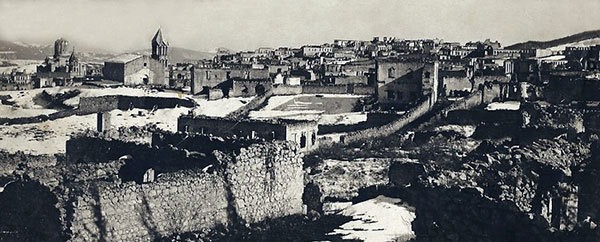
The Armenian quarters of city of Shusha destroyed by Azerbaijani armed forces in 1920 with the defiled Cathedral of the Holy Savior in the background.


The commanders of the Armenian self-defense tried to anticipate Sultanov’s movements. A small Armenian detachment entered Shushi in the early morning of March 23, 1920, when the Turkish population was celebrating the festivity of Novruz, and tried to take over the barrack, according to an uprising plan previously developed. The exchange of fire served as a signal for Shushi’s armed Turkish population, the Azeri army soldiers, and Kurdish gangs abounding in the town to attack the Armenian district, plunder and set everything on fire, and start a horrible massacre of the Armenian population. According to historian Richard Hovannisian, “Azerbajani troops, joined by the city’s Azerbaijani inhabitants, turned Armenian Shushi into an inferno. From March 23 to 26, some 2,000 structures were consumed in the flames, including the churches and consistory, cultural institutions, schools, libraries, the business section, and the grand homes of the merchant class. Bishop Vahan (Ter-Grigorian), long an advocate of accommodation with the Azerbaijani authorities, paid the price of retribution, as his tongue was torn out before his head was cut off and paraded through the streets on a spike. The chief of police, Avetis Ter-Ghukasian, was turned into a human torch, and many intellectuals, including Bolshevik Alexander Tsaturyan, were among the 500 Armenian victims.”


Much of the population fled, and the Armenian section of the city was completely destroyed. According to data of 1921, some 8,000 Azerbaijanis lived in Shushi, and the number of Armenians was about 300. The Armenian section remained in ruins for several decades.


The historical Armenian city became an Azerbaijani city during the Soviet period, until the Armenian forces of self-defense liberated Shushi on May 9, 1992, in one of the most crucial moments of the Karabagh war.

SUNDAY OF ADVENT

This Sunday, March 22, is the sixth and final Sunday of Great Lent, known as Sunday of Advent (Kalstyan Giragi). On Advent Sunday we are asked to ponder the mystery of the first coming of Christ and especially his second coming which is a fundamental tenet of our Christian faith, and which is mentioned in the prayers read this Sunday. Christ came to the world for the salvation of humankind. We are told to be ready at all times because He will come again for the judgment of sinners, and when the righteous will become worthy of entering the Kingdom of God. “Then people will see the Son of Man coming in clouds with great power and glory. He will send out his angels and gather his elect from the four winds, from the ends of the earth to the ends of heaven.” (Mark 13:26-27)
       Advent Sunday has its own special hymn, which proclaims that the apostles knew the mystery of the advent of Christ. The story of the expulsion from paradise is repeated and an appeal is made to Christ to ask the Heavenly Father to establish peace on earth. Sunday of Advent is in preparation of the following Sunday, Palm Sunday, which is the celebration of the glorious entry of our Lord into Jerusalem and the beginning of Holy Week.
       The terrible manifestation of your glory which will be in your second coming David foresaw and announced beforehand by the Holy Spirit’s inspiration, God will come openly, fire will burn before him. Then, O Jesus, spare us, have compassion, O Christ, and have mercy.
       Mother of God unwedded, bride of heaven on earth, when in the sight of light you sit at the right hand of your only-begotten beseech him for us to deliver us from the awful flame, to number us with the righteous that we also may sing glory with the heavenly ones.
(Canon for the Sixth Sunday of Great Lent from the Liturgical Canons of the Armenian Church)

BIRTH OF ALAN HOVHANESS

THIS WEEK IN ARMENIAN HISTORY
(Prepared by the Armenian National Education Committee)

[ANEC]


Birth of Alan Hovhaness
(March 8, 1911)


Armenian American composer Alan Hovhaness is said to be one of the most prolific composers of the 20th century.

He was born Alan Vaness Chakmakjian in Somerville (Massachusetts), on March 8, 1911. His father, Haroutioun Chakmakjian (1878-1973), was a professor of chemistry at Tufts College and author of a popular English-Armenian dictionary, as well as onetime editor of Hairenik. His mother, Madeleine Scott, was of Scottish ancestry, and did not especially approve that he learned about Armenian culture from his father. Until her death in 1931, the composer would sign his earliest music as Alan Scott Vaness.

AlanHovaness

Alan Hovhaness conducts the Ani Symphony at the Metropolitan Museum of Art in New York City on April 21, 1989, in one of several events sponsored by the Prelacy on the occasion of the 1000th anniversary of the Great Cathedral of Ani.

Alan Hovhaness was a precocious composer who already penned operas by age 14. After initial studies at Tufts College, he studied composition at the New England Conservatory of Music, in Boston. In the 1930s, he composed mostly chamber music in Western modes of expression.

He would shift to a fusion of Western and Eastern music in the 1940s, starting with his job as organist at St. James Armenian Church in Watertown, where he was exposed to the Armenian liturgy and the works of Komitas Vartabed. “It was through Komitas that I got the idea of saying as much as possible with the fewest possible notes,” he would write later. He got rid of most of his earliest music, and started anew to seek out his Armenian heritage. His “Armenian period” lasted from 1943 to 1951, and was benefited from the performances of important works and rave reviews in the mainstream press. The Friends of Armenian Music, a committee headed by pianist Maro Ajemian and her sister, violinist Anahid Ajemian, were instrumental in supporting him in various capacities. Maro Ajemian performed and recorded many of his works.

After a three-year stint at the Boston Music Conservatory (1948-1951), while he had married for the third time, Hovhaness gradually acquired considerable reputation. He received academic honors and a steady flow of commissions. He embarked on a more Western phase of writing and devoted himself to full-time composing. His Symphony No. 2 (Mysterious Mountain ) that premiered in 1955, brought him national recognition. MGM Records released 8 long-plays of all-Hovhaness records from 1955-1957. “Mysterious Mountain” was recorded in 1958 by Fritz Reiner and the Chicago Symphony Orchestra, and became his most famous recording and most-performed orchestral work. To this day it is considered to be one of the best recordings ever made.

After a Fulbright research scholarship in India (1959-1960), Alan Hovhaness also visited and studied in Japan and Korea. He also visited the former Soviet Union in 1965, including Soviet Armenia. He shared his time between New York and Switzerland in the mid-1960s, while steadily maintaining his prolific output. He settled in Seattle, Washington, in the early 1970s. At this time, his music veered towards a more Western neo-romantic expression. In 1977 he married his sixth wife, Japanese soprano Hinako Fujihara. In the same year, he was elected to the American Academy of Arts and Letters.

In 1991 the American Composers Society and the Eastern Prelacy, by initiative of Archbishop Mesrob Ashjian, celebrated the 80th birthday of Alan Hovhaness at Carnegie Hall. He directed his own works, including the premiere of his symphony No. 65 “Artsakh,” dedicated to the heroic fighters for the liberation of Karabagh and commissioned by the Prelacy.

The composer continued to be active until his 85th birthday. In 1996 his health suffered a marked decline. He passed away on June 21, 2000 at the age of 89. His official catalogue includes 67 symphonies and 434 works.

THIS WEEK IN ARMENIAN HISTORY
(Prepared by the Armenian National Education Committee)

[ANEC]


Armenia becomes a member of the United Nations
(March 2, 1992)


The Supreme Council of the Republic of Armenia declared the independence of Armenia by 213 votes to 0 on September 23, after the popular referendum of September 21 had answered with an overwhelming “Yes” to the question whether Armenians wanted independence.


The three Baltic republics (Estonia, Latvia, and Lithuania) had been incorporated into the United Nations in September 1991, and thus, Lithuania recognized the independence of Armenia in November. However, international recognition essentially started after December 10, 1991, the date when the former Union of Soviet Socialist Republics (USSR) was officially dissolved. Ironically, Turkey was among the first countries to recognize Armenian independence on December 24, 1991, one day before the United States, but has refused to establish diplomatic relations until the present.


The Republic of Armenia officially applied for membership in the United Nations on January 23, 1992. Six days later, the U.N. Security Council discussed the application of Armenia in its session 3035 and advised the U.N. General Assembly to incorporate the newly independent Republic as a member (resolution 735, January 29, 1992).


On March 2, 1992, Ambassador Samir S. Shihabi of Saudi Arabia opened the meeting of the U.N. General Assembly as its president. Secretary General Boutros Boutros-Ghali placed on the agenda the application of nine countries, eight of them former Soviet republics (Armenia, Azerbaijan, Kazakhstan, Kirguizia, Moldova, Tajikistan, Turkmenistan, and Uzbekistan), as well as San Marino, which previously had enjoyed observer status. The Republic of Armenia was represented by Foreign Minister Raffi Hovannisian; Armenian ambassador to the United Nations, Alexander Arzumanian, and Armenian ambassador to the United Kingdom, Armen Sargsyan. Some 30 representatives of the Armenian American community were also attending, including Archbishop Mesrob Ashjian, Prelate of the Eastern Prelacy of the Armenian Apostolic Church, of blessed memory.


The need to find a solution to the ongoing crisis of Karabagh was noted by the representatives of the United States, the Organization for Security and Cooperation in Europe (OSCE), the Russian Federation, and the European Community. Foreign Minister Hovannisian spoke and, after greeting those present in Armenian, continued speaking in English and declared that Armenia wanted a peaceful resolution of the issue.


The resolution 46/227 of the General Assembly was approved on the same day. Due to the civil war, the membership of Georgia was to be approved in July 1992.


The representatives of the invited countries, led by Boutros-Ghali, were invited to the ceremony of the raising of the flags at 1:30 p.m. Thousands of Armenians had gathered outside the United Nations headquarters and their overwhelming applause greeted Raffi Hovannisian while he raised the Armenian flag. The tricolor floating in front of the United Nations became a symbol of Armenia’s membership in the international community.


In remembrance of this historic date, the government of the Republic of Armenia issued a resolution on March 23, 2012, which established March 2 as the day of the diplomat of the Republic of Armenia.