THIS WEEK IN ARMENIAN HISTORY
(Prepared by the Armenian National Education Committee)

[ANEC]


Declaration of Secession of Nagorno Karabagh from Azerbaijan

(February 20, 1988)


The question of Karabagh started in the years of the first independent Republic of Armenia and was not solved after the South Caucasus became part of the Soviet Union. The arbitrary decision of the Caucasian Bureau of the Soviet Communist Party (July 5, 1921) to attach Karabagh to Azerbaijan only contributed to open a new Pandora’s box. Throughout the decades, the Azerbaijani discriminatory policy had the other historical Armenian region, the Autonomous Republic of Nakhichevan, as poster child: due to continuous emigration, its Armenian population went from 40% in 1926 to 2% in 1988.          

It is not surprising then, that the Armenians of Mountainous Karabagh, who constituted 90% of its population in 1926, took every opportunity to address Moscow and ask for a fair solution of the issue. Various letters were sent in 1945, 1965, and 1977. The petition of 1965 was signed by 45,000 people. On its grounds, the Secretariat of the Central Committee of the Communist Party of the Soviet Union assigned to the Central Committees of the party in Armenia and Azerbaijan the mission of preparing a proposal for the solution of the problem of Karabagh in 1966. However, Azerbaijan was able to put the brakes on any possible solution. The Azerbaijani KGB, led by Heydar Aliyev (future president in post-Soviet times) stimulated interethnic conflict. As a result, more than 150 Armenians were sent to prison, where 20 people were killed and ten others disappeared. More than a hundred families, after two years of persecution, were forced to leave Karabagh. The issue was again treated in 1977 during the discussions of the draft Soviet Constitution, but never went through.

After the proclamation of the policies of restructuring (perestroika) and transparency (glasnost) by the last Soviet leader, Mikhail Gorbachev, the movement for Karabagh entered a new phase in mid-1987. There were demonstrations and meetings, and the representatives of the autonomous region sent petitions to the party and state organs of the Soviet Union. A petition that asked for the reattachment of the autonomous region to Soviet Armenia was signed by 80,000 people.
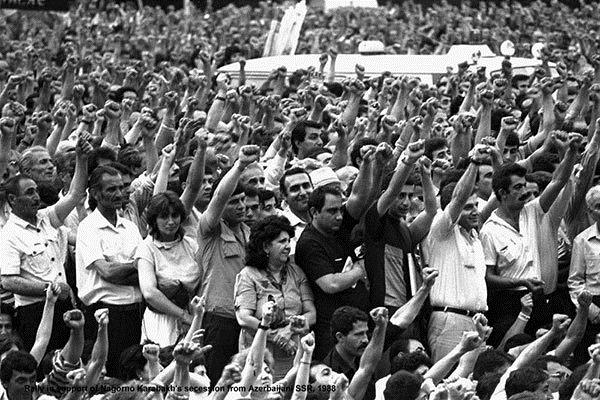
This phase found its climax on February 20, 1988. The first secretary of the Central Committee of Azerbaijan, Kamran Baghirov; members of the Bureau of the Central Committee, and the instructor of the Soviet Communist Party, V. Yashin, arrived in Stepanakert, the capital of Mountainous Karabagh, with the intention of thwarting the extraordinary session of the Regional Council of the Nagorno (Mountainous) Karabagh Autonomous Region (NKAR), intended to pass a resolution on the issue. The visitors called for a session of the party regional committee, and the local party structure was held responsible the organization for the situation. Despite the pressure of representatives from Baku and of the first secretary of the Communist Party in Karabagh, Boris Kevorkov, the session was held on the same day and the Regional Council passed the following resolution, entitled “On a Petition to the Supreme Councils of the Azerbaijani SSR and the Armenian SSR on the NKAR’s Secession from Soviet Azerbaijan and Its Transfer to Soviet Armenia”:

“After hearings and debates on a petition to the Supreme Councils of the Azerbaijani SSR and the Armenian SSR on the secession of the Nagorno Karabagh Autonomous Region from Soviet Azerbaijan and its transfer to Soviet Armenia, the special session of the Nagorno Karabagh Autonomous Oblast Regional Council of People’s Deputies have decided:  “Meeting the requests of the NKAR workers, to appeal to the Supreme Councils of the Azerbaijani SSR and the Armenian SSR to show a profound understanding of the expectations of the Armenian population of Nagorno Karabagh and to resolve the issue of NKAR’s secession from the Azerbaijani SSR and its transfer to the Armenian SSR, and at the same time to submit a petition to the Supreme Council of the USSR on a positive resolution of the issue on NKAR’s secession from the Azerbaijani SSR and its transfer to the Armenian SSR.”

This document followed the legal procedures established by Soviet law and was backed by peaceful demonstrations held in Stepanakert and Yerevan in the same day. The Karabagh Movement, the “test of the perestroika,” had started. Three years later, it would end in the independence of the Republics of Armenia and Nagorno Karabagh.
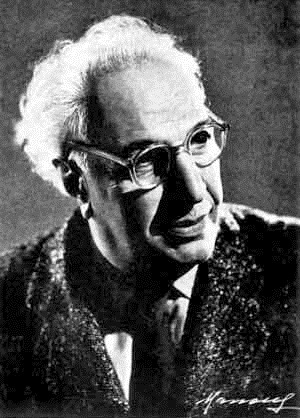


HAGOP OSHAGAN

THIS WEEK IN ARMENIAN HISTORY
(Prepared by the Armenian National Education Committee)

[ANEC]


Death of Hagop Oshagan
(February 17, 1948)


His writing has remained unknown by the general public. However, Hagop Oshagan was one of the most important novelists and literary critics in twentieth-century Armenian literature.


He was born Hagop Kufejian on December 9, 1883 in Sölöz, a village near Brusa, in western Turkey. He lost his father at the age of five and endured much hardship during his childhood. He studied for a short while in the seminary of Armash, but he was essentially an autodidact. His voracious reading was the main source for his learning.

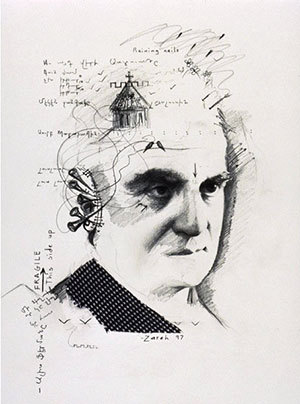
Hagop Oshagan

Illustration by Zareh Meguerditchian


He became a teacher at the age of 19, when his first short story appeared in the newspaper Arevelk of Constantinople. He started to make a name for himself in the short period of literary renaissance that followed the Ottoman Revolution of 1908, both as a short story writer and a critic. He joined with Gostan Zarian, Taniel Varoujan, Kegham Parseghian, and Aharon Dadourian to create the short-lived literary group “Mehyan,” which published the journal of the same name from January-July 1914 and attempted a literary renovation.


Hagop Kufejian was on the April 24 lists of the Turkish government, but was able to elude persecution for the next three years, despite being arrested several times. In early 1918, disguised as a German officer, he managed to flee to Bulgaria, where he remained until 1920. He married and would have three children. His elder son, Vahe Oshagan (1921-2000), a poet and literary critic, would become one of the leading names of Armenian literature in the Diaspora during the second half of the twentieth century.


Hagop Kufejian adopted the last name Oshagan in 1919 and returned to Constantinople, where he worked as a teacher and was active in literary life. He published his first book, a collection of short stories, The Humble Ones, in 1921. In 1922, together with Gostan Zarian, Vahan Tekeyan, Shahan Berberian, and Kegham Kavafian, published Partzravank, a literary journal that tried to be a qualified literary voice.


The occupation of Constantinople by the troops of Mustafa Kemal in 1922 provoked the escape of many Armenians from the city. Oshagan also left and, after living in Bulgaria from 1922-1924, he became a teacher in Egypt (1924-1928), at the Melkonian Institute of Cyprus (1928-1935), and at the Seminary of Jerusalem (1935-1948).


In the last twenty-five years of his life, Oshagan put together a prodigious amount of literary production, including several lengthy novels. Particularly important was the eighteen hundred-page novel The Remnants (1932-1933), which he left unfinished and was intended to be a novel about the Armenian catastrophe of 1915. Barely read at its time, it became an object of cult followers during the past thirty years, as well as the subject for important literary studies.


Aside from his fiction, including also plays and many literary essays, Hagop Oshagan wrote the ten-volume Panorama of Western Armenian Literature (1939-1944), a collection of monographs about the most important literary figures of the period 1850-1915, which he intended to be the “novel” of that period in Western Armenian culture. He only saw the publication of the first volume in 1945. The remaining nine volumes were published between 1951 and 1982. This cemented his fame as the most important name in Armenian literary criticism.


Oshagan passed away in Aleppo, where he had gone to visit the areas that had been the scene of the Armenian deportation and killing in 1915. He died from a heart attack on February 17, 1948, and was buried in the local Armenian cemetery. He had not been a writer for the masses in his lifetime; nevertheless, twenty thousand people attended his funeral. Every year (until the recent Syrian civil war), the students of the Karen Jeppe College of Aleppo went to the Armenian cemetery at the beginning of the school year to pay their respect at his tomb.


GOSTAN ZARIAN


THIS WEEK IN ARMENIAN HISTORY
(Prepared by the Armenian National Education Committee)

[ANEC]


Birth of Gostan Zarian
(February 8, 1885)


The life span of Gostan Zarian, one of the foremost names of twentieth century Armenian literature, covered eight crucial decades. He was active in Constantinople with the Western Armenian generation before the genocide, then lived forty years in the Diaspora, and finally went to die in Soviet Armenia. He was a sort of “wandering Armenian,” not only physically, but also spiritually. His literature was at the crossroads of many influences.

Gostan Zarian

Gostan Zarian

Zarian was born in Shamakhi (Azerbaijan) on February 8, 1885. His father, a general in the Russian army, died when he was four, and he was sent to Baku, where he attended a Russian school. In 1895 he moved to France, where he continued his studies in Asnieres and Saint-Germain-en-Laye, two suburbs of Paris. After finishing high school, he went to the Université Libre of Brussels and obtained a doctorate in literature and philosophy in 1909.

Zarian initially wrote poetry and essays in Russian and French, until the famous Belgian poet Emile Verhaeren advised him to write in his mother tongue. The Armenian poet, who already spoke Armenian, went to Constantinople in 1910, where he started to participate in the renewal of literary life. In mid-1911 he left the Ottoman capital and went to Venice, where he studied Armenian with the Mekhitarist Fathers until the end of 1912. He married Rachel (Takuhi) Shahnazarian in December 1912, from whom he would have three children, and the newlyweds moved back to Constantinople. Zarian would actively participate in Western Armenian literary life until the beginning of the war. He was one of the leading voices of the group “Mehian,” together with Hagop Kufejian (Oshagan), Kegham Parseghian, Taniel Varoujan, and Aharon (Dadourian), and editor-in-chief of the homonymous journal Mehian, which was published from January-July 1914.

Zarian escaped with his family to Bulgaria in late October 1914, the day before Turkey declared war and joined the Central Powers, and thus he avoided the genocide. After living for a year in Bulgaria, he moved to Italy, where he lived for the next six years in Rome and Florence. In 1916 he published his poem “Three Songs,” translated from Armenian into Italian, which was widely critiqued. His literary activities were matched with an active engagement for the Armenian Cause. In 1919 he went to the Caucasus as a special reporter for several Italian newspapers.

Zarian moved back to Constantinople in late 1921, when the remnants of the Western Armenian intelligentsia were starting again a cultural and literary movement. He published the monthly Partzravank, together with Oshagan, Vahan Tekeyan, Shahan Berberian, and Kegham Kavafian, which lasted from January-July 1922. He also published his first book in Armenian, a collection of poems entitled The Crown of the Days. At the end of the year, when the Kemalist forces were about to occupy Constantinople, the writer accepted an invitation of the Soviet Armenian government and moved to Yerevan. For the next two years, he taught European literature at Yerevan University. However, he returned to Europe in June 1924 and would spend the next four decades on the move. He lived in Paris, Venice, Milan, Corfu, Florence, New York (1942-1947), Amsterdam, Ischia, Beirut, Aix-en-Provence, Vienna, Rapallo, Oakland, California (1960-1962), and in 1963 he repatriated to Soviet Armenia.

In the 1920s and 1930s, Zarian published his major works of prose in the monthly Hairenik of Boston, such as The Traveller and His Road, Bancoop and the Bones of the Mammoth, and Countries and Gods, among others. He also published as a book his poems The Bride of Dadrakom in 1930 and Three Songs (1931), and his masterpiece, the novel The Ship on the Mountain (1943). He contributed prose, poetry, essays, and commentary to a variety of Armenian and non-Armenian publications, writing in Armenian, French, Italian, and, later, English. He published two short-lived journals, the literary monthly La Tour de Babel in French (1925), and the pioneering journal of Armenian Studies in New York, Armenian Quarterly (1946). He was friends with various noted European writers, such as English novelist Lawrence Durrell and others. He taught at the American University of Beirut and at the University of California at Berkeley.

His return to Armenia was somewhat controversial, because he had criticized the Soviet regime in several works. His novel The Ship on the Mountain was about the period of the first independence. It was reissued in a heavily censored way (1963) and this created a heated polemics. In any case, Zarian was almost ignored in the last years of his life. He died on December 15, 1969 and was almost totally forgotten by literary circles in Armenia until the end of the regime. Several of his works were printed in book form in the 1970s and 1980s in the Diaspora. His rediscovery in Armenia started with the twenty-first book century, and several works scattered in the press and also unpublished have also been published.

ARMEN GARO

THIS WEEK IN ARMENIAN HISTORY
(Prepared by the Armenian National Education Committee)

[ANEC]


Birth of Armen Garo
(February 9, 1872)


Armen Garo was the ambassador of the first Republic of Armenia in the United States from 1918-1921, but that was the ending chapter of a comparatively short life dedicated to serve his people.

ArmenGaro1

Armen Garo

Karekin Pastermadjian was born on February 9, 1872 in Garin (Armenian name of Erzerum). He completed his studies at the Sanasarian School of his birthplace and graduated in 1891. Three years later, he went to France to pursue higher education at the School of Agronomy of the University of Nancy. In the meantime, he became a member of the Armenian Revolutionary Federation.

When the Armenians of Zeitun started their second rebellion against the power of Sultan Abdul Hamid in the winter of 1895-1896, Karekin abandoned his studies and decided to help them. He went to Geneva, the center of the A.R.F., and was sent to Egypt to help the rebels. Soon he left Egypt with a group of fellow activists and entered the Ottoman Empire. At this time, he took his pseudonym Armen Garo.

He organized the occupation of the Ottoman Bank, the main financial institution of the empire, controlled by European capitals, together with another young party member, Papken Siuni (pseudonym of Bedros Parian). The group of 26 revolutionaries hoped to attract the attention of Europe and threatened to destroy the bank if Turkey did not enact reforms in Western Armenia.  After the death of Papken Siuni during the occupation, in August 1896, Armen Garo took command. Finally, on August 27, the group left the bank under the warranty of European powers for Marseilles.

Armen Garo was forced to leave France and go to Switzerland, where he continued his studies at the University of Geneva. Meanwhile, he continued his activities within the A.R.F. He graduated in 1900 with a Ph.D. in physics and chemistry. A year later, he opened a laboratory in Tiflis to carry out research in the field of chemistry.

The A.R.F. organized the Armenian self-defense during the Armeno-Tatar conflict of 1906-1907. Armen Garo headed the Armenian volunteer groups of self-defense in Tiflis.

After the Ottoman Revolution of 1908, the Armenians of Erzerum, as well as the A.R.F., asked Armen Garo to become their candidate in the forthcoming elections for the Ottoman Parliament.

After finishing his four-year term as a Parliament member, in 1913 Armen Garo was actively involved in the discussions for the Armenian reforms. In the fall of 1914, he crossed the frontier and went to Russia, where he participated in the organization of the Armenian volunteer battalions in the Russian army that would fight in the Caucasian front against the Ottoman Empire. In November 1914 he accompanied the second battalion as representative of the Armenian National Bureau of Tiflis. However, when its commander, Dro, was wounded, Armen Garo was forced to replace him and led the battalion in the Caucasian front until March 1915. Afterwards, he reached Van with the volunteers, bringing the self-defense of the city against the Turkish forces to a successful end.

In 1917 he came to the United States as representative of the Armenian National Council of Tiflis. After the proclamation of the Republic of Armenia, he was designated ambassador. Together with Shahan Natalie, from 1919-1922 he was the main organizer of the Nemesis Operation, the A.R.F. covert operation to punish the main culprits of the Armenian Genocide.

Weakened by long years of non-stop activities, as well as the final fall of the Republic, Armen Garo passed away in Geneva on March 23, 1923 from heart disease at the age of 51. His memoirs, published in the monthly Hairenik, were later collected in a book (1948). His son was historian Hrand Pastermadjian, who published a well-regarded history of Armenia in French.


What We Talk About When We Talk About Genocide.

DEATH OF YEGHISHE TADEOSIAN

THIS WEEK IN ARMENIAN HISTORY

(Prepared by the Armenian National Education Committee)

[ANEC]

 Death of Yeghishe Tadeosian (January 22, 1936)

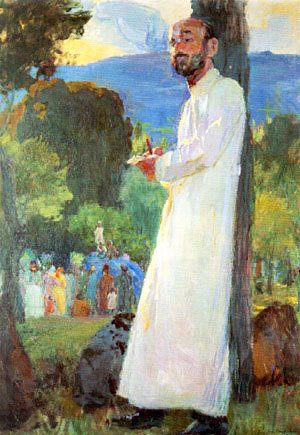
Yeghishe Tadeosian was a talented painter of the late nineteenth and early twentieth century. He was born on September 12, 1870 in Vagharshapat. He studied in the Ter Hakobian pension of Tiflis from 1879-1881 and then at the Lazarian Lyceum of Moscow (1881-1885). Afterwards he

Gomidas

Y. Tadeosian, Komitas, 1936.

entered the School of Fine Arts, Sculpture, and Architecture of Moscow, where he was a student of Russian influential painters Vladimir Makovsky (1846-1920) and Vasily Polenov (1844-1927).

After graduation in 1894, Tadeosian returned to Armenia and taught for a year at the Kevorkian Seminary of Holy Etchmiadzin. In 1896 he returned to Moscow and participated in the 24th salon of the Peredvizhniki (“The Wanderers”), a group of realist painters to which his teachers Makovsky and Polenov were affiliated. The budding artist won two prizes in 1898 at the competition of the Society of Artists of Moscow for his paintings “Midday Meal” and “Preaching to the Right Believers.” He traveled to Palestine with his mentor Polenov in 1898 and, later, almost every day traveled through the Middle East and Europe (until 1914), Russia, and Armenia, which became the source for his art.

The painter settled in Tiflis in 1901 and was a member of the literary and artistic group “Ikar,” founded in 1907. He participated in the exhibitions of the “classical period” of the avant-garde group Mir isskustva (“World of Art”), and its successor, the Union of Russian Artists, until 1910. He collaborated with the foundation of the Union of Armenian Artists in Tiflis (1916) and was elected as its chairman.

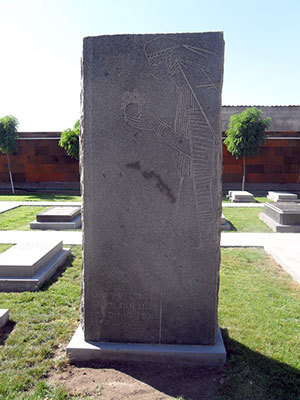
Tadeosian's tombstone at the Komitas Pantheon in Yerevan.

Tadeosian’s tombstone at the Komitas Pantheon in Yerevan.

Tadeosian organized the exhibition of the Union of Armenian Artists in Yerevan (1921) and two years later, he was one of the founders and first professors of the Academy of Fine Arts of Georgia. In 1935 he was bestowed the title of Emeritus Worker of Art of Soviet Armenia.

In his works of the 1890s and 1900s, Tadeosian showed some trends close to impressionism, although he remained essentially a realist painter. He tried many varieties of plastic art, including mosaic, small sculptures, and stage decoration. He was a master of portrait and landscape. He also touched the subject of the Armenian massacres, as well as traditions and historical past.

He passed away on January 22, 1936 in Tiflis. His body was later moved to Yerevan, where a street bears his name, and was buried in the Pantheon, the cemetery of cultural and political figures situated near Gomidas Park. His tombstone offers a unique piece of trivia: for some reason, the name of the painter has been written as «Եղիշէ Թադէոսեան» (Yeghishe Tadeosian), in Classical Armenian spelling, even though his name should have been «Եղիշե Թադեւոսյան» (Yeghishe Tadevosyan) in Soviet Armenian spelling. One may only wonder how this happened and how the writing escaped the attention of Soviet Armenian censors.


On Saturday, January 17, the Armenian Church remembers four early Christians, the Hermits Anthony, Tryphon, Barsauma, and Onouphrius. Of the four, Anthony is the best known. He lived during the time of our Lord and he heard the words spoken by Jesus to a wealthy young man advising, “If you will be perfect, go and sell all that you have and give it to the poor and come follow me.” Anthony did exactly that, lived as a hermit, preached the teachings of Jesus and encouraged others to follow his example. The place he selected to live became the site of the first monastery; and he is therefore recognized as the father of monasticism.
Posted from the Eastern Prelacy of the Armenian Church’s Weekly E-Newsletter.

ASSASSINATION OF HRANT DINK

THIS WEEK IN ARMENIAN HISTORY
(Prepared by the Armenian National Education Committee)

[ANEC]


Assassination of Hrant Dink
(January 19, 2007)


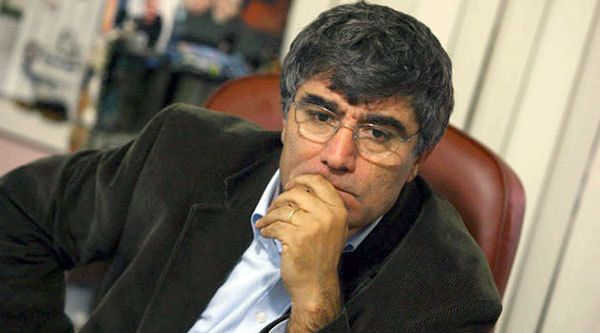
Eight years ago, the assassination of journalist Hrant Dink became a crucial moment in the last decade of Turkish public life and a symbol of intolerance against freedom of speech.hDink1

Dink was born in Malatia on September 15, 1954. At the age of five, his family moved to Istanbul. Due to the separation of their parents, he and his two brothers were sent to the kindergarten of the Armenian Evangelical Church of Gedigpaşa as boarders. The three brothers continued their education at the elementary school of the same church in Incirdibi and went to its summer camp in Tuzla. Hrant went to the Bezjian School in junior high and to the Surp Khach Tbrevank in high school, and graduated as a senior from the public school of Şişli.

At summer camp, he met Rakel Yagbasan, five years his junior, who was born in Silopi and came from the Varto clan. In 1972 he entered university and engaged in the Turkish leftist movement, which he left four years later, when he got married. Hrant and Rakel Dink had three children. He completed his degree in zoology, but could not finish his second bachelor degree in philosophy.

In 1979 he opened a bookstore with his brothers, which they ran successfully. From 1979-1984, he and his wife also ran the Tuzla summer camp, until the Turkish government seized it after a five year legal battle.

In the 1990s Dink was a contributor to Marmara newspaper, reviewing Turkish books about Armenians with the pen name “Chutak” (Violin). On April 5, 1996, he launched the first bilingual (Turkish and Armenian) weekly in the history of Turkey, Agos, which he edited until his death. Agos spoke loudly against any unfair treatment of the Armenian community in Turkey, covered human rights violations and problems of democratization in Turkey, carried news of developments in the Republic of Armenia, with special emphasis on Turkey-Armenia relations, published articles and serials on the Armenian cultural heritage and its contributions to the Ottoman Empire and Turkey, and criticized malfunctions and lack of transparency in Armenian institutions.

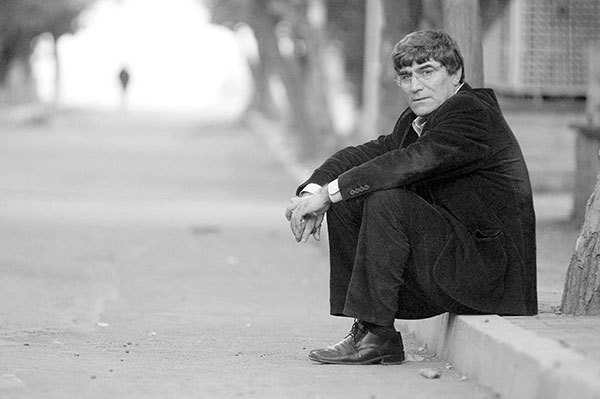
Dink was also a commentator for Turkish periodicals. He wrote about the establishment of good neighborhood relations between Turkey and Armenia, the opening of the borders, support of Turkish democratic processes, and the Armenian genocide. He also lectured in many countries about Armenian identity and Turkish-Armenian relations.HDink2

His views and his outspokenness started to discomfort many people. He was prosecuted three times for denigrating Turkishness, pursuant to article 301 of the Turkish Penal Court.  He was taken to court for statements during a lecture in Urfa (2002), but acquitted in 2006. A second trumped-up charge, stemming from the purposeful misunderstanding of a statement, resulted in a six-month suspended sentence (2005) that Dink, after ending all avenues in the Turkish judicial system, had appealed to the European Court of Human Rights at the time of his death. The ECHR concluded in 2010 that Turkish authorities had violated his freedom of speech. A third trial came in 2006 after he declared to Reuters that what happened in 1915 was genocide. The latter was dropped after his death, but Agos general director Arat Dink (his son) and publisher Sarkis Seropyan were sentenced to one year of prison.

The actual witch hunt had started in February 2004, after the mainstream Hurriyet daily reprinted a news piece from Agos, published in September 2003, claiming that Sabiha Gökçen, one of the adoptive daughters of Mustafa Kemal Atatürk, was actually an Armenian orphan of the genocide. The press release from the office of the Chief of General Staff stated on February 22, 2004: “Whatever the reason, opening up such a symbol to public debate is a crime against national unity and social peace.”. Dink was called to the governor’s office in Istanbul and given a warning by two people whose identities remained undisclosed. Afterwards, a virulent campaign started in the press that continued until his death. The well-known journalist Mehmet Ali Birand wrote, “We are the real murderers of Hrant. We have brought up our murderers in an atmosphere and mentality created by Article 301.”

On January 19, 2007, Hrant Dink was killed outside the offices of Agos by seventeen-year-old Ogün Samast. His burial ceremony became a demonstration of more than one hundred thousand people protesting the killing and claiming, “We are all Armenians. We are all Hrant Dink.” His assassin was condemned to 22 years and 10 months in prison in 2011, while another suspect, Yasin Hayal, convicted of ordering the murder, was sentenced to life imprisonment.

However, it has become clear that justice has not been served yet. The Turkish top court ruled in July 2014 that the investigation of the killing was flawed, and recent arrests of policemen for “negligence” in the inquiry of the murder have shown that there is still a long way before closing the books on the assassination of the brave Armenian journalist.


BAKU POGROM

THIS WEEK IN ARMENIAN HISTORY
(Prepared by the Armenian National Education Committee)

[ANEC]


Baku Pogrom
(January 13, 1990)


Baku, the capital of Azerbaijan, which had a large Armenian community since the late nineteenth century, was the theater of anti-Armenian massacres in 1905 and 1918. In January 1990, the local community was persecuted, massacred, and forced to leave the city forever.

The beginning of the Karabagh conflict, followed by the pogrom of Sumgait in February 1988, was marked with a violent Azerbaijani response to the peaceful Armenian demonstrations and claims. Exchange of population started. However, while Armenians were expelled by force from Kirovabad (currently Ganja, the second city of Azerbaijan) in the fall of 1988, as well as from other locations, Azerbaijanis were able to sell their properties and leave Armenia without being disturbed.

Azerbaijani mass media, and particularly television, were flooded with anti-Armenian propaganda, which paved the way for violence. The Popular Front of Azerbaijan, a nationalist and anti-communist movement, called to expel Armenians from Baku and take up their homes. Killings and robbery became frequent throughout 1989.

On December 1 of that year, the Supreme Councils of the Armenian SS Republic and the Mountainous Karabagh Autonomous Region passed a joint resolution on the formal unification of Armenia and Karabagh. This resolution triggered the anti-Armenian massacre of Baku from January 13-19, 1990 as a direct response.

The violence was preceded by demonstrations of the Popular Front, which called for the defense of Azerbaijan’s sovereignty from Armenian demands. Groups of young Azerbaijanis roamed the streets, terrorizing Armenians and warning them to leave Baku. Azaddin Gyulmamedov, a young Azerbaijani who attended the rally in Baku on January 13 and witnessed the outbreak of anti-Armenian violence, gave the following testimony: “We went to see what was happening. We saw these guys in the streets. I don’t know who they were – drug addicts, maybe. They had sticks and clubs, and lists of Armenians and where they lived. They wanted to break down the doors of Armenian apartments and chase them out. The police didn’t do anything. They just stood and watched. Same with the soldiers, who had weapons. We asked them to help. There were about a dozen soldiers and ten of us, and there were about twenty in the gang, but the soldiers wouldn’t help. They said: ‘You can do it yourself, Blackie. We’re not getting involved.’”

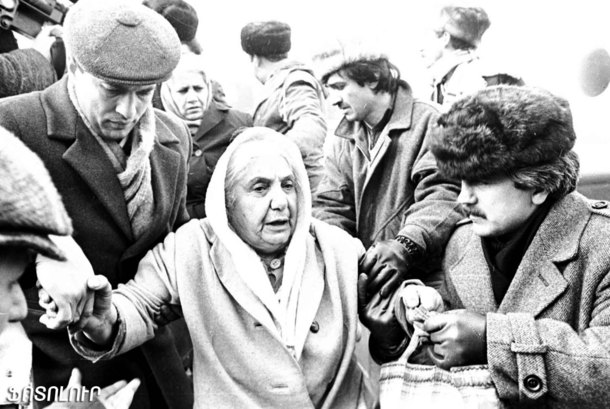
An elderly Armenian woman is one of many evacuees that escaped Baku after the massacres of Armenians by Azeris began in mid-January of 1990.

An elderly Armenian woman is one of many evacuees that escaped Baku after the massacres of Armenians by Azeris began in mid-January of 1990.

At nightfall of January 12-13, attacks started; Armenian homes were set on fire and looted, while Armenians were killed or injured. The homes of Armenians had been previously identified and mapped, while law enforcement bodies stood idle, and ambulance people made fake medical certificates, according to which the deaths of Armenians were caused by circulatory injury and not by the violence.

According to Radio Liberty, on the night of January 14 alone, 25 people were killed in the Armenian district. The Russian daily Izvestia reported on January 18 and 19 that 64 cases of pogrom had been identified, with Armenians as victims, on January 16, and 45 pogroms and arsons of residential houses on January 17. The New York Times wrote on January 19: “Nationalists in Lithuania are struggling to wrest independence from Moscow by nonviolent, political means. Nationalists in Azerbaijan also talk of independence, but their protest includes bloody pogroms against their Armenian neighbors.”

One of the leaders of the National Front of Azerbaijan, Etibar Mamedov, testified about the cruelties and the lack of official intervention: “I myself witnessed the murder of two Armenians near the railway station. A crowd gathered, threw petrol on them and burned them, whereas the regional militia division was only 200 meters away with some 400-500 soldiers of the internal forces. The soldiers passed by the burning bodies at a distance of some 20 meters, and nobody attempted to circle the area and dissolve the crowd.”

Central authorities in Moscow did little to stop the violence until January 20, when Soviet troops entered Baku and declared the state of emergency. As Moscow News wrote on February 4, “the troops entered the town seized with pogroms not to stop them, but to prevent the final seizure of power by the People’s Front of Azerbaijan, which was planned for January 20.” Most Armenians fled Baku. Former world chess champion Garry Kasparov and his family was among the evacuees. Kasparov later testified:  “No one would halt the Armenian pogroms in Baku, although there were eleven thousand soldiers of internal troops in the city. No one would intervene until the ethnic cleansing was carried out. The pogroms were happening not in a random place but in the huge capital city with blocks of flats. In such a megapolis as Baku the crowd simply cannot carry out targeted operations like that. When the pogrom-makers go purposefully from one district to another, from one apartment to another this means that they had been given the addresses and that they had a coordinator.”

The number of victims of the Armenian massacres in Baku is not clear yet, with estimates going up to 400. The events were never assessed from a legal point of view and the damages were not repaid.


Armenian Christmas

Why Do Armenians Celebrate Christmas on January 6th?

by Hratch Tchilingirian

“Armenian Christmas,” as it is popularly called, is a culmination of celebrations of events related to Christ’s Incarnation. Theophany or Epiphany (or Astvadz-a-haytnootyoon in Armenian) means “revelation of God,” which is the central theme of the Christmas Season in the Armenian Church. During the “Armenian Christmas” season, the major events that are celebrated are the Nativity of Christ in Bethlehem and His Baptism in the River Jordan. The day of this major feast in the Armenian Church is January 6th. A ceremony called “Blessing of Water” is conducted in the Armenian Church to commemorate Christ’s Baptism.

It is frequently asked as to why Armenians do not celebrate Christmas on December 25th with the rest of the world. Obviously, the exact date of Christ’s birth has not been historically established—it is neither recorded in the Gospels. However, historically, all Christian churches celebrated Christ’s birth on January 6th until the fourth century.

According to Roman Catholic sources, the date was changed from January 6th to December 25th in order to override a pagan feast dedicated to the birth of the Sun which was celebrated on December 25th. At the time Christians used to continue their observance of these pagan festivities. In order to undermine and subdue this pagan practice, the church hierarchy designated December 25th as the official date of Christmas and January 6th as the feast of Epiphany. However, Armenia was not effected by this change for the simple fact that there were no such pagan practices in Armenia, on that date, and the fact that the Armenian Church was not a satellite of the Roman Church. Thus, remaining faithful to the traditions of their forefathers, Armenians have continued to celebrate Christmas on January 6th until today.

In the Holy Land: January 19th

In the Holy Land, the Orthodox churches use the old calendar: Julian Calendar (which has a difference of thirteen days) to determine the date of the religious feasts. Accordingly, the Armenians celebrate Christmas on January 19th (January 6 in Julian Calendar) and the Greek Orthodox celebrate on January 7th (December 25 in Julian Calendar). On the day before Armenian Christmas, January 18th, the Armenian Patriarch together with the clergy and the faithful, travels from Jerusalem to the city of Bethlehem, to the Church of Nativity of Christ, where elaborate and colorful ceremonies take place. Outside, in the large square of the Church of Nativity, the Patriarch and his entourage are greeted by the Mayor of Bethlehem and City officials. A procession led by Armenian scouts and their band, advance the Patriarch into the Church of Nativity, while priests, seminarians and the faithful join in the sing of Armenian hymns. Afterwards, church services and ceremonies are conducted in the Cathedral of Nativity all night long and until the next day, January 19th.

Source: St. Andrew Information Network