This Sunday, March 22, is the sixth and final Sunday of Great Lent, known as Sunday of Advent (Kalstyan Giragi). On Advent Sunday we are asked to ponder the mystery of the first coming of Christ and especially his second coming which is a fundamental tenet of our Christian faith, and which is mentioned in the prayers read this Sunday. Christ came to the world for the salvation of humankind. We are told to be ready at all times because He will come again for the judgment of sinners, and when the righteous will become worthy of entering the Kingdom of God. “Then people will see the Son of Man coming in clouds with great power and glory. He will send out his angels and gather his elect from the four winds, from the ends of the earth to the ends of heaven.” (Mark 13:26-27)
Advent Sunday has its own special hymn, which proclaims that the apostles knew the mystery of the advent of Christ. The story of the expulsion from paradise is repeated and an appeal is made to Christ to ask the Heavenly Father to establish peace on earth. Sunday of Advent is in preparation of the following Sunday, Palm Sunday, which is the celebration of the glorious entry of our Lord into Jerusalem and the beginning of Holy Week.
The terrible manifestation of your glory which will be in your second coming David foresaw and announced beforehand by the Holy Spirit’s inspiration, God will come openly, fire will burn before him. Then, O Jesus, spare us, have compassion, O Christ, and have mercy.
Mother of God unwedded, bride of heaven on earth, when in the sight of light you sit at the right hand of your only-begotten beseech him for us to deliver us from the awful flame, to number us with the righteous that we also may sing glory with the heavenly ones.
(Canon for the Sixth Sunday of Great Lent from the Liturgical Canons of the Armenian Church)
Posted in Lent Sundays | Tagged Kalstyan Giragi, SUNDAY OF ADVENT |
THIS WEEK IN ARMENIAN HISTORY
(Prepared by the Armenian National Education Committee)
[ANEC]
Birth of Alan Hovhaness
(March 8, 1911)
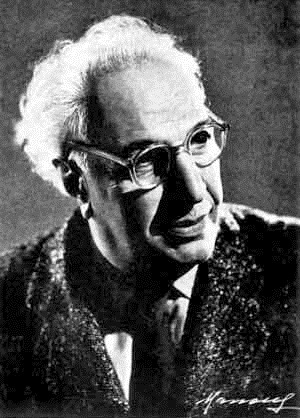
Armenian American composer Alan Hovhaness is said to be one of the most prolific composers of the 20th century.
He was born Alan Vaness Chakmakjian in Somerville (Massachusetts), on March 8, 1911. His father, Haroutioun Chakmakjian (1878-1973), was a professor of chemistry at Tufts College and author of a popular English-Armenian dictionary, as well as onetime editor of Hairenik. His mother, Madeleine Scott, was of Scottish ancestry, and did not especially approve that he learned about Armenian culture from his father. Until her death in 1931, the composer would sign his earliest music as Alan Scott Vaness.
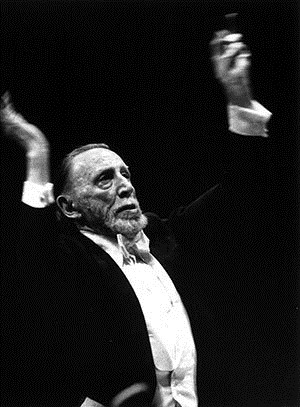
Alan Hovhaness conducts the Ani Symphony at the Metropolitan Museum of Art in New York City on April 21, 1989, in one of several events sponsored by the Prelacy on the occasion of the 1000th anniversary of the Great Cathedral of Ani.
Alan Hovhaness was a precocious composer who already penned operas by age 14. After initial studies at Tufts College, he studied composition at the New England Conservatory of Music, in Boston. In the 1930s, he composed mostly chamber music in Western modes of expression.
He would shift to a fusion of Western and Eastern music in the 1940s, starting with his job as organist at St. James Armenian Church in Watertown, where he was exposed to the Armenian liturgy and the works of Komitas Vartabed. “It was through Komitas that I got the idea of saying as much as possible with the fewest possible notes,” he would write later. He got rid of most of his earliest music, and started anew to seek out his Armenian heritage. His “Armenian period” lasted from 1943 to 1951, and was benefited from the performances of important works and rave reviews in the mainstream press. The Friends of Armenian Music, a committee headed by pianist Maro Ajemian and her sister, violinist Anahid Ajemian, were instrumental in supporting him in various capacities. Maro Ajemian performed and recorded many of his works.
After a three-year stint at the Boston Music Conservatory (1948-1951), while he had married for the third time, Hovhaness gradually acquired considerable reputation. He received academic honors and a steady flow of commissions. He embarked on a more Western phase of writing and devoted himself to full-time composing. His Symphony No. 2 (Mysterious Mountain ) that premiered in 1955, brought him national recognition. MGM Records released 8 long-plays of all-Hovhaness records from 1955-1957. “Mysterious Mountain” was recorded in 1958 by Fritz Reiner and the Chicago Symphony Orchestra, and became his most famous recording and most-performed orchestral work. To this day it is considered to be one of the best recordings ever made.
After a Fulbright research scholarship in India (1959-1960), Alan Hovhaness also visited and studied in Japan and Korea. He also visited the former Soviet Union in 1965, including Soviet Armenia. He shared his time between New York and Switzerland in the mid-1960s, while steadily maintaining his prolific output. He settled in Seattle, Washington, in the early 1970s. At this time, his music veered towards a more Western neo-romantic expression. In 1977 he married his sixth wife, Japanese soprano Hinako Fujihara. In the same year, he was elected to the American Academy of Arts and Letters.
In 1991 the American Composers Society and the Eastern Prelacy, by initiative of Archbishop Mesrob Ashjian, celebrated the 80th birthday of Alan Hovhaness at Carnegie Hall. He directed his own works, including the premiere of his symphony No. 65 “Artsakh,” dedicated to the heroic fighters for the liberation of Karabagh and commissioned by the Prelacy.
The composer continued to be active until his 85th birthday. In 1996 his health suffered a marked decline. He passed away on June 21, 2000 at the age of 89. His official catalogue includes 67 symphonies and 434 works.
Posted in the Armenian National Education Committee (ANEC) | Tagged Alan Hovhaness |
THIS WEEK IN ARMENIAN HISTORY
(Prepared by the Armenian National Education Committee)
[ANEC]
Armenia becomes a member of the United Nations
(March 2, 1992)
The Supreme Council of the Republic of Armenia declared the independence of Armenia by 213 votes to 0 on September 23, after the popular referendum of September 21 had answered with an overwhelming “Yes” to the question whether Armenians wanted independence.
The three Baltic republics (Estonia, Latvia, and Lithuania) had been incorporated into the United Nations in September 1991, and thus, Lithuania recognized the independence of Armenia in November. However, international recognition essentially started after December 10, 1991, the date when the former Union of Soviet Socialist Republics (USSR) was officially dissolved. Ironically, Turkey was among the first countries to recognize Armenian independence on December 24, 1991, one day before the United States, but has refused to establish diplomatic relations until the present.
The Republic of Armenia officially applied for membership in the United Nations on January 23, 1992. Six days later, the U.N. Security Council discussed the application of Armenia in its session 3035 and advised the U.N. General Assembly to incorporate the newly independent Republic as a member (resolution 735, January 29, 1992).
On March 2, 1992, Ambassador Samir S. Shihabi of Saudi Arabia opened the meeting of the U.N. General Assembly as its president. Secretary General Boutros Boutros-Ghali placed on the agenda the application of nine countries, eight of them former Soviet republics (Armenia, Azerbaijan, Kazakhstan, Kirguizia, Moldova, Tajikistan, Turkmenistan, and Uzbekistan), as well as San Marino, which previously had enjoyed observer status. The Republic of Armenia was represented by Foreign Minister Raffi Hovannisian; Armenian ambassador to the United Nations, Alexander Arzumanian, and Armenian ambassador to the United Kingdom, Armen Sargsyan. Some 30 representatives of the Armenian American community were also attending, including Archbishop Mesrob Ashjian, Prelate of the Eastern Prelacy of the Armenian Apostolic Church, of blessed memory.
The need to find a solution to the ongoing crisis of Karabagh was noted by the representatives of the United States, the Organization for Security and Cooperation in Europe (OSCE), the Russian Federation, and the European Community. Foreign Minister Hovannisian spoke and, after greeting those present in Armenian, continued speaking in English and declared that Armenia wanted a peaceful resolution of the issue.
The resolution 46/227 of the General Assembly was approved on the same day. Due to the civil war, the membership of Georgia was to be approved in July 1992.
The representatives of the invited countries, led by Boutros-Ghali, were invited to the ceremony of the raising of the flags at 1:30 p.m. Thousands of Armenians had gathered outside the United Nations headquarters and their overwhelming applause greeted Raffi Hovannisian while he raised the Armenian flag. The tricolor floating in front of the United Nations became a symbol of Armenia’s membership in the international community.
In remembrance of this historic date, the government of the Republic of Armenia issued a resolution on March 23, 2012, which established March 2 as the day of the diplomat of the Republic of Armenia.
Posted in the Armenian National Education Committee (ANEC) | Tagged independence of Armenia |
THIS WEEK IN ARMENIAN HISTORY
(Prepared by the Armenian National Education Committee)
[ANEC]
Declaration of Secession of Nagorno Karabagh from Azerbaijan
(February 20, 1988)
The question of Karabagh started in the years of the first independent Republic of Armenia and was not solved after the South Caucasus became part of the Soviet Union. The arbitrary decision of the Caucasian Bureau of the Soviet Communist Party (July 5, 1921) to attach Karabagh to Azerbaijan only contributed to open a new Pandora’s box. Throughout the decades, the Azerbaijani discriminatory policy had the other historical Armenian region, the Autonomous Republic of Nakhichevan, as poster child: due to continuous emigration, its Armenian population went from 40% in 1926 to 2% in 1988.
It is not surprising then, that the Armenians of Mountainous Karabagh, who constituted 90% of its population in 1926, took every opportunity to address Moscow and ask for a fair solution of the issue. Various letters were sent in 1945, 1965, and 1977. The petition of 1965 was signed by 45,000 people. On its grounds, the Secretariat of the Central Committee of the Communist Party of the Soviet Union assigned to the Central Committees of the party in Armenia and Azerbaijan the mission of preparing a proposal for the solution of the problem of Karabagh in 1966. However, Azerbaijan was able to put the brakes on any possible solution. The Azerbaijani KGB, led by Heydar Aliyev (future president in post-Soviet times) stimulated interethnic conflict. As a result, more than 150 Armenians were sent to prison, where 20 people were killed and ten others disappeared. More than a hundred families, after two years of persecution, were forced to leave Karabagh. The issue was again treated in 1977 during the discussions of the draft Soviet Constitution, but never went through.
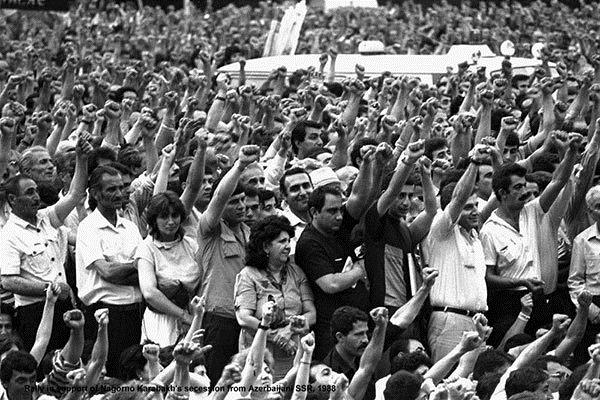
After the proclamation of the policies of restructuring (perestroika) and transparency (glasnost) by the last Soviet leader, Mikhail Gorbachev, the movement for Karabagh entered a new phase in mid-1987. There were demonstrations and meetings, and the representatives of the autonomous region sent petitions to the party and state organs of the Soviet Union. A petition that asked for the reattachment of the autonomous region to Soviet Armenia was signed by 80,000 people.
![]()
This phase found its climax on February 20, 1988. The first secretary of the Central Committee of Azerbaijan, Kamran Baghirov; members of the Bureau of the Central Committee, and the instructor of the Soviet Communist Party, V. Yashin, arrived in Stepanakert, the capital of Mountainous Karabagh, with the intention of thwarting the extraordinary session of the Regional Council of the Nagorno (Mountainous) Karabagh Autonomous Region (NKAR), intended to pass a resolution on the issue. The visitors called for a session of the party regional committee, and the local party structure was held responsible the organization for the situation. Despite the pressure of representatives from Baku and of the first secretary of the Communist Party in Karabagh, Boris Kevorkov, the session was held on the same day and the Regional Council passed the following resolution, entitled “On a Petition to the Supreme Councils of the Azerbaijani SSR and the Armenian SSR on the NKAR’s Secession from Soviet Azerbaijan and Its Transfer to Soviet Armenia”:
“After hearings and debates on a petition to the Supreme Councils of the Azerbaijani SSR and the Armenian SSR on the secession of the Nagorno Karabagh Autonomous Region from Soviet Azerbaijan and its transfer to Soviet Armenia, the special session of the Nagorno Karabagh Autonomous Oblast Regional Council of People’s Deputies have decided: “Meeting the requests of the NKAR workers, to appeal to the Supreme Councils of the Azerbaijani SSR and the Armenian SSR to show a profound understanding of the expectations of the Armenian population of Nagorno Karabagh and to resolve the issue of NKAR’s secession from the Azerbaijani SSR and its transfer to the Armenian SSR, and at the same time to submit a petition to the Supreme Council of the USSR on a positive resolution of the issue on NKAR’s secession from the Azerbaijani SSR and its transfer to the Armenian SSR.”
This document followed the legal procedures established by Soviet law and was backed by peaceful demonstrations held in Stepanakert and Yerevan in the same day. The Karabagh Movement, the “test of the perestroika,” had started. Three years later, it would end in the independence of the Republics of Armenia and Nagorno Karabagh.
Posted in the Armenian National Education Committee (ANEC) | Tagged Declaration of Secession of Nagorno Karabagh from Azerbaijan, Mountainous Karabagh, Nagorno KarabagH |
THIS WEEK IN ARMENIAN HISTORY
(Prepared by the Armenian National Education Committee)
[ANEC]
Death of Hagop Oshagan
(February 17, 1948)
His writing has remained unknown by the general public. However, Hagop Oshagan was one of the most important novelists and literary critics in twentieth-century Armenian literature.
He was born Hagop Kufejian on December 9, 1883 in Sölöz, a village near Brusa, in western Turkey. He lost his father at the age of five and endured much hardship during his childhood. He studied for a short while in the seminary of Armash, but he was essentially an autodidact. His voracious reading was the main source for his learning.
He became a teacher at the age of 19, when his first short story appeared in the newspaper Arevelk of Constantinople. He started to make a name for himself in the short period of literary renaissance that followed the Ottoman Revolution of 1908, both as a short story writer and a critic. He joined with Gostan Zarian, Taniel Varoujan, Kegham Parseghian, and Aharon Dadourian to create the short-lived literary group “Mehyan,” which published the journal of the same name from January-July 1914 and attempted a literary renovation.
Hagop Kufejian was on the April 24 lists of the Turkish government, but was able to elude persecution for the next three years, despite being arrested several times. In early 1918, disguised as a German officer, he managed to flee to Bulgaria, where he remained until 1920. He married and would have three children. His elder son, Vahe Oshagan (1921-2000), a poet and literary critic, would become one of the leading names of Armenian literature in the Diaspora during the second half of the twentieth century.
Hagop Kufejian adopted the last name Oshagan in 1919 and returned to Constantinople, where he worked as a teacher and was active in literary life. He published his first book, a collection of short stories, The Humble Ones, in 1921. In 1922, together with Gostan Zarian, Vahan Tekeyan, Shahan Berberian, and Kegham Kavafian, published Partzravank, a literary journal that tried to be a qualified literary voice.
The occupation of Constantinople by the troops of Mustafa Kemal in 1922 provoked the escape of many Armenians from the city. Oshagan also left and, after living in Bulgaria from 1922-1924, he became a teacher in Egypt (1924-1928), at the Melkonian Institute of Cyprus (1928-1935), and at the Seminary of Jerusalem (1935-1948).
In the last twenty-five years of his life, Oshagan put together a prodigious amount of literary production, including several lengthy novels. Particularly important was the eighteen hundred-page novel The Remnants (1932-1933), which he left unfinished and was intended to be a novel about the Armenian catastrophe of 1915. Barely read at its time, it became an object of cult followers during the past thirty years, as well as the subject for important literary studies.
Aside from his fiction, including also plays and many literary essays, Hagop Oshagan wrote the ten-volume Panorama of Western Armenian Literature (1939-1944), a collection of monographs about the most important literary figures of the period 1850-1915, which he intended to be the “novel” of that period in Western Armenian culture. He only saw the publication of the first volume in 1945. The remaining nine volumes were published between 1951 and 1982. This cemented his fame as the most important name in Armenian literary criticism.
Oshagan passed away in Aleppo, where he had gone to visit the areas that had been the scene of the Armenian deportation and killing in 1915. He died from a heart attack on February 17, 1948, and was buried in the local Armenian cemetery. He had not been a writer for the masses in his lifetime; nevertheless, twenty thousand people attended his funeral. Every year (until the recent Syrian civil war), the students of the Karen Jeppe College of Aleppo went to the Armenian cemetery at the beginning of the school year to pay their respect at his tomb.
Posted in the Armenian National Education Committee (ANEC) | Tagged Hagop Kufesjian, Hagop Oshagan, Partzravank |
THIS WEEK IN ARMENIAN HISTORY
(Prepared by the Armenian National Education Committee)
[ANEC]
Birth of Gostan Zarian
(February 8, 1885)
The life span of Gostan Zarian, one of the foremost names of twentieth century Armenian literature, covered eight crucial decades. He was active in Constantinople with the Western Armenian generation before the genocide, then lived forty years in the Diaspora, and finally went to die in Soviet Armenia. He was a sort of “wandering Armenian,” not only physically, but also spiritually. His literature was at the crossroads of many influences.
Zarian was born in Shamakhi (Azerbaijan) on February 8, 1885. His father, a general in the Russian army, died when he was four, and he was sent to Baku, where he attended a Russian school. In 1895 he moved to France, where he continued his studies in Asnieres and Saint-Germain-en-Laye, two suburbs of Paris. After finishing high school, he went to the Université Libre of Brussels and obtained a doctorate in literature and philosophy in 1909.
Zarian initially wrote poetry and essays in Russian and French, until the famous Belgian poet Emile Verhaeren advised him to write in his mother tongue. The Armenian poet, who already spoke Armenian, went to Constantinople in 1910, where he started to participate in the renewal of literary life. In mid-1911 he left the Ottoman capital and went to Venice, where he studied Armenian with the Mekhitarist Fathers until the end of 1912. He married Rachel (Takuhi) Shahnazarian in December 1912, from whom he would have three children, and the newlyweds moved back to Constantinople. Zarian would actively participate in Western Armenian literary life until the beginning of the war. He was one of the leading voices of the group “Mehian,” together with Hagop Kufejian (Oshagan), Kegham Parseghian, Taniel Varoujan, and Aharon (Dadourian), and editor-in-chief of the homonymous journal Mehian, which was published from January-July 1914.
Zarian escaped with his family to Bulgaria in late October 1914, the day before Turkey declared war and joined the Central Powers, and thus he avoided the genocide. After living for a year in Bulgaria, he moved to Italy, where he lived for the next six years in Rome and Florence. In 1916 he published his poem “Three Songs,” translated from Armenian into Italian, which was widely critiqued. His literary activities were matched with an active engagement for the Armenian Cause. In 1919 he went to the Caucasus as a special reporter for several Italian newspapers.
Zarian moved back to Constantinople in late 1921, when the remnants of the Western Armenian intelligentsia were starting again a cultural and literary movement. He published the monthly Partzravank, together with Oshagan, Vahan Tekeyan, Shahan Berberian, and Kegham Kavafian, which lasted from January-July 1922. He also published his first book in Armenian, a collection of poems entitled The Crown of the Days. At the end of the year, when the Kemalist forces were about to occupy Constantinople, the writer accepted an invitation of the Soviet Armenian government and moved to Yerevan. For the next two years, he taught European literature at Yerevan University. However, he returned to Europe in June 1924 and would spend the next four decades on the move. He lived in Paris, Venice, Milan, Corfu, Florence, New York (1942-1947), Amsterdam, Ischia, Beirut, Aix-en-Provence, Vienna, Rapallo, Oakland, California (1960-1962), and in 1963 he repatriated to Soviet Armenia.
In the 1920s and 1930s, Zarian published his major works of prose in the monthly Hairenik of Boston, such as The Traveller and His Road, Bancoop and the Bones of the Mammoth, and Countries and Gods, among others. He also published as a book his poems The Bride of Dadrakom in 1930 and Three Songs (1931), and his masterpiece, the novel The Ship on the Mountain (1943). He contributed prose, poetry, essays, and commentary to a variety of Armenian and non-Armenian publications, writing in Armenian, French, Italian, and, later, English. He published two short-lived journals, the literary monthly La Tour de Babel in French (1925), and the pioneering journal of Armenian Studies in New York, Armenian Quarterly (1946). He was friends with various noted European writers, such as English novelist Lawrence Durrell and others. He taught at the American University of Beirut and at the University of California at Berkeley.
His return to Armenia was somewhat controversial, because he had criticized the Soviet regime in several works. His novel The Ship on the Mountain was about the period of the first independence. It was reissued in a heavily censored way (1963) and this created a heated polemics. In any case, Zarian was almost ignored in the last years of his life. He died on December 15, 1969 and was almost totally forgotten by literary circles in Armenia until the end of the regime. Several of his works were printed in book form in the 1970s and 1980s in the Diaspora. His rediscovery in Armenia started with the twenty-first book century, and several works scattered in the press and also unpublished have also been published.
Posted in the Armenian National Education Committee (ANEC) | Tagged Gostan Zarian |
THIS WEEK IN ARMENIAN HISTORY
(Prepared by the Armenian National Education Committee)
[ANEC]
Birth of Armen Garo
(February 9, 1872)
Armen Garo was the ambassador of the first Republic of Armenia in the United States from 1918-1921, but that was the ending chapter of a comparatively short life dedicated to serve his people.
Karekin Pastermadjian was born on February 9, 1872 in Garin (Armenian name of Erzerum). He completed his studies at the Sanasarian School of his birthplace and graduated in 1891. Three years later, he went to France to pursue higher education at the School of Agronomy of the University of Nancy. In the meantime, he became a member of the Armenian Revolutionary Federation.
When the Armenians of Zeitun started their second rebellion against the power of Sultan Abdul Hamid in the winter of 1895-1896, Karekin abandoned his studies and decided to help them. He went to Geneva, the center of the A.R.F., and was sent to Egypt to help the rebels. Soon he left Egypt with a group of fellow activists and entered the Ottoman Empire. At this time, he took his pseudonym Armen Garo.
He organized the occupation of the Ottoman Bank, the main financial institution of the empire, controlled by European capitals, together with another young party member, Papken Siuni (pseudonym of Bedros Parian). The group of 26 revolutionaries hoped to attract the attention of Europe and threatened to destroy the bank if Turkey did not enact reforms in Western Armenia. After the death of Papken Siuni during the occupation, in August 1896, Armen Garo took command. Finally, on August 27, the group left the bank under the warranty of European powers for Marseilles.
Armen Garo was forced to leave France and go to Switzerland, where he continued his studies at the University of Geneva. Meanwhile, he continued his activities within the A.R.F. He graduated in 1900 with a Ph.D. in physics and chemistry. A year later, he opened a laboratory in Tiflis to carry out research in the field of chemistry.
The A.R.F. organized the Armenian self-defense during the Armeno-Tatar conflict of 1906-1907. Armen Garo headed the Armenian volunteer groups of self-defense in Tiflis.
After the Ottoman Revolution of 1908, the Armenians of Erzerum, as well as the A.R.F., asked Armen Garo to become their candidate in the forthcoming elections for the Ottoman Parliament.
After finishing his four-year term as a Parliament member, in 1913 Armen Garo was actively involved in the discussions for the Armenian reforms. In the fall of 1914, he crossed the frontier and went to Russia, where he participated in the organization of the Armenian volunteer battalions in the Russian army that would fight in the Caucasian front against the Ottoman Empire. In November 1914 he accompanied the second battalion as representative of the Armenian National Bureau of Tiflis. However, when its commander, Dro, was wounded, Armen Garo was forced to replace him and led the battalion in the Caucasian front until March 1915. Afterwards, he reached Van with the volunteers, bringing the self-defense of the city against the Turkish forces to a successful end.
In 1917 he came to the United States as representative of the Armenian National Council of Tiflis. After the proclamation of the Republic of Armenia, he was designated ambassador. Together with Shahan Natalie, from 1919-1922 he was the main organizer of the Nemesis Operation, the A.R.F. covert operation to punish the main culprits of the Armenian Genocide.
Weakened by long years of non-stop activities, as well as the final fall of the Republic, Armen Garo passed away in Geneva on March 23, 1923 from heart disease at the age of 51. His memoirs, published in the monthly Hairenik, were later collected in a book (1948). His son was historian Hrand Pastermadjian, who published a well-regarded history of Armenia in French.
Posted in the Armenian National Education Committee (ANEC) | Tagged Armen Garo, Karekin Bastermadjian, Karekin Pastermadjian |
Posted in Articles |
THIS WEEK IN ARMENIAN HISTORY
(Prepared by the Armenian National Education Committee)
[ANEC]
Death of Yeghishe Tadeosian (January 22, 1936)
Yeghishe Tadeosian was a talented painter of the late nineteenth and early twentieth century. He was born on September 12, 1870 in Vagharshapat. He studied in the Ter Hakobian pension of Tiflis from 1879-1881 and then at the Lazarian Lyceum of Moscow (1881-1885). Afterwards he
entered the School of Fine Arts, Sculpture, and Architecture of Moscow, where he was a student of Russian influential painters Vladimir Makovsky (1846-1920) and Vasily Polenov (1844-1927).
After graduation in 1894, Tadeosian returned to Armenia and taught for a year at the Kevorkian Seminary of Holy Etchmiadzin. In 1896 he returned to Moscow and participated in the 24th salon of the Peredvizhniki (“The Wanderers”), a group of realist painters to which his teachers Makovsky and Polenov were affiliated. The budding artist won two prizes in 1898 at the competition of the Society of Artists of Moscow for his paintings “Midday Meal” and “Preaching to the Right Believers.” He traveled to Palestine with his mentor Polenov in 1898 and, later, almost every day traveled through the Middle East and Europe (until 1914), Russia, and Armenia, which became the source for his art.
The painter settled in Tiflis in 1901 and was a member of the literary and artistic group “Ikar,” founded in 1907. He participated in the exhibitions of the “classical period” of the avant-garde group Mir isskustva (“World of Art”), and its successor, the Union of Russian Artists, until 1910. He collaborated with the foundation of the Union of Armenian Artists in Tiflis (1916) and was elected as its chairman.
Tadeosian organized the exhibition of the Union of Armenian Artists in Yerevan (1921) and two years later, he was one of the founders and first professors of the Academy of Fine Arts of Georgia. In 1935 he was bestowed the title of Emeritus Worker of Art of Soviet Armenia.
In his works of the 1890s and 1900s, Tadeosian showed some trends close to impressionism, although he remained essentially a realist painter. He tried many varieties of plastic art, including mosaic, small sculptures, and stage decoration. He was a master of portrait and landscape. He also touched the subject of the Armenian massacres, as well as traditions and historical past.
He passed away on January 22, 1936 in Tiflis. His body was later moved to Yerevan, where a street bears his name, and was buried in the Pantheon, the cemetery of cultural and political figures situated near Gomidas Park. His tombstone offers a unique piece of trivia: for some reason, the name of the painter has been written as «Եղիշէ Թադէոսեան» (Yeghishe Tadeosian), in Classical Armenian spelling, even though his name should have been «Եղիշե Թադեւոսյան» (Yeghishe Tadevosyan) in Soviet Armenian spelling. One may only wonder how this happened and how the writing escaped the attention of Soviet Armenian censors.
Posted in the Armenian National Education Committee (ANEC) | Tagged Եղիշե Թադեւոսյան, Peredvizhniki, Yeghishe Tadeosian |
On Saturday, January 17, the Armenian Church remembers four early Christians, the Hermits Anthony, Tryphon, Barsauma, and Onouphrius. Of the four, Anthony is the best known. He lived during the time of our Lord and he heard the words spoken by Jesus to a wealthy young man advising, “If you will be perfect, go and sell all that you have and give it to the poor and come follow me.” Anthony did exactly that, lived as a hermit, preached the teachings of Jesus and encouraged others to follow his example. The place he selected to live became the site of the first monastery; and he is therefore recognized as the father of monasticism.
Posted from the Eastern Prelacy of the Armenian Church’s Weekly E-Newsletter.
Posted in Saints |


You must be logged in to post a comment.