UAF ENDS SHIPMENTS

The Board of Directors of the United Armenian Fund announced that the non-profit organization ended its operations on November 30, 2015, following the recent passing away of its main benefactor, Mr. Kirk Kerkorian, preceded by the closing down of his Lincy Foundation.

After 26 years of providing humanitarian aid to Armenia and Artsakh, the five major Armenian American religious and charitable organizations that formed the UAF have decided to concentrate their attention and resources on other projects that they sponsor and fund in Armenia and the Diaspora.

The leaders of UAF member organizations expressed their gratitude to Mr. Kerkorian for his generosity, who through his Lincy Foundation, contributed tens of millions of dollars over the past quarter century to fund the UAF’s operations, including the shipment of hundreds of millions of dollars of relief supplies to Armenia and Artsakh by air and sea.

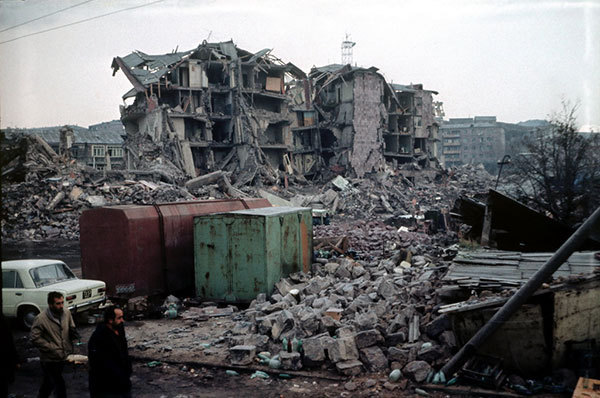
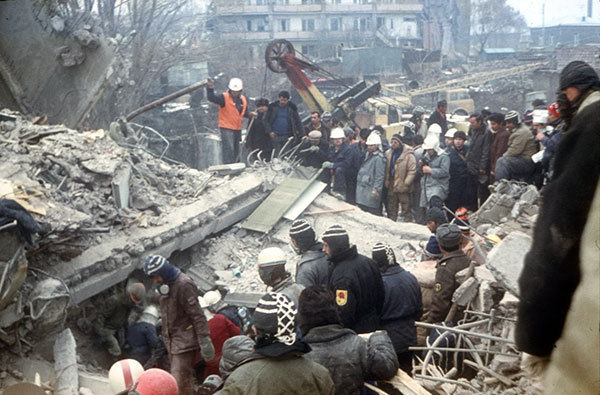
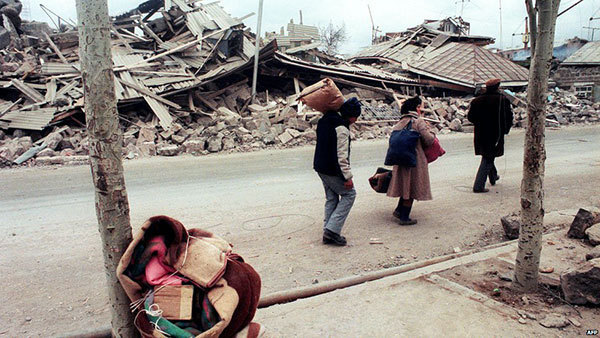
The UAF was formed shortly after the devastating 1988 earthquake in Armenia to provide much needed humanitarian aid to the destitute survivors in the earthquake zone. But, after the collapse of the Soviet Union and the blockade of Armenia by Turkey and Azerbaijan, the UAF decided to expand its mission to include the entire population of Armenia and Artsakh.

Over the years the UAF acquired, shipped and distributed all types of relief supplies, including medicines and medical equipment, agricultural equipment, seeds, computers, books, toys, winter clothing and shoes to hospitals, clinics, schools, orphanages, and hundreds of charitable organizations throughout Armenia and Artsakh.

The UAF Board of Directors thanked the many generous donors who contributed large quantities of vital goods and supplies to the UAF ever since 1989. The Board also commended the UAF staff—President Harut Sassounian and Administrative Assistant Nouritza Abujamra—for their dedicated service to the organization and the needs of the people in Armenia and Artsakah.

In the past 26 years, the UAF has delivered to Armenia and Artsakh a total of $720 million worth of relief supplies on board 159 airlifts and 2,260 sea containers.

The UAF is the collective effort of the Armenian General Benevolent Union, Armenian Missionary Association of America, Armenian Relief Society, Diocese of he Armenian Church of America, and the Prelacy of the Armenian Apostolic Church.

Source: Eastern Prelacy’s Crossroads E-Newsletter

THE SPITAK EARTHQUAKE

THIS WEEK IN ARMENIAN HISTORY
(Prepared by the Armenian National Education Committee)

[ANEC]


The Spitak Earthquake

(December 7, 1988)

Earthquakes have frequently hit Armenia throughout history. Soviet Armenia had three major quakes in the first fifty years of existence in Leninakan (1926) and Zangezur (1931 and 1968). The fourth earthquake would be the worst, prompting a global effort for relief that remained unprecedented in the history of the former Soviet Union.

The seismic movement in the northern region of the Republic of Armenia occurred on Wednesday, December 7, 1988 at 11:41 am local time (2:41 am in the U.S. East Coast). The earthquake measured 6.8 on the surface wave magnitude scale. It was coincidental with the political turmoil that had been produced by the Karabagh movement since February 1988. In November of the same year, tens of thousands of Armenian refugees had arrived from Azerbaijan, and an unknown number of them had settled in the seismic area.SBidag1

The cities of Spitak, Leninakan (nowadays Gyumri), and Kirovakan (nowadays Vanadzor) were greatly affected with large loss of life and devastating effects to buildings and other structures. Smaller outlying villages away from the big cities were also severely affected. Leninakan and Kirovakan were the second and third cities of Armenia by population.

Some of the strongest shaking occurred in industrial areas with chemical and food processing plants, electrical substations, and power plants. The nuclear power plant of Metzamor, 47 miles from the epicenter, did not experience damage, but vulnerability concerns triggered its shutdown from February 1989 until 1995.

Many buildings did not hold up to the shaking of the earthquake and just came down like houses of cards. A saying in Leninakan at the time made reference to the resistance of old buildings from pre-Soviet time: “Leninakan went away, Gyumri remained.” The scrutiny by earthquake engineering experts found fault in the substandard quality of construction during the period of Leonid Brezhnev (1964-1982). Lack of effective medical care and poor planning also contributed to the substantial scope of the disaster. Most hospitals collapsed, killing two-thirds of the doctors, destroying equipment and medicine, and reducing the capacity to handle the critical medical needs in the region.Sbidag2

Soviet leader Mikhail Gorbachev, who was in New York on his first day of official visits with President Ronald Reagan and Vice President George H. W. Bush at the time of the earthquake, formally asked the United States for humanitarian help within a few days of the earthquake, the first such request since World War II. One hundred and thirteen countries sent substantial amounts of humanitarian aid to the Soviet Union in the form of rescue equipment, search teams, and medical supplies, but private donations and assistance from non-governmental organizations also had a large part of the international effort.

A group of French recording artists and actors came together with French Armenian writer and composer Charles Aznavour to record the 1989 song “Pour toi Arménie” (For you Armenia), with lyrics and music by Aznavour himself, as a call for help for the Armenians. Aznavour, together with his brother-in-law, French Armenian composer Georges Garvarentz, formed a foundation called “Aznavour for Armenia.” Almost two million copies of the disc were sold, which allowed the foundation to build 47 schools and three orphanages for the victims of the disaster.Sbidag3

As of July 1989 about $500 million in donations had been delivered to the Armenians from 113 countries. Most of those funds went into the initial relief work and medical care plus the beginning portion of the rebuilding phase. Yuri S. Mkhitarian, an Armenian State Building Committee official, gave an updated damage report that stated that 342 villages had been damaged and another 58 destroyed. One hundred and thirty factories had been destroyed and 170,000 people were out of work. Officials acknowledged that the work to complete the rebuilding may take up to five years or longer, a supposition that more than doubled Gorbachev’s estimate of two years.

The number of victims of the earthquake was officially given as 25,000, even though there were estimates of up to 100,000. The material and moral impact of the earthquake was long-term. The collapse of the Soviet Union and the second independence of Armenia (1991), including the economic crisis and the Kharabagh war, became a hurdle to complete the efforts of reconstruction. Rebuilding in major cities and villages was completed after years, and still there were people living in makeshift homes twenty-five years after the earthquake.

A bronze sculpture by Frederic Sogoyan, “Armenian Earthquake,” which expresses Armenian gratitude for the aid provided after the catastrophe, was dedicated on March 1991 on the north lawn of the American Red Cross national headquarters in Washington D.C. The inscription reads: “To the American people / from a grateful / Armenian people / Earthquake assistance / December 7, 1988.”


THIS WEEK IN ARMENIAN HISTORY
(Prepared by the Armenian National Education Committee)

[ANEC]


Death of Maghakia Ormanian
(November 19, 1918)

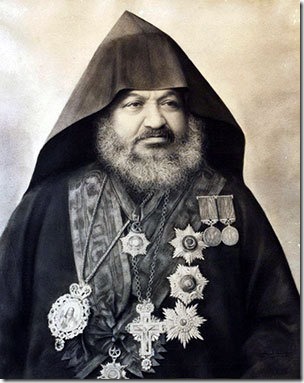
 Archbishop Maghakia Ormanian was a remarkable figure of the Armenian Church in turbulent times at the end of the nineteenth and beginning of the twentieth century.
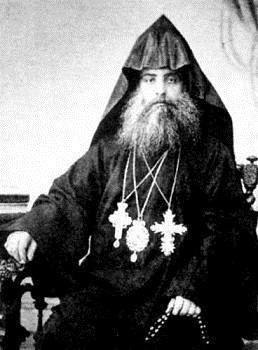
Boghos Ormanian was born on February 23, 1841 in Constantinople. After learning the first letters, in 1851 he was sent to Rome, where he pursued studies at the convent of St. Gregory, belonging to the Antonine Congregation, and then at the Vatican. He returned to Constantinople in 1866 and became secretary of the Antonine Congregation, while a year later he was designated principal of the Antonine School in Rome. In 1868 he obtained a master degree in philosophy, theology, and Church law, and became a member of the Theological Academy of Rome, as well as teacher of Armenian at the College of the Propaganda Fide.

Meanwhile, an acute conflict had started within the Armenian Catholic community as a result of the bulla Reversurus, promulgated by Pope Pius IX in 1867, which made dramatic changes in the traditions with which Armenians were familiar. The conflict was around the figure of Andon Hassoun, Armenian Catholic archbishop-primate of Constantinople, who was consecrated Armenian Catholic Patriarch of Cilicia by the Pope in 1867, with residence in Constantinople.

Ormanian took position with the anti-Hassoun camp, and returned to Constantinople in 1870, where he published numerous commentaries in French and Armenians newspapers against the Vatican policy, as well as several books in Italian and French, which in 1874 were included in the Index (the catalog of forbidden books) of the Vatican.

Maghakia (Malachai) Ormanian

Maghakia (Malachai) Ormanian

In 1876 Ormanian decided to sever his links with the Catholic Church and renounce to Catholicism, and the following year he applied to Archbishop Nerses Varjabedian, Armenian Patriarch of Constantinople, asking to return to the Armenian Apostolic Church. In 1879 he received the grade of archimandrite superior (dzayrakooyn vartabed)of the Armenian Apostolic Church from the Patriarch in a ceremony at the cathedral of Kum-Kapu, in Constantinople.

After a short stint as preacher at the church of St. Gregory the Illuminator in the neighborhood of Galatia, in 1880 he was designated prelate of the diocese of Garin (Erzerum) and had an important role in the opening of the Sanasarian School of Erzerum in 1881. He also established links with the leaders of the secret organization “Defenders of the Fatherland,” founded in the same year. After his consecration as bishop by Catholicos of All Armenians Magar I in 1886, a year later he left the diocese of Garin and was invited to Holy Echmiadzin as lecturer of Theology at the Kevorkian Seminary. Among his students were future luminaries of the Armenian Church and culture, such as Gomidas Vartabed, Karekin I Hovsepiants, Karapet Ter-Mkrtichian, Yervant Ter-Minasian, and others. His teaching made an impact in the seminary.

His liberal views attracted the attention of the Russian authorities and, under the pretext of not being a Russian citizen, he was expelled from the Russian Empire in 1889. He returned to Constantinople and was named abbot of the monastery of Armash and director of the newly founded seminary.

On November 19, 1896 Ormanian, already an archbishop, was elected Armenian Patriarch of Constantinople. He succeeded Abp. Mateos Izmirlian (1894-1896), labeled the “Iron Patriarch” for his energetic protests against the Armenian massacres of 1894-1896. For this reason, he has been forced to resign by the Turkish authorities, which had exiled him to Egypt.

Ormanian adopted a conciliatory attitude towards the “Red Sultan” Abdul Hamid II, in order to avoid further massacres and create a more or less tolerable situation in the years of tyranny. His conservative policies alienated part of the Armenian constituency, and shortly after the Ottoman Revolution of 1908, a huge Armenian demonstration invaded the offices of the Armenian Patriarchate on July 16, 1908 and declared Ormanian’s dismissal from his position. The former Patriarch, in a book published in 1910, rebutted charges that he had been unreceptive to national problems and a knee-jerk to the Sultan, as well as a dictator in the management of community issues. The National Representative Assembly vindicated the former Patriarch in its session of January 3, 1913.

Ormanian was elected delegate of the Church convention and member of the Religious Council in 1913, as well as prelate of the diocese of Egypt, but he rejected this position. He took various positions in the monastery of St. James, in Jerusalem, from 1914-1917, and also taught at the seminary. He returned to Constantinople in 1918 and passed away on November 19, on the twenty-second anniversary of his election as Patriarch.

Archbishop Maghakia Ormanian was, along with his long administrative and teaching career in the Church, an accomplished scholar. He was the author of the monumental Azkabadoom (National History, 1910-1911 and 1927), a three-volume history of the Armenian nation based on the history of the Armenian Church, and The Armenian Church (1910, in French; 1911, in English, also translated into Armenian), a fundamental text on the doctrine, history, and administrative situation of the Armenian Apostolic Church on the eve of the Armenian Genocide, among many other works.

BIRTH OF MICHAEL ARLEN

THIS WEEK IN ARMENIAN HISTORY
(Prepared by the Armenian National Education Committee)

[ANEC]


Birth of Michael Arlen

(November 16, 1895)


Michael Arlen was one of the stars of English literature in the 1920s, but he was also a controversial name within the Armenian diaspora. His position regarding Armenian reality was frequently contrasted with that of another writer across the pond, who would shine in the 1930s: William Saroyan.


He was born Dikran Kouyoumdjian on November 16, 1895 in Rustchuk (Bulgaria), now Ruse. He was the youngest child of five to an Armenian merchant family that had initially settled in Plovdiv in 1892, where his father had established a successful import business. The family moved again, this time to England, in 1901, and settled in the seaside town of Southport.


Young Dikran attended Malvern College, and in 1913 enrolled at the University of Edinburgh, in Scotland, as a medical student. However, both he and his family intended that he would go to Oxford. In his first book, The London Venture, Arlen wrote: “I, up at Edinburgh, was on the high road to general fecklessness. I only stayed there a few months; jumbled months of elementary medicine, political economy, metaphysics, theosophy–I once handed round programs at an Annie Besant lecture at the Usher Hall–and beer, lots of beer. And then, one night, I emptied my last mug, and with another side-glance at Oxford, came down to London; ‘to take up a literary career’ my biographer will no doubt write of me.”


His literary career actually started in 1916. He contributed regularly under his birth name to the Armenian monthly Ararat, published in London between 1913 and 1919, where he wrote essays and book reviews about Armenian issues. He also published essays and literary pieces in the British weekly The New Age. He assembled some personal essays from the latter and published it as The London Venture in 1920 with the pen name Michael Arlen, which he adopted as his legal name when he naturalized as a British citizen in 1922.


Michael Arlen

Michael Arlen

After this book, he worked on collections of short stories, including The Romantic Lady (1921), Piracy: A Romantic Chronicle of These Days (1922), and These Charming People (1923). They culminated into the book that would launch Arlen’s fame and fortune in the 1920s: The Green Hat (1924). This novel narrates the short life and violent death of femme fatale and dashing widow Iris Storm, owner of the hat of the title and a yellow Hispano Suiza car. Arlen became almost instantly famous, rich, and incessantly in the spotlight. He frequently traveled to the United States and worked on plays and films. The Green Hat was adapted into Broadway and London’s West End plays, and a silent Hollywood film starring Greta Garbo and John Gilbert in 1928. The novel was considered provocative in the United States; the movie was therefore dubbed A Woman of Affairs. It was adapted again in 1934 for a sound movie, Outcast Lady, with Constance Bennett and Herbert Marshall in the main roles.


Arlen published Young Men in Love (1927), but it received mixed reviews, the same as the next books: Lily Christine (1928), Babes in the Wood (1929), and Men Dislike Women (1931). He moved to Cannes (France), where he married Greek Countess Atalanta Mercati. They had two children, Michael John (1930), the author of the celebrated memoir Passage to Ararat, and Venetia Arlen (1933).


His immaculate manners invariably impressed everyone. He was always impeccably dressed and groomed, and drove around London in a fashionable yellow Rolls Royce, engaging in all kinds of luxurious activities. His success was viewed by some with envy, mixed with latent suspicion for foreigners. Another popular author of the time, Sydney Horler, is said to have called Arlen “the only Armenian who never tried to sell me a carpet.”


Arlen made occasional references to Armenians (he gave a speech in 1925 to the Armenian Cultural Foundation in New York) in the 1920s, but run in trouble after an essay published in Babes in the Wood, “Confessions of a Naturalized Englishman.” Many pieces published in the Armenian press criticized his seemingly anti-Armenian stance.


He would never be able to make a comeback into the literary fame that The Green Hat had brought to him. He ventured into science fiction with Man’s Mortality (1933) and into gothic horror with Hell! Said the Duchess: A Bed-Time Story (1934), and briefly returned to his earlier romantic style in his final collection of short stories, The Crooked Coronet (1939), but did not have much success.


His final novel, The Flying Dutchman (1939), was released coincidentally with the outbreak of World War II. He returned to England to contribute to the war effort. He was appointed as an information officer for Civil Defense in 1940, but when his loyalty to England was questioned in 1941, he resigned and returned to America. He moved to New York in 1945, but he suffered from writer’s block for the rest of his life. He died of lung cancer on June 23, 1956 in New York.


MARIA JACOBSEN

THIS WEEK IN ARMENIAN HISTORY
(Prepared by the Armenian National Education Committee)

[ANEC]


Birth of Maria Jacobsen
(November 6, 1882)

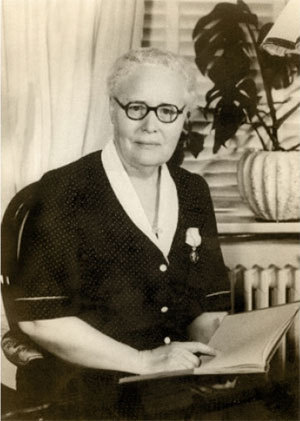
Maria Jacobsen in 1910

Maria Jacobsen in 1910

     Maria Jacobsen was a key witness of the Armenian Genocide. She belonged to a group of missionaries of different nationalities who had been active since the years before in various areas of Armenian population and continued their work for years, helping victims and survivors with their humanitarian efforts.

    Jacobsen was born in Denmark, in the town of Siim, near Ry, on November 6, 1882. She lived in Horsens with her parents. She learned about the Hamidian massacres of 1894-1896 through the Danish media. Feminist activist Jessie Penn-Lewis arrived in Denmark from England in 1898 and helped form the Women’s Missionary Workers (Kvindelige Missions Arbejdere, K.M.A.) two years later. Young Maria soon partook in the efforts to support and provide relief to orphans in the eastern provinces of the Ottoman Empire. In 1907, at the age of twenty-five, she departed to Constantinople with American missionaries, and then left for Kharpert, where she worked at the Armenian hospital. She also developed charitable activities in Malatia, Aintab, and other cities.

     After a two-years sojourn in Denmark from 1912-1914 with a charity mission, she returned to Kharpert on the eve of 1915 and became a witness of the Turkish atrocities and the deportation of the Armenians.

     Maria Jacobsen kept a diary in Danish from 1907-1919, which became a valuable source to document the day-to-day unfolding of the Turkish anti-Armenian policy. In a diary entry on June 26, 1915 regarding the deportations, she stated: “It is quite obvious that the purpose of their departure is the extermination of the Armenian people.” She added: “Conditions now are completely different from what they were during the massacres of 20 years ago. What could be done then is impossible now. The Turks know very well about the war raging in Europe, and that the Christian nations are too busy to take care of Armenians, so they take advantage of the times to destroy their ‘enemies.’”

     Jacobsen adopted three children during this period. The first, Hansa, had fled the Bedouin family to which she had been sold, and was hiding in a tree until she became unconscious from sickness and fell. A Turk police officer and Jacobsen found her, and the Danish missionary chose to adopt her on the spot. The second child was Beatrice, and the third was Lilly, who she had found on the side of the road.

Maria Jacobsen

Maria Jacobsen

     In 1919 Maria Jacobson left the Ottoman Empire after contracting typhus from the orphans. She first went to Denmark and then to the United States, where she gave a series of lectures and speeches on the plight of the Armenian people, and the massacres that they had undergone, and raised money for the orphans.

    The Kemalist government prohibited the activities of all foreign missionaries, and in 1922, Jacobsen went to Beirut, where she continued to gather and care for the orphans. In July 1922, after moving to Saida, she helped establish an orphanage which sheltered 208 Armenian orphans. The Women’s Missionary Workers (K.M.A.) acquired in 1928 an orphanage previously owned by the Near East Relief, located in Jbeil, where Jacobsen moved with her orphans and would be known as Bird’s Nest (Terchnots Pooyn, in Armenian). She would be known to the orphans as “Mama.”

     Jacobsen was also fluent in Armenian, and often read the Bible to the orphans in their mother language. She married an Armenian dentist. She became the first woman to receive the Gold Medal Award of the Kingdom of Denmark in 1950 for her humanitarian work. Four years later, on December 14, 1954, she was awarded the Gold Medal of Honor by the government of Lebanon on her 50th jubilee celebration for her service and dedication to the Armenian community.

     Maria Jacobsen passed away on 6 April 1960 and, according to her will, was buried in the courtyard of Birds’ Nest. Part of her archives were deposited in the Armenian Genocide Museum-Institute in 2010. Her diary was first published in a bilingual Danish-Armenian edition in 1979 by Archbishop Nerses Pakhdigian and Mihran Simonian, and years later, an English translation was published by the Gomidas Institute.


THE DREAM MUST BE CONTINUED

“The Dream Must be Continued”

Richard Hovanissian on Genocide and Denial

at Marquette Law School

By David Luhrssen


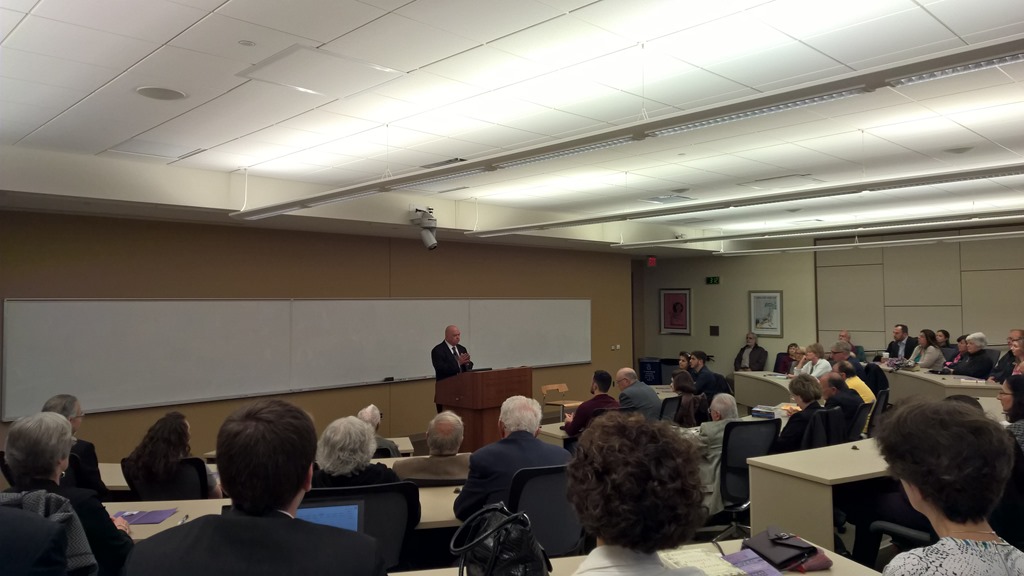
(Milwaukee, Wis.) Prof. Richard Hovanissian opened his Oct. 18, 2015, talk at Marquette University Law School by reflecting on this year’s centennial observation of the Armenian Genocide. The UCLA professor emeritus commented on the amount of good press and academic conferences the Armenian cause received in 2015, Pope Francis’ proclamation, and the unity shown by the Armenian community. But the events of a century ago and their ongoing implications, rather than the commemoration, were the primary subject of his talk. The event, sponsored by the Wisconsin Armenian Genocide Centenary Committee, drew an overflow audience.


Speaking extemporaneously from a deep well of emotion as he articulated the horror of the Genocide, Hovanissian recounted memories of growing up in California as the child of survivors. When he began his academic career he had no thought of becoming one of America’s foremost authorities on the Genocide and focused instead on Armenia’s First Republic. “I backed into this field because my father was called a liar,” Hovanissian said, referring to his work of refuting Genocide deniers. He denounced the Turkish Coalition of America, funded by a Turkish-American industrialist, for “expending millions of dollars to silence the Armenian case. It may be discouraging but one doesn’t stop. The dream must be continued.”


Hovanissian asked the question: “What have we learned after 100 years?” He began his answer by citing “utter admiration” for the resilience shown by the survivors. “After seeing such cruelty, how could they ever sing and dance and joke again? But most did recover and recreated an existence—a new space.”


The initial strategy of the Kemalists, not to deny as much as prevent discussion, crumbled after 1965 when Armenians from around the world from Yerevan to New York, took to the streets in protest on the 50th anniversary of the Genocide. He added that the trial of Holocaust mastermind Adolf Eichmann “opened the door. The Holocaust is now not just part of Jewish history but part of human history. The Armenian Genocide should be remembered as the prototype for the mass killings of the 20th century. It set the model.”

Prof. Richard Hovanissian speaks at Marquette University Law School

Prof. Richard Hovanissian speaks at Marquette University Law School


Hovanissian suggested ideology and technology as the causes of such mass killings. In the case of the Genocide, the ideology was the extreme nationalism of Turkism and the technology was the telegraph, which allowed Talaat Pasha to wire instructions to subordinates across the Ottoman Empire and to expect detailed reports in return. The outbreak of World War I gave the Turkish regime its opportunity. Without the cover of war, Hovanissian suggested, the Genocide might never have occurred.


He added that in every story he has collected of Genocide survivors, “there was a good Turk, or a good Muslim, who sheltered Armenian victims.”


Although the war against the memory of the Genocide continues to be waged by the present Turkish government and its lobbyists, Hovanissian sees reason for optimism. “There is a crack in the wall,” he said. “Young Turkish intellectuals are challenging the official narrative and using the ‘G’ word, which even the President of the United States is afraid to use.”

THIS WEEK IN ARMENIAN HISTORY
(Prepared by the Armenian National Education Committee)

[ANEC]


Terrorist attack on the National Assembly of Armenia

(October 27, 1999)

The election of Karekin II as Catholicos of All Armenians had just been held on October 27, 1999 in the afternoon when the news of a terrorist attack on the building of the National Assembly in Yerevan came to Holy Echmiadzin.


At around 5:15 p.m., five men led by journalist Nairi Hunanyan, armed with AK-47 assault rifles hidden under long coats, stormed into the building while the government was holding a question-and-answer session. The group included Hunanyan’s brother Karen and uncle Vram, as well as Derenik Bejanyan and Eduard Grigoryan.


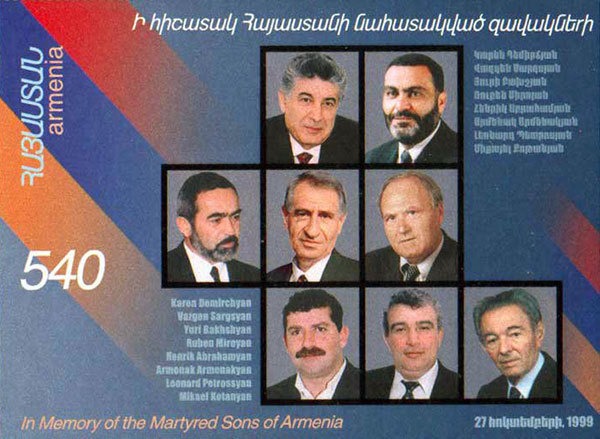
The main target was Prime Minister Vazgen Sargsyan (1959-1999). According to reporters who witnessed the shooting, the men went up to Sargsyan and said, “Enough of drinking our blood,” to which he calmly responded, “Everything is being done for you and the future of your children.” The Prime Minister was shot point blank several times. Seven other people were also shot dead. The list included National Assembly Speaker Karen Demirchyan and two Deputy Speakers, Yuri Bakhsyan and Ruben Miroyan; Minister of Emergency Affairs Leonard Petrosyan, and MPs Henrik Abrahamyan, Armenak Armenakyan, and Mikayel Kostanyan. Some 30 people were injured.


The group claimed they were carrying out a coup d’état in a “patriotic” act. They claimed that Armenia was in a “catastrophic situation” and that “corrupt officials” were not doing anything to find a way out. The gunmen held around 50 hostages inside the building, surrounded by policemen and army forces personnel positioned on Baghramyan Avenue. After overnight negotiations with President Robert Kocharian, the gunmen released the hostages and, after a standoff that lasted 17-18 hours, they gave themselves up on the morning of October 28.


President Kocharian declared a three-day mourning period.  The state funeral ceremony for the victims of the parliament shooting took place from 30-31 October 1999. Their bodies were placed inside the Yerevan Opera Theater, with high-ranking officials from some 30 countries attending the funeral.


According to a poll carried out by the Center for Sociological Studies of the National Academy of Sciences on October 30-31, 56.9% of respondents said that the October 27 events were a crime against statehood and the country’s authorities, and 63.4% believed that the terrorist group consisted of assassins–traitors and enemies.


Armenian American journalist Garin Hovannisian described the aftermath of the attack in the following terms: “For weeks the Armenians mourned in silence, but from their grief a startling theory began to evolve. The assassinations had been pinned on the terrorist leader, an ex-journalist named Nairi Hunanyan, but the public was not satisfied. The fact was that Prime Minister Sargsyan and Speaker Demirchyan had recently created in parliament an alliance for democratic reform, and they were the only men who commanded the resources and popularity to challenge the president one day. Of course, there was no actual evidence that Robert Kocharyan was complicit in this monstrous crime against the Armenian people, but it was clear that he emerged from the bloodbath with absolute power.”

A stamp commemorating the victims of the terrorist attack on the Armenian Parliament on October 27, 1999 issued by the Republic of Armenia in 2000.

A stamp commemorating the victims of the terrorist attack on the Armenian Parliament on October 27, 1999 issued by the Republic of Armenia in 2000.


From early June to late October 1999, the Unity alliance forged by Demirchan and Sargsyan, which controlled the military and the legislative and executive branches, had become the pillar of the political system in Armenia. Their murder disrupted the balance of power and the political arena was left in disarray for months. The assassination hit Armenia’s international reputation and resulted in a decline in foreign investment. Political power was transferred to President Kocharyan.


The motives behind the attack were never fully explained. While the gunmen claimed to have acted on their own initiative, no convincing evidence was disclosed to suggest that any political leader or party was behind the attack, although abundant conspiracy theories flourished to prove that there had been a sabotage of a Karabagh peace deal. Aram Sargsyan, who briefly succeeded his elder brother Vazgen as Prime Minister from 1999-2000, stated in March 2013 that, “I have never accused this or the former authorities in being responsible for October 27. I have accused them in not fully disclosing October 27.”


The five men were charged with terrorism aimed at undermining authority on October 29. The investigation was led by Chief Military Prosecutor Gagik Jhangiryan. At its end, the case was sent to court on July 12, 2000. The trial began on February 15, 2001, in Yerevan’s Kentron and Nork-Marash District Court. The judicial case was transferred to the jurisdiction of Prosecutor General Aghvan Hovsepyan and his office, which finally closed the case for lack of evidence. Nairi Hunanyan and his co-conspirators were sentenced to life in prison on December 2, 2003.

DEATH OF SAYAT-NOVA

THIS WEEK IN ARMENIAN HISTORY
(Prepared by the Armenian National Education Committee)

[ANEC]


Death of Sayat-Nova
(September 22, 1795)


For almost three centuries, the songs composed by troubadour Sayat-Nova have been among the favorites of the Armenian people. Despite being written in the dialect of Tiflis, with a mix of Turkish, Persian, and Arabic, their lyrics have always spoken to the heart of the listener.


Sayat-Nova’s life is involved in a cloud of mystery. It has been reconstructed to a certain level by the work of several generations of scholars, but there are many details that are still a matter of controversy.


It has been traditionally held that Sayat-Nova was born in Tiflis, the capital of the kingdom of Georgia, in 1712, and the 250th anniversary of his birth was celebrated throughout the Armenian world with great pomp in 1962. However, poet and scholar Paruyr Sevak was the first to demonstrate in his doctoral dissertation defended in 1966 and published in 1969 that there were more than enough grounds to date the poet’s birth in 1722.


Most likely, Sayat-Nova’s ancestors were born in Cilicia, and the birthplace of his father was either Adana or Aleppo. The future poet and troubadour spent his childhood and youth in Tiflis, his birthplace, where he learned to write and read Armenian and Georgian, and he also knew the Arabic alphabet.


At the age of 12 he became an apprentice of weaving and in a short time became a very capable weaver. However, his actual love was songs and music, perhaps influenced by his parents.


Sayat-Nova perfected himself in the art of the ashugh (troubadours) until the age of 30. He learned melodies and different metrics. At the same time, he created poems, which he interpreted during popular gatherings. It is likely that he traveled through the Near East and visited Persia, India, and the Ottoman Empire. He later was acknowledged as a poet-singer and baptized with the name of Sayat-Nova (from Persian, meaning “hunter of songs”).


Sayat Nova wrote in three languages: Armenian, Georgian, and (Azerbaijani) Turkish. More than 230 of his poems have reached us, which were collected in manuscript books that he wrote by his own hand or that his son Ohan compiled and copied, in various collections of folklore, or remained in the memory of the people and were gradually written down and published.


The earliest poem is dated 1742, even though there may be earlier compositions. The last poem was the famous “The World is a Window…” («Աշխարըս մե փանջարա է…»), written in April 1759. Sayat-Nova was the first who created and sang Georgian poems using the motifs of Persian poetry. This innovation was well received and he was appointed musician in the court of King Irakli II of Kakheti (one of the Georgian kingdoms). For some ten years the poet was in the court and produced some of his best works in this period. His poems spoke of justice and nobility, condemned deceit and villainy, and social and moral flaws. His love poetry expressed the most delicate and sacred feelings with images that were unusual.

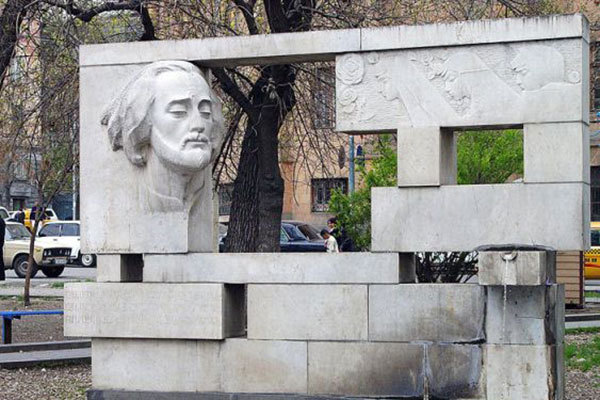
The monument to Sayat Nova in central Yerevan.

The monument to Sayat Nova in central Yerevan.


His life was not peaceful. There were conspiracies against him and he was expelled from the palace at least twice, in 1753 and 1759. The last one was the final, and his life as poet, composer, and musician ended there, at the age of 37. He would still live for more than three decades.


In 1759 Irakli II forced him to become a priest, with the name of Der Stepanos, and he was sent to the port of Enzeli (Persia), on the southern shore of the Caspian Sea. He “repented” here and copied the poem Book of Lamentations, by Gregory of Narek, in 1760. In 1766 he was a priest in the small town of Kakhi, on the road from Zakatala to Shamakhi, where he copied another manuscript, a compilation of biblical fragments. Both manuscripts are kept today in the Matenadaran of Yerevan.


Sayat-Nova’s wife, Marmar, passed away in 1768 and left four small children (Hovhannes or Ohan, Melkiset, Sarah, and Mariam). In 1768 or 1769 Der Stepanos, the former Sayat-Nova, moved to Tiflis, where he served in the prelacy of the congregation of Haghbat, which had settled in the Georgian city. In 1778, when the monastery of Haghbat was rebuilt, he was designated sacristan of the church of Surp Nshan. He returned to Tiflis with the congregation later, probably in 1784.


On September 22, 1795, during the Afghan invasion of Georgia, led by Agha-Mahmad Kajar, Sayat-Nova was killed when he refused to renege his religion. He was buried in the courtyard of the church of Surp Kevork. There, by initiative of poet Hovhannes Tumanian, the memory of Sayat-Nova has been observed since 1914 every May with popular festivities.


MASSACRE OF BAKU

THIS WEEK IN ARMENIAN HISTORY

(Prepared by the Armenian National Education Committee (ANEC)


Massacre of Baku
(September 14-15, 1918)


At the beginning of the twentieth century, Baku was, after Tiflis, the second Armenian city of the Caucasus. By the end of the same century, the Armenian population of the city had been practically wiped out.

One of the chapters of that ethnic cleansing was the massacre of September 1918. While the Third Ottoman Army Corps was stopped in its advance in the battles of May 1918 that allowed Armenia to become an independent state, the Second Army Corps continued its advance through the line Gharakilise-Dilijan-Ghazakh (Ijevan)-Elizavetpol (Gandzak, Ganja) towards Baku.


Azerbaijan had proclaimed its independence on May 27, 1918 with Elizavetpol as its capital. Baku, the richest city in the country with its oil fields, had been governed since April 1918 by a Soviet (council) led by Bolshevik Stepan Shahumian. The Baku Soviet collaborated with the local branch of the Armenian Revolutionary Federation to establish control over the city and its environs. While the Bolsheviks had the revolution in mind, the Armenians were primarily concerned with physical survival. However, by the beginning of summer, the Soviet found itself under increased threat by the Ottoman army, which had been enthusiastically received by the newly created Azerbaijani government, presided by M. Fatali Khan-Khoyski. Both sides clashed in June and July, but the joint Ottoman-Azerbaijani offensive could not be stopped by the forces loyal to the Baku Soviet, which, with no promise of material support from Moscow, was forced to turn to a British expeditionary force stationed in Persia under the command of Major-General Lionel C. Dunsterville. Although Shahumian had been ordered by Moscow to deny entry to the British, he was overruled by his peers in the Soviet, which formally requested help in late July. On July 31 Shahumian and the other Bolshevik members resigned from their posts and the Centro-Caspian Dictatorship assumed control of the city.


The size of the British force, however, proved to be too small to make much of an impact. In August, the Ottoman military, led by the so-called Army of Islam headed by Nuri Pasha (Ottoman War Minister Enver Pasha’s half-brother), launched a new assault against the frontline positions, which were primarily manned by Armenians, who were forced to retreat despite some initial victories. In the first week of September, a joint Ottoman-Azerbaijani force composed of 15,000 men advanced without much resistance toward Baku and reached the suburbs by September 13. Meanwhile, the Muslim population of Baku prepared to welcome the entry of the Ottoman army. The Armenian troops were too ill-prepared to halt the advance and Dunsterville refused to retain his force, which evacuated from Baku on September 14 and sailed to Enzeli, in Persia, leaving the city virtually defenseless.


A terrible panic ensued once the invaders entered Baku. The Armenians crowded the harbor in a frantic effort to escape the fate that they knew very well. Regular Ottoman troops were not allowed to enter the city for two days, so that the local irregulars (bashibozuks) would conduct the usual looting and pillaging. Despite this order, regular Ottoman troops participated alongside the irregulars and the Azeris of Baku in the plundering, and then turned their fury against the Armenian population. Calls by German officers attached to the Ottoman command staff to treat the local population with leniency were ignored.

Massacre of Baku

Armenians fleeing the massacre through the Azerbaijani countryside.


On September 16, the Ottoman divisions formally entered the city in a victory parade reviewed by the Ottoman High Command. Baku would subsequently be proclaimed as the capital of the newly established Azerbaijani Republic.


According to a special commission formed by the Armenian National Council of Baku, a total of 8,988 Armenians were massacred, among which were 5,248 Armenian inhabitants, 1,500 Armenian refugees from other areas of the Caucasus, and 2,240 Armenians whose corpses were found in the streets but remained unidentified. Other estimates range up to 30,000 people.

PAUL CHATER

THIS WEEK IN ARMENIAN HISTORY
(Prepared by the Armenian National Education Committee)

[ANEC]


Birth of Paul Chater

(September 8, 1846)

Sir Paul Chater is regarded as the man who placed the footprint of Hong Kong down and allowed the city to become one of the leading economies of the world today. In 1902 he represented Hong Kong at the coronation of King Edward VII of England, even though he was neither Chinese nor even born in Hong Kong.


Catchick Paul Chater was born Khachik Poghos Astvatzatoor (Khachik Pogose Astwachatoor) in Calcutta (now Kolkata), India, on September 8, 1846. He was one of the thirteen children of Chater Paul and Miriam Chater. His father was a member of the Indian civil service.


The young Khachik, orphaned at the age of seven, entered La Martiniere College. In the early 1910s he would become a benefactor of the desperately struggling school by making his single biggest donation to any institution or organization while still alive. It allowed his alma mater to avoid certain closure.


Chater moved in 1864 to Hong Kong and lived with the family of his sister Anna and sister’s husband Jordan Paul Jordan. He was an assistant at the Bank of Hindustan, China, and Japan. Later, with the aid of the Sassoon family, he set up business as an exchange broker, resigned from the bank, and traded gold bullion and land on his own account. He took sea-bed soundings at night and was thus instrumental in the reclamation of Victoria Harbour. He is credited with a fundamental role in the colonial government’s success in acquiring lands then held by the military.


In 1868 he and Sir Hormusjee Naorojee Mody formed Chater & Mody, a largely successful business partnership in Hong Kong. In 1886 Chater entered the Legislative Council, taking the place of another Armenian, F. D. Sassoon. In 1889 he partnered with James Johnstone Kewsick to establish Hong Kong Land. The following year, the company commenced the land reclamation project under the Praya Reclamation Scheme. They secretly acquired an old graveyard, where they built one of the earliest electricity power stations in the world. The Hong Kong Electric Company went into production with Chater’s help as an informal member of the Executive Council of Hong Kong. He was appointed to the Council in 1896 and served until 1926.


Chater was knighted in 1902. The year before, he had built a very fine home with imported European marble, which he named Marble Hall. He housed there his collection of fine porcelain. In 1904 Chater financed the construction of St. Andrew’s Church.

PAUL CHATER

PAUL CHATER


The Armenian businessman held many titles and positions, including those of senior justice in Hong Kong and consul for the kingdom of Siam (Thailand).


Chater died on May 27, 1926 and bequeathed Marble Hall and its entire contents, including his unique collection of porcelain and paintings, to Hong Kong. The remainder of his estate, besides generous bequests to nephews and members of his family, went to the Armenian Church of the Holy Nazareth in Calcutta, which runs a home for Armenian elderly, named The Sir Catchick Paul Chater Home. He was interred at the Hong Kong cemetery.


His wife lived in Marble Hall as a life tenant until her death in 1935. Ownership then passed to the government. It became the official residence of the naval commander-in-chief, and was commandeered by the Japanese during their occupation. It accidentally burned down in 1946, and government buildings occupied the site since its demolition in 1953. Government residences named “Chater Hall Flats” are today located on the site of Marble Hall.


Chater gifted to Hong Kong his large collection of historical pictures and engravings relating to China (430 pieces). The Chater Collection was dispersed and largely destroyed during the Japanese occupation, and only 94 pieces, now at the Hong Kong Museum of Art, are known to have survived.


His name is also preserved in other places of Hong Kong, such as Chater Road, Catchick Street, Chater House, and Chater Garden. In 2009 the company he cofounded, Hong Kong Land, commissioned a bust of him on the 120th anniversary of its foundation, which is permanently displayed in Chater House.