THIS WEEK IN ARMENIAN HISTORY
Prepared by

the Armenian National Education Committee (ANEC)

The Battle of Arara, on September 19, 1918, was the most remarkable performance of the Armenian Legion. Initially named Légion d’Orient (Eastern Legion), the Armenian Legion was formed in November 1916 as the result of an agreement between Boghos Nubar Pasha, president of the Armenian National Delegation, and the French government. It would be a foreign legion unit within the French army, originally formed by Armenians and Syrians of Ottoman nationality, under the command of French officers.

            The aim of creating the Legion was to allow Armenians to contribute to the liberation of Cilicia and to help them realize their national aspirations towards the creation of a state in that region, under Ottoman domination. The Legion was to fight only Turks and only in Cilicia.

            Six battalions were formed, each containing 800 volunteers. Most soldiers were recruited from the survivors of the self-defense of Musa Dagh in 1915, living in refugee camps in Port Saaid, Egypt. Others were volunteers who came from France, the United States, and even South America.

            The Legion was first deployed in Palestine, to help the French and British armies against the Ottoman and German alliance. The Palestinian front was crumbling upon the advance of the British expeditionary forces. The Armenian volunteers had a decisive role in the Battle of Arara, which was part of the Battle of Megiddo. British general Edmund Allenby commended Armenian forces in his official dispatch to the Allied High Command, "On the right flank, on the coastal hills, the units of the Armenian Legion d’Orient fought with great valor. Despite the difficulty of the terrain and the strength of the enemy defensive lines, at an early hour, they took the hill of Dir el Kassis.” Allenby remarked, "I am proud to have had an Armenian contingent under my command. They have fought very brilliantly and have played a great part in the victory.”

            The Allied victory over the Ottoman-German troops opened the doors for the occupation of Palestine and Syria. After the campaign was ended, the Armenian Legion was deployed in Cilicia. They were active around the cities of Adana and Mersin involved in skirmishes with local civilians and unorganized Turkish militia, as well as protecting the surviving members of the local Armenian population which was returning from the deportation of 1915.

            In May 1920, Armenians declared an independent state in Cilicia. However, this state was short lived as France disbanded the Armenian Legion and recognized Turkey’s sovereignty over the region in 1920. The advancement of the forces of Mustafa Kemal provoked new massacres of the Armenian population and the evacuation of Cilicia by the survivors in 1920-1921.

            A monument for the Armenian troops killed during the battle of Arara was moved from its original location on the battlefield to Mount Zion in October 1925.

THIS WEEK IN ARMENIAN HISTORY
Prepared by the Armenian National Education Committee (ANEC)


The Catastrophe of Smyrna (September 9-22, 1922) 

       Smyrna was the second city of the Ottoman Empire and its Armenian population, together with most Armenians from Constantinople, had been spared deportation in 1915. But in 1922, after the success of the Kemalist movement, Armenians and Greek residents were not spared. According to American Consul General George Horton, before the fire of 1922 there were 400,000 people living in the city of Smyrna, of whom 165,000 were Turks, 150,000 Greeks, 25,000 Jews, 25,000 Armenians, and 20,000 foreigners from Italy, France, Great Britain, and the United States.

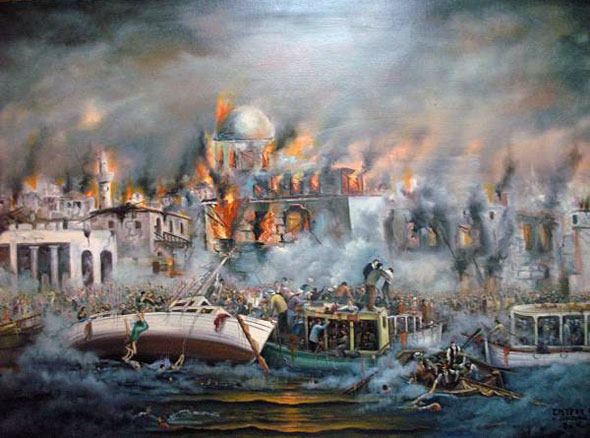
        Greek troops had landed in Smyrna in May 1919. The Greco-Turkish war of 1919-1922 ended with the complete victory of the nationalist army headed by Mustafa Kemal. On SeSmyrnaptember 9, 1922, the Kemalist troops occupied Smyrna. Four days later, on September 13, the fire began. It continued for nine days. Estimated Greek and Armenian deaths resulting from the fire and massacres range from 10,000 to 100,000.

        The fire completely destroyed the Greek and Armenian quarters of the city; the Muslim and Jewish quarters escaped damage. There are different claims about who was responsible for the fire; however, numerous eye witness accounts singled out uniformed Turkish soldiers setting fire to Greek and Armenian homes and businesses.


The Smyrna Catastrophe Painting by Vasilis Bottas

       The testimony of Fatih Rifki Atay, a well-known Turkish writer, editor, Parliament member, and close friend of Mustafa Kemal, is quite important:

       “Gavur (infidel) Izmir burned and came to an end with its flames in the darkness and its smoke in daylight. Were those responsible for the fire really the Armenian arsonists as we were told in those days? … As I have decided to write the truth as far as I know I want to quote a page from the notes I took in those days. ‘The plunderers helped spread the fire… Why were we burning down Izmir? Were we afraid that if waterfront konaks, hotels and taverns stayed in place, we would never be able to get rid of the minorities? When the Armenians were being deported in the First World War, we had burned down all the habitable districts and neighborhoods in Anatolian towns and districts with this very same fear. This does not solely derive from an urge for destruction. There is also some feeling of inferiority in it. It was as if anywhere that resembled Europe was destined to remain Christian and foreign and be denied to us.’

       “. . . If there were another war and we were defeated, would it be sufficient guarantee of preserving the Turkishness of the city if we had left Izmir as a devastated expanse of vacant lots? Were it not for Nureddin Pasha, who I know to be a dyed-in-the-wool fanatic and rabble rouser, I do not think this tragedy would have gone to the bitter end. He has doubtless been gaining added strength from the unforgiving vengeful feelings of the soldiers and officers who have seen the debris and the weeping and agonized population of the Turkish towns which the Greeks had burned to ashes all the way from Afyon.

       “. . . At the time it was said that Armenian arsonists were responsible. But was this so? There were many who assigned a part in it to Nureddin Pasha, commander of the First Army, a man who Kemal had long disliked . . . .”

       Despite the fact that there were at least 21 Allied warships and other ships in the harbor of Smyrna, the vast majority, citing "neutrality," did not pick up Greeks and Armenians who were forced to flee from the fire, and Turkish military bands played loud music to drown out the screams of those who were drowning in the harbor and who were forcefully prevented from boarding Allied ships. A Japanese freighter, however, dumped all of its cargo and filled itself to the brink with refugees, taking them to safety at the Greek port of Piraeus.

       The catastrophe of Smyrna became the last link in the Turkish genocidal chain that had unfolded in 1915.


THIS WEEK IN ARMENIAN HISTORY
Prepared by the Armenian National Education Committee (ANEC)
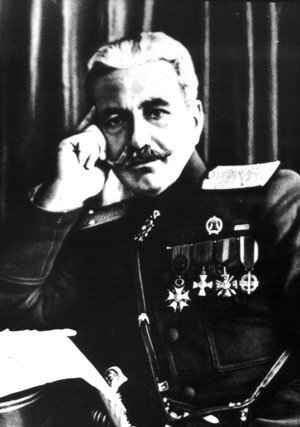
Death of General Antranig (August 31, 1927)


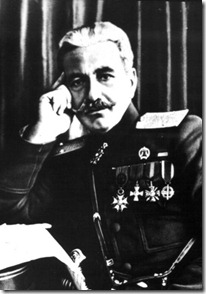
From Armenia to Argentina, there are statues, memorials, streets, metro stations, even a highway section (in Connecticut) which remember General Antranig’s name. Perhaps the most recognizable Armenian hero of the twentieth century, he was highlighted in 1920 by The Literary Digest as "Armenia’s Robin Hood, Garibaldi, and Washington, all in one. He is the ideal patriot of whom broadside ballads are published, and whose name inspires songs sung by the Armenian at his workbench, by the Armenian housewife at her tasks, by their children at play.”

Antranig Ozanian was born on February 25, 1865, in the city of Shabin-Karahisar, in the vilayet of Trebizonda. He was the son of a carpenter, Toros; his mother MariaGeneralAntranigm died when he was one-year-old. He married at the age of 17, but his wife died a year later, after giving birth to their son, who also died days later
He was 23 when he joined the revolutionary groups of the Social Democratic Hunchakian Party (founded in 1887), and became a party member in 1891. In 1894 Antranig left the Hunchakian Party and joined the Armenian Revolutionary Federation (founded in 1890). The next year he met the fedayee commander Aghpiur Serop and joined his group. After Serop’s death in 1899, Antranig became the leader of fedayee groups of Vasburagan and Daron in Western Armenia. His first mission was to capture and kill Beshara Khalil, a Kurdish soldier of the Ottoman Hamidiye regiments and tribal chief who had murdered Aghpiur Serop and was notorious for his atrocities against the Armenian population.

Antranig’s most famous battles were the battle of the Monastery of Holy Apostles in Mush (1901) and the second resistance of Sasun in 1904. In November 1901, Antranig barricaded himself in the Monastery of Holy Apostles in Mush with 30 fedayees, including the famed Kevork Chavush, and some ten peasants. The well-fortified monastery was besieged by five Turkish battalions with a total of 1,200 men. After a nineteen-day resistance and causing substantial losses to the Turkish army, the group was able to leave the monastery and flee in small groups. Antranig gained legendary stature among Armenians after breaking through the siege. In 1924 he would write in his memoirs that “it was necessary to show to the Turkish and Kurdish peoples that an Armenian can take a gun, that an Armenian heart can fight and protect his rights.”

He participated in the second insurrection of Sasun in 1904. He was pressed by Armenian leaders to allow temporary peace in the region. He moved to the Caucasus through Iran and then traveled to Europe, where he was engaged in advocacy in support of the national liberation struggle. In 1906 he published a book of military tactics in Geneva. In 1907 he settled in Bulgaria. During the fourth Congress of the A.R.F. (Vienna, 1907), Antranig announced his decision to leave the party due to his disagreement about the establishment of cooperation with the Young Turks.

He participated in the First Balkan War of 1912-1913 within the Bulgarian army, together with Karekin Nzhteh and a detachment of 273 Armenian volunteers. Antranig was honored with the Order of Bravery for his heroic participation in the war.

During World War I, Antranig returned to the ranks of the A.R.F. and participated in the Caucasus Campaign as head of the first Armenian volunteer battalion, which helped lift the siege of Van on May 6, 1915. He participated in twenty different offensives where he gained fame due to his courage and his tactics to defeat the Ottoman forces. The Russian authorities made him a Major General in 1918 and decorated him five times for bravery.

After the disbandment of the six volunteer battalions in 1916, Antranig resigned his commission and departed from the front. He left the ranks of the A.R.F. for the second time in 1917 and organized the First Congress of Western Armenians; he also published the newspaper Hayasdan in Tiflis in 1917-1918, with writer Vahan Totovents as its editor.

After the Russian army left the Caucasus following the Revolution, Armenian forces were created in a rush to try to fill the vacuum against the Turkish offense. In March-April 1918, Antranig was the head of a provisional government created in the areas of Western Armenia formerly occupied by the Russians. His military leadership allowed the Armenian surviving population to escape to Eastern Armenia.

After the foundation of the Republic of Armenia in May 1918, Antranig fought along volunteer units against the Ottoman army. In July of the same year, he arrived in Zankuezur, in the south, to participate in the interethnic warfare between Armenians and the local Turkish population. He also tried several times to seize Shushi, the most important city of Karabagh, but was prevented by British troops in the area.

In April 1919, Antranig arrived in Holy Etchmiadzin. His 5,000-strong division had dwindled to 1,350 soldiers. As a result of disagreements with the government of the Republic and British diplomatic machinations in the Caucasus, Antranig disbanded his division and handed over his belongings and weapons to Kevork V, Catholicos of All Armenians. In late 1919 he led a delegation to the United States to lobby in support of an American mandate. He was saluted as “the George Washington of Armenians.”

He married again in Paris in 1922, with Boghos Nubar Pasha as best man. Antranig and his wife, Nevart Kurkjian, settled in Fresno, California, where a young William Saroyan met him and later described the meeting in his short story “Antranig of Armenia” (Inhale and Exhale, 1936). He passed away near Chico, in northern California, on August 31, 1927, of a heart attack. His remains were moved to the Père Lachaise Cemetery in Paris in early 1928. They were set to be buried in Armenia, according to his desire, but Soviet authorities refused entry. His body was eventually returned to Armenia in 2000 and was reburied at the Yeraplur Military Cemetery.


THIS WEEK IN ARMENIAN HISTORY
Prepared by

the Armenian National Education Committee (ANEC)

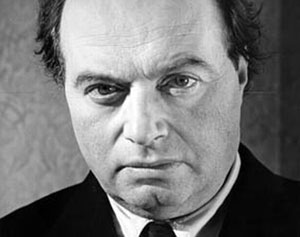
            Writer Franz Werfel (1890-1945) had no Armenian connections whatsoever, and probably he was little known among Armenians until his novel The Forty Days of Musa Dagh turned him into a world celebrity at the age of 43.

            Born in Prague, which was then part of the Austro-Hungarian Empire, to a wealthy Jewish family, Werfel was educated in a Catholic school. He published his first book of poetry in 1911. During World War I, Werfel served in the Austro-Hungarian Army on the Russian front as a telephone operator. In 1917, he left the army and moved to Vienna, where he fell in love with Alma Mahler, widow of composer Gustav Mahler and wife of architect Walter Gropius. Mahler divorced in 1920, but she refused to marry Werfel for the next nine years. Meanwhile, the latter became one of the well-established German and Austrian writers by the end of the 1920s.

            In the winter of 1930, Werfel and Alma Mahler made a trip to the Middle East. In Aleppo, they met a group of Armenian children working in a carpet factory. He was told that they were orphans. On his way in Lebanon, he heard the story of the seven villages of Musa Dagh. The plot for a future novel started to thicken in his mind.

        During the next two years and a half, the writer researched feverishly to write a novel that would become the most popular literary text about the Armenian genocide. The story of howthe 5,000 villagers living in seven villages in the southern corner of Cilicia had defied the Turkish order of deportation captured Werfel imagination. The 53 days of resistance and final rescue by French ships on the “Mount of Moses” (Musa Dagh) took a Biblical resonance with the use of the 40 days that would parallel the 40 years that the Jews spent in the desert before arriving in the Promised Land. Many other symbolisms and parallel may be found in a novel that was said at the time to have foreseen the destiny of the Jews in Europe.

            It was 1933, and Werfel’s books were among the ones burned by Nazi students. The publication of the novel in November 1933 led to its prohibition three months later in Germany by Turkish pressure; the book was also forbidden and condemned in Turkey.

Franz Werfel

       Meanwhile, The Forty Days of Musa Dagh became a worldwide success and translations into English and French soon were published. Hollywood’s Metro Goldwyn Mayer bought the rights to the movie, but Turkish pressure on the U.S. State Department had that project shelved, as well as several other attempts in the following years. Werfel was triumphantly received by Armenians in France and in the United States during a trip to both countries in 1935-1936.

        In 1938, the writer and his wife left Vienna after the Nazi occupation of Austria and settled in France. But the defeat of France to Germany in 1940 and the Nazi occupation forced them to narrowly escape to the United States. Werfel died in Los Angeles in 1945 and was buried there. By the initiative of Armenian American historian and educator Vartan Gregorian, Werfel’s remains were returned to Vienna and reburied in 1975.

        The Forty Days of Musa Dagh was translated into English by Geoffrey Dunlop in 1934 and became an immediate best-seller in the United States, with several reprints over the decades. However, the translation was not faithful to the German original, as Haigaz Kazarian had already discovered in 1951 in an article translated in 1963 in the Armenian Review. The equivalent of ninety pages of text had been excised by Dunlop. The recent publication of the unabridged English version of the novel (Boston, 2012), with the missing text restored by James Reidel, allows Anglo-American readers to savor this classic at a time when literary works on the Armenian genocide are quite fashionable.

NOTE: THE UNABRIDGED VERSION OF THE FORTY DAYS OF MUSA DAGH IS AVAILABLE AT THE PRELACY BOOKSTORE

The biography of Franz Werfel by Peter Stephan Jungk is now available as an eBook

Shantal Der Boghosian

The Armenian Weekly
http://www.armenianweekly.com/2012/08/23/to-infinity-and-beyond/
Sept. 1, 2012

Since the beginning of time, Space has been a source of mystery for man—a mystery they sought to decipher. Thanks to the scientific curiosity of Ptolemy, Galileo Galilee, and Isaac Newton, man has discovered numerous planets, landed on the Moon, and has even captured ancient images of space with the Hubble telescope that shine light on the Big Bang. Scientists know that our planet Earth has the perfect components for life, but as Earth begins to feel the effects of global warming and human overpopulation, it is only natural that scientists start looking to Space for answers- particularly from our neighbor, Mars.

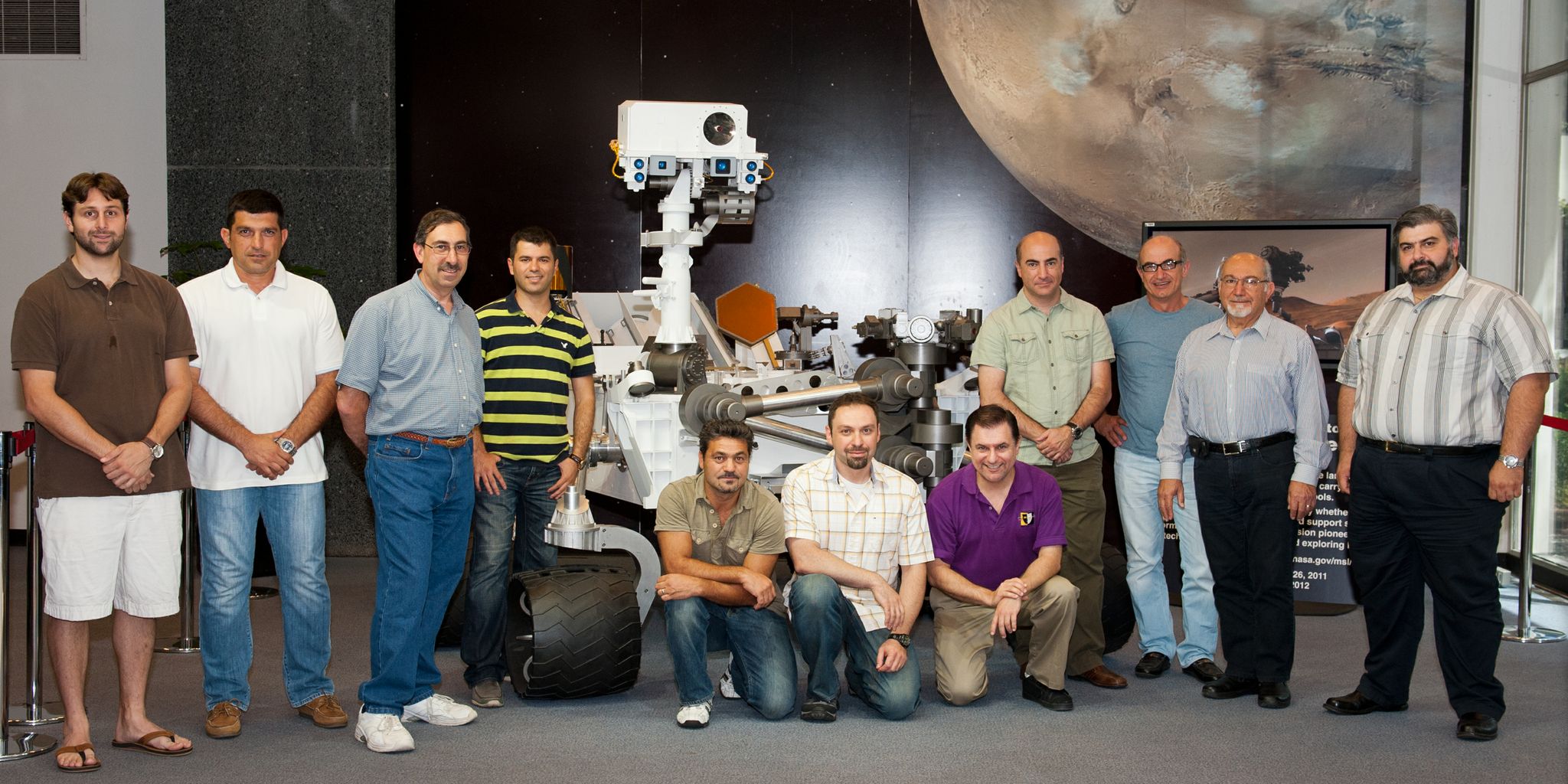
(L-R) Toorian, Gharakhanian, Sarkissian, Ohanian, Hartounian, Khanoyan, Gorjian, Zadourian, Aintablian, Demirjian, and Karapetian.

August 5, 2012 at 10:31p.m. PDT, the Mars Rover Curiosity successfully descended on parachute and landed upright on Martian soil. Curiosity is part of NASA’s Mars Exploration Program, a long-term robotic exploration of the red planet so close to our own home! Curiosity was designed to assess Mars’s habitability, and to see if it ever had the proper environment to support small life-forms called microbes. The rover carries the largest, most advanced suite of instruments ever sent to Mars and will analyze samples scooped from the soil and drilled from rocks. Any planet’s geology record is essentially stored in rocks and soil- particularly in the formation, chemical composition and structure. Curiosity has an on-board laboratory and it will study rocks and soil in order to detect any chemical building blocks of life in order to piece together Mars’s past.

One of the most impressive features is Curiosity’s power source. The rover carries a radioisotope system that generates electricity from the heat of Plutonium’s radioactive decay. Radioactive decay is the process by which an atomic nucleus of an unstable atom loses energy by emitting ionizing particles. In turn, an ion is created when an atom gains or loses a charged particle, such as an electron or a proton. This power source is strong enough to give Curiosity a life-span of one Martian year, or 687 Earth Days, and also gives Curiosity more operational flexibility and greater mobility than any previous Mars mission.

According to JPL, Curiosity represents a huge step in Mars surface science and exploration because it demonstrates the ability to land a very large and heavy rover to the surface of Mars, as well as demonstrating the ability to land more precisely in the calculated landing circle. This is a large feat! Not only am I proud as a scientist, but I’m also proud to know that there were fourteen Armenians who collaborated in this project’s success! Arbi Karapetian, a group supervisor at JPL, joined the project during the design and implementation phase. He was a Test Conductor during Assembly, Testing and launch. When asked how he felt about the project’s success, Arbi said “As an engineer you’re aware of statistical analysis and reliability. Every engineer understands that you do the best you can, but there’s always room for failure. This project was exponentially more complicated than any previous project because of the advances in engineering. The complexity was so high that you could no longer have one engineer, the work had to be spread amongst many engineers, which allowed more room for error.” Arbi was very proud of the team’s accomplishment, and the success was the greatest reward for all the long, arduous hours they put into the project. “If you love doing what you do, then you’ll never work a day in your life. There are very long hours which are taxing on everything you do. If this is really your passion, then all of that lines itself up, and it’s not hard to get motivated to do what it takes.”

The following Armenians made significant contributions to the success of the MSL (Mars Science laboratory) Project: Avo Demirjian, Vache Vorperian, Alfred Khashaki, Felix Sarkissian and Hrair Aintablian in the field of Electronics; Garen Khanoyan and Richard Ohanian on the Landing Radar System; Serjik Zadourian and Vazrik Kharakhanian in Assembly Test and Launch; Gayaneh Kazarians in Biology; Hanry Hartounian in Flight Software; Armen Toorian in Mechanisms and Testbeds; and Zareh Gorjian in Computer Animation.

http://www.armenianweekly.com/2012/08/23/to-infinity-and-beyond/

By Harut Sassounian

http://www.armenianweekly.com/2012/08/16/sassounian-leading-muslim-cleric-issued-fatwa-condemning-turks-for-killing-armenians/

I recently came across an extremely significant Islamic document that severely criticizes Turks for using religion as a cover to killing Armenian Christians.

This rarely seen document is a fatwa, or religious decree, issued in May 1909 by Grand Sheikh Salim al-Bishri of Egypt, condemning Turkish Muslims for massacring 30,000 Armenians in Adana, a major city in the Ottoman Empire.

Sheikh al-Bishri of al-Azhar Mosque, the leader of the Muslim world’s preeminent center of Islamic studies in Cairo, issued this fatwa to counter the decree issued in April 1909 by a Turkish mufti (religious leader) that urged Turks to kill Armenians because “they were against Muslims and God.”

Upon seeing a passing reference to the Egyptian fatwa on the internet, I contacted Prof. Mohammed Rifaat al-Emam, an expert on Armenian history, whom I had met during a recent visit to Cairo. Dr. al-Emam kindly sent me the original Arabic text of this important religious document, excerpts of which are presented below in English translation for the first time:

“We have seen in local newspapers agonizing news and vile reports about Muslims of some Anatolian provinces of the Ottoman Empire attacking Christians and killing them brutally. We could not believe these reports and hoped that they were false, because Islam forbids aggression, oppression, bloodshed, and harming human beings—Muslims, Christians, and Jews alike.

“Oh Muslims living in that region and elsewhere, beware of actions prohibited by Allah in His Sharia [Islamic law] and spare the blood that Allah prohibited to spill and do not transgress on anyone since Allah does not like aggressors…

“Your duty towards those who are allied with you, who entrusted their safety to you and who reside among you and next to you from Ahlul Dhimma [Jewish and Christian minorities protected under Islam], as imposed by Allah, is to uplift them as you would uplift yourselves, prevent them from what you prevent yourselves and your kinsfolk, make your strength their strength, make pride and prosperity out of your strength, and protect their monasteries and churches the way you protect your mosques and temples.

“Whoever abuses their women, draws the sword on them, and oppresses them contradicts Muslims’ pledge to Allah, which is the obligation of Muslims.

“Be informed that if what the public is hearing is true, then you have angered your Allah and did not satisfy your Prophet and the Sharia. You kept your Muslim brothers away from their religion, whose rejection became hideous by this heinous act, violating what is forbidden, and you let loose tongues of people ignorant of your religion to pronounce hideous words against all Muslims.

“Then, hear some of what your Prophet said about conditions similar to what you are in today. He said: ‘He who kills an allied person [person joined with Islam by an agreement in order to give help and support] will not smell the fragrance of Paradise, and if he smells it, that would be at a distance of 40 years.’ He also said: ‘A person who rejects a dhimmi [a person from Jewish and Christian minorities] will be whipped with flagella of fire on Judgment Day.’”

This document makes it amply clear that the Armenian massacres of 1909 and the subsequent genocide of 1915 were not the result of religious conflict between Muslim Turks and Christian Armenians. The Grand Sheikh of al-Azhar rightly condemned the Turks for the mass murder of Armenians, which was committed for racist Pan-Turkic—not Pan-Islamic—reasons, along with the intent of capturing Armenian lands and properties. The various fatwa issued by Turkish muftis were intended to provoke fanatical Turkish mobs to attack and massacre innocent Armenians.

Sheikh al-Bishri’s 1909 fatwa was further reinforced by the decree issued in 1917 by al-Husayn Ibn Ali, the sharif of Mecca, ordering all Muslims to defend Armenians and “provide everything they might need…because they are the Protected People of the Muslims about whom the Prophet Muhammad said: ‘Whoever takes from them even a rope, I will be his adversary on the Day of Judgment.’”

In 2009, when Turkish Prime Minister Recep Erdogan stated that “Muslims don’t commit genocide,” he was only partly right. He should have said, “Good Muslims don’t commit genocide.” The leaders of the Young Turk Party who masterminded the Armenian Genocide in 1915 were not faithful Muslims, judging by the teachings of the Quran, the Holy Book of Islam. They were simply criminals who used Islam as a convenient cover to carry out mass murder. The compassionate fatwa of the Grand Sheikh of al-Azhar still rings true today as the Muslim world celebrates the end of Ramadhan.

http://www.armenianweekly.com/2012/08/16/sassounian-leading-muslim-cleric-issued-fatwa-condemning-turks-for-killing-armenians/


This Week in Armenian History
Prepared by the Armenian National Education Committee (ANEC)
Death of Joseph Emin (August 2, 1809)

The small Armenian community of India became one of the protagonists of the second half of the eighteenth century. The “group of Madras” introduced the ideas of the Enlightenment in the Armenian realm, while an Armenian from Calcutta, Joseph (Hovsep) Emin, engaged in political projects in Armenia proper.

Emin was born in Hamadan (Persia) in 1726. He moved to Calcutta in 1744 to join his merchant father. Seven years later, against the wishes of his family, he left for London. After four years of hardship and misery, deprived from any financial assistance from his family, he met the famous British philosopher Edmund Burke (1729-1797), who took him under his wings. He later entered the Royal Military Academy in Woolwich, and after a year of studies, he enlisted as a volunteer in the British and Prussian armies during the seven-year war (1756-1763) against France.

In 1759, Joseph Emin traveled to Holy Etchmiadzin to motivate the Catholicos towards the idea of liberating Armenia. But his expectations were not met and he returned to London. Two years later, he went to Russia and obtained a letter of recommendation from Russian Imperial Chancellor, Count Vorontsov, which he presented to King Erekle II of Georgia in 1763. Emin’s goal was to engage the Georgian king in a joint Armenian-Georgian project to liberate Armenia from Persian and Ottoman rule. The king was initially interested, but in the end dismissed Emin’s project and ordered him to leave the country. Emin went to the Northern Caucasus and was able to reach Karabagh and Zanguezur, but hopes of liberation were pinned to any possible help by the Georgian king. After being ordered to leave Georgia for a second time, he returned to India, but his hopes of getting financial assistance from Armenian merchants there were dashed by clerical opposition.

Emin, disillusioned, remained in India for the rest of his life. In 1792, he published his memoirs, Life and Adventures of Joseph Emin, an Armenian, in London. He passed away in 1809 and was buried in the courtyard of Kolkatta’s (Calcutta) Holy Nazareth Armenian Church. His memoirs were reprinted in 1918 by his great, great grand-daughter, Amy Apcar, and translated into Armenian in 1958 by an Armenian American intellectual that old New Yorkers may remember, Hagop Kashmanian (1886-1968).


Executive Profile: Mark Hoplamazian, Hyatt Hotels president and CEO.

By Tom Vartabedian On July 4, 2012 http://www.armenianweekly.com/2012/07/04/turks-rebuke-school-genocide-classes/

Just when you think life has dealt you a pat hand, along comes a conniver to steal your pot.

For the past four years, members of our Armenian Genocide Education Committee of Merrimack Valley have filtered in and out of high schools north of Boston.

We’ve also expanded our reach to include schools around Greater Boston like Newton South. Scores of children have benefitted from our lessons. In most every case, instructors have been overwhelmed by the impact being made, for they, too, come out learning a valuable lesson in history.

There hasn’t been one repercussion, not even a grunt from a naysayer—until now. A vile and vindictive article from a pro-Turkish website (History of Truth) crossed my eyes bearing the headline: “Armenians Spreading Their Lies at High Schools.”

The gutless piece failed to carry a byline, thus making it more intolerable.

What’s more, a photograph of Wilmington High students holding samples of postage stamps they had designed carried the inscription: “Their Lies Reached to Schools.”

The group photo also had the two presenters that day, myself and Albert S. Movsesian. The ideas for a postage stamp were being sent to the postmaster general of the United States in an effort to get a commemorative stamp minted for the 100th anniversary in 2015.

A completely harmless project meant to both elucidate and arouse our younger non-Armenian population was slurred with malice.

The rebuttal was generated in response to an all-encompassing piece written by chairman Dro Kanayan giving readers a fairly detailed account of the progress made in schools this year. How effective has it been?

While attending a grand niece‘s Chelmsford High graduation party the week before, I approached a table occupied by students who had been addressed during a genocide class taught by Jennifer Doak.

“Hey, you look familiar. Aren’t you the guy who spoke to us about the Armenian Genocide?” a co-ed remarked.

“Yes, that’s me,” I replied. “What do you remember most about the class?”

“How difficult it was for your race to be slaughtered like that,” she replied. “We loved the story about the Calvin Coolidge Orphan Rug and how it found its way to the White House.”

The article goes go to say that the “Armenian Diaspora is spreading its lies by telling them at high schools.”

The next paragraph quoted Kanayan’s story: “Armenian researcher Dro Kanayan said for those people who feel that our elders and the youth cannot work together, don’t worry. Kanayan and both of his peers, Albert Movsesian and Tom Vartabedian, have been working together to have the so-called Armenian Genocide included in the high school curriculum on Human Rights in the Merrimack Valley.”

“They are teaching students about the so-called Armenian Genocide and Armenian culture.”

The story went on to say how we have “poisoned” the students in over 10 high schools, providing individual classroom presentation on comparative genocides over the past 100 years.

It proceeded to include other high school students, including a deaf student we encountered at Newton South who had learned about the genocide through American Sign Language.

Adding more insult to injury, a second photo was used of Dro Kanayan holding a picture of his famous grandfather General Dro, who led the siege at Bash Abaran during World War I.

I should be fuming over such poppycock. Instead, I hold no regret over those who are ill-informed and continue to show their absurdity. The more Turkey refutes historical fact, the more scornful it becomes.

The more truth will prevail and people will see how superficial the Turkish government continues to remain. What people lack in intelligence, they usually make up for in stupidity.

I recall once how vandals had climbed to the top of a billboard in Watertown and defaced a genocide sign that had been sponsored by activist/artist Daniel Varoujan Hejinian. For years, Hejinian has been putting up these notices to draw attention during April 24th.

For the most part, the Armenian papers publicized the act, but it also caught the attention of the American press, which matters more. The fact that some screwball scaled a building at night to commit an act of degradation suddenly became media hype. It appeared in newspapers and television networks, giving the Armenian Genocide more exposure than normal.

During a commemoration that week in Merrimack Valley, a local priest approached the podium and talked about the insanity.

“If that’s the way our genocide is going to catch the outside public’s eye, then let the billboards be vandalized,” he lashed out. “And let those responsible find guilt in the process.”

http://www.armenianweekly.com/2012/07/04/turks-rebuke-school-genocide-classes/

THIS WEEK IN ARMENIAN HISTORY

Prepared by the Armenian National Education Committee (ANEC)

The Constitution of the Republic of Armenia
(July 5, 1995)

Three years before the American Revolution, in 1773, a book called Որոգայթ փառաց (“Vorokayt parats,” The Snare of Glory) was published in Madras (India). It reflected the thoughts and projects of a group of intellectuals known as the “Madras Group.” Its author was Hagop Shahamirian, who, for the first time in Armenian history, called for a “constitutional republic” as the best way of maintaining democracy and equality in the free Armenia of his dream. He also attached a project of Constitution for a republican and free Armenia.

The first Republic of Armenia, despite its democratic institutions, did not have enough time to draft and pass a Constitution. The Armenian Soviet Socialist Republic had two Constitutions, in 1936 and 1978, which logically replicated the Constitution of the Soviet Union.

Independence came in 1991 and with it, the need to have a basic document that outlined the organization of the new state and the rights and duties of its citizens. Initially, the Constitution of 1978 remained in effect, except in those cases when legislation had superseded it. A draft constitution was presented in late 1992 by the government. A long struggle between the government and the opposition alternative drafts ensued. The final project of Constitution was voted in a nationwide referendum and approved on July 5, 1995, which became Constitution Day in Armenia. A new referendum amended the Constitution on November 27, 2005.

The Constitution is composed of nine chapter and 117 articles. Its preamble says:

“The Armenian people — recognizing as a basis the fundamental principles of the Armenian statehood and the pan-national aspirations enshrined in the Declaration on the Independence of Armenia, having fulfilled the sacred behest of its freedom-loving ancestors for the restoration of the sovereign state, committed to the strengthening and prosperity of the fatherland, with a view to ensuring the freedom of generations, general well-being and civic solidarity, assuring the faithfulness to universal values — hereby adopt the Constitution of the Republic of Armenia.”

Click here to view  the Constitution of the Republic of Armenia.

http://www.parliament.am/parliament.php?id=constitution&lang=eng