Subject: For Hire, and the resume of Jesus Christ 

Address: Ephesians 1:20

Phone: Romans 10:13

Website: The Bible

Keywords: Christ, Lord, Savior and Jesus

Objective

My name is Jesus -The Christ.  Many call me Lord! I’ve sent you my resume because I’m seeking the

top management position in your heart. Please consider my accomplishments as set forth in my resume.

____________________________________________________________________

Qualifications

I founded the earth and established the heavens, (See Proverbs 3:19)

I formed man from the dust of the ground, (See Genesis 2:7)

I breathed into man the breath of life, (See Genesis 2:7)

I redeemed man from the curse of the law, (See Galatians 3:13)

The blessings of the Abrahamic Covenant comes  upon your life through me, (See Galatians 3:14)

_____________________________________________________________________

Occupational Background

I’ve only had one employer, (See Luke  2:49).

I’ve never been tardy, absent, disobedient, slothful or disrespectful.  My employer has nothing but rave reviews for me, (See Matthew 3:15 -17)

___________________________________________________________________

Skills Work Experiences

Some of my skills and work experiences include: empowering the poor to be poor no more, healing the broken hearted, setting the captives Free, healing the sick, restoring sight to the blind and setting at liberty them that are bruised, (See Luke 4:18).

I am a Wonderful Counselor, (See Isaiah 9:6).

People who listen to me shall dwell safely and shall not Fear evil, (See Proverbs 1:33).

Most importantly, I have the authority, ability and power to cleanse you of your sins, (See I John 1:7-9)

_____________________________________________________________________

Educational Background

I encompass the entire breadth and length of knowledge, wisdom and Understanding, (See Proverbs 2:6).

In me are hid all of the treasures of wisdom and knowledge, (See Colossians 2:3).

My Word is so powerful; It has been described as being a lamp unto your feet and a light unto your path, (See Psalms 119:105).

I can even tell you all of the secrets of your heart, (See Psalms 44:21).

____________________________________________________________________

Major Accomplishments

I was an active participant in the greatest Summit Meeting of all times, (See Genesis 1:26).

I laid down  my life so that you may live, (See II Corinthians 5:15).

I defeated the arch enemy of God and Mankind and made a show of them openly, (See Colossians 2:15).

I’ve miraculously fed the poor, healed the sick and raised the dead!  There are many more major accomplishments, too many to mention Here. You can read them on my website, which is located at:

www dot – the BIBLE.

You don’t  need an Internet connection or computer to access my website.

_____________________________________________________________________

References

Believers and followers worldwide will testify to my divine healing,

Salvation, deliverance, miracles, restoration and supernatural guidance.

_____________________________________________________________________

In Summation

Now that you’ve read my resume, I’m confident that I’m the only candidate uniquely qualified to fill this vital position in your heart. In summation, I will properly direct your paths, (See Proverbs 3:5-6), and lead you into everlasting life, (See John 6:47).   

When can I start? Time is of the essence, (See Hebrews 3:15).

Send this resume to everyone you know, you never know who may have an opening!

******************************************************************************** 

THIS WEEK IN ARMENIAN HISTORY

Prepared by
the Armenian National Education Committee (ANEC)

Hamo (Hampartsum) Bek-Nazarian was one of the pioneers of Armenian cinema. Born in Yerevan in 1892, he moved with his family to Tashkent (currently the capital of Uzbekistan). He first became a cyclist, and then a wrestler. He participated in competitions outside the Russian Empire and even wrestled in the circus with the pseudonym of Maroni.

In 1914 he started his career in Russian cinema. His first role was a minor one in a film, significantly titled Enver-pasha – predatel’ Turtsii (“Enver Pasha, Traitor of Turkey”), released in 1915. He appeared with the artistic name of Hamo Bek in more than 70 Russian silent movies, where he met his future wife, the actress Sofya Volkhovskaya (1888-1956).

He graduated from the Commerce Institute of Moscow in 1918. In 1921 he headed the movies section of the film studios of Georgia and then became a film director of the State Film of Georgia. In 1923 he moved to Armenia following an invitation by the government and founded the Armenfilm (Haifilm)studios. This was a real challenge, as there were no grounds for cinema in Armenia and Bek-Nazarian had to start everything from scratch. Two years later, he directed the first Armenian feature film, Namus (The Honor), based on the homonymous play by Shirvanzade (1858-1935). He also directed other important films, such as Zare (the first movie on Kurdish life) and the first Armenian comedy, Shor and Shor Shor, in 1926. He wrote the scenario of Shor and Shor Shor in one night and filmed it in eleven days. He also filmed three Georgian movies in 1924-1925, and would later film two Azerbaijani movies (1927 and 1941).Hamo

By 1935 Bek-Nazarian had written (alone or in collaboration) and directed sixteen films, both features and documentaries. He achieved another feat in that year: he directed the first Armenian sound film (“talkie”), Pepo, also based on a classical play by Gabriel Sundukian (1825-1912). This was four years after the release of the first Soviet sound film, at a time when less than one out of a hundred film projectors in the Soviet Union were equipped for sound. Pepo became his masterpiece, as well as one of the masterworks of the Armenian movie industry. He earned the title of Popular Artist of Soviet Armenia in the same year.

He produced two other important films among his works: Zangezur (1938), which received the Stalin Prize of second degree in 1941, and David Bek (1943). The latter was based on the Armenian rebellion against Persian domination in the eighteenth century. However, he suffered a very big disappointment with his film Yerrort karavan (Third Caravan), dedicated to the subject of the repatriation to Armenia in 1946-1948, which was probably set to become his masterpiece. The filming of the movie, which was halfway, was forbidden and the production was shut down in 1951, probably as part of the change of heart of the Soviet regime with regards to repatriation and repatriates. Bek-Nazarian, deeply upset and disillusioned, abandoned both Armenfilm and Armenia, and went to work in the Central Asian republics, such as Uzbekistan and Tajikistan. He passed away on April 27, 1965, and was buried at the Armenian cemetery of Moscow beside his wife. His work was posthumously acknowledged and the movie studios of Armenfilm were named after him.

This Sunday, May 19, the Armenian Church celebrates the Feast of Pentecost (Hokekaloust), the descent of the Holy Spirit to the Apostles, and the birth of the church. Jesus had commanded the apostles to “Go therefore to all nations and make them my disciples,” (Matthew 28:19). Recognizing the difficulty of this great responsibility, Christ had advised His disciples not to begin their teaching mission until after the “descent of the Holy Spirit.”

In the Acts of the Apostles, we read that on the day of Pentecost the apostles gathered in one place, and suddenly a strong wind seemed to fill the house in which they were assembled. “And there appeared to them flames like tongues of fire distributed among them and coming to rest on each one. They were all filled with the Holy Spirit and began to talk in other tongues, as the Spirit gave them power of utterance,” (Acts 2:2-4). It was the Jewish feast of Pentecost (Shabuoth) commemorating the giving of the law on Mount Sinai and many people from different lands had come to Jerusalem. They marveled that they could understand the Apostles’ words in their own language. This day when the Holy Spirit descended upon the Apostles was the beginning of the mission of the Church to spread the Good News throughout the world.

In a sense Pentecost is the opposite of what occurred in the Old Testament story of the Tower of Babel when God disapproved of the building of a tower to reach the heavens and He created confusion by having the workers suddenly speak in different tongues, and unable to understand each other. At Pentecost He gave the disciples the ability to speak other tongues and thus be able to be understood by everyone everywhere.

Life-creating God, Spirit and lover of mankind, with tongues of fire you enlightened those united with one accord in love; therefore we also celebrate today your holy descent.

Filled with joy by your coming the holy apostles began in different-sounding tongues to call into unity them that had been divided from each other; therefore we also celebrate today your holy descent.

By spiritual and holy baptism through them you have adorned the universe in a new and radiant garment; therefore we also celebrate your holy descent.

From the Canon for the First Day of Pentecost according to the Liturgical Canons of the Armenian Church


Posted from Eastern Prelacy’s Crossroads E-Newsletter

(Armenpress) – The Vicar General of the Armenian Patriarchate of Constantinople, Archbishop Aram Ateshian, gave an interview to the Turkish Bugun TV channel, where he discussed the existence of hidden Armenians living in Turkey.Ateshian explained that these individuals were forced to conceal their nationality and convert to Islam during World War I because of persecution in Ottoman Turkey.

Ateshian said, "There are about 100,000 people in the present generation in Turkey whose parents are Armenians and they are Muslims. They speak Armenian and wear a cross secretly… They do not want to attend church, as it will reveal their identity. The liturgy held in the Saint Kirakos Church in Diyarbakir was attended by more than 400 people, half of which had Armenian roots. My family as well lives in Diyarbakir as Muslims. The sons of my elder sister also live in Diyarbakir. They accepted Islam under pressure in 1950."

"I was born in 1954. When I was 4 or 5, my sister became a Muslim. Their children became Muslims as well. My sister wore her cross secretly and spoke Armenian. I lost them, as they did not attend our church and I could not christen them. Many of the concealed Armenians talked about their being Armenians only before the death," he continued.

Ateshian also shared other first-hand experiences, saying, "A 30-year-old man came to me and asked [me] to christen him. I told him to prove his being Armenian and he could not. Then his father called me and asked to accept his son. He said that he worked in the municipality and when he retires, he will return to his roots. According to his son, 90 percent of the population of Tunceli are Armenians and now he is a member of our church."

     Prepared by

the Armenian National Education Committee (ANEC)


          Shushi had historically been the capital of Karabagh and the third most important Armenian cultural center in the Southern Caucasus (after Tiflis and Baku) until 1920, when the pogrom executed by Azerbaijani forces ended in the destruction of the Armenian quarters and the extermination of the Armenian population of the city.

          During Soviet times, the capital of the autonomous region of Mountainous Karabagh was moved to Stepanakert, while Shushi, located four miles to the south, became an Azerbaijani center.

          In the years of the Karabagh war (1989-1994), the strategic importance of Shushi, situated on a mountaintop overlooking Stepanakert, acquired more relevance for Azerbaijani forces in Karabagh after the occupation of Khojalu by Armenians in February 1992. The town became the main base for the indiscriminate shelling of Stepanakert with Soviet-built GRAD multiple rocket launchers. These launchers were capable of shelling 40 rockets at the same time and cause enormous damage to the civilian population. Over 2,000 people were killed in Stepanakert as a result of Azerbaijani shelling in the first months of 1992.

          The capture of Shushi became imperative to end the relentless bombing of Stepanakert and the suffering of its population. The plan was finalized on April 28 and the order of attack was given on May 4, 1992.  However, various reasons caused a delay of four days.

 LiberationofShushi
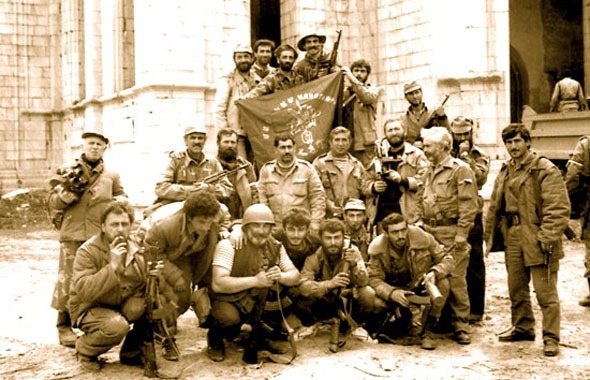
Members of the ARF battalion celebrating the liberation of Shushi in front of the Ghazanchetsots Cathedral in 1992.

The military operation was directed by Commander Arkadi Ter-Tadevosyan, who had a force of 1,200 members of the Self-Defense Forces of Karabagh, divided into five companies. The Armenian forces were complemented by four tanks and two attack helicopters. The Azerbaijani defending forces counted 1,200 people in Shushi, where the civilian population had been already evacuated, and some 800 around the town. A Chechen volunteer contingent led by guerrilla warlord Shamil Basayev (who was among the last to leave the city and was killed in 2006 in Chechnya) had reinforced the Azerbaijanis.

          Shushi was attacked by the flanks and the rears in the twilight hours of May 8, as the ridge facing Stepanakert was easier to defend. There was a full engagement by midday, and the ending to the battle was envisioned in the evening, when Armenians, occupying favorable positions around Shushi, allowed the enemy forces a corridor for retreat.

          The ancient Armenian capital was occupied on May 9. Azerbaijani military plane and helicopters shelled the Armenian ranks, as well as Shushi and Stepanakert during midday. Later, it was discovered that the air offensive was aimed at exploding the weapon deposits abandoned in Shushi with the hope of destroying the entire city. However, the plan did not succeed, and the “clean up” of the city ended in the evening of the same day. It has been estimated that the Armenians lost 60 people, while Azerbaijanis had a total of 150 to 200 casualties.

          The victory at Shushi had a crucial importance in the Karabagh war. The Armenian forces immediately launched an offensive over the corridor of Lachin, which was central to the connection between Armenia (Goris) and Karabagh (Stepanakert), and occupied Lachin (nowadays Berdzor) on May 18. The consequent falls of Shushi and Lachin triggered the deposition of Azerbaijani president Ayaz Mutalibov.

          The liberation of Shushi was of enormous symbolical value, as it represented the recovery of a city that had been abandoned for more than seventy years to Azerbaijanis. In the last twenty years, Shushi has been slowly recovering its Armenian profile and population, with the white and imposing silhouette of the nineteenth-century Ghazanchetsots Cathedral (which had been converted by Azerbaijanis into a deposit of GRAD launchers) standing completely renovated as a symbol of resilience and faith in the future.

SECOND PALM SUNDAY

This Sunday, May 12, is Second Palm Sunday (Yergrort Dzaghgazart). The seventh Sunday of Easter is called Second Palm Sunday because of the readings on that day. Beginning with New Sunday and continuing until Pentecost, the Armenian Church reads from the four Gospels every day in their proper order. Luke is read in the morning; John at midday; Matthew at the beginning of the evening hour; and Mark at the end of the evening hour. The sections related to Christ’s entry into Jerusalem coincide with the seventh Sunday of Easter, hence the designation of “Second Palm Sunday.”

        There are several feast days in our liturgical calendar dedicated to St. Gregory the Illuminator, but according to tradition he is also remembered on the fourth day of Hampartsoum, known as Second Palm Sunday. During the years of Gregory’s imprisonment in the deep pit his guardian angel would appear daily to give him nourishment. On the fourth day of the Ascension the angel did not come, and the next day Gregory asked why. The angel told him that the fourth day of Ascension is the feast day for his celestial army of the 4th rank, and he was permitted to remain in the heavens to celebrate the feast day and enjoy Christ in heaven. 


A tradition has come down to us concerning the mysterious meaning of this great and wonderful feast; the Enlightener of our souls heard from his guardian angel: On this day there is a great feast in the heavens in my rank. For during the ascent of the heavenly One from earth the heavenly spirits in their ranks celebrated this event with rejoicing, beginning with the angels and concluding with the thrones. The Illuminator’s guardian angel being from the fourth rank hastened to share in the joyful celebration of which the angel in the flesh learned when he asked him a question. This great mystery took place for the salvation of the logical of angels and mankind so that both of them might unite in one.


(From the Liturgical Canons of the Armenian Church for the first Sunday after Christ’s Ascension, known as Second Palm Sunday).

Posted from Eastern Prelacy’s Crossroads E-Newsletter 


Prepared by

the Armenian National Education Committee (ANEC)


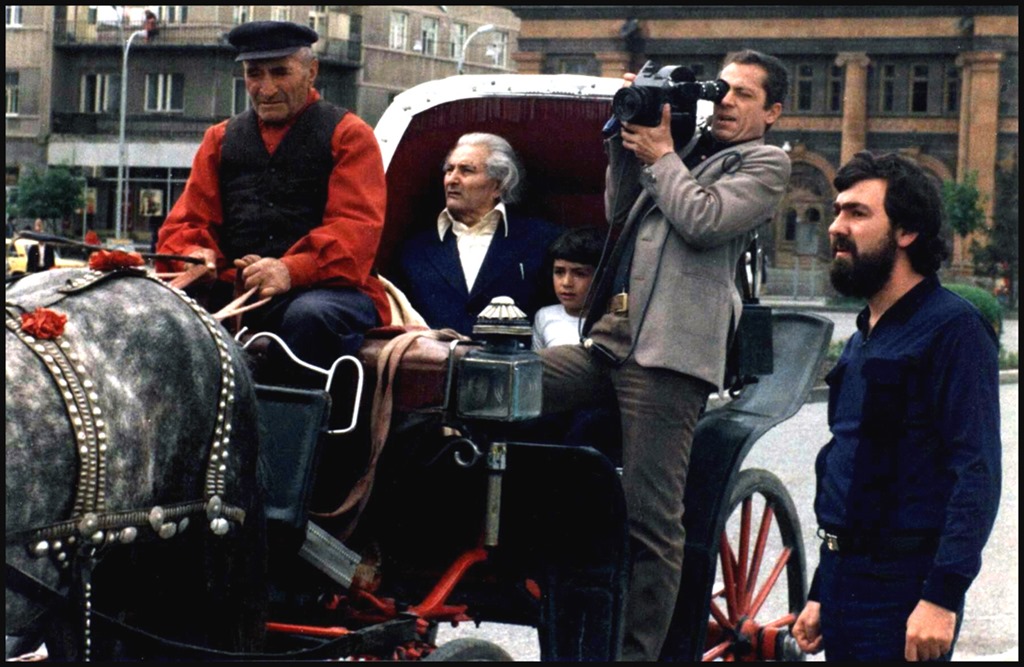
       Poet Hovhannes Shiraz, one of the most popular names in Armenia and the Diaspora during Soviet times, was born in Alexandropol (later Leninakan, now Gumri), in 1915. His birth name was Onnig Garabedian. At the age of five, he lost his father, who was killed in the Turkish invasion of Armenia that followed the Armenian-Turkish war of 1920. He grew in poverty. He went to work at the textile factory of Leninakan in 1932. He published his first poems in the factory newspapers. Apparently, he first signed them with the pseudonym Hovhannes Shirag (Gumri is located in the plain of Shirag).HovhannesShiraz

A behind the scenes shot of the making of the film, Shiraz, in Gyumri, in 1983. Hovhannes Shiraz is second from left, sitting in the carriage.

        One year later, he was hired as teacher in the village of Haji Nazar (now Kamo), in the district of Akhurian. He published his first book of poetry, “Spring Initiation,” in 1935, with the pseudonym Hovhannes Shiraz. According to his testimony, writer Atrpet (1860-1937) gave him the pseudonym of Shiraz (a city in Iran, well known for its flowers), saying: “The poems of this young man have the perfume of the fresh and dew-covered roses of Shiraz.” In the same year, Shiraz became a member of the Writers Union of Armenia.

        He attended the Faculty of Philology of the Yerevan State University between 1941 and 1947, where he studied Armenian language and literature. Afterwards, he lived from his pen. He also followed the courses of the Institute of Literature Maxim Gorky of Moscow from 1952-1954.

        Shiraz’s most important collection of poetry was “Lyre of Armenia” (three volumes, 1958, 1965, and 1974). He won the State Prize of Soviet Armenia in 1975 and the Hovhannes Tumanian prize in 1982.

       Although the press run of his books was over half a million copies and his poems were translated into 58 languages, Shiraz ran into many problems with censorship. His patriotic poetry, particularly his evocation of the historical injustice suffered by Armenians and the lost territories of Western Armenia and, at the time, Gharapagh, was forbidden several times. In 1974, when the well-known literary critic Suren Aghababian told Shiraz about receiving the Lenin Medal, the response was: “And what do they want from me in exchange? To buy my silence?”

        He was never allowed to travel outside the Soviet Union, but many of his unpublished poems were smuggled outside the country and published in the Diaspora press. For instance, the first draft of his poem “The Armenian Dante,” about the Armenian Genocide, was written in 1941. Only a few excerpts were published in Armenia during his lifetime and a few chapters in Beirut and Tehran. The entire poem was posthumously published in 1990. His poem “Ani,” about the medieval capital of Armenia, written in 1950, was also published in excerpts in the Diaspora, and the final edition only appeared in 2012.

        Shiraz first married poet Silva [Gaboudigian] Kaputikian (1919-2006). They had a son, the future sculptor Ara Shiraz. Shiraz and his second wife, Shushan, had seven children, including poet Sipan Shiraz (1967-1997).

        Shiraz, who had become a living legend, passed away in Yerevan on March 14, 1984. He was buried in the pantheon of Gomidas Park, where many famous Armenians are buried.

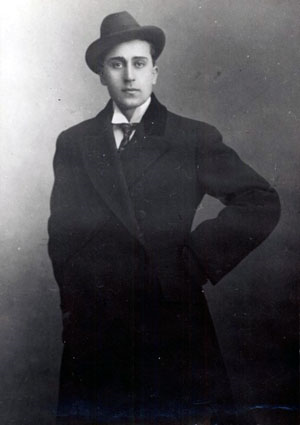
In the first decade and half of the twentieth century, poet Taniel Varoujan rose to become the most remarkable name of Armenian literature. He would have become an internationally known name had not his exile and assassination trounced his career during the Armenian Genocide.

            Taniel Chibukkiarian was born in the village of Perknik, in the vilayet of Sepastia. After attending the local school, in 1896 he went to Constantinople, where he attended one of the schools of the Mekhitarist Congregation of Venice. He then continued his education at the Moorat-Raphaelian school of Venice from 1902-1905. In 1905 he entered the University of Ghent, in Belgium, where he followed courses in literature, sociology, and economics. He adopted the surname Varoujan (from an Armenian word that means "male dove") when he started to publish his poems. In 1906 he published his first volume of poetry, Shivers, followed the next year by a booklet that contained a long poem, The Massacre. He graduated in 1909 and returned to the Ottoman Empire. The same year he published a new volume, Heart of the Race, which TanielVaroujanestablished him as a poet.

Returning to Sepastia, he became a teacher between 1909 and 1912. In 1910 he married his student, Araksi Tashjian, vanquishing the opposition of her father. In 1912 they moved to Constantinople, where he became the principal of the St. Gregory the Illuminator School until his deportation in April 1915.

               He published a new and even more powerful collection of poetry, Pagan Songs, in 1912. In late 1913 he joined forces with four young writers, Kostan Zarian (1885-1969), Hagop Oshagan (1883-1948), Kegham Parseghian (1883-1915), and Aharon Dadourian (1888-1965), to create the group "Mehyan." They issued a manifesto that called for the renovation of Armenian literature and language, and founded a short-lived but important monthly journal, Mehyan, that published seven issues (January-July 1914). Due to aesthetic divergences, Varoujan left the group after the third issue (March 1914).

                The poet had three children: Veronica, Armen, and Haig. His wife was pregnant with their third child, when Varoujan was included in the Turkish black list and arrested on the night of April 23-24, 1915, by the police with hundreds of Armenian intellectuals and leaders. He was deported to Changr (Chankiri) together with many of his colleagues, where they lived in a sort of internal exile for the next two months. On August 26, 1915, along with his friend, the poet and physician Rupen Sevag (Chilingirian, 1885-1915), and three other Armenians, they were taken to Kalayjek. On the road, following a previous plan, a group of Turkish chetes (irregular soldiers) attacked the carriage that transported them. They were forced to take their clothes out, and then savagely assassinated. The same day, Varoujan’s son, Haig, was born in Constantinople.

            The poet’s papers had been confiscated at the time of his arrest. In 1921 his wife Araksi was able to recover, after paying a hefty bribe, his unfinished last book, The Song of the Bread, which was published the same year in Constantinople.

               After his death, Varoujan’s works were published in no less than thirty editions over the past nine decades. Collections of his poetry have been also published in French and Italian. His daughter Veronica Safrasian (1910-2009) lived for many years in New York, while his younger son Haig (1915-2002) passed away in Fresno.

GREEN SUNDAY

Easter Sunday is followed by a period of fifty days (Hisnag) during which there are no fasting days and no saints’ days. This period from the Resurrection to Pentecost (Hokekaloost) is dedicated to the glorification of the Resurrections. Each of the seven Sundays of Hisnag has a special name. Last Sunday, the first Sunday after Easter, was New Sunday.

This Sunday, April 14, is Green Sunday (Ganach Giragi), also called Sunday of the World Church (Ashkharhamadoor). Green Sunday most probably originates from an ancient folk holiday celebrating spring. Our forefathers, seeing mother earth bloom after long winter months, glorified the Creator with an act of thanksgiving and celebrated by decorating the church and themselves with greenery. The reawakening of nature is symbolic of the Resurrection. Green is the color of life, freshness, and promise. After a barren winter we are filled with hope, life, and love

.

clip_image002[4]

THE MESSAGE OF HIS HOLINESS KAREKIN II
SUPREME PATRIARCH AND CATHOLICOS OF ALL ARMENIANS
THE FEAST OF THE GLORIOUS RESURRECTION
OF OUR LORD JESUS CHRIST

Mother See of Holy Etchmiadzin, March 31, 2013

In the Name of the Father, and the Son and the Holy Spirit. Amen

"That God gave us eternal life,
and this life is in his Son."
1 John 5:11

Dear and pious faithful,

With the warmth of the dawning spring and the awakening of nature filled with new life, the hope and joy of the Feast of the Resurrection take flight in our souls today with the angelic tiding of "Christ is Risen", renewing and strengthening us in the confidence "that God gave us eternal life, and this life is in his Son".

These words of the Apostle testify to the event that changed the course of the history of mankind, which occurred when the crucified and entombed Christ rose from the dead. From that moment on, death has no power over men, sin is absolved, and the reign of death is destroyed. It is the light of salvation and eternal life on the other side of the grave that brightly shines today in our souls – renewing us in our hope and faith.

The belief in the Resurrection of Christ always brings strength and power to always rise up and live that life that is in the Son of God. The foundation of that life is love – the love that sacrifices. That love with which the Son of God came to the world, fulfilled His mission of salvation, and instructed His disciples and followers saying, "A new commandment I give to you, that you love one another". John 13:34. Christ placed love at the foundation of human life, so that man would be perfect and that he would lack nothing. Love creates, builds and establishes and does not ruin; it illuminates, inspires hope, grants joy and bliss and does not succumb to indecision and despondency; it does not bring pain and grief. Love is the fountainhead of goodness and joy, the rock of peace and justice, the encouragement to support and help each other for the sake of a life of goodness and ongoing progress.

Today, alongside the bliss in our heart of the feast of Christ’s Resurrection, is also the regret that our Lord’s message of love for mankind and all of God’s creation does not manifest itself everywhere and always in human life. The seeds of Christ-commanded love that have been preached for two millennia often fall on the barren stones of souls that have strayed away from God, or do not produce results due to the negligence of man; or that which is planted by the Lord is plundered by evil, spreading dissension and leading men astray from their good paths. The present difficult global-political and economic developments, the growing self-centered mindset, and the disregard of spiritual and moral values, bring forth new disagreements and conflicts, problems and concerns in the life of societies, and human relationships. The path to rise above these realities that devastate the peaceful and harmonious life is illuminated by the good news today of Christ’s Resurrection, bringing with it the message of that life, which is in the Son of God. That life is real, attainable and within reach for us all. When human thoughts and works are born and guided by faith in God and love for one another, that is the life that is in Christ. When care and mutual support are the characteristic and natural state of society, that is the life that is in Christ. When thirty pieces of silver do not clear the way for Judas-like falsification and betrayal, and injustices are not realized through Pilate-like indifference, that is the life that is in Christ. When both in times of difficulty and plenty, the mouths of men resound with prayer and praise to God; when families raise pious children, that is the life that is in Christ, and for which mankind is called through God’s benevolent grace.

Dear and beloved faithful, today our state and national life continues to be troubled by serious challenges: the issue of Artsakh, the illegal blockade of our country, socio-economic concerns, emigration, and the influx of false values and customs. Worrisome also are the moods of despondency and disparagement, the lack of mutual trust, the lack of will to listen to each other; and the implacable imposition of one’s own truth. Let us expel from ourselves these kinds of behaviors. Our truth is the newly independentArmenia– the inextinguishable dream of centuries of our fathers and grandfathers; liberated Artsakh – the modern day heroism of our spirit and our proud victory. Our truth is our people who face difficulties and distress, the Armenian Armed Forces who defend our native borders under threats of war, our communities dispersed throughout the world, struggling daily for their national and spiritual identity, and today’s endangered and shrinking Syrian Armenian community – yearning for aid and support. These are the realities before us, dear faithful. We have only one path to strengthen our homeland, to build our flourishing life, for the realization of our visions and with aspirations for national rebirth and reawakening: that life that is in the Son of God. Let us renew our oath with God with the tiding of the Savior’s resurrection, let us fortify ourselves with faith and the hope of the risen life, to overcome our present difficulties and troubles. Let us reject fear, indifference, despondency and all doubt that can weaken our people and our unity, and by helping one another, let us implement all of our nation-building programs and cherished goals. Let us live with the love witnessed and testified by our Lord, so that the success and accomplishment of each one of us serve the general welfare and progress, turn into victory, glory and honor for our country and the entire nation, and may we remain God’s own and faithful people, worthy of the Lord’s heavenly graces and gifts.

With the glad tiding of our Lord’s glorious Resurrection, we extend our brotherly love in Christ and best wishes to the incumbents of the hierarchal Sees of our Apostolic Holy Church: His Holiness Aram I, Catholicos of the Great House of Cilicia; His Beatitude Archbishop Nourhan Manougian, Armenian Patriarch of Jerusalem; His Beatitude Archbishop Mesrob Mutafian, Armenian Patriarch of Constantinople; and the graceful heads of our Sister Churches.

Appealing for the graces of the Risen Lord, we greet President Serzh Sargsian of the Republic of Armenia; President Bako Sahakian of the Republic of Artsakh; and all Armenian state officials, wishing many accomplishments and lasting achievements done in the name of the bright future for our land and people. With the good news of the glorious Holy Resurrection of Christ, we extend our blessings to the leaders and representatives of diplomatic missions accredited inArmenia, wishing them all good things and success to their work.

We extend our pontifical love and blessings to the oath-bound clergy and faithful sons and daughters of ourHolyChurchdispersed throughout the world.

We pray that the graces of our Risen Lord flow into the souls of men, so that peace, love for one another and justice be established and flourish everywhere throughout the world. May the Lord keep our homeland and our people in peace, and may He bless all efforts in the name of the goodness of our life and the vibrancy of our faith, so that the Armenian Nation, today and always says with joy:

Christ is Risen from the dead!
Blessed is the Resurrection of Christ.