THIS WEEK IN ARMENIAN HISTORY
(Prepared by the Armenian National Education Committee[ANEC])

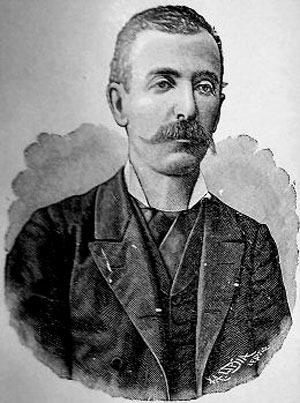
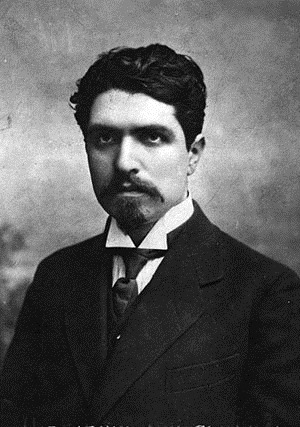
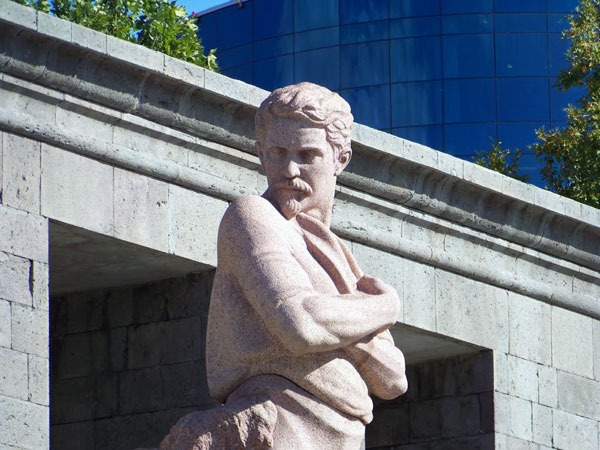
Death of Vahan Terian [Derian]
(January 7, 1920)

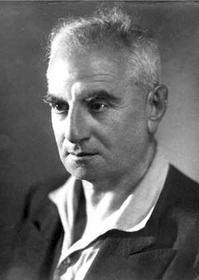
At the beginning of the twentieth century, the lyrical production of Vahan Derian marked a new era in Eastern Armenian poetry. He was hailed by Hovhannes Tumanian as the most original poetical voice of his age, and his works closed the first period of modern Armenian literature.VahanDerian
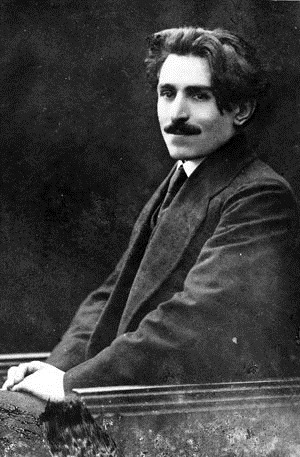
His real name was Vahan Der Krikorian. He was born on January 28, 1885 in the village of Gandza, in the region of Akhalkalak (Djavakhk), today in Georgia. He departed to Tiflis, where his elder brothers were studying, in 1897. He learned Russian with them and prepared to enter the Lazarian Oriental Institute in Moscow. He was admitted in 1899 at the Institute, where he met and befriended several young people who would become important public and literary figures, such as Alexander Miasnikian, Boghos Makintsin, Tsolak Khanzadian, and others. He graduated in 1906 and entered Moscow University.

However, Terian had already engaged in revolutionary activities, as a sympathizer of the Bolshevik branch of the Russian Social Democratic Party. Soon after entering the university, he was arrested and briefly jailed in the prison of Butirka in Moscow.

After his liberation, he published his first volume of poetry, Twilight Dreams, in Tiflis (1908). It was very well-received by readers and critics for its originality. Sadness and pain, spring and love, the homeland and its fate were some of the markers of his poetry, which became the basis for many songs still interpreted today. He married Susanna Pakhalova in 1911 and published the first volume of his collected poetry, titled Poems, in 1912, where he gathered also works written after 1908. He left Moscow University in 1913 and went to St. Petersburg University, where he majored in Oriental Studies.

His wife died in 1916 after giving birth to a daughter, who did not survived. In the same year, the first signals of tuberculosis appeared in the poet. Terian went to the Caucasus for treatment, but the first Russian Revolution (March 1917) prompted him to abandon the region and return to St. Petersburg. He became a close collaborator to Stalin, the future strongman of the Soviet Union.

Derian participated actively in the second Russian Revolution of November 1917, led by the Bolshevik Party, and the civil war that ensued. As Armenian representative at the Commissariat of Nationalities led by Stalin, he participated actively in the writing of the decree on Western Armenia that was issued in January 1918 and proclaimed its freedom of self-determination. As a member of the Central Executive Committee of Soviet Russia, Terian was assigned a mission in Turkestan in late 1919, but his illness had gotten worse and the poet was forced to stop in Orenburg, in Russia, where he passed away on January 7, 1920 at the age of 35. His daughter Nvard, fruit of his relationship with Anahit Shahinjanyan, was born posthumously, in April 1920.

The memory of the poet has been evoked in July in his birthplace with a “Day of Derian Poetry” since 1967, which gathers thousands of admirers every year.
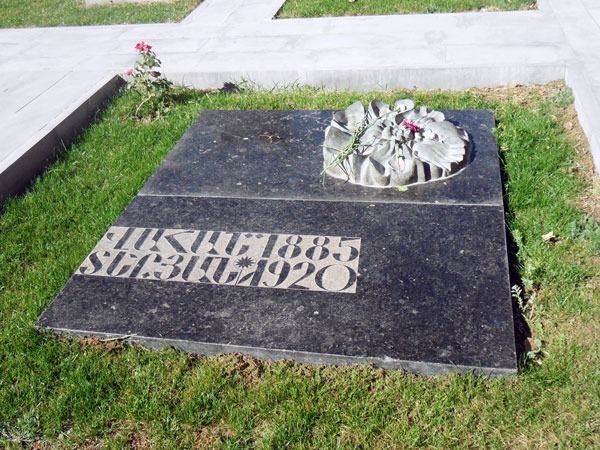
DeriansToumb

The tomb of Vahan Derian at the Pantheon in Yerevan’s Gomidas Park.
Armenian Music in Milwaukee

By David Luhrssen 


Armenian music from the present and past will be live on stage in Milwaukee during the next several months. 

First up, a composition by Detroit’s Eve Beglarian, based on a traditional melody, will be performed as part of Present Music’s "Women in the Chamber" program. An internationally acclaimed ensemble from Milwaukee dedicated to exploring classical music from the 20th and 21st centuries, Present Music will perform Beglarian’s music as part of a concert of work by contemporary female composers. The concert is scheduled for 2 p.m., Jan. 9 at the Women’s Club of Wisconsin, 813 E. Kilbourn Ave.; and 7:30 p.m., Jan. 10 and 11 at Anodyne Coffee Roasters, 224 W. Bruce St. For tickets call (414) 271-0711 or go to www.presentmusic.org. 

Later this year, a nationally recognized touring group called East of the River will present a performance of centuries-old music in a program called "Levantera." Led by Jesse Kotansky on oud and violin, the concert promises to "travel east through the Balkans to Armenia and the Middle East." East of the River will perform at 5 p.m., March 15 at UWM’s Zelazo Center, 2400 E. Kenwood Blvd. For tickets call (414) 225-3113 or go to EarlyMusicNow.org. 

Birth of Hagop Oshagan

THIS WEEK IN ARMENIAN HISTORY
(Prepared by the Armenian National Education Committee[ANEC])

Birth of Hagop Oshagan

(December 9, 1883)

When Hagop Oshagan, one of the foremost Armenian writers of the twentieth century, passed away at the age of 65, he left many thousands of pages of published works in newspapers and many more that were unpublished. In Beirut alone, 33 volumes of published or previously unpublished works bearing his name were published after his death, between 1958 and 2013.HagopOshagan

He was born Hagop Kufejian in the village of Sölöz, near Brusa, in Asia Minor. He was a dropout from school and an autodidact, who read voraciously the classics of the nineteenth century, including Dostoyevsky, his inspiration for his novels. He published his first story in 1902, but his literary career started after 1909 in Constantinople. By 1914 he was already known by his literary criticism and his short stories. He became, along with Gostan Zarian, Kegham Parseghian,  Taniel Varoujan, and Aharon, the founder of the short-lived monthly Mehyan, with the hope of starting a literary movement among Western Armenians that was cut short by the genocide.

He was on the Turkish list of targeted intellectuals, but he managed to escape persecution and arrest, and lived in hiding in Constantinople until early 1918, when he surreptitiously crossed the border into Bulgaria, where he married Araksi Astarjian. They would have three children, Vahe, Anahid, and Garo, of which the first two would be writers. (Vahe Oshagan would become one of the leading intellectuals of the Diaspora in the second half of the twentieth century.) They returned to Constantinople after the Armistice. Kufejian started to use the name Hagop Oshagan around 1920 in the newspaper Jagadamard. He became a teacher and continued his literary production. In 1922 he published another short-lived journal, together with Zarian, Vahan Tekeyan, Shahan Berberian, and Kegham Kavafian, but the new attempt at a literary revival was cut short by the retreat of the Allied forces from Constantinople and the victory of the Kemalist movement in Turkey. He left the city, as many other Armenian intellectuals and much of the community did, and moved back to Bulgaria. After 1924, Oshagan worked as a teacher, first in Cairo, then in Nicosia, at the Melkonian Educational Institute, and finally, after 1934, at the Seminary of Jerusalem. He forged his reputation as a charismatic literature teacher, and a demanding literary critic.

Oshagan published two collections of short writings in the early 1920s, but then he focused on his novels. His literary life was defined by the Catastrophe (he practically coined the term Aghed to name the event that had swept over Western Armenian culture in 1915), as he shifted into the literary reconstruction of the lost world. His magnum opus, Mnatsortats (The Remnants), a three-volume novel published in 1932-1934, depicted the life of a Western Armenian family and the complicated Turkish-Armenian relationship on the eve of the Catastrophe. However, he was unable to write a projected final volume where he intended to represent the deportation itself. The first volume of this novel has just been translated into English by G. M. Goshgarian.

He also wrote the “novel of Western Armenian literature,” Panorama of Western Armenian Literature, a monograph that encompassed the period 1850-1915 in ten volumes, of which only the first was published at the time of his death, and the last nine were published in the next quarter of a century.

Hagop Oshagan passed away in Aleppo on February 17, 1948, on the eve of a planned visit to the killing fields of Der Zor. He was buried at the Armenian Cemetery of the city, in an imposing funeral attended by some 20,000 people.


Hagop Baronian

THIS WEEK IN ARMENIAN HISTORY

(Prepared by the Armenian National Education Committee [ANEC])


Birth of Hagop Baronian
(November 19, 1843)

Every society and every point in time needs critics. Critics may lash out at negative points, and they can hit very hard. However, they will hit even harder if they use satire as their weapon. This is why the late nineteenth century critics of Armenian society are not remembered today, but Hagop Baronian has become the most famous Armenian satirist writer of all time.

He was born in Adrianople (nowadays Edirne, in Eastern Thrace) on November 19, 1843, in a family belonging to the poor class. After graduating from the local Arshaguniats School, he studied for a year at the Greek school of the town (1857-1858). Then he had to contribute to family living. He first worked two years at a pharmacy, and then entered a tobacco company as a bookkeeper. Self-teaching and continuous reading made up for his lack of formal education.

He moved to Constantinople in 1863 and taught at the Scutari Baronian Lyceum, where one of his students was Bedros Turian, the future poet. He entered journalism in 1871 as editor-in-chief of the newspaper Yeprad, but soon took a position as editor of the newspaper Meghu, published by Harutiun Svajian, and turned it into a well-known satirical publication. Meghu ceased publication in 1874 and Svajian transferred the right of publication to Baronian, who renamed it Tadron. Becoming the publisher, Baronian gave a free ride to his lashing and educational wit to criticize the negative aspects of society. However, economic troubles ended the publication of Tadron in 1879.

Baronian married Satenik Etmekjian in 1879 and they had two children, Zabel and Ashod. In the same year, he started to work for Minas Kapamajian’s Luys, as the editor of the comic section. His writing attracted a lot of attention, but Kapamajian did not appreciate him, and Baronian was forced to stop his contribution to Luys.

He started to publish the monthly Khigar in 1884, and despite financial hurdles and short interruptions, managed to continue it until 1888. Some of his most important satirical works were published here.

Between 1871 and 1888, he published more than 10,000 pages in the newspapers, although most of his works were published in book form posthumously. His most important works were the novel The Honorable Beggars, the collection of stories The Perils of Politeness, the satirical chronicles A Trip in the Neighborhoods of Constantinople and National Big Shots, and the comedies The Oriental Dentists and Brother Baghdasar.

To make ends meet, Baronian became a teacher of accountancy at the Getronagan School of Galatia from 1888-1890. One of his students was the famous linguist Hrachia Ajarian. He died of tuberculosis on May 27, 1891, at the age of 48, leaving his widow and his young children penniless. Nevertheless, a compact crowd participated in his burial. His colleague Mateos Mamurian, another noted journalist, wrote: “How many people who loved education and the nation responded to the invitation formulated by the Armenian newspapers at the time of his illness…? As a matter of fact, what did we do for the poor man? What did the nation make collectively for its brave son? It made the burial and just decided to collect monies for his orphans. There was not a single official body or individual who would put a crown of flowers on the immortal Baronian, even though his works are his perennial crowns.”

As supreme irony, Baronian was buried in the cemetery of Ortakeuy without a tombstone marking his grave, and the exact location was soon forgotten. Nevertheless, his works were widely published and read after his death; his plays have been frequently performed and even turned into movies (The Perils of Politeness and The Honorable Beggars were adapted into plays), and the comedy theater of Yerevan bears his name.

MARIE JACOBSEN

130th BIRTHDAY OF MARIE JACOBSEN

Yesterday, November 6, was the 130th birthday of Marie Jacobsen, the 24-year old Danish missionary who saved thousands of Armenian children during the Genocide. She was lovingly called “Mama” by the thousands who grew up under her care, first in Kharpurt, and later in an orphanage located between Byblos and Beirut in Lebanon called “The Birds Nest.”

The Birds Nest remained under DanMarieJAcobsonish supervision until 1970 when the Danish missionaries turned it over to the care of the Catholicosate of the Great House of Cilicia, as it continues to this day. Marie Jacobsen was extraordinary because of her lifelong devotion to missionary work and to Armenian children, but she was also extraordinary because she kept voluminous diaries. She kept extensive day by day accounts and records of events. Her diaries are one of the most detailed and most important primary accounts of the genocide.

We will light a candle in her memory this Sunday in church. Hope you will also.

To read a remembrance of Marie Jacobsen, “Pink Flowers for Mama,” that appeared in the April 1996 issue of Outreach click here.

Posted from Eastern Prelacy’s E-Newsletter.

Stepan Malkhasiants

THIS WEEK IN ARMENIAN HISTORY
(Prepared by the Armenian National Education Committee[ANEC])

Birth of Stepan Malkhasiants
(November 7, 1857)

Modern Armenian did not have a fully comprehensive dictionary of the language until the mid-twentieth century, and such a dictionary was the result of the two-decade efforts of one man, Stepan Malkhasiants.

Stepan (Stepanos) Malkhasiants was born on November 7, 1857 in Akhaltskha, actual Djavakhk, in the Republic of Georgia. He graduated from the Armenian parish school and then continued studies at the Russian district school of his hometown and the Kevorkian Seminary of Vagharshapat (1874-1878). He entered the School of Oriental Studies of the Imperial University of St. Petersburg in 1878 and graduated with a Ph.D. in Armenian, Sanskrit, and Georgian in 1889. By then, he had already published his first scholarly work, the critical edition of tenth-century historian Asoghik’s Universal History (1885).

In 1890 Malkhasiants started his long educational career as teacher at the Nersisian School of Tbilisi, where he worked for twenty years. He was also the principal of the school from 1903-1906, and during these years he married Satenik Benklian. He produced the history of the Nersisian School, as well as several textbooks and many articles in the scientific and popular press. He also wrote two seminal monographs on the grammar of Classical Armenian.
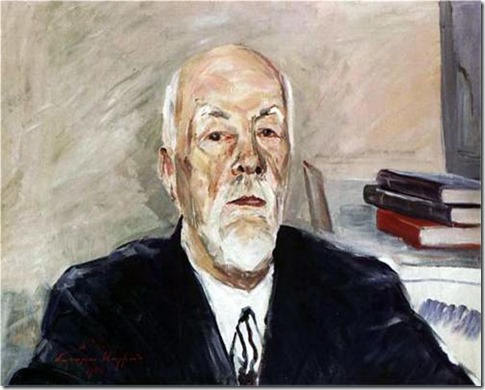
Malkhasiants

A portrait of Stepan Malkhasiants painted by Martiros Saryan.

Between 1910 and 1919 he became principal of several schools:  Hovnanian Girls’ School of Tbilisi (1910-1914), Kevorkian Seminary of Vagharshapat (1915-1917), Gayanian School of Tbilisi (1915-1919). After 1917 he became one of the leading figures of the newly-founded Armenian Popular Party (one of the ancestors of the current Armenian Democratic Liberal Party). Finally, in 1919 he settled in Armenia and worked for a year at the University of Armenia, which was opened in Alexandropol (now Gumri). His report to the Parliament in 1918 became the grounds for the adoption of the Armenian tricolor flag as the official symbol of the first independent Republic (1918-1920). He gave the first lecture at the recently opened Yerevan State University on February 1, 1920.

Malkhasiants published several important works in the last decades of his life, such as the critical edition of seventh century historian Sebeos (1939), and the Modern Armenian version of Movses Khorenatsi’s (1940) and Pavstos Buzand’s (1947) histories. He received a doctorate honoris causa in 1940 and became a founding member of the Armenian Academy of Sciences in 1943. But his lifetime achievement was the publication of the Explanatory Dictionary of the Armenian Language (Հայերէն բացատրական բառարան), in four volumes and 2,380 pages in three columns, in 1944-1945.

He had already acquired great experience in the preparation of dictionaries and the publication of the four-volume dictionary was the result of more than two decades of meticulous research. The dictionary, with 120,000 entries, comprised the vocabulary of Classical, Medieval, and Modern Armenian (both Eastern and Western), as well as dialects and even neologisms entering the language until 1940 with examples of usage. The dictionary, published exceptionally in Classical spelling (instead of the spelling currently in use in Armenia), still remains a fundamental source for any student of the Armenian language. It won the State Prize of the Soviet Union and was reprinted three times (Beirut, 1955-1956; Tehran, 1982; Yerevan, 2008).

Malkhasiants became a member of the Supreme Council of Holy Echmiadzin after 1944 and a member of the editorial board of the journal Echmiadzin. He passed away on July 21, 1947 in Yerevan, shortly before his ninetieth anniversary.


By David Luhrssen


(Greenfield, Wis.) The Mazmanian Family took its audience on a musical world tour with Armenia as the home base. At their Oct. 26 concert at St. John the Baptist Armenian Church in Greenfield, the quartet journeyed across Eastern Europe, to Spain via Cuba, to Ireland and the U.S., but their repertoire’s heart and soul was rooted in the Armenian homeland.

Leading the San Francisco ensemble was violinist Greg Mazmanian, a veteran musician who has performed with the San Francisco Symphony Orchestra along with Frank Sinatra, Tony Bennett and Ray Charles. He acted as the evening’s gracious host and humorous icebreaker in brief introductions for each piece on the program, and leading his three grown children through the selections. Ida anchored the quartet on piano with siblings Eddy and Rose joining their father on violin.

The Mazmanian Family

The Mazmanians harmonized virtuosity and entertainment in a program that included Gypsy music, a rendition of the jazz standard “Take Five” as never heard before and an original variation on the familiar melody of “Fiddler on the Roof.” The torrid flamenco rhythms of “Malaguena” by Cuban composer Ernesto Lecuona provided lively contrast. The Mazmanians responded to an audience request by performing a medley of Irish jigs.

Much of the evening, however, was rooted in Armenian traditional music, especially the melodies collected at the turn of the 20th century by Gomidas Vartabed and transmuted into art songs. After a standing ovation, the Mazmanians concluded their concert with a rousing encore of Aram Khachaturian’s “Sabre Dance.”

Fall of Kars

THIS WEEK IN ARMENIAN HISTORY

(Prepared by the Armenian National Education Committee [ANEC])


Fall of Kars
 (October 30, 1920)

The Turkish nationalist movement headed by Mustafa Kemal, with headquarters in Ankara, did not recognize the Treaty of Sevres signed by the legal government of the Ottoman Empire on August 10, 1920. Barely a month later, on September 23, Turkish armed forces under the command of General Kiazim Karabekir started an attack, without mediating a war declaration, against the Republic of Armenia. A month later, again, the fortress of Kars—the most important bulwark of the Southern Caucasus—would fall almost without a fight to the advancing troops.

Kars, the capital of an Armenian medieval kingdom ruled by a branch of the Bagratuni family, had changed hands several times over the past hundred years. After being briefly occupied by Russian troops in 1855 during the Crimea War of 1854-1856, it was occupied again during the Russian-Turkish war of 1877 and annexed to the Russian Empire as a result of the Treaty of Berlin in 1878. It fell to the advancing Turkish troops in March 1918 and was re-conquered by the troops of the newly born Republic of Armenia after the Turkish retreat following the end of World War I.

The young commander of the fortress, Col. Mazmanian, gave the order of attack to his soldiers, who refused to follow his orders and, instead, deserted. Confronted with the shameful desertion, Mazmanian took his own life with his revolver in the sight of his soldiers. According to the memoirs of Karabekir and other sources, the Kemalist soldiers and the Turkish, Kurdish, Muslim, and Armenian Bolshevik rebels occupied the entire city in three hours, took hundreds of Armenian officers and soldiers as prisoners, seized an enormous quantity of war material (cannons, projectiles, weapons, and bullets) and massacred thousands of people among the civil population; in 1920-1921, the Turks would kill a total of 20,000 Armenians in the city and the province of Kars. Years later, Garegin Nejdeh, who headed the successful defense of Zangezur against the attacks of Azerbaijanis and Bolsheviks from 1919-1921, would write: “The shame of Kars is not only of the government of the Republic of Armenia, but of the entire Armenian people. The armies measure their forces and clash, but the nations are the winners or the losers. Under the walls of Kars, not only the Armenian soldier and the general were defeated, but also the entire Armenian people, lacking spirit of fight and bravery."

The effects of the fall of Kars would be catastrophic. Despite Armenian heroic resistance in other places, two weeks later, Alexandropol (now Gumri) fell to the Turks, which practically reached the outskirts of Yerevan from the west. The cabinet of Prime Minister Hamo Ohanjanian fell, and Simon Vratzian became Prime Minister of a coalition cabinet, which lasted scarcely a week. On November 29, 1920, Bolshevik forces entered Armenia from the east, and the Armenian government, confronting the menace of destruction, chose the lesser of two evils and power was transferred to the Communists on December 2. Armenia would enter the Soviet Union in 1922 as part of the Federative Republic of Transcaucasia.

The trauma of the fall was masterfully addressed by poet Yeghishe Charents, a native of Kars, in his only novel, Yerkir Nayiri (Land of Nayiri), published in 1926. The fall of Kars still remains a polemical one in the historiography of the Republic of Armenia.

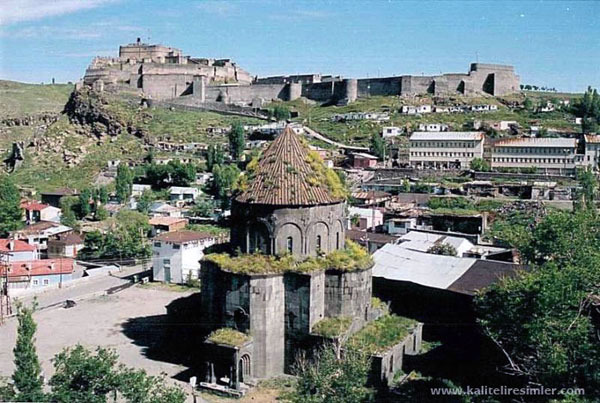
Gars

A general view of modern Kars with the central Armenian church in the foreground and the fortress in the background.

Death of Gomidas Vartabed

THIS WEEK IN ARMENIAN HISTORY

(Prepared by the Armenian National Education Committee [ANEC])


Death of Gomidas Vartabed

(October 22, 1935)


Gomidas Vartabed was a survivor of the Armenian Genocide, but he was also a victim of it, for he was never able to recover from the traumatic effects of his short-termed deportation.

Soghomon Soghomonian was born in Kütahya (Gudina), in western Turkey, on October 8, 1869. His family was Turkish-speaking.  He lost his mother when he was one year old and his father when he was ten. In 1881 he was taken to Holy Etchmiadzin, where he entered the Kevorkian Seminary.

His exceptional voice and musical abilities attracted special attention. He studied Armenian musical notes and religious music, collected popular songs, and made his first attempts at composing. In 1893 he graduated and was designated music teacher and choirmaster of the cathedral. One year later he was ordained a celibate priest, and named Gomidas in honor of Catholicos Gomidas, a musician and poet of the 7th century. In 1895, he was elevated to the rank of archimandrite (vartabed).Gomidas

He pursued musical studies in Berlin from 1896-1899. He returned to Etchmiadzin from 1899-1910. He collected close to 3,000 popular songs and dances, which he mostly arranged for choir versions. He presented his arrangements of Armenian popular and religious music in Paris (1906) with great success.

His musical programs included folk and sacred music, but his actions and ideas upset a conservative faction in Etchmiadzin. After Catholicos Mgrdich I (Khrimian Hairig) passed away in 1907, Gomidas’ situation became more problematic. He wrote that he could not breathe and was suffocating in Etchmiadzin. His formal request to become a hermit and continue his work was denied, and finally he decided to move to Constantinople.

He created the 300-member “Kusan” Choir and gave concerts in various places in the Ottoman Empire and Egypt. Five of its members (Parsegh Ganachian, Mihran Toumajan, Vartan Sarxian, Vagharshag Srvantzdian, and Haig Semerjian) took classes of musical theory with him and came to be known as the “five Gomidas students.”

In April 1915, Gomidas was arrested with more than 200 Armenian intellectuals and community leaders and exiled to Chankiri. His behavior changed along the exile route. A few weeks later, while officiating at a church service, word came that he would be sent back to Constantinople with a few other notables.

The return was very difficult for him. His friends could not understand his odd behavior and considered him mad, committing him to the Turkish Military Psychiatric Hospital. Many of his compositions and notes were dispersed and lost.

In 1919 he was sent to Paris, where he spent the rest of his life, first in a private psychiatric hospital and then in the Villejuif asylum, where he passed away. In 1936 his body was sent to Armenia and buried in the pantheon named after him, where famous personalities found their final rest. The Music Conservatory of Yerevan is named after him, as is the state chamber quartet.

Gomidas was justly termed the Father of Armenian Music, as he rescued from oblivion more than 4,000 village songs and melodies, and set the foundation for the scientific study of Armenian music. He also wrote pieces for piano and songs, fragments for comedies and operas. His version of the Holy Mass is a classic work, used to this day by the Armenian Church.

Stepan Shahumian

THIS WEEK IN ARMENIAN HISTORY

Prepared by the Armenian National Education Committee (ANEC)


Birth of Stepan Shahumian
(
October 13, 1878)

After the independence of Armenia and Karabagh, neither the city of Stepanavan, in the northern region of Lori, which was severely damaged during the earthquake of 1988, nor Stepanakert, the capital of the Republic of Mountainous (Nagorno) Karabagh, changed their names, even though they had been renamed after a famous communist revolutionary.

Stepan Shahumian was born in Tiflis to a working family. He studied at the Royal School in his hometown and then followed with university studies in St. Petersburg and Riga (1898-1902). He was attracted by Marxism in early 1900. He graduated from the philosophy department of Alexander Humboldt University in Germany in 1905, while being actively involved in politics following Shahoumianthe line of Vladimir Lenin, the leader of the Bolshevik fraction of the Russian Social Democratic Party.

Shahumian returned to the Caucasus in 1905 and became a leader first in Tiflis and then in Baku from 1907, both actively in the field and as an editor and polemicist. After being exiled to Astrakhan in 1912, he returned to Baku in 1914. He was arrested in March 1916 and exiled to Saratov, and liberated only after the February Revolution of 1917.

He returned to Baku once again, and led the Soviet of Workers and  Villagers, which in November 1917 took control of the city. Shahumian was designated Extraordinary Commissar for the Caucasus in December. The Turkish army expanded its military campaign on the Caucasian front in late March 1918; encouraged, the Azerbaijani Musavat Party stepped up its anti-Soviet work and attempted to seize Baku to establish its own regime. After the crushing of the revolt, the Soviets took full control of the city government and established an alliance of Bolsheviks, Left Socialist Revolutionaries, Mensheviks (Social Democrats), and Armenian Revolutionary Federation members, chaired by Shahumian, which was known as the Baku Commune.

The Bolsheviks clashed with the A.R.F. and the Mensheviks over the involvement of British forces, which the latter two welcomed. In either case, Shahumian was under direct orders from Moscow to refuse any and all aid offered by the British. However, in July the alliance broke and a new government replaced the Commune by the Central Caspian Dictatorship, with an alliance of Right Socialist Revolutionaries, Mensheviks, and A.R.F. members; British forces temporarily entered Baku to abandon it later.

On July 31, the 26 commissars attempted the evacuation of Bolshevik armed forces by sailing over to Astrakhan, but the ships were captured by the military vessels of the Dictatorship two weeks later. They were arrested and placed in Baku prison. The city fell to Turkish forces, despite the heroic resistance of the Armenian population, which executed the massacre of 15,000 to 20,000 Armenians.

Amidst the confusion, Shahumian and his fellow commissars either escaped or were released on September 14. They boarded a ship to Krasnovodsk, where upon arrival they were arrested by anti-Bolshevik elements. In the end, on the night of September 20, Stepan Shahumian and the other 25 Baku commissars were executed by a firing squad on a remote location on the Trans-Caspian railway. Together with Shahumian and various Azerbaijanis, Georgians, and Russians, six other Armenians perished: Arsen Amirian, Suren Hovsepian, Armenak Borian, Baghdasar Avakian, Aram Kostandian, and Tateos Amirian.

 ShahoumianStatue

A statue of Stepan Shahumyan located in central Yerevan.