FALL OF ARDZEVASHEN

THIS WEEK IN ARMENIAN HISTORY
(Prepared by the Armenian National Education Committee [ANEC])

Fall of Ardzevashen
 (August 8, 1992)


The Soviet policy of “divide and rule” created ethnic enclaves (piece of land surrounded by foreign territory) under various pretexts, such as the incorporation in Azerbaijan of the highlands of the historically Armenian region of Karapagh as an autonomous region (the lowlands were directly annexed to that country). It also created exclaves (piece of land politically attached to a larger piece, but surrounded by foreign territory), such as Ardzevashen, part of the Kegharkounik province of Armenia.

The village of Ardzevashen was founded in 1854 with the name of Bashkend by Armenians from Shamshadin, although an inscription on the St. Hovhannes church of the village, dated to 1607, attests to an earlier Armenian presence on the site.

The population of the village was entirely of Armenian origin. It had a surrounding territory of 40 square kilometers (15.5 square miles) and enjoyed a town status in the 1980s, managing four factories. This included a branch of Haykork, the Armenian state carpet company.

In May 1991, during the last months of the Soviet Union, when the conflict for Karapagh had already started, the inhabitants of the village surrendered their weapons to Soviet military units to avert an imminent occupation.

Indeed, Azerbaijan was prone to occupy those portions of Armenian territory that were completely landlocked, and one of them was Ardzevashen. After a four-day resistance headed by the unit 016 of motorized artillery of Vanatsor, Ardzevashen was surrendered to Azerbaijani armed forces on August 8, 1992. According to The New York Times, Azerbaijan announced the “liberation” of the town, destroying enemy tanks and weaponry, and killing 300 Armenian “brigands,” while Armenian reports did not mention any dead, but said that 29 people were “missing without trace.” The bodies of 12 Armenian soldiers were later delivered; one of the Azerbaijani colonels declared: “They fought until the last bullet. They are the pride of your nation.”

The Armenian population was given one hour to evacuate the village. According to the Regional Administration of Kegharkounik, 719 families (around 2,800 people) were displaced after its occupation. A total of 664 families resettled in the towns of Chambarak and nearby villages, and the rest went to other provinces. The migrants were not considered a separate commune, but the government of the Republic decided to create a separate working staff, financed by the national budget. This staff takes care of problems related to documents and workbooks of displaced people, as well as claims of property rights and improvement of living conditions.

KILLING OF ENVER PASHA

THIS WEEK IN ARMENIAN HISTORY
(Prepared by the Armenian National Education Committee [ANEC])

 Killing of Enver Pasha
(August 4, 1922)

EnverPasha

Enver Pasha

The Russian revolution of November 1917 that set the grounds for the Soviet Union was followed by a civil war. Bolshevik troops were sent into Central Asia to establish Soviet power in 1919-1920. A local movement headed by Muslim elements, known as the Basmachi revolt (the Turkic word basmachi originally meant “bandit”), took advantage of the blunders of the Soviet government in Tashkent (the current capital of Uzbekistan) to challenge its authority and set a movement of national liberation.

Enver Pasha, former Ministry of War of the Ottoman Empire and one of the main perpetrators of the Armenian Genocide, had become a fugitive of justice after his condemnation to death in absentia by the Ottoman court-martial in July 1919. He had first left Constantinople for Berlin in late 1918 and in 1919 had gone to Moscow, where he engaged in pro-Turkish activities among the Bolsheviks. After participating in the Congress of Eastern Peoples of Baku (September 1920), he tried to reenter Anatolia in 1921, but was rejected by Mustafa Kemal.

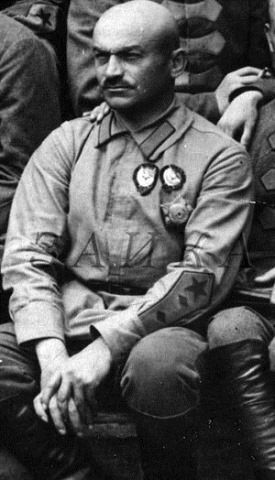
HagopMelkoumian

Hakob Melkumian

Enver decided to return to Moscow and won over the trust of Soviet authorities. Lenin sent him to Bukhara, in Soviet Turkestan, to help suppress the Basmachi Revolt. He arrived on November 8, 1921. Instead of carrying his mission, he made secret contacts with some rebel leaders and defected along with a small number of followers. He aimed at uniting the numerous rebel groups under his own command and taking the offensive against the Bolsheviks. He managed to turn the disorganized rebel forces into a small well-drilled army and establish himself as its supreme commander. However, David Fromkin has written, “he was a vain, strutting man who loved uniforms, medals and titles. For use in stamping official documents, he ordered a golden seal that described him as ‘Commander-in-Chief of all the Armies of Islam, Son-in-Law of the Caliph and Representative of the Prophet.’ Soon he was calling himself Emir of Turkestan, a practice not conducive to good relations with the Emir whose cause he served. At some point in the first half of 1922, the Emir of Bukhara broke off relations with him, depriving him of troops and much-needed financial support. The Emir of Afghanistan also failed to march to his aid.”

Operation Nemesis had succeeded in the liquidation of several of Enver’s colleagues in European capitals. An Armenian group assassinated Ahmed Djemal Pasha on July 25, 1922, in Tiflis under the very sight of the Cheka, the Soviet secret police. Ten days later, Enver would find his own Armenian nemesis in Central Asia.

Yakov Melkumov (Hakob Melkumian), born in Shushi (Gharabagh) in 1885, was a decorated career officer who had participated in World War I and after the revolution had entered the Red Army. After fighting in Bielorrusia (Belarus) in 1918, he became a cavalry brigade commander in Turkestan in late 1919, and from 1920-1923 he was involved in the suppression of the Basmachi revolt.

On August 4, 1922 Melkumian’s brigade launched a surprise attack while Enver had allowed his troops to celebrate the Kurban Bayrami holiday, retaining a 30-men guard at his headquarters near the village of Ab-i-Derya, near Dushanbe. Some Turkish sources claimed that Enver and his men charged the approaching troops, and the Turkish leader was killed by machine-gun fire. Melkumian published his memoirs in 1960, where he stated that Enver had managed to escape on horseback and hid for four days in the village of Chaghan. A Red Army officer infiltrated the village in disguise and located his hideout, after which the troops stormed Chaghan, and Melkumian himself killed Enver in the ensuing combat.

After seven decades in Ab-i-Derya, Enver’s remains were taken to Turkey in 1996 and buried at the Monument of Liberty cemetery in Istanbul. Melkumian was decorated with the second order of the Red Army for killing Enver and defeating his forces. The Armenian officer continued his military career until 1937 in Central Asia. He was arrested in June 1937, during the heyday of the Stalinist purges, and charged with participated in the “military-fascist conspiracy.” He was sentenced to 15 years in prison and 5 years of deprivation of civil rights. After the death of Stalin, he was freed in 1954 and rehabilitated. He died in Moscow in 1962.


IVAN AIVAZOVSKY

THIS WEEK IN ARMENIAN HISTORY
(Prepared by the Armenian National Education Committee [ANEC])


Birth of Ivan Aivazovsky
(July 29, 1817)

Ivan Aivazovsky is considered one of the greatest marine painters in history. Famous Russian story writer Anton Chekhov popularized the winger word “worthy of Aivazovsky’s brush,” used for “describing something ineffably lovely.”

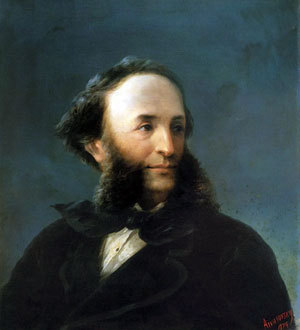
aivazovskySelfPortrait

Self Portrait, 1874

Aivazovsky was born Hovhannes Aivazian on July 29, 1817, in Feodosia, a port on the Black Sea in Crimea. He received parochial education at the local St. Sargis Armenian Church and was taught drawing by a local architect. He attended the Russian gymnasium of Simferopol from 1830-1833 and then studied at the Imperial Academy of Arts from 1833-1837, graduating with gold medal two years in advance.

The promising painter was sent by the Academy in 1840 to study in Europe. He first traveled to Venice, where his brother Gabriel was a member of the Mekhitarist Congregation (he would leave the congregation and return to the Armenian Apostolic Church in the 1850s). Aivazovsky studied Armenian manuscripts and became familiar with Armenian art. After a four year sojourn in Italy and France, with visits to half a dozen European countries and prolific exhibitions, he returned to Russia in 1844.

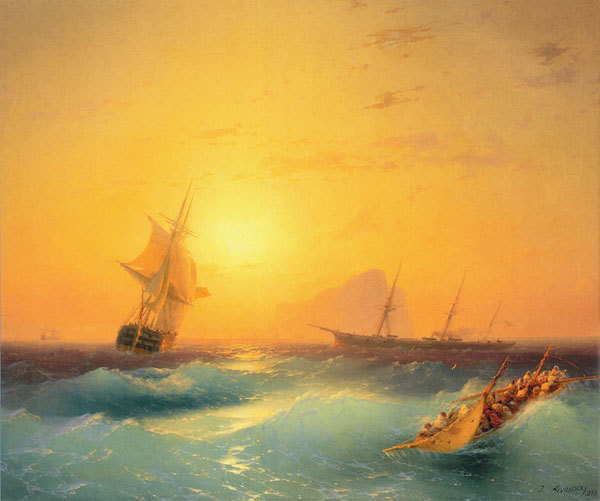
American Shipping off the Rock of Gibraltar1873

American Shipping off the Rock of Gibraltar, 1873

Upon his return, he was appointed academician of the Imperial Academy of Arts, from where he had graduated seven years before, and appointed the official artist of the Russian Navy. After traveling to the Aegean Sea and Constantinople in 1845, he settled in his hometown, Feodosia. The Academy gave him a title of professor of seascape painting in 1847, while the Royal Netherlands Academy of Arts and Sciences elected him a member in the same year.

He married English governess Julia Graves in 1848 and had four daughters. They separated in 1860 and divorced in 1877 with permission from the Armenian Church, since Graves was a Lutheran.

Aivazovsky would receive many honors throughout his life: first non-French artist to receive the Legion d’Honneur in France (1857), Order of the Medjidie (Ottoman Empire, 1857), honorary member of the Moscow Art Society (1857), Order of the Redeemer (Greece, 1859), Order of St. Vladimir (Russia, 1865), Order of Osmanieh (Ottoman Empire, 1874), member of the Academy of Arts of Florence (Italy, 1876), honorary member of the Royal Academy of Fine Arts of Stuttgart (Germany, 1878), and others. He held fifty-five solo exhibitions over the course of his career in the Russian Empire, Europe, and the United States (New York, Chicago, and San Francisco, 1893), and participated in many collective exhibitions. He was one of the most prolific artists of his time: he created around 6,000 paintings during his almost sixty-year career. The vast majority of his works are seascapes, but he often depicted battle scenes, Armenian themes, and portraiture. He never painted his pictures from nature, but from memory. His artistic memory was legendary, The Ninth Wave (1850, State Russian Museum, St. Petersburg) is generally considered his masterpiece.

Aivazovsky visited Russian Armenia for the first time in 1868. The next year, he participated in the opening ceremony of the Suez Canal in Egypt, and became the first artist to paint the Canal. He continued his travels abroad during the next three decades, including a trip to the United States in 1892. In 1880, he opened an art gallery in his Feodosia house, which became the third museum in the Russian Empire, after the Hermitage Museum of St. Petersburg and the Tretyakov Gallery of Moscow. Two years later, he remarried to a young Armenian widow, Anna Burnazian. He said that he “became closer to [his] nation” by marrying her. His career across the civil ranks of Russian government reached its highest position in 1896 when, at the age of 79, he was promoted to the rank of full privy councillor.

Aivazovsky was deeply affected by the Hamidian massacres of 1894 and 1896. He painted a number of works on the subject. More symbolically, he threw the medals given to him by the Ottoman Sultan into the sea and told the Turkish consul in Feodosia: “Tell your bloodthirsty master that I’ve thrown away all the medals given to me, here are their ribbons, send it to him and if he wants, he can throw them into the seas painted by me.” He spent his last years in his hometown, to which he contributed many efforts to its improvement.

Aivazovsky passed away on May 2, 1900, in Feodosia and was buried in the courtyard of the St. Sarkis Church. A quote in Classical Armenian from Movses Khorenatsi’s History of Armenia is engraved on his tombstone: “Born as a mortal, left an immortal memory of himself.


THIS WEEK IN ARMENIAN HISTORY
(Prepared by the Armenian National Education Committee [ANEC])


Assassination of Djemal Pasha
(July 21, 1922)

JamalPasha

Djemal Pasha

The Nemesis Operation, approved by the Armenian Revolutionary Federation in its 9th World Assembly, held in Yerevan in September-October 1919, had a long list of Turkish leaders responsible for the Armenian Genocide among its targets.

One of them was Ahmed Jemal, minister of Marine of the Ottoman Empire and member of the leading triumvirate of the Committee of Union and Progress (Ittihad), together with Talaat, minister of Interior, and Enver, minister of War. Jemal had taken the command of the IV Ottoman Army, based in Syria, and had overseen the execution of the second phase of the genocide, when the survivors of the caravans of deportees were dispatched and killed in the  camps along the Euphrates River. He had also been in charge of the assimilation of Armenian orphans.

Some targets of the operation, such as Talaat and former grand vizier Said Halim, Behaeddin Shakir (leader of the Special Organization) and Jemal Azmi (the “monster of Trebizond”), had been liquidated in Berlin and Rome, under the supervision of the special body created by the A.R.F. (Enver would be killed by a Bolshevik Armenian in August 1922, in Central Asia.) Jemal Pasha was also in Berlin, but had been able to avoid the Armenian avengers.

On July 26, 1922, The New York Times published a dispatch of the Associated Press, with byline Tiflis:

“Djemal Pasha, former Minister of Marine in the Turkish Unionist Government, Chief of Staff of the Afghan Army, has been assassinated here. Two Armenians are charged with the crime.

“Djemal Pasha was accompanied by two aides, who were also shot dead. He was traveling to Kabul from Berlin, where he had made important purchases from [sic] the Afghan Army.”

The Central Committee of the A.R.F. in Georgia still operated, although clandestinely, after Georgia had become a Soviet republic in March 1921. It organized the killing, according to Simon Vratzian:

“At the initiative of the Armenian Revolutionary Federation’s Central Committee of Georgia, on July 21, 1922, in Tiflis and in broad daylight, the last surviving member [of the Ittihad triumvirate] and friend and accomplice of the Bolsheviks, Jemal Pasha, was assassinated. The incident had a shocking effect on everyone. The Cheka made innumerable arrests but did not dare to violent measures for fear of retaliations. Dro got permission from Moscow and quickly left for Tiflis, where all the distinguished Dashnaktsakans had been arrested. Dro’s prestige in the eyes of both the Dashnaktsakan comrades and the Bolsheviks was so great that it was possible for him to get the members of the Central Committee and other prisoners out of jail with conditions acceptable to both parties.”

Little is known about the details of the operation. The name of Stepan Dzaghigian (who would later die in Siberia, exiled during the Stalinist purges) has been mentioned as one of the executors, helped by Petros Ter Poghosian and Ardashes Gevorgian. A fourth name, Zareh Melik-Shahnazarian, has also been mentioned as their collaborator in the last years, with the archives still waiting to yield their secrets.


ARSHAG TCHOBANIAN

THIS WEEK IN ARMENIAN HISTORY
(Prepared by the Armenian National Education Committee [ANEC])


Arshag Tchobanian
(July 15, 1872)

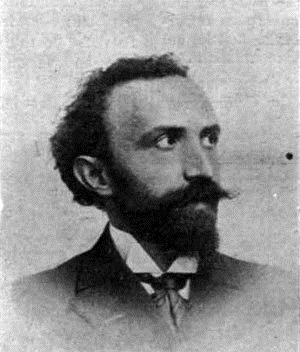
An influential literary critic and political activist, Arshag Tchobanian would become a sought-after name in the first half of the twentieth century.

ArshagTchobanian

Arshag Tchobanian

He was born in Constantinople on July 15, 1872. He lost his mother when he was a year old. After graduating from the Makruhian School in his neighborhood of Beshigtash (1886), he entered the newly founded Getronagan (Central) School in 1886. He graduated in 1891, when he had already started his literary contributions to the most important newspapers of the time, Arevelk and Hairenik. He published his first two books in 1891 and 1892. He taught at his alma mater in 1892-1893 and, after a year sojourn in France, continued his teaching. In 1895 he published a literary monthly, Dzaghig, but, due to the political repression and the Hamidian massacres of 1895-1896, he decided to leave Constantinople for good. He settled in Paris, where he would live the rest of his life.

Tchobanian became the leading voice of the Armenians in France and a promoter of Armenian literature and the Armenian Cause in Europe, with many publications in various journals and newspapers, and a series of books in French, along with his own wide production in Armenian. Among his books in French, the most important would be the three-volume Roseraie de l’Arménie (Rose Garden of Armenia), dedicated to Armenian medieval poetry, a subject of which he was a respected translator and scholar.

Between 1898 and 1911, he published the literary journal Anahid, which would become an influential name in Armenian literature. He also wrote for many Armenian newspapers throughout the world.

Tchobanian adopted ideological positions closer to the Reorganized Hunchakian Party, created after the division of the Hunchakian Party in 1896. Later, he entered the ranks of the Liberal Party, created after 1908 in Europe by members of the Reorganized Hunchakian Party.

The Armenian writer was an activist of the Armenian Cause during World War I and denounced the genocidal policy of Turkey. He was the editor of the newspaper Veradznunt from 1917-1919 and became a member of the Armenian National Delegation led by Boghos Nubar in February 1919. He was sent to Lebanon and Cilicia in 1920 to negotiate with the French authorities, at a time when Cilicia was still under French mandate, before being abandoned to the forces of Mustafa Kemal.

In October 1921 Tchobanian entered the Democratic Liberal (Ramgavar Azadagan) Party, founded in Constantinople, and was elected first chairman of its Central Board. During the 1920s, along with the party, he adopted a position favorable to cooperation with Soviet Armenia to further its economic and social development, including the settlement of Armenian refugees and orphans. He visited year the United States from coast to coast in 1926-1927. In 1929 he relaunched Anahid, which would last until 1949, with a pause between 1940 and 1946 due to World War II.

Tchobanian would continue his literary and public activities until his death on June 8, 1954, killed by a car when crossing a street in Paris at the age of 82.


THIS WEEK IN ARMENIAN HISTORY
(Prepared by the Armenian National Education Committee [ANEC])


Mountainous Gharapagh
Becomes Part of Soviet Azerbaijan
(July 5, 1921)

The establishment of the Soviet regime in the Southern Caucasus between April 1920 and April of 1921 included the solution of ethno-territorial conflicts such as that of Mountainous Gharapagh, which had been in dispute between Armenia and Azerbaijan since 1918.

Soviet Russia had recognized the mountainous area of Gharapagh as a disputed zone and, in August 1920, after an agreement signed by Soviet Russian and the Republic of Armenia, Russian forces had been temporarily deployed in the region.

On November 30, 1920, one day after the Armenian Bolsheviks had proclaimed Armenia as a Soviet republic (the power was actually transferred on December 2), the Revolutionary Committee of Azerbaijan (the highest executive power of the country at the moment) recognized that Gharapagh, Zangezur, and Nakhichevan, territories formerly pretended by Azerbaijan, were indivisible part of Armenia. GharabaghMap

The National Council of Azerbaijan, on the basis of the agreement signed by Soviet Azerbaijan and Soviet Armenia, proclaimed Mountainous Gharapagh as indivisible part of Armenia by the declaration of June 12, 1921. On the basis of the November 30, 1920 declaration and the agreement signed by the Soviet governments of Azerbaijan and Armenia, Armenia also made a similar declaration.

The text of the decree approved by the government of Armenia was published in the Armenian and Azerbaijani press (Bakinski rabotchi, organ of the Communist Party of Azerbaijan, June 22, 1921), thus confirming legally the union of Mountainous Gharapagh to Armenia. In the context of international law, this was the last legal act regarding Mountainous Gharapagh during the Communist regime.

The fact was totally overlooked by the Caucasian Bureau of the Communist Party of Russia, which invited to a plenary session on July 4, 1921 in Tbilisi, where the union of Mountainous Gharapagh to Soviet Armenia was confirmed as a fact. However, by suggestion of Moscow and the immediate intervention of Joseph Stalin, the decision of the previous day was revised in the wee hours of July 5 and a new resolution was imposed, which established that Mountainous Gharapagh would be part of Soviet Azerbaijan as an autonomous region. This resolution was an unprecedented legal act in the history of international law, when the party body of a third country (Russia), without any legal grounds or jurisdiction, decided the status of Mountainous Gharapagh after another decision had been agreed before.

The Soviet republics of Azerbaijan and Armenia were included in the process of the formation of the Union of Soviet Socialist Republics in December 1922. Despite the resistance of the Armenian population, on a small fraction of the territory of Gharapagh, by decision of the Central Executive Revolutionary Committee of Soviet Azerbaijan, on July 7, 1923, the Autonomous Region (Oblast) of Mountainous (Nagorno) Gharapagh was formed as part of the Soviet Socialist Republic of Azerbaijan, without having any common borders with Armenia.

This would not solve, but just freeze the question of Gharapagh for the next six decades and half, until the popular explosion of 1988 and the beginning of the Gharapagh movement.


THIS WEEK IN ARMENIAN HISTORY
(Prepared by the Armenian National Education Committee[ANEC])


Fall of Hromkla [Hromgla]
(June 28, 1292)

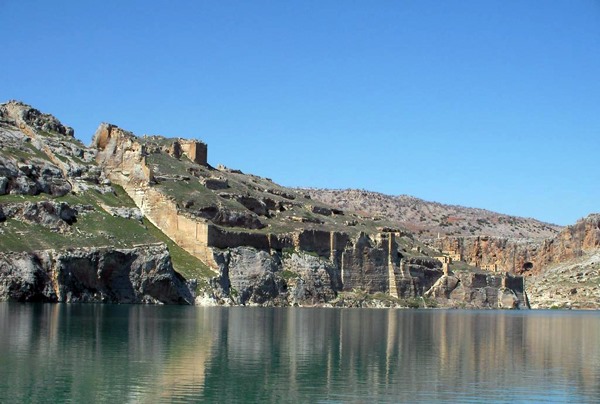
Hromkla means “Roman Castle” (Qal’at al-Rum in Arabic, Rumkale in Turkish ). It was the Armenian name of a fortress built on the right bank of the Euphrates River, on the place of its confluence with the Parzman (Merzumen) Creek, 50 kilometers west of Urfa (Edesa).

A strategic border crossing during Byzantine domination of the area, Hromkla was surrounded by water on three sides and by inaccessible rocks on the remaining, with a four-layer wall.

Hromkla

Hromkla Fortress (Pronounced Hromgla)

Around 1080-1086 the fortress was occupied by the short-lived Armenian princedom of Philartos (Filaret) Varajnuni, and afterwards by the Armenian prince Kogh Vasil. After the death of the latter (1112), the dux Baldwin II of Edessa seized the fortress from his son, also called Vasil, and offered it to his relative, Joscelin I de Courtenay, who would succeed him as Count of Edessa (1119-1131).

The Seljuk invasions had forced to move the Holy See of the Armenian Apostolic Church outside Armenia in the middle of the eleventh century. After various moves, Catholicos Grigor III Pahlavuni (1113-1166) settled in Hromkla in 1149 and two years later bought the fortress from Beatrice, wife of count Joscelin II de Courtenay, who had been imprisoned in 1150 after the fall of Edessa in 1144.

Catholicos Grigor III rebuilt the fortifications of Hromkla and founded two magnificent churches, St. Gregory the Illuminator and St. Mary. The church of St. Savior was built at a later time. Hromkla became a cultural center during the tenure of Grigor III’s successor, the famous Catholicos St. Nerses IV Shnorhali (1166-1173). Many old manuscripts were collected and illustrated, and new ones were copied and written. Hromkla was famous for its school of miniatures. Two councils held there in 1178 and 1179, with the participation of almost all Armenian archbishops and bishops, studied and rejected the proposal to join the Greek Orthodox, and recognized the authority of the Catholicosate over all Armenians.

Hromkla was a domain of the Catholicos until the beginning of the thirteenth century, when King Levon I of Cilicia (1198-1219) turned the fortress into part of the court domains.

In May 1292 the Mamluk Sultan of Egypt, Melik-al-Ashraf, besieged the fortress. After a heroic resistance of 33 days by the population and the Armenian troops, the superior number of the attackers and the impossibility to obtain outside help forced the defenders to surrender on June 28. The guardians were killed, the fortress was ransacked, and most of the population, including Catholicos Stepanos IV, was taken prisoner. The fall of Hromkla was considered by contemporary historians as a catastrophe. The seat of the Catholicosate was moved to Sis, in Cilicia proper where it would remain until 1920.

The church of St. Mary was turned into a mosque after the sixteenth century, during Ottoman dominion, and the other churches were ruined (the  remains of the Catholicoi Grigor III and Nerses IV were buried at the church of St. Gregory the Illuminator). The bombing by Ibrahim Pasha of Egypt, in 1839, destroyed Hromkla for good. Until the beginning of the twentieth century, St. Gregory the Illuminator Church was a sanctuary for Armenians and Yezdies.


GHAZAROS AGHAYAN

THIS WEEK IN ARMENIAN HISTORY
(Prepared by the Armenian National Education Committee[ANEC])

Death of Ghazaros Aghayan
(June 20, 1911)

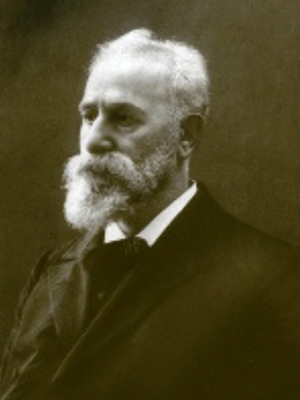
Ghazaros Aghayan was one of the important names in the literary and education awakening of Eastern Armenians in the late nineteenth century.

ghazarosaghayan1

Ghazaros Aghayan

He was born on April 4, 1840, in the Armenian village of Bolnis-Khachen, currently in Georgia. After receiving elementary education in his birthplace, in 1853 he entered the Nersisian School of Tiflis, but left after a year. He would become an autodidact.

He worked as a typographer in Tiflis, Moscow, and St. Petersburg. In 1867 he returned to the Southern Caucasus, and became the manager of the printing house of Holy Etchmiadzin and the editor of the monthly Ararat of the Holy See (1869-1870). He later entered the educational field and taught in schools of Akhaltskha (Akhaltsikhe), Alexandropol (Gumri), Yerevan, and Shushi (1870-1882), and was also the diocesan director of the Armenian schools of Georgia.

He was a theoretician of education. The aim of his pedagogical system was to develop “strong, smart, and virtuous” citizens. He gave preeminence to learning the mother tongue and to moral and esthetic education. He was against corporal punishments and favored co-ed schools, as well as practical education and physical education. He wrote many works in the field, and his textbook “Study of the Mother Tongue” was particularly appreciated; its first volume, with 33 printings, was the most commonly used first-grade textbook in Armenian schools for four decades (1875-1916.

Aghayan, who wrote the first autobiographical novel in Armenian literature (“AGhazaros Aghayan and Hovhannes Toumanianrutin and Manuel,” 1867) was also a famed author of children’s poetry and tales; his tale “Anahit” (1881) is a classic of the genre. His fairy tale “Aregnazan” and his poem “Tork Angegh” are also well-known works.

He worked in the editorial boards of the monthly Portz and the children journal Aghbiur. In 1895 he was arrested with the charge of being a member of the Hunchakian Party; he was exiled first to Nakhichevan-on-the-Don, and then to Crimea (1898-1900). He remained under police surveillance until the end of his life. In the 1900s he was the elder member of the literary cenacle “Vernatun” (Attic), together with Hovhannes Tumanian, Avetik Isahakian, Levon Shant, and Derenik Demirjian. He passed away on June 20, 1911, in Tiflis.

Aghayan was the father-in-law of renowned painter Martiros Sarian (1880-1972) and maternal grandfather of composer Ghazaros

Today, June 19, is the Feast of St. John the Baptist (also called the Forerunner), and Bishop Athenogenes.

John the Baptist is prominent in each of the four Gospels. He is associated with the beginning of the ministry of Jesus and is considered to be the “forerunner” to Jesus the Messiah. He baptized those who repented their sins, and he preached of the coming of one after him who is greater than he and would baptize not with water but with the Spirit. In the third chapter of Matthew, John is reluctant to baptize Jesus and does so only after encouragement from Jesus. The Armenian Church considers St. John the Baptist as one of the two prime intercessors to Jesus, the other being the Blessed Mother.

Athenogenes, a bishop and theologian was burned to death along with ten of his disciples in Sebastia, Armenia, during the persecution of Christians by Emperor Diocletian. Athenogenes wrote a hymn of praise proclaiming the divinity of the Holy Spirit. He is remembered as singing this hymn as he went into the flames.


Posted from Armenian Prelacy’s (Eastern) Crossroads E-Newsletter

FEAST OF HOLY ETCHMIADZIN
This Sunday, June 22, is the Feast of Holy Mother Etchmiadzin, the cathedral built by St. Gregory after his deliverance from the pit, to the specifications he saw in a vision, and on the place marked by the Lord with a golden hammer. This feast day commemorates the establishment of the Armenian Church and the end of paganism.
Etchmiadzin is the oldest example of a four-altar, four-pillar, domed, cruciform church in Christian architecture. More than 1,700 years old, it is the oldest surviving Armenian Christian site. Relief sculptures on the exterior walls are some of the oldest examples of the Christian Armenian art of sculpting.
Posted from Armenian Prelacy’s (Eastern) Crossroads E_Newsletter