Archive for the ‘Articles’ Category

For decades after they were discovered in a cave, the Dead Sea Scrolls were allowed to be examined closely only by fewer than a couple dozen scholars and archaeologists.

By Gali Tibbon, AFP/Getty Images

Dr. Adolfo Roitman, curator of the Dead Sea Scrolls and head of the Shrine of the Book, points at the original Isaiah scroll found in Qumaran caves in the Judean Desert and dated around 120 BC at the Israel Museum on Monday in Jerusalem.

 Now, with infrared- and computer-enhanced photography, anyone with a computer can view these 2,000-year-old relics, which include the oldest known copies of biblical text and a window on the world and times of Jesus.

 High-quality digitized images of five of the 950 manuscripts were posted for free online for the first time this week by Google and the Israel Museum in Jerusalem, where the scrolls are housed. The post includes an English translation and a search feature to one of the texts, the Great Isaiah Scroll.

 The scroll, one of seven animal skin parchments discovered in 1947 in a cave in Wadi Qumran in the West Bank, is the largest and best preserved.

 “Some of these images are appearing for the first time in Google — what no one has seen for 2,000 years and no scholar since the Dead Sea Scrolls were found,” says James Charlesworth, director and editor of the Princeton Dead Sea Scrolls Project, who is one of the few who has handled the ancient pieces of parchment. “Now images and letters that were never found are appearing in Google.”

 Charlesworth said the new images allow him to decipher in 30 minutes fragments of documents that once took 14 hours to analyze. The digital project will preserve documents that were eaten by worms and so fragile they’re turning to dust or rotting away.

Nathan Jastrum, an associate professor of theology at Concordia University in Mequon, Wis., says scholars were allowed to view scraps of some scrolls and prohibited from viewing others. The museum said allowing too many to handle the scrolls would destroy them.

With the new technology, Jastrum says, scholars and others can learn of the similarities between early Christians and Jews of the day, known as Essenes, who wrote most of the scrolls. The Essenes and other early Christians thought the ruling Jewish Pharisees had misinterpreted the Bible, Jastrum says. “Essenes help bridge the distance between the Jewish group that came to be known as Christian” and the Pharisees, he says.

Jesus and his disciples would not have been accepted by the Essenes, the separatist Jewish sect that is believed to have owned and created much of the Qumran library. Yet they shared so many customs that the Essenes help bridge a gap between Jesus’ followers and the Pharisees, whose version of Judaism became the established norm, Jastrum says.

The disciples associated with common people; the Essenes avoided people. Both had ritual washings: The disciples had baptism, and the Essenes had daily purification rites. Both shared communal meals that early Christians called the Lord’s Supper.

And both saw the world separated into two classes of people fighting a cosmic war of good vs. evil whom they called “sons of light and sons of darkness, each seeing themselves as sons of light,” Jastrum says.

The scrolls were discovered in 11 caves near Khirbet Qumran on the northwestern shores of the Dead Sea. They date from about 200 B.C. to about 68 A.D., Jastrum says.

Most were written in Hebrew, mostly on parchment, and most survived in fragments. They were found in clay pots and preserved over the centuries because of the dry desert environment, according to the Israel Museum.

The scrolls include the oldest known biblical manuscripts in existence, religious manuscripts not included in the Bible and documents that describe daily Jewish life in the land of Israel during the time of the Second Temple Period, and the birth of Christianity and Rabbinic Judaism.

The manuscripts span a time when the Holy Land was under Greek rule and then the Roman Empire, whose soldiers destroyed the Jews’ Second Temple in Jerusalem in 70 A.D. to quash a rebellion. All that remains of the temple today is the Western Wall.

Charlesworth says he was working last weekend with images of a Dead Sea document known as the Qumran Thanksgiving Hymns, some of which were illegible before the digital process, because of flaking off of the ink.

Parts of the book of hymns are believed to be written by a Jewish high priest accustomed to luxury who was exiled from Jerusalem to the desert wilderness with his followers by Greek conquerors in the second century before Christ.

“I thank you O Lord because you have placed me as the overflowing fountain in a parched land. … You have placed spring rain in my mouth,” the author writes. He describes his followers as “trees planted in Eden.”

“Even though you look out and see a horrible world the man sees people finding God through his inspiration,” Charlesworth says.

 http://www.usatoday.com/news/religion/story/2011-09-26/dead-sea-scroll/50554550/1?csp=Dailybriefing
Read Full Post »

Jerusalem in Limbo

By Edmond Y. Azadian

Armenians have a knack for living in or placing their major national treasures in troubled spots around the globe. The Caucasus and the Middle East have been historically volatile regions, where rival political forces have clashed and Armenia and Armenians have often constituted the collateral damage.

Following the Genocide, large masses of survivors settled in Middle Eastern countries, which served as a safe haven, only to deteriorate in time one by one, undermining the lives of well-established communities.

Thriving Armenian communities in Egypt, Iraq, Iran, Jordan, Lebanon have shrunk into mere skeletons of their former selves. Today, it is the turn of Syria, where a vibrant Armenian community lives.

In most of those countries — perhaps except for Egypt — Armenian presence dates back to the Genocide era. The only spot that the Armenians have been anchored for almost 2,000 years has been Jerusalem. Archeological excavations have proven that Armenians have lived in the Holy Land even before the Christian era. And Patriarch Abraham of Jerusalem traveled to Mecca in the seventh century to secure special privileges for the patriarchate from the prophet Mohammed himself.

Jerusalem being the land of miracles, the survival of the Armenian Patriarchate can be defined as one of those miracles. Our historic experience has given us good reason to vilify the Ottoman rulers for their treatment of their minority subjects, but at times, for their own good, they have supported the Armenian interests, indirectly. One being Fatih Sultan Mohammed, who conquered Constantinople in 1453. He encouraged the establishment of the Armenian Patriarchate in Istanbul as a counterweight to the Greek Patriarchate.

Another instance in Jerusalem is where the conflicting interests of Greeks, Latins and Russians were counterbalanced by the Ottoman sultan’s support of the Armenian Patriarchate, which was, any way, under the tutelage and control of the Istanbul Patriarchate, until the end of the World War I.

The 19th-century “Status Quo” agreement had granted rights and privileges to the Christian churches in Jerusalem. Armenians benefited from that status and they maintained their control of one quarter of the Christian Quarter for centuries. But today they stand to lose that position for internal and external reasons.

Under President Bill Clinton, parameters laid down at Camp David in 2000 stated that the Christian and Muslim sectors were to remain under Palestinian control in case East Jerusalem becomes the capital of the Palestinian state. The agreement also guaranteed full access for Jews to reach and pray at the Wailing Wall, through the Armenian Quarter.

Despite recent pronouncements by President Barack Obama, the formation of a Palestinian independent state remains an illusory political dream while the Israeli government continues to create “facts on the ground” at the expense of Christian Churches. Occupied Palestinian territories have suffered the brunt of that policy for too long, as a consequence of the Jewish settlement expansion, undeterred by international outcry or UN resolutions.

That policy is also creeping into the Christian Quarter as time passes. As long as the Israeli-Palestinian issue continues to drag land grab in the territories and in Jerusalem itself will become a fact of life.

In 2005, the Greek Patriarch Irineos sold a piece of property at Jaffa Gate in Jerusalem to Israel, creating a firestorm in Greece and Greek communities around the world. In fact the deal was a lease for 198 years. Other deals are for 99 years. For all practical purposes, these deals are, in effect, final sales. It is any one’s guess what happens to the destiny of those properties at the maturity date of the deal.

Armenians have also become victims of such suspicious deals and the only explanation given by the patriarchate authorities was that they were duped to sign the deal.

Armenians have churches and other property at prime locations, which are easy target for future “deals.”

At this crucial period in history when the entire Armenian existence in Holy Land is in jeopardy, the patriarchate and the brotherhood are in disarray. The public agenda of the Armenians is composed of the ailments of 94-year-old Patriarch Torkom Manoogian, rather than his achievements or the good deeds of the St. James Brotherhood.

At its heyday, the Armenian population in Jerusalem numbered at 25,000; today it has been reduced to less than 1,000. The large Armenian presence would only amount to moral support to the patriarchate, which runs its own affairs without outside interference, with the authority granted to the brotherhood by the Status Quo agreement.

Greeks, Russians and the Vatican have always interfered and supported their respective patriarchates in Jerusalem. Only the St. James Brotherhood savors to the full extent of its independence granted by the Status Quo, so much so that during the last conclave of the brotherhood, high-ranking clergy from Echmiadzin were not accorded the courtesy of being invited to attend the conclave and the message of the Supreme Patriarch Karekin II was handed to the brotherhood to be read.

On top of the Israeli-Palestinian rivalry, which affects Armenian interests, there is a tug of war behind the scenes between Echmiadzin and Antelias forces, all compounded by the personal ambitions of individual members of the clergy.

March 15 was the deadline to elect a co-adjutor patriarch to help the frail patriarch in running the affairs of the brotherhood. The deadline passed and no action was taken, despite the fact that with the passage of time, the patriarch is only becoming more feeble.

In view of potentially dangerous prospects, there is footdragging, which can produce catastrophic results.

The internal by-laws of the patriarchate was supposed to be amended to allow for the election of the co- djutor. No communication was made public to that effect.

Over the long centuries Armenians around the world have sacrificed to build the present wealth in Jerusalem, but since 1914 when Patriarch Ormanian was dispatched from Istanbul to inspect the irregularities in the patriarchate, public accountability has not been the policy of St. James Brotherhood.

The recent Israeli government policy of taxing the Christian church properties will further erode the tenuous situation of the Armenian patriarchate, but that threat does not even compel the brotherhood to put its house in order.

Horse trading continues between the potential candidates. The high-ranking clergy who can secure the stability of the patriarchate are shunning the responsibility, while all other members in their presumptions feels competent to serve as co-adjutor patriarch and eventually the patriarch.

Personal and partisan rivalries dominate the scene, while Israeli-Palestinian confrontation threatens our vital interests and stands to give away our much coveted properties.

There seems to be no sense of urgency, while everything is behind a veil of mysterious secrecy.

The Jerusalem Patriarchate is in limbo.

But not for too long.

Reposted from the Armenian Mirror Spectator http://www.mirrorspectator.com/2011/05/29/jerusalem-in-limbo/

Read Full Post »

By Matti Friedman
Associated Press
Published: Friday, May 13, 2011

JERUSALEM — One of the four quarters of old Jerusalem belongs to the Armenians, keepers of an ancient monastery and library, heirs to a tragic history and to a stubborn 1,600-year presence that some fear is now in doubt.

Buffeted by Mideast forces more powerful than themselves and drawn by better lives elsewhere, this historic Jerusalem community has seen its numbers quietly drop below 1,000 people. The Armenians, led by an ailing 94-year-old patriarch, find themselves caught between Jews and Muslims in a Middle East emptying of Christians, and between a deep sense of belonging in Jerusalem and a realization that their future might lie elsewhere.

"Very few will remain here if it goes on like this," said Kevork Kahvedjian, a Jerusalem storeowner.

Kahvedjian sells vintage black-and-white photos of the Holy Land from a store founded in 1949 by his father, who arrived in Jerusalem as a child after mass killings of Armenians under Ottoman rule during World War I claimed his own parents. Today, Kahvedjian said, he has siblings in Canada and the U.S., a son in Washington, D.C., and a daughter who plans to move away soon.

The insular world of the Jerusalem Armenians is reached through a modest iron door set in a stone wall.

The door, locked every night at 10:30, leads into a monastery compound that is home to a contingent of cloaked clergymen and also to several hundred Armenian laypeople: grandparents, parents and children, living in a warrens of small apartments alongside their priests in a self-contained outpost that has existed here, in some form, at least as far back as the fifth century A.D.

Also inside is a library, a health center, two social clubs and a school where each grade now has an average of only six or seven pupils.

"We worry about this, of course. But we haven’t found a solution," said Samuel Aghoyan, 71, one of the community’s senior priests.

On a recent afternoon in the Armenian monastery’s nerve center, the medieval cathedral of St. James, clerics in black cowls chanted under dozens of oil lamps suspended from the vaulted ceiling. Next to a priest waving a censer was an inlaid panel concealing the entrance to a staircase ascending inside the wall to the church’s second floor.

The monastery, led by the patriarch Torkom Manoogian, 94, guards other secrets. It holds the world’s second-largest collection of ancient Armenian manuscripts, 4,000 texts guarded in a chapel opened only once a year. It also owns the Bible of Keran, a gold-covered manuscript named for an Armenian queen and kept in a treasury whose location the priests will not divulge, and the staff of King Hetum, made from a single piece of amber and revealed to the public for a few minutes every January.

The several dozen priests, most of whom are sent to Jerusalem by the church from elsewhere, will remain, as will their edifices and relics. But the community itself, made up of laypeople subject to the pressures and pulls of this world, may not.

Aghoyan arrived at the monastery as a 16-year-old seminarian in 1956 from Syria, where his parents had fled from Turkey. He found the Jerusalem monastery crowded with families, most of them refugees or descendants of refugees who escaped the killings.

Many international historians say up to 1.5 million Armenians were killed by Ottoman Turks around the time of World War I, which they call the first genocide of the 20th century. Turkey disputes this, saying the death toll has been inflated and those killed were victims of civil war and unrest as the Ottoman Empire collapsed.

The resulting refugees swelled the small existing community of Armenian priests and laymen, and by the time Jerusalem was split between Jordan and Israel in 1948 the Armenians numbered more than 25,000, by some counts. They were traders and craftsmen whose distinctive mosaics of painted tiles remain one of the city’s signature design features.

After 1948, with the city divided, the Old City under Jordanian control and economic prospects bleak, most Armenians left, joining thriving exile communities in places like Fresno, Calif., and Toronto.

Perhaps 3,000 remained by the time Israel captured the Old City in 1967.

The Armenians, along with Arab residents of east Jerusalem, were given residency rights in Israel, and some have since applied for full citizenship. But the community has tried to plot a neutral course in a place where that is difficult. Ties with both Israelis and Palestinians have been tense at times.

Israel’s Interior Ministry does not have statistics on the number of Armenians. Community leaders like Aghoyan and Tsolag Momjian, the honorary consul of Armenia, agree there are now fewer than 1,000 in the city.

The slow decline of the Jerusalem Armenians reflects a broader shrinking of the Middle East’s ancient Christian population. For much of the past century, Christians in Lebanon, Iraq, Egypt, the Palestinian territories and elsewhere have been moving to the West, fleeing poverty, religious intolerance and violence like the anti-Christian riot that erupted this week in Cairo, leaving 12 dead and a church burned.

Young Armenians, expected to marry Armenians, are faced with a shortage of potential spouses. Because they are typically well-educated, fluent in English and have family connections abroad, they are equipped to leave.

Those who do join a diaspora that numbers an estimated 11 million people worldwide and supports churches, community centers and at least a dozen international online dating sites with names like Armenians Connect and armenianpassion.com.

"Whoever leaves still dreams about Jerusalem and says they’ll come back. But they won’t," Aghoyan said.

Others are more optimistic. Ruppen Nalbandian, 29, a community youth leader with a master’s degree in neurobiology from an Israeli university, said the outflow has slowed. Of 11 students in his class at school, he said, only two have left. Ten men he knows have found brides in Armenia and brought them back to Jerusalem, he said.

Some in the community point to an unexpected boon in the form of Armenian Christians — possibly more than 10,000 of them, though estimates vary — who arrived in Israel as part of a mass immigration of Soviet Jews in the 1990s and were eligible for citizenship because they had a Jewish parent or spouse. Some have mixed with the established Armenian community.

Not long after the Armenians adopted Christianity in 301 A.D. in their homeland around the biblical Mt. Ararat, on the eastern border of modern-day Turkey, they dispatched priests to Jerusalem.

They have remained ever since, through often devastating conquests by Arab dynasties, Persian armies, mounted Turkish archers, Crusaders, the Ottoman Empire, Englishmen, Jordanians and Jews.

"As we have lived here for 1,600 years, we will continue to live here," Nalbandian said.

Read Full Post »

PAREGENTAN OF THE FAST OF THE CATECHUMENS

Posted from Armenian Prelacy’s Crossroad E-Newsletter 
       
       This Sunday, February 13, is the Paregentan of the Fast of the Catechumens. It occurs three weeks before Poun Paregentan (eve of Lent) and 10 weeks before Easter, ushering in three days of strict fast (dzom). According to tradition, the Catechumens were instructed for several hours daily and required to stand through every church service apart from the baptized congregation. This continued until Easter when they were baptized, anointed and received their first Communion.

Read Full Post »

       February 14th, marks the Presentation of Jesus to the Temple (Dyarnuntarach, which literally means “going forward to meet the Lord”). In English it is known as “Candlemas.” This is a fixed feast since it always occurs on February 14.
       Forty days after the birth of Christ, Mary obeyed Mosaic Law and presented her son to the temple (Numbers 18:15). She was purified by the prayer of Simeon the Just in the presence of Anna the Prophet (Luke 2:22-40). This was the first introduction of Jesus into the house of God.
       Some pre-Christian Armenian customs have been incorporated with the feast, including one of the most popular. On the eve of the holiday a bonfire is lit using a flame from the church. Young people gather around the fire and the young men leap over the flames. The light of the bonfire is symbolic of Christ, the light of our lives.

Read Full Post »

STS. THADDEUS AND SANDOUKHT

Posted from Armenian Prelacy’s Crossroad E-Newsletter       

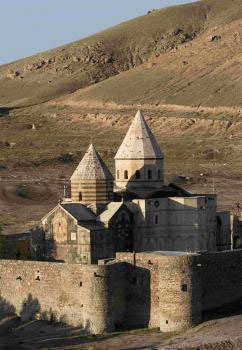
      According to the historian Movses Khorenatsi, the apostle Thaddeus came to Edessa where he healed the sick and baptized King Abgar. Khorenatsi writes that from Edessa, Thaddeus went to AStTadeosChurchrmenia where he preached and converted the Armenian king, Sanatrouk, and the king’s daughter, Sandoukht. When faced with the opposition of his governors, the king recanted his conversion. Sandoukht, however, refused to renounce the Christian faith. She was imprisoned and executed by order of her father, and thus became Armenia’s first martyr.
       Thaddeus was martyred at Artaz (in present day northern Iran). The Armenian monastery of St. Thaddeus is built on the apostle’s tomb. During the early 20th century the monastery was an important crossroads for the defense of the Armenian population of Van, Daron, and surrounding areas. A popular annual pilgrimage by Armenians from around the world takes place  in July. During the four-day festival thousands gather in tents pitched on the monastery grounds, attend services, sing and dance in remembrance of St. Thaddeus, one of the two apostles who brought Christianity to Armenia. St. Thaddeus Monastery and the other famous Armenian monastery in northern Iran, St. Stephen on the banks of the Arax River, have undergone major renovation and restoration in recent years.

Read Full Post »

By David Luhrssen

On Sunday, Jan. 30, Donald Rask was one of only three teenage piano students from the Milwaukee area to takeDonnieRask1 part in the Milwaukee Music Teachers Association Youth Concert. He earned his position in the program by passing a citywide audition held in 2010.

Donnie’s talents are familiar to Milwaukee’s Armenian community. He serves as a tbir (acolyte) at St. John the Baptist Armenian Church, occasionally fills in on organ during the liturgy and has performed on piano at events in the church’s Culture Hall. A sophomore at Oak Creek High School, Donnie is a member of the marching band, symphonic band and jazz band as well as a pianist in the pit orchestra for school musicals. A multi-talented instrumentalist, Donnie also plays French horn and trumpet.

For the Sunday afternoon Youth Concert at the Steinway Piano Gallery, Donnie performed Beethoven’s Sonata in C minor Op. 10, Scarlatti’s Sonata in A major, Mendelssohn’s Duet Op. 38 and Sibelius’ Romance. Seated behind the shiny grand piano with a look of gracefully focused concentration, Donnie executed the challenging works of music with ease. His fingers climbed with great agility across the peaks and valleys of great compositions from Europe’s Romantic Era. Donnie allowed himself a smile of triumph as he bowed before the applauding audience.

Read Full Post »

Catholicos Aram I Declares 2011 as ‘Year of the Child’ | Asbarez Armenian News.

Read Full Post »

« Newer Posts