Archive for the ‘Articles’ Category

Shantal Der Boghosian

The Armenian Weekly
http://www.armenianweekly.com/2012/08/23/to-infinity-and-beyond/
Sept. 1, 2012

Since the beginning of time, Space has been a source of mystery for man—a mystery they sought to decipher. Thanks to the scientific curiosity of Ptolemy, Galileo Galilee, and Isaac Newton, man has discovered numerous planets, landed on the Moon, and has even captured ancient images of space with the Hubble telescope that shine light on the Big Bang. Scientists know that our planet Earth has the perfect components for life, but as Earth begins to feel the effects of global warming and human overpopulation, it is only natural that scientists start looking to Space for answers- particularly from our neighbor, Mars.
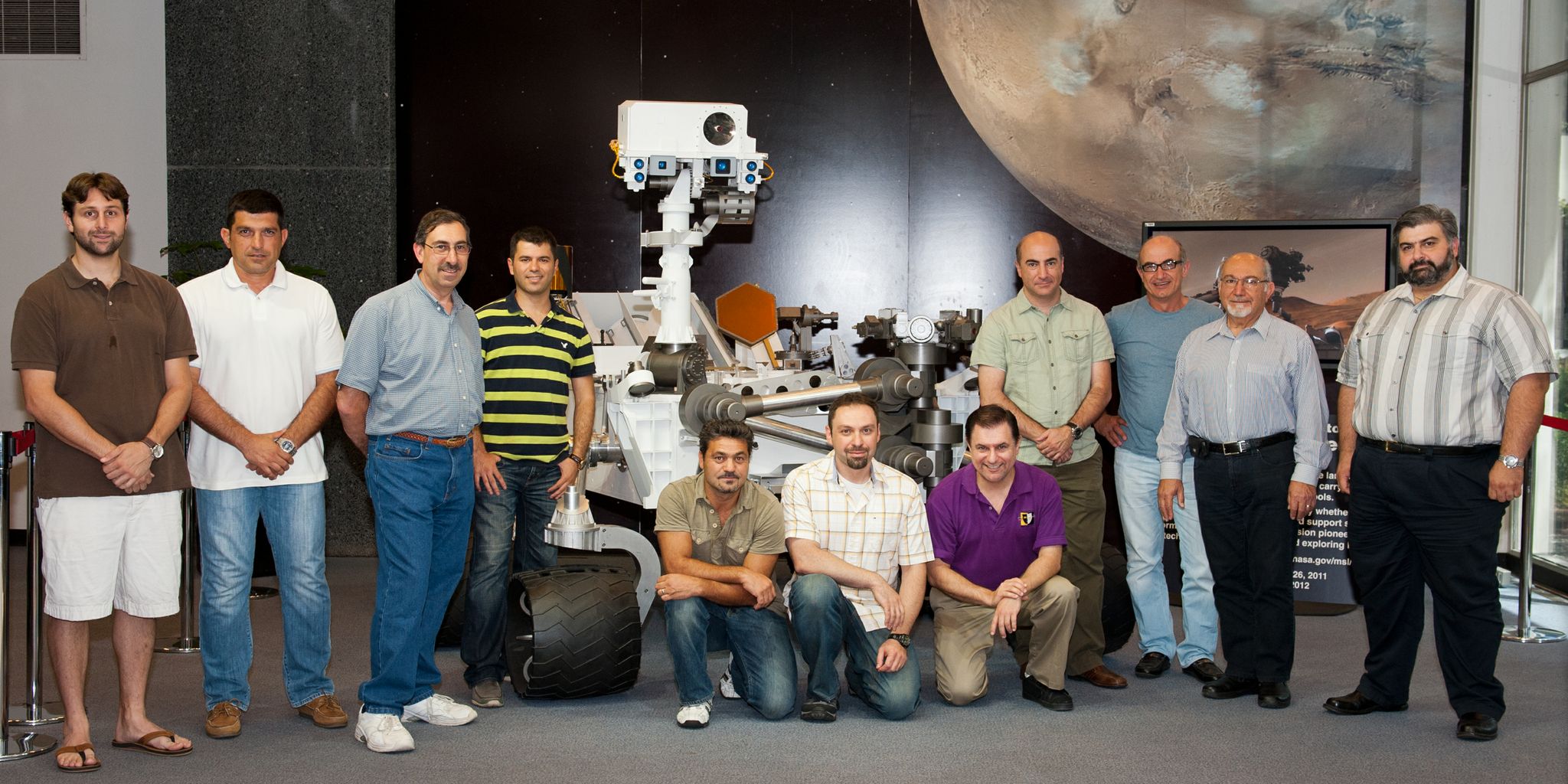
(L-R) Toorian, Gharakhanian, Sarkissian, Ohanian, Hartounian, Khanoyan, Gorjian, Zadourian, Aintablian, Demirjian, and Karapetian.

August 5, 2012 at 10:31p.m. PDT, the Mars Rover Curiosity successfully descended on parachute and landed upright on Martian soil. Curiosity is part of NASA’s Mars Exploration Program, a long-term robotic exploration of the red planet so close to our own home! Curiosity was designed to assess Mars’s habitability, and to see if it ever had the proper environment to support small life-forms called microbes. The rover carries the largest, most advanced suite of instruments ever sent to Mars and will analyze samples scooped from the soil and drilled from rocks. Any planet’s geology record is essentially stored in rocks and soil- particularly in the formation, chemical composition and structure. Curiosity has an on-board laboratory and it will study rocks and soil in order to detect any chemical building blocks of life in order to piece together Mars’s past.

One of the most impressive features is Curiosity’s power source. The rover carries a radioisotope system that generates electricity from the heat of Plutonium’s radioactive decay. Radioactive decay is the process by which an atomic nucleus of an unstable atom loses energy by emitting ionizing particles. In turn, an ion is created when an atom gains or loses a charged particle, such as an electron or a proton. This power source is strong enough to give Curiosity a life-span of one Martian year, or 687 Earth Days, and also gives Curiosity more operational flexibility and greater mobility than any previous Mars mission.

According to JPL, Curiosity represents a huge step in Mars surface science and exploration because it demonstrates the ability to land a very large and heavy rover to the surface of Mars, as well as demonstrating the ability to land more precisely in the calculated landing circle. This is a large feat! Not only am I proud as a scientist, but I’m also proud to know that there were fourteen Armenians who collaborated in this project’s success! Arbi Karapetian, a group supervisor at JPL, joined the project during the design and implementation phase. He was a Test Conductor during Assembly, Testing and launch. When asked how he felt about the project’s success, Arbi said “As an engineer you’re aware of statistical analysis and reliability. Every engineer understands that you do the best you can, but there’s always room for failure. This project was exponentially more complicated than any previous project because of the advances in engineering. The complexity was so high that you could no longer have one engineer, the work had to be spread amongst many engineers, which allowed more room for error.” Arbi was very proud of the team’s accomplishment, and the success was the greatest reward for all the long, arduous hours they put into the project. “If you love doing what you do, then you’ll never work a day in your life. There are very long hours which are taxing on everything you do. If this is really your passion, then all of that lines itself up, and it’s not hard to get motivated to do what it takes.”

The following Armenians made significant contributions to the success of the MSL (Mars Science laboratory) Project: Avo Demirjian, Vache Vorperian, Alfred Khashaki, Felix Sarkissian and Hrair Aintablian in the field of Electronics; Garen Khanoyan and Richard Ohanian on the Landing Radar System; Serjik Zadourian and Vazrik Kharakhanian in Assembly Test and Launch; Gayaneh Kazarians in Biology; Hanry Hartounian in Flight Software; Armen Toorian in Mechanisms and Testbeds; and Zareh Gorjian in Computer Animation.

http://www.armenianweekly.com/2012/08/23/to-infinity-and-beyond/
Read Full Post »

By Tom Vartabedian On July 4, 2012 http://www.armenianweekly.com/2012/07/04/turks-rebuke-school-genocide-classes/

Just when you think life has dealt you a pat hand, along comes a conniver to steal your pot.

For the past four years, members of our Armenian Genocide Education Committee of Merrimack Valley have filtered in and out of high schools north of Boston.

We’ve also expanded our reach to include schools around Greater Boston like Newton South. Scores of children have benefitted from our lessons. In most every case, instructors have been overwhelmed by the impact being made, for they, too, come out learning a valuable lesson in history.

There hasn’t been one repercussion, not even a grunt from a naysayer—until now. A vile and vindictive article from a pro-Turkish website (History of Truth) crossed my eyes bearing the headline: “Armenians Spreading Their Lies at High Schools.”

The gutless piece failed to carry a byline, thus making it more intolerable.

What’s more, a photograph of Wilmington High students holding samples of postage stamps they had designed carried the inscription: “Their Lies Reached to Schools.”

The group photo also had the two presenters that day, myself and Albert S. Movsesian. The ideas for a postage stamp were being sent to the postmaster general of the United States in an effort to get a commemorative stamp minted for the 100th anniversary in 2015.

A completely harmless project meant to both elucidate and arouse our younger non-Armenian population was slurred with malice.

The rebuttal was generated in response to an all-encompassing piece written by chairman Dro Kanayan giving readers a fairly detailed account of the progress made in schools this year. How effective has it been?

While attending a grand niece‘s Chelmsford High graduation party the week before, I approached a table occupied by students who had been addressed during a genocide class taught by Jennifer Doak.

“Hey, you look familiar. Aren’t you the guy who spoke to us about the Armenian Genocide?” a co-ed remarked.

“Yes, that’s me,” I replied. “What do you remember most about the class?”

“How difficult it was for your race to be slaughtered like that,” she replied. “We loved the story about the Calvin Coolidge Orphan Rug and how it found its way to the White House.”

The article goes go to say that the “Armenian Diaspora is spreading its lies by telling them at high schools.”

The next paragraph quoted Kanayan’s story: “Armenian researcher Dro Kanayan said for those people who feel that our elders and the youth cannot work together, don’t worry. Kanayan and both of his peers, Albert Movsesian and Tom Vartabedian, have been working together to have the so-called Armenian Genocide included in the high school curriculum on Human Rights in the Merrimack Valley.”

“They are teaching students about the so-called Armenian Genocide and Armenian culture.”

The story went on to say how we have “poisoned” the students in over 10 high schools, providing individual classroom presentation on comparative genocides over the past 100 years.

It proceeded to include other high school students, including a deaf student we encountered at Newton South who had learned about the genocide through American Sign Language.

Adding more insult to injury, a second photo was used of Dro Kanayan holding a picture of his famous grandfather General Dro, who led the siege at Bash Abaran during World War I.

I should be fuming over such poppycock. Instead, I hold no regret over those who are ill-informed and continue to show their absurdity. The more Turkey refutes historical fact, the more scornful it becomes.

The more truth will prevail and people will see how superficial the Turkish government continues to remain. What people lack in intelligence, they usually make up for in stupidity.

I recall once how vandals had climbed to the top of a billboard in Watertown and defaced a genocide sign that had been sponsored by activist/artist Daniel Varoujan Hejinian. For years, Hejinian has been putting up these notices to draw attention during April 24th.

For the most part, the Armenian papers publicized the act, but it also caught the attention of the American press, which matters more. The fact that some screwball scaled a building at night to commit an act of degradation suddenly became media hype. It appeared in newspapers and television networks, giving the Armenian Genocide more exposure than normal.

During a commemoration that week in Merrimack Valley, a local priest approached the podium and talked about the insanity.

“If that’s the way our genocide is going to catch the outside public’s eye, then let the billboards be vandalized,” he lashed out. “And let those responsible find guilt in the process.”

http://www.armenianweekly.com/2012/07/04/turks-rebuke-school-genocide-classes/

Read Full Post »

THIS WEEK IN ARMENIAN HISTORY
Prepared by the Armenian National Education Committee (ANEC)


THE TWENTY HUNCHAKIAN GALLOWS (June 15, 1915)

       One of the main episodes of the repression exerted against the Armenian leadership in the initial phase of the Armenian genocide was the case of the Hunchakian Party activists who were hanged in Constantinople in 1915.

        The Social Democratic Hunchakian Party was founded in Geneva in 1887 by a group of Eastern Armenian students. It had pursued revolutionary activities with the aim of the self-defense of Armenians in the Ottoman Empire. After the 20gallows Ottoman Revolution of 1908, it maintained a certain distance from the Young Turk party. The coup d’état of early 1913 that practically concentrated the power in the hands of a triumvirate (Talaat, minister of Interior; Enver, minister of War, and Djemal, minister of Navy) was not well-received by the Hunchakian Party, which was concerned with the safety of Ottoman Armenians. The 7th General Convention of the Party, held in Constanta (Romania) in September 1913, stressed that the dictatorial government of the Young Turks would make impossible that the aim of an independent Armenia (which was the declared aim of the party in its political program) would be accomplished.

        The convention adjourned with two main objectives:

        1. The party would become again a clandestine organization.

        2. It would carry a plan to assassinate the leaders of the Young Turk party.

        An Armenian double-agent, who was also a member of the party and attended the meetings, reported these developments to the Turkish government. The Ottoman Armenian delegates to the convention were arrested as soon as they went back to Constantinople. By the end of 1913, a total of 140 members of the party had been arrested.

        Lengthy mock trials followed, while the prisoners endured terrible conditions in the Turkish prison. Finally, twenty-two members of the party were sentenced to death by hanging. The sentence was carried out for twenty of them (two were fugitives) on June 15, 1915, in the central square of Constantinople, known as Sultan Bayazid Square. As one of the prominent Hunchakian leaders, Paramaz, who was among the sentenced, said before his hanging, “You can only hang our bodies, but not our ideology.” The sacrifice of the Twenty Hunchakian gallows, also known as the “Twenty Hunchakian martyrs,” became an example and inspiration for political action of the following generations.

Read Full Post »

BY HARUT SASSOUNIAN

http://asbarez.com/102833/lawsuit-happy-turkish-group-loses-appeal-on-armenian-genocide/

The Turkish Coalition of America (TCA) has been on a rampage in recent years, filing lawsuits against scholars, public officials, and civic groups who support the recognition of the Armenian Genocide.

Last week, a federal appeals court put an end to TCA’s legal tirade against the University of Minnesota by unanimously upholding a federal court’s decision dismissing TCA’s baseless allegations.

The Turkish advocacy group had filed a lawsuit against Prof. Bruno Chaouat, Director of the Center for Holocaust and Genocide Studies at the University of Minnesota, for labeling TCA’s website and others as “unreliable.” The university’s webpage had posted the following stern admonition to students: “We do not recommend these sites. Warnings should be given to students writing papers that they should not use these sites because of denial, support by an unknown organization, or contents that are a strange mix of fact and opinion.”

Initially, TCA had complained that the inclusion of TCA’s website on the university’s list of “Unreliable Websites” violated the Turkish group’s freedom of speech. The university rejected TCA’s allegation, although, the Center for Holocaust and Genocide Studies revised its website on Nov. 18, 2010, removing the “Unreliable Websites” and recommending new resources for genocide research. The university asserted that the revision was not prompted by TCA’s complaint and denied any wrongdoing. On Nov. 24, 2010, Prof. Chaouat posted a statement on the Center’s website explaining that the list of “Unreliable Websites” was removed because he did not want to “promote, even negatively, sources of illegitimate information.”

TCA then filed a lawsuit against the university, its president, and Prof. Chaouat, claiming that including its website on the same list as websites denying the Jewish Holocaust, stigmatized the Turkish organization. The court dismissed the lawsuit.

A three-judge panel of the 8th circuit federal appeals court upheld the lower court’s decision on May 3, 2012, ruling that the university did not violate TCA’s First Amendment rights, since it neither blocked nor restricted access to the Turkish website.

The judges also rejected the Turkish group’s second claim that it was defamed when the university stated that TCA’s website is “unreliable,” engages in “denial,” presents “a strange mix of fact and opinion,” and is an “illegitimate source of information.” In a sinister attempt to win the lawsuit, TCA claimed that its website did not deny certain underlying historical facts, affirming that “certainly hundreds of thousands of Armenians died.” However, since the Turkish website had alleged that it is “highly unlikely that a genocide charge could be sustained against the Ottoman government or its successor,” the judges ruled in favor of the university asserting that TCA had in fact engaged in “denial.”

TCA’s malicious lawsuit disturbed many US scholars who were worried that this case would set a dangerous precedent and have a chilling effect on academic freedom. The gravity of these concerns had prompted the Middle East Studies Association to demand TCA to withdraw its lawsuit.

Although TCA failed in its bullying tactics against the University of Minnesota, there is no guarantee that this Turkish group will stop suing other academic or civic organizations for refusing to cave in to Turkey’s denialist campaign. It should be noted that TCA spent $630,000 on legal fees out of its 2010 budget of $3.6 million. Significantly, no mention was made in its annual report of the sources of TCA’s funding, except a passing remark that it is “supported entirely by private donations.” The Boston Business Journal reported that Turkish-American Yalcin Ayasli, founder of Hittite Microwave Corp., contributed $30 million to TCA in 2007.

TCA engaged in the following wide ranging activities and political objectives with its $3.6 million budget in 2010:

– Delivered 75 position papers to members of Congress and US opinion leaders; – Monitored the American media; – Took a Native American business delegation to Turkey; – Lobbied the Congress against the Armenian Genocide resolution; – Advertised in Roll Call and Washington Quarterly; – Organized Summer internships in Washington for Turkish students; – Provided scholarships to African-American, Armenian-American, Hispanic American, Native American, and Turkish-American students to study in Turkish universities; – Awarded grants for academic conferences; – Offered research fellowships to professors Michael Gunter, Justin McCarthy, Hakan Yavuz, and others; – Contributed $100,000 grants to each of the Assembly of Turkish American Associations and Federation of Turkish American Associations, and a smaller amount to the Azerbaijan Society of America; – Spent $630,000 on lawsuits against various entities that support the Armenian Genocide issue; – Funded congressional trips to Turkey, and – Filed a report with the US government accusing the Armenian National Committee of America (ANCA) of being a “hate group.”

Given TCA’s tax-exempt charitable status, the Internal Revenue Service should investigate the legality of this Turkish group’s involvement in such extensive political and lobbying activities.

http://asbarez.com/102833/lawsuit-happy-turkish-group-loses-appeal-on-armenian-genocide/


Read Full Post »

http://www.huffingtonpost.com/courtney-cachet/armenian-genocide-anniversary_b_1448315.html

Courtney Cachet
Designer, TV Personality, Style Slave, Writer, Ninja

April 24th marks the 97th anniversary of the Armenian Genocide. Armenians mark this date in 1915, when several hundred Armenian leaders were rounded up, arrested and later executed as the start of the Armenian genocide and it is generally said to have extended to 1917. In total, over 1.5 million Armenians were massacred by the Turks in what is known as the Armenian Genocide. It was the first Holocaust of the 20th century. This, the world knows for sure. Turkey still denies this and whenever another country — as so many have — stands up and recognizes what happened to the Armenians as a genocide, they flex their political muscle and governments cave.

The reasons for their denial are simple. They want to be members of the European Union. The reasons governments such as the U.S. always promise the Armenians they will do something and never do is equally political. They are a key NATO ally, they are in a strategic geographic location for the U.S. and we have a military base there.

The thing is, Turkey can deny what they did over and over again but there are men and women who survived the reprehensible atrocities they inflicted on the Armenian people. They’ve told their stories.

We know them and we know what you did.

One such person was my grandfather, whom I knew as Marcel Cachat. Let me tell you about his life as it was told to me by him.

I can’t tell you when he was born, because when he lost his entire family in the infamous death marches. He was just a little boy. After all, who else could survive countless days without food or water marching into the Syrian desert? Only young, strong children. He was rescued by Greek missionaries who raised him in an orphanage in Greece. As a young man, he made his way on a boat and went to the South of France where many Armenians had gone. There, he went to work for a farm family because that is what he knew how to do. He needed to learn the language. As a a kid, I visited that farm family with him and my father. Soon after his arrival, local authorities got wind of his presence and he was called down to the local office. The French naturalized him, but suggested he change his name, as to assimilate into French society a little easier.

His name was changed from Missak Kachadurian to Marcel Cachat. Date of birth: unknown.

Eventually, through the Armenian community in Marseille, he met my grandmother Ardemis Tashjian. They married, started a little business and had my father, Marc.

During World War II, my grandfather fought for the French army and was captured right away without ever firing his gun. He was kept a German prisoner of war for several years while my grandmother raised my father back in France. Till the day he died, the very little English he spoke was with a heavy German accent. Not only did he speak fluent German, but he spoke fluent Turkish, Armenian, Greek, French and enough English later in life to hold a job in New York.

My father came to New York as a young man and started his life here in America. After my grandmother passed away in 1969, he followed him to New York, as well. He never knew his birthday and he had no known blood relatives besides us. He told me he remembered lots of people in his home growing up, but the memories were sketchy, at best.

I remember him as kind man who possessed a level of intelligence that was mind boggling, given his obvious lack of formal education. He was generous, too. He would buy us frivolous gifts and cook us wonderful dinners on Sundays. My mother told me he used to send donations in to PBS because he appreciated the educational shows they aired. He was a painter and had a garden that would make people stop their cars and ask him who his gardener was. He was humble, hard-working and very funny.

Pepe Marcel eventually went back to Marseille after several years in New York. He was happiest there, I believe. After all, it was practically his country. He raised his family there and most of my cousins still live there today. He remained active, walking four miles a day on the Corniche, one of the most beautiful streets in Marseille. He ended every day with a glass of red wine, how very French. He was very French, but he was always an Armenian man. With no roots, very little memories of a childhood and no place to go back home. Nevertheless, he married an Armenian woman, remained active in the Armenian community and raised his family in the Armenian Church. My husband is also Armenian and we will raise our children with the same values instilled in most Armenians. We work hard, we value family, education and are widely considered as high achievers in business. And no matter what happens to us, we will endure as my grandfather did.

 A famous quote comes to mind today:

 I should like to see any power of the world destroy this race, this small tribe of unimportant people, whose wars have all been fought and lost, whose structures have crumbled, literature is unread, music is unheard, and prayers are no more answered. Go ahead, destroy Armenia. See if you can do it. Send them into the desert without bread or water. Burn their homes and churches. Then see if they will not laugh, sing and pray again. For when two of them meet anywhere in the world, see if they will not create a New Armenia. — William Saroyan

So to anyone who denies the Armenian Genocide ever happened I say only this. We know you did it and the world does, too. It will always be the stain you cannot remove from your history, no matter how hard you try to silence the truth.

More importantly, the survivors like Missak Kachadurian know you did it.

À la mémoire de mon Grand-Père Missak “Marcel” Cachat.

We will always remember.


Read Full Post »

“I CALL UPON OUR PEOPLE TO DEMAND
THEIR STOLEN RIGHTS FROM TURKEY”, Said His Holiness Aram I

The summary of the message of His Holiness Aram I delivered on 24th April 2012 in Antelias to thousands of Armenian people who were gathered to commemorate the Armenian Genocide.

We are gathered today in front of the Martyrs Chapel, where the remains of some of the victims of the Armenian Genocide were buried in 1935 when the Catholicosate of Cilicia finally settled in Antelias.

We are here to recommit ourselves to the legacy we inherited from our martyrs, irrespective of the changing political conditions around us. Our martyrs also want us to make our voice heard by the leadership in the Arab world and Europe.

Turkey is seeking to expand its political and economic influence in the Arab World, Europe and Africa. Claiming to be a defender of minorities and a champion of democratic principles and human rights, Turkey is presenting itself as a peace-builder in the Arab World.

Can a nation that fills its prisons with human rights advocates and journalists lecture others on the imperative to champion democratic principles and human rights? Can a nation that systematically killed a million and a half members of one of its minority peoples and today denies that act demand that others defend their minorities?

The Prime Minister of Turkey has cynically stated that if there really was a genocide we should be able to show them where the graves of the victims are. We can tell them that the graves are in places that the Turks have renamed in order to attempt to erase historical memories: the Turkish towns and villages in Western Armenia, Cilicia and in Der Zor, the Syrian Desert.

In a cynical attempt to appear reasonable, Turkish authorities suggest that historians should sit down together and attempt to determine what really happened in Turkey in 1915. Neutral historians have long ago determined what happened by having read the internationally accepted and verified Western Diplomatic, Armenian and Turkish sources that document the horrors that the Turkish government foisted upon the Armenians in 1915.

We hold the present Republic of Turkey, in its capacity as the legitimate successor of the Ottoman Empire, accountable for its crimes against our people. We demand our rights to compensation for the confiscated Church, community and individually owned properties not only since 1936, as the August 2011 decision stipulated, but also those confiscated from1915 to 1920.

During the international conference that we organized last February, here in Antelias, we said that recognition and compensation are inseparable. Therefore, and in consultation with the government of Armenia, the Catholicosate of Cilicia will work together with the Armenian Catholic and Evangelical communities to obtain the legal rights to confiscated properties.

On the eve of our 100th anniversary, I call upon our people in Armenia, Karabagh and the diaspora to renew their commitment to the legacy of the martyrs of the 1915 Genocide.

Read Full Post »

My Feelings In The Armenian Church

By Krikor Tertsagian

"Aztag" Newspaper, Beirut Lebanon


I am not a churchgoer every Sunday without fail. I have not mastered our thousand year old church’s sometimes golden, but often tragic history.

From Gregory the Illuminator to Movses of Khoren, passing by Gregory of Nareg, all the way to the details of our centuries old pair of Catholicates – I am far from mastering these!

I have not read the Nareg. I also confess that I haven’t finished reading the Holy Gospels from cover to cover.

I am familiar only in general with our wonderful Holy Divine Liturgy.

But..

Every time I enter the Armenian Church, my body turns into an electrified current; my head quickly yields to my heart, and my heart in turn yields to my soul.

The enticement at the entrance of the church, is it the half melted candles? Is it our church’s altars with their starkly recognizable and mystical letter "eh?" Is it the faith and devotion of the Armenian clergyman, the singing of the choir, the bishop’s throne? I wonder, is it the history of the Armenians summarized in a few sharagans, or Jesus’ crucifixion, rendered sublimely by a talented artist? The answer to all these things is not even important.

I know that the church wields over me a hypnotic and indescribable influence, ponderous and deep with its thousand year old weightiness.

The choir sings, “Christ in our midst has been revealed, he who is God…” In a flash my soul is awakened, my eyes are filled and my inner world is turned upside down, even more than the cauldron of newly prepared Holy Muron. “Father, have you begun to cry again?” my son, Alex, whispers in my ear. “No, my son, I am not crying, I am only slightly emotional.”

“Don’t start again!” says my other son, Sevan. “It’s nothing,” I answer, “Nothing.”

Why did it happen? I don’t know, what did happen? Those hypnotic “what happened” I do not know, nor am I able to explain.

“Faith” and “reverence toward the Church” are words and phrases that are not easily explainable. Open any dictionary and look up the definition of “faith.” I assure you that all definitions and answers are lacking and insufficient.

Feelings have always been stronger yet than mere strings of words.

Yes, “faith” is an indescribable human feeling.

But “faith of the Armenian Church” becomes more complex, pressing but at the same time healing and satisfying.

I am sure that one day my two boys will understand and feel all these things.


Translated by Fr. Stephan Baljian

Read Full Post »


[1]

Steve Wozniak rides a Segway through the streets of Yerevan (photolour)

YEREVAN (Combined Sources)—Apple Inc. co-founder Steve Wozniak is in Armenia to advise the country on investing in education and youth at the initiative of the Armenian government.

On Thursday, Wozniak, 61, met with Armenia’s IT business community and received a certificate from Synopsis Armenia for his “humanistic vision, enthusiasm and boundless energy in promoting innovation in the spirit of entrepreneurship around the world and in Armenia,” reported ArmRadio.

He is scheduled to meet with President Serzh Sarkisian Friday. Sarkisian is expected to award the former Apple Inc. executive with the “Global Award” for “Outstanding Contribution to Humanity through IT 2011.”

Wozniak is also scheduled to meet with Prime Minister Tigran Sargsyan, other government officials, university leaders and students.

In an interview with RFE/RL’s Armenian service (Azatutyun.am), Wozniak stressed the importance of good education for steady growth of the hi-tech industry. “Even the Silicon Valley always attributed a lot of its success to good schools that had created a lot of good engineers,” he said.

Wozniak, who co-founded Apple with the late Steve Jobs in a Silicon Valley garage in 1976, emphasized at the same time that this should go hand in hand with “inspiring creativity” in children and young people.

“In the age of the Internet it’s very easy for anyone anywhere in the world to come up with ideas that could catch on massively, instantly,” he said. “It’s rare but it’s usually from young people because they aren’t so set in knowing how to do things already.”

“Don’t restrict smart young people, whether they have a college degree or not,” continued Wozniak. “It’s not that great when companies require all sorts of degrees or certification. You have to be able to spot young people who will think for themselves and come up with good new ideas — the real innovators.”

The sector’s growth in recent years has been facilitated by a rapid spread of Internet access in Armenia. Tightening competition among local Internet providers has been improving the quality and lowering the cost of the service.

“I would say that … chess is the sort of thinking that is so involved in a lot of the working out the logistics of hardware and software engineering, being able to hold a lot of patterns, independent ways and results in your head,” he said.

“But you have to encourage people to want to do the best in the world and to be the best in the world,” added Wozniak.

The President’s Global IT Award serves as a great networking tool for potential future investments, adds to the prestige of Armenia as a growing high-tech hub, and helps highlight Armenia on the world IT map, according to Armenia’s presidential press service, which added that the award also “adds to the confidence of foreign investors in Armenia. The award consists of Gold Medal, Diploma and Trophy approved by Award Committee.”


Article printed from Asbarez Armenian News: http://asbarez.com

URL to article: http://asbarez.com/99270/apple-co-founder-wozniak-visits-armenia/

Read Full Post »

Police say that in every case where a complaint is filed, the offender has been caught thanks to security cameras installed in the Old City.

By Oz Rosenberg
When Narek [g] Garabidian, a Canadian of Armenian extraction, came to Israel to study at the Armenian Orthodox theological seminary in Jerusalem, he never thought he would have to endure harsh insults from passersby.

For the past 18 months, Garabidian said last week, he has been spit at and cursed by ultra-Orthodox passersby in the Old City.

About a month ago he was spit at again, but this time, it hit his clothes. Garabidian, a former football player, said: "I pushed the two young ultra-Orthodox men up against the wall and asked, ‘Why are you doing this?’ They were really scared and said, ‘Forgive us, we’re sorry.’ So I let them go."

When asked about the matter, Armenian clergymen said they had all been spit at, from the archbishop to the youngest of the divinity students. The most recent incident was on Thursday night, when a group of ultra-Orthodox Jews got together to spit at the gates of the Armenian church. However, the police found out about the incident and thwarted it by stationing officers in front of the church.

Police say that in every case where a complaint is filed, the offender has been caught thanks to security cameras installed in the Old City.

But in a verdict almost two weeks ago, Jerusalem Magistrate’s Court Judge Dov Pollock said: "The enforcement authorities are unable to root out the phenomenon and do not catch the spitters."

Pollock dismissed charges against Johannes Maratersian, an Armenian divinity student, who was spit at by an ultra-Orthodox man in May 2008 and responded by punching the man. Pollock ruled that prosecuting a man who has been spit on for years as he walks down the street in his clerical robes would contravene the principles of justice.

The Jerusalem district police responded: "All complaints of mutual assault are treated with the utmost severity. In the past, more than one case ended with charges being filed and the deportation of clergy involved in assault. As opposed to the situation about three years ago, the frequency of spitting has declined dramatically."

Published on Sunday, November 6, 2011 in Haaretz Newspaper

http://www.haaretz.com/print-edition/news/armenian-clergy-subjected-to-haredi-spitting-attacks-1.393912

Read Full Post »

clip_image001[4]

By Khatchig Mouradian

Posted from The Armenian Weekly

In the newly released No Higher Honor: A Memoir of My Years in Washington, former Secretary of State Condoleezza Rice brags about her efforts to kill the Armenian Genocide Resolution in Congress in 1991 and 2007, dismissing the genocide as “something that had happened almost a hundred years before” and about which “there are many historical interpretations.”

Rice reveals how in 1991, as the acting special assistant for European affairs for the Bush Administration, she was tasked with the responsibility “to mobilize an effort to defeat the [Armenian Genocide] resolution in the House of Representatives.”

“The Turks, who had been essential in the first Gulf War effort,” Rice remembers, “were outraged at the prospect of being branded for an event that had taken place almost a century before—under the Ottomans!”

“Back then I had succeeded in my assigned task,” Rice congratulates herself, noting that in the years that followed, presidents and secretaries of state continued “to fight off the dreaded Armenian genocide resolutions,” pushed forward, of course, by none other than “the powerful Armenian American lobby.”

Pulling a page from the Turkish state’s official narrative on 1915, Rice notes that the massacres of Armenians are better left to scholars.  “Tragic” as these deaths were, “it was a matter for historians—not politicians—to decide how best to label what had occurred,” she observes.

Rice then proceeds to discuss her second encounter with the “dreaded” resolution in 2007, “in the midst of tension on the Turkish-Iraqi border and with Ankara’s forces on high alert.” Rice recounts how she begged House Speaker Nancy Pelosi to block the vote, and the latter said “there was little she could do.”

She continues: “Defense Secretary Bob Gates and I delivered a press statement outside the White House, reiterating our opposition and saying that our own commanders in Iraq had raised the prospect of losing critical bases in Turkey. Eight former secretaries of state signed a letter opposing congressional action on the issue.”

At this point, having already argued a few paragraphs before that 1915 was old and passé, Rice repeats herself: “All this occurred over a resolution condemning something that had happened almost a hundred years before.”

The former secretary of state then notes that the Bush Administration persuaded Ankara that everything possible was being done to prevent a vote. The administration eventually succeeds in its efforts.

Rice proceeds to chastise Congress’ tendency “to grandstand on hot-button issues.”

“This was all the more galling,” she adds, “because the democratically elected Armenian government had little interest in the resolution. In fact, it was engaged in an effort to improve relations with Turkey, and it didn’t need it either.”

In two pages, Rice manages to repeatedly trivialize and deny the Armenian Genocide; mention, twice, that it’s a disputed, century-old issue; rehash the official Turkish narrative; and brag about killing its recognition efforts twice!

No higher honor indeed!

http://www.armenianweekly.com/2011/11/04/condi-rice/

Read Full Post »

« Newer Posts - Older Posts »