This Monday and Tuesday, June 20 and 21, the Armenian Church commemorates the virgin saints Hripsime and Kayane and their companions. Thirty-three nuns, led by Kayane, left Rome and sought refuge in Armenia hoping to escape the Roman Emperor who desired one of the nuns, the beautiful Hripsime. In Armenia King Drtad became captivated by Hripsime’s beauty and sought to wed her. She refused. Enraged, the king had Hripsime (and the other nuns) imprisoned and tortured to death.
When Gregory was released from his imprisonment in the deep pit (khor virab) he built chapels over the relics of the nuns, which Catholicos Sahag Bartev later renovated. During the 7th century churches were built over both sites. The church dedicated to Saint Hripsime, built by Catholicos Gomidas, is considered to be an architectural masterpiece and was a great influence on the future course of Armenian architecture. Catholicos Gomidas also wrote a sharagan (hymn) in their memory—the famous Antsink Nviryalk (Dedicated Beings).
The two churches, as well as a third (Shoghogat) are in the city of Etchmiadzin (Vagharshabad), not far from the complex of buildings that comprise the Holy See of Etchmiadzin, which UNESCO recognizes as a World Heritage site.
Posted in Saints |
This Sunday, May 27, 2012, is the Feast of Pentecost (Hokekaloust), which is celebrated fifty days after Easter. Jesus had commanded the apostles to “Go therefore to all nations and make them my disciples,” (Matthew 28:19). Recognizing the difficulty of this great responsibility, Christ had advised His disciples not to begin their teaching mission until after the “Descent of the Holy Spirit.” In the Acts of the Apostles, we read that on the day of Pentecost the apostles gathered in one place, and suddenly a strong wind seemed to fill the house in which they were assembled. “And there appeared to them flames like tongues of fire distributed among them and coming to rest on each one. They were all filled with the Holy Spirit and began to talk in other tongues, as the Spirit gave them power of utterance,” (Acts 2:2-4). It was the Jewish feast of Pentecost (Shabuoth) commemorating the giving of the Law on Mount Sinai, and many people from different lands had come to Jerusalem. They marveled that each one of them could understand the Apostles’ words in his own language. This day when the Holy Spirit descended upon the Apostles was the beginning of the mission of the Church to spread the Good News throughout the world. In essence Pentecost marks the birth of the Church.
We celebrate the descent of the Spirit who comforted the apostles having rested in them in tongues of fire, blessed be he forever. We celebrate the manifestation of the Spirit; we confess him God who makes new and gives life; blessed be he forever. Today, filled with joy by the Spirit, we confess as God the Holy Spirit who is procession and fills all things; blessed be he forever. Bless the Lord, O all the works of the Lord, bless and exalt him forever. Bless him who proceeds from the Father, the Holy Spirit, of one essence with the Son and exalt him forever. Bless God who came today in tongues for fire as a word of discernment and exalt him forever.
From the Canon for the First Day of Pentecost according to the Liturgical Canons of the Armenian Church
Posted from the Eastern Prelacy’s weekly E-Newsletter
Posted in Feast Day | Tagged Armenian Pentecost, hokekaloust, Pentecost |
By Edmond Y. Azadian
Armenians have a knack for living in or placing their major national treasures in troubled spots around the globe. The Caucasus and the Middle East have been historically volatile regions, where rival political forces have clashed and Armenia and Armenians have often constituted the collateral damage.
Following the Genocide, large masses of survivors settled in Middle Eastern countries, which served as a safe haven, only to deteriorate in time one by one, undermining the lives of well-established communities.
Thriving Armenian communities in Egypt, Iraq, Iran, Jordan, Lebanon have shrunk into mere skeletons of their former selves. Today, it is the turn of Syria, where a vibrant Armenian community lives.
In most of those countries — perhaps except for Egypt — Armenian presence dates back to the Genocide era. The only spot that the Armenians have been anchored for almost 2,000 years has been Jerusalem. Archeological excavations have proven that Armenians have lived in the Holy Land even before the Christian era. And Patriarch Abraham of Jerusalem traveled to Mecca in the seventh century to secure special privileges for the patriarchate from the prophet Mohammed himself.
Jerusalem being the land of miracles, the survival of the Armenian Patriarchate can be defined as one of those miracles. Our historic experience has given us good reason to vilify the Ottoman rulers for their treatment of their minority subjects, but at times, for their own good, they have supported the Armenian interests, indirectly. One being Fatih Sultan Mohammed, who conquered Constantinople in 1453. He encouraged the establishment of the Armenian Patriarchate in Istanbul as a counterweight to the Greek Patriarchate.
Another instance in Jerusalem is where the conflicting interests of Greeks, Latins and Russians were counterbalanced by the Ottoman sultan’s support of the Armenian Patriarchate, which was, any way, under the tutelage and control of the Istanbul Patriarchate, until the end of the World War I.
The 19th-century “Status Quo” agreement had granted rights and privileges to the Christian churches in Jerusalem. Armenians benefited from that status and they maintained their control of one quarter of the Christian Quarter for centuries. But today they stand to lose that position for internal and external reasons.
Under President Bill Clinton, parameters laid down at Camp David in 2000 stated that the Christian and Muslim sectors were to remain under Palestinian control in case East Jerusalem becomes the capital of the Palestinian state. The agreement also guaranteed full access for Jews to reach and pray at the Wailing Wall, through the Armenian Quarter.
Despite recent pronouncements by President Barack Obama, the formation of a Palestinian independent state remains an illusory political dream while the Israeli government continues to create “facts on the ground” at the expense of Christian Churches. Occupied Palestinian territories have suffered the brunt of that policy for too long, as a consequence of the Jewish settlement expansion, undeterred by international outcry or UN resolutions.
That policy is also creeping into the Christian Quarter as time passes. As long as the Israeli-Palestinian issue continues to drag land grab in the territories and in Jerusalem itself will become a fact of life.
In 2005, the Greek Patriarch Irineos sold a piece of property at Jaffa Gate in Jerusalem to Israel, creating a firestorm in Greece and Greek communities around the world. In fact the deal was a lease for 198 years. Other deals are for 99 years. For all practical purposes, these deals are, in effect, final sales. It is any one’s guess what happens to the destiny of those properties at the maturity date of the deal.
Armenians have also become victims of such suspicious deals and the only explanation given by the patriarchate authorities was that they were duped to sign the deal.
Armenians have churches and other property at prime locations, which are easy target for future “deals.”
At this crucial period in history when the entire Armenian existence in Holy Land is in jeopardy, the patriarchate and the brotherhood are in disarray. The public agenda of the Armenians is composed of the ailments of 94-year-old Patriarch Torkom Manoogian, rather than his achievements or the good deeds of the St. James Brotherhood.
At its heyday, the Armenian population in Jerusalem numbered at 25,000; today it has been reduced to less than 1,000. The large Armenian presence would only amount to moral support to the patriarchate, which runs its own affairs without outside interference, with the authority granted to the brotherhood by the Status Quo agreement.
Greeks, Russians and the Vatican have always interfered and supported their respective patriarchates in Jerusalem. Only the St. James Brotherhood savors to the full extent of its independence granted by the Status Quo, so much so that during the last conclave of the brotherhood, high-ranking clergy from Echmiadzin were not accorded the courtesy of being invited to attend the conclave and the message of the Supreme Patriarch Karekin II was handed to the brotherhood to be read.
On top of the Israeli-Palestinian rivalry, which affects Armenian interests, there is a tug of war behind the scenes between Echmiadzin and Antelias forces, all compounded by the personal ambitions of individual members of the clergy.
March 15 was the deadline to elect a co-adjutor patriarch to help the frail patriarch in running the affairs of the brotherhood. The deadline passed and no action was taken, despite the fact that with the passage of time, the patriarch is only becoming more feeble.
In view of potentially dangerous prospects, there is footdragging, which can produce catastrophic results.
The internal by-laws of the patriarchate was supposed to be amended to allow for the election of the co- djutor. No communication was made public to that effect.
Over the long centuries Armenians around the world have sacrificed to build the present wealth in Jerusalem, but since 1914 when Patriarch Ormanian was dispatched from Istanbul to inspect the irregularities in the patriarchate, public accountability has not been the policy of St. James Brotherhood.
The recent Israeli government policy of taxing the Christian church properties will further erode the tenuous situation of the Armenian patriarchate, but that threat does not even compel the brotherhood to put its house in order.
Horse trading continues between the potential candidates. The high-ranking clergy who can secure the stability of the patriarchate are shunning the responsibility, while all other members in their presumptions feels competent to serve as co-adjutor patriarch and eventually the patriarch.
Personal and partisan rivalries dominate the scene, while Israeli-Palestinian confrontation threatens our vital interests and stands to give away our much coveted properties.
There seems to be no sense of urgency, while everything is behind a veil of mysterious secrecy.
The Jerusalem Patriarchate is in limbo.
But not for too long.
Reposted from the Armenian Mirror Spectator http://www.mirrorspectator.com/2011/05/29/jerusalem-in-limbo/
Posted in Articles |
Posted in Feast Day |
By Matti Friedman
Associated Press
Published: Friday, May 13, 2011
JERUSALEM — One of the four quarters of old Jerusalem belongs to the Armenians, keepers of an ancient monastery and library, heirs to a tragic history and to a stubborn 1,600-year presence that some fear is now in doubt.
Buffeted by Mideast forces more powerful than themselves and drawn by better lives elsewhere, this historic Jerusalem community has seen its numbers quietly drop below 1,000 people. The Armenians, led by an ailing 94-year-old patriarch, find themselves caught between Jews and Muslims in a Middle East emptying of Christians, and between a deep sense of belonging in Jerusalem and a realization that their future might lie elsewhere.
"Very few will remain here if it goes on like this," said Kevork Kahvedjian, a Jerusalem storeowner.
Kahvedjian sells vintage black-and-white photos of the Holy Land from a store founded in 1949 by his father, who arrived in Jerusalem as a child after mass killings of Armenians under Ottoman rule during World War I claimed his own parents. Today, Kahvedjian said, he has siblings in Canada and the U.S., a son in Washington, D.C., and a daughter who plans to move away soon.
The insular world of the Jerusalem Armenians is reached through a modest iron door set in a stone wall.
The door, locked every night at 10:30, leads into a monastery compound that is home to a contingent of cloaked clergymen and also to several hundred Armenian laypeople: grandparents, parents and children, living in a warrens of small apartments alongside their priests in a self-contained outpost that has existed here, in some form, at least as far back as the fifth century A.D.
Also inside is a library, a health center, two social clubs and a school where each grade now has an average of only six or seven pupils.
"We worry about this, of course. But we haven’t found a solution," said Samuel Aghoyan, 71, one of the community’s senior priests.
On a recent afternoon in the Armenian monastery’s nerve center, the medieval cathedral of St. James, clerics in black cowls chanted under dozens of oil lamps suspended from the vaulted ceiling. Next to a priest waving a censer was an inlaid panel concealing the entrance to a staircase ascending inside the wall to the church’s second floor.
The monastery, led by the patriarch Torkom Manoogian, 94, guards other secrets. It holds the world’s second-largest collection of ancient Armenian manuscripts, 4,000 texts guarded in a chapel opened only once a year. It also owns the Bible of Keran, a gold-covered manuscript named for an Armenian queen and kept in a treasury whose location the priests will not divulge, and the staff of King Hetum, made from a single piece of amber and revealed to the public for a few minutes every January.
The several dozen priests, most of whom are sent to Jerusalem by the church from elsewhere, will remain, as will their edifices and relics. But the community itself, made up of laypeople subject to the pressures and pulls of this world, may not.
Aghoyan arrived at the monastery as a 16-year-old seminarian in 1956 from Syria, where his parents had fled from Turkey. He found the Jerusalem monastery crowded with families, most of them refugees or descendants of refugees who escaped the killings.
Many international historians say up to 1.5 million Armenians were killed by Ottoman Turks around the time of World War I, which they call the first genocide of the 20th century. Turkey disputes this, saying the death toll has been inflated and those killed were victims of civil war and unrest as the Ottoman Empire collapsed.
The resulting refugees swelled the small existing community of Armenian priests and laymen, and by the time Jerusalem was split between Jordan and Israel in 1948 the Armenians numbered more than 25,000, by some counts. They were traders and craftsmen whose distinctive mosaics of painted tiles remain one of the city’s signature design features.
After 1948, with the city divided, the Old City under Jordanian control and economic prospects bleak, most Armenians left, joining thriving exile communities in places like Fresno, Calif., and Toronto.
Perhaps 3,000 remained by the time Israel captured the Old City in 1967.
The Armenians, along with Arab residents of east Jerusalem, were given residency rights in Israel, and some have since applied for full citizenship. But the community has tried to plot a neutral course in a place where that is difficult. Ties with both Israelis and Palestinians have been tense at times.
Israel’s Interior Ministry does not have statistics on the number of Armenians. Community leaders like Aghoyan and Tsolag Momjian, the honorary consul of Armenia, agree there are now fewer than 1,000 in the city.
The slow decline of the Jerusalem Armenians reflects a broader shrinking of the Middle East’s ancient Christian population. For much of the past century, Christians in Lebanon, Iraq, Egypt, the Palestinian territories and elsewhere have been moving to the West, fleeing poverty, religious intolerance and violence like the anti-Christian riot that erupted this week in Cairo, leaving 12 dead and a church burned.
Young Armenians, expected to marry Armenians, are faced with a shortage of potential spouses. Because they are typically well-educated, fluent in English and have family connections abroad, they are equipped to leave.
Those who do join a diaspora that numbers an estimated 11 million people worldwide and supports churches, community centers and at least a dozen international online dating sites with names like Armenians Connect and armenianpassion.com.
"Whoever leaves still dreams about Jerusalem and says they’ll come back. But they won’t," Aghoyan said.
Others are more optimistic. Ruppen Nalbandian, 29, a community youth leader with a master’s degree in neurobiology from an Israeli university, said the outflow has slowed. Of 11 students in his class at school, he said, only two have left. Ten men he knows have found brides in Armenia and brought them back to Jerusalem, he said.
Some in the community point to an unexpected boon in the form of Armenian Christians — possibly more than 10,000 of them, though estimates vary — who arrived in Israel as part of a mass immigration of Soviet Jews in the 1990s and were eligible for citizenship because they had a Jewish parent or spouse. Some have mixed with the established Armenian community.
Not long after the Armenians adopted Christianity in 301 A.D. in their homeland around the biblical Mt. Ararat, on the eastern border of modern-day Turkey, they dispatched priests to Jerusalem.
They have remained ever since, through often devastating conquests by Arab dynasties, Persian armies, mounted Turkish archers, Crusaders, the Ottoman Empire, Englishmen, Jordanians and Jews.
"As we have lived here for 1,600 years, we will continue to live here," Nalbandian said.
By David Luhrssen
Milwaukee Armenians gathered at St. John the Baptist Armenian Church in suburban Greenfield for the parish’s annual Martyrs Day commemoration. Greenfield alderwoman Shirley Saryan presented a proclamation from the city’s mayor, Michael J. Neitzche, which acknowledged the longtime presence of Armenians in the community, called memory of the events of 1915 “crucial for preventing new genocides” an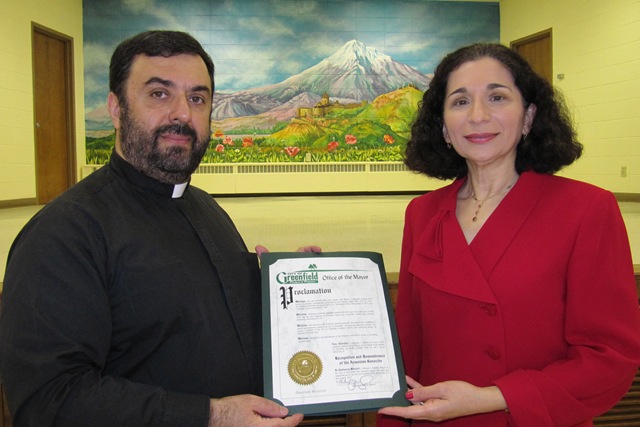 d proclaimed a day of remembrance in Greenfield.
The reading of the proclamation was part of a program held on Sunday, May 1, which also included a requiem in honor of the 1.5 million who fell during the Genocide, a traditional madagh dinner in the church’s cultural hall and the screening of a DVD filmed during the 2009 Genocide commemoration at Glendale Community College in California. The film’s keynote speaker, Rev. Fr. Vazken Movsesian, emphatically presented the prevention of genocide in our time as the message for Martyrs Day by placing the Armenian response to 1915 in the context of wider world campaigns for human rights. Movsesian is a well-known activist for the homeless and the needy in California and has taken the lead in involving Armenians in protests against genocide in Darfur.
It’s no coincidence, he reminded listeners, that Martyrs Day Commemoration as we know it began in 1965 alongside the rise of the American civil rights movement under Martin Luther King, Jr. But the resulting renewal of ethnic pride and call for public protests has had only limited effect in the U.S., where several years ago Secretary of State Condoleezza Rice blandly called for more historical study and President Barack Obama has not fulfilled his pledge to call the Genocide by its name.
“We need to look at ourselves as something bigger than a community consumed with Genocide,” Movesian said. “We need to show we are worthy to be called the people of the first genocide.” Movsesian recounted a 2006 visit to Rwanda, where his conversations with survivors of that country’s genocide where virtually identical with the memories of his grandparents. “Every story was an Armenian story—except the color of their skin was different.” He also noted that the Genocide Museum in Rwanda devoted two rooms to 1915 while the so-called Museum of Tolerance in West Hollywood, CA, constructed by a governor of Armenian descent ignores the Armenian Genocide.
A greater involvement by Armenians in contemporary campaigns against oppression could pay political dividends in the form of Genocide recognition, but Movsesian reminded listeners that the greater imperative comes from the gospel message of compassion for the least of our brethren. Only by being true to the deeper meaning of the Armenian Christian heritage will the Armenian cause of Genocide recognition move forward.
Posted in News |
April 17, 2011 – Palm Sunday
Divine Liturgy 10:00 A.M.
Opening of the Great Door Service 11:30 A.M.
PALM SUNDAY BRUNCH
At the conclusion of the church services on Palm Sunday, our Sunday School teachers and parents of the students will once again prepare and serve brunch to everyone. We cordially invite everyone to attend.
Կիրակի Ապրիլ 17, 2011 Ծաղկազարդ
Ս. Պատարագ Ժամը 10:00-ին
Դռնբացէք Ժամը 11:30-ին
Յաւարտ Ծաղկազարդի Ս. Պատարագի ու դռնբացեքի արարողութեանց, Կիրակնօրեայ Վարժարանիս ուսուցչական կազմն ու աշակերտութեանց ծնող-ները այս տարի եւս պիտի սպասարկեն՝ մեր եկեղեցիէն ներս աւանդութիւն դարձած՝ Ծաղկազարդի Նախաճաշ: Սիրով կը հրաւիրենք մեր հաւատացեալ ժողովուրդը սոյն նախաճաշին:
Posted in News | Tagged armenian palm sunday, palm sunday |
By David Luhrssen
(Milwaukee, WI) Vartanants, commemorating the Armenian defeat by Persia at the Battle of Avarayr (AD 451), is familiar to all Armenians. Less well known than the martyrdom of St. Vartan Mamigonian and his companions in the struggle for religious freedom is the road that led to Avarayr and the decades-long conflict that followed. In a talk at St. John the Baptist Armenian Church of Milwaukee during its Feb. 27 observation of Vartanants, Dr. Levon Saryan provided the battle with its historical context, outlining the events that came before an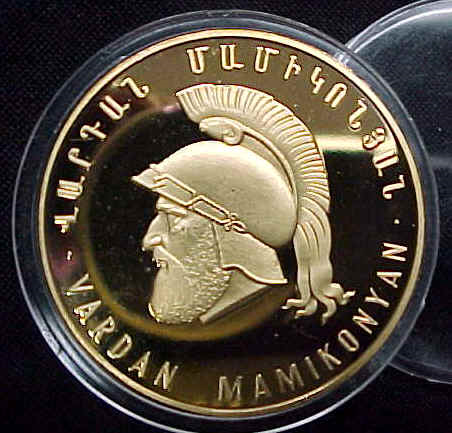 d after Avarayr.
A professor of pathology at Medical College of Wisconsin and a member of the Armenian National Academy of Sciences, Saryan has also pursued a scholarly interest in Armenian numismatics and antiquities. He is a member of the Society for Armenian Studies, the Armenian Library and Museum of America, and the Armenian Numismatic Society and other organizations.
“It seems as though the political landscape has not changed in its essential characteristics,” he began, pointing to Armenia’s perennial location at the cusp of larger, more powerful states. In the centuries before Avarayr, Armenia had been a buffer state between Rome and Persia and was later partitioned between the Byzantine and Persian empires. During this time Armenia’s unique Christian culture flourished, encouraged by the introduction of the Mesrobic alphabet and the growth of Armenian translations and original literature. However, it was not entirely a happy period. Saryan described a fourth century Persian invasion that ransacked cities, pillaged the countryside and took tens of thousands of lives as “a holocaust proportionately comparable to the 1915 Genocide.”
Given their country’s precarious status, it might be expected that Armenia’s princes would have accepted the edict by the Persian shah to renounce Christianity in favor of Zoroastrianism. But in St. Vartan’s famous words, “From this faith no one can shake us.” But resistance against the Persian effort to impose fire worship by force was not universal and many traitors collaborated with the enemy. Vartan lost his life at Avarayr but as Saryan explained, his nephew Vahan continued the struggle with a force of only 400 men. Using guerilla tactics, Vahan scored defeats against the Persian occupiers and their collaborators and by 484 forced the shah to sign a treaty. Along with protecting the freedom of the Armenian Church, it guaranteed the right to a just and tolerant government 800 years before English nobles forced their monarch to sign the Magna Carta.
For Saryan, the lesson of Avarayr is that “we should always we wary of disunity when our national interest is at stake. We should not let go of our principles for the sake of temporary expediency.”
Posted in News | Tagged vartanants, vartanantz |
 Milwaukee Armenians
You must be logged in to post a comment.