"To abide by Etchmiadzin and to live for Etchmiadzin means to live with the holy legacy of our land, our history, and our Motherland. Furthermore, to live for Etchmiadzin constitutes our faithfulness toward our aspirations and expectations, all of them being our guide in Armenia and in the Diaspora. Today it is our collective dream to see our Motherland in good progress, and the Armenians gathered around her with our national and cultural values at hand, aiming at national and unified purposes, bearing at heart the vision of Holy Etchmiadzin and Mt. Ararat".

H.H. KAREKIN II, CATHOLICOS OF ALL ARMENIANS                                                          

The above pontifical message carries with it the kind of spiritual power that can transform the soul of every Armenian. It is a message focused on the authenticity and the validity of 1700-year old history. These words move our souls and oblige us to bow before divine and historic realities and make us confront eternal truths. It is in this same message that the Armenian Christian realizes his true existence.

How can we utter wordimages on behalf of the mission of the Church without even alluding to the status of Holy Etchmiadzin, our Holy of the Holies?  How can a person address the children of our people forgetting to acknowledge Holy Etchmiadzin and Mother Armenia which should appear on our lips and in our hearts in the first place?
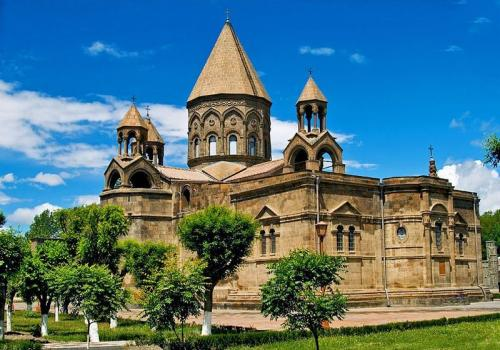
Each word and each message that spring from the heart and soul of an Armenian should build both spiritual Etchmiadzin and spiritual Armenia in our being. Holy Etchmiadzin is indeed the birthplace of the Armenian Church, as it is the rock on which Mother Armenia is founded.

Glory and honor to Vasken I, Catholicos of All Armenians of Blessed Memory, whose inspiring presence ever cultivated our mind and soul with Christian love and faith, so that we could dedicate ourselves to our homeland and to secure Holy Etchmiadzin as the way of our renewed life.

Holy Etchmiadzin is the Font of our souls in which we were christened and which radiated a new capacity through the vision and the message of Karekin I, Catholicos of All Armenians of Blessed Memory. He distributed them to the children of our nation as spiritual nourishment and as a destination to eternity. Today the Mother See of Holy Etchmiadzin is full of life, thanks to Karekin II, Catholicos of All Armenians, who made himself the non-consuming oil burning in the Lantern of the Illuminator and the calling of our soil, a challenge that keeps us all awake in our commitments so that we may dedicate our lives in unlimited service to the Holy Altar of God. Indeed that Altar is where Christ descended, and it is through the light of that Lantern that we can behold the history of our past and welcome the dawn of our new Armenia, now bloomed and bright with the blessings of Holy Etchmiadzin.

The love of God obliges us to humbly acknowledge and justly witness the ever blossomed fields of the Armenian Church, headed by the Mother See of Holy Etchmiadzin, the Holy of the Holies of all Armenians. It was in front of the Altar of Holy Etchmiadzin that our ancestors bowed their heads loyally and faithfully, anticipating in their souls the rebirth of our present generation. Along with that experience, our Mother Language in Golden Age Armenia embodied the newly written scripts by St. Mesrob, and at the same time the heroic sacrifice of the Holy Translators assured the essence of our nation adorned with multifaceted virtues and values.

We remember as clear as today when in 1976 we entered the Mother See for the first time. The Holy See was the same then as today, attractive from within and from without. What we witness today is the tireless accomplishments of His Holiness’ twelve years pontificate. Today, what we actually witness certainly entices and obligates us, the clergy and the laity alike, to extend our just and sincere gratitude to His Holiness. This refers not only to the Mother See, but also to the complete objectives and missions realized in various fields projected from a clear crystal as it were. Those accomplishments represent only the beginning of His Holiness’ journey during his Pontificate, and God knows how much more miraculous achievements under divine providence will register our history in the coming decades on behalf of His Holiness, thus enriching "the Birthplace of our souls".

How is it possible to speak about the mission of the Church without saying even one word in favor of the Church unity, a dream with which our Church and faithful are living?  It is a fallacy if our words addressed to our people do not pave way toward unity. In this temporary life what is expected from us, clergy and laity, is to reject all foreign and destructive powers that create distance between us and the source of our Mother Tutor, namely, Holy Etchmiadzin. The Armenian Church is privileged to have our Hierarchic Sees which comprise golden bridges spanned toward the Mother See Holy Etchmiadzin, the unmatched authority whose head is the Chosen of God, the Catholicos of All Armenians in the land of Armenia.

We express our deep respects to all of our Hierarchic Sees and to their honorable incumbents and salute them for their God-given service to our people through their equally illustrious leaders. This we say asking them to humbly achieve the miraculous unity and bring it to life so that they may rise in our history as truly illustrious models.

God of our fathers, we ask Thee to bless our Holy Church and the Armenian nation so that we may respond to the challenge of church unity in utmost faith founded by our Illuminator St. Gregory, by the vision of St. Sahag and St. Mesrob, St. Nersess the Graceful, St. Gregory of Narek, and of those numerous saints who served unselfishly who left behind our holy legacy. That legacy is the embodiment of the Armenian Church, founded firmly by God Himself, along with her mission which includes prime tribute to the memory of millions of our martyrs of the Genocide whose graves are left unmarked.

Our Church has been and today remains to be the Mount Tabor of our nation’s children. The Armenian Church is the anchor of our existence, as it is the "Altar of Light" for our lives. Under the arches of that church we preach the Gospel of Christ and spread the knowledge of God to renew the lives of our faithful.

Let us keep our Church away from the danger of dissension, the Church originated from the vision of the Illuminator and from the "Altar of Light" of Holy Etchmiadzin. Our Church is identified by the name of Holy Etchmiadzin, the Great Mystery in which we feel the descent of the Son of God who founded our Church personally by the golden hammer in His hand. The eternal existence of the Armenian Apostolic Mother Church is guaranteed by our loyalty toward the Mother See, as long as we concentrate our mind and spirit on that Great Mystery which rises from earth to heaven.      

Archbishop Hovnan Derderian

Primate of the Armenian Church Western Diocese
 

          This Sunday, October 23, the Armenian Church commemorates the Feast of the Discovery of the Holy Cross (Kude Khatchi). Empress Helena, mother of Constantine and a devout Christian, wanted to find the True Cross. She went to Golgotha (Calvary), which had become an obscure and neglected place. According to some chronicles, it was an informed Jew named Juda who pointed out the location. After excavation at the site, three wooden crosses were found. In order to identify the True Cross, the three crosses were successively placed on the body of a youth who had just died. When one of the crosses was placed on him, the young man came back to life. This was determined to be the True Cross. The commemoration of this event take place on the Sunday closest to October 26, and can vary from October 23 to 29.

       Christ’s exact burial site was also located, and the Church of the Holy Sepulcher was built on that spot in 335. The church was destroyed by fire in 614 when the Persians invaded Jerusalem; it was subsequently rebuilt. The current dome dates back to 1870. Three denominations (Armenian Orthodox, Greek Orthodox, and Russian Orthodox) administer and maintain the church and surrounding grounds, unfortunately not always harmoniously. Agreements strictly regulate times and places of worship for each denomination. Ironically, for centuries a Muslim family has been the custodian of the keys to the church, which is within the walled Old City of Jerusalem.

SIX SAINTS HONORED

       This Monday, October 17, the Armenian Church remembers six saints, namely, Longinus the Centurion, who pierced the side of Jesus, and became a believer at the crucifixion; Joseph, the foster father of the Lord, known as the Father-of-God, who was faithful to God’s command to be the earthly spouse of the Theotokos; Joseph of Arimathea, a follower of Jesus, sometimes secretly, but was emboldened to go to Pilate and request the body of Jesus for burial; Lazarus, a close friend of the Lord, whom He raised from the dead; and Mary and Martha, sisters of Lazarus, friends of the Lord and whose home Jesus visited often.

THE HOLY EVANGELISTS

       This Saturday, October 15, the Armenian Church commemorates the Holy Evangelists, Matthew, Mark, Luke, and John, the authors of the four Gospels.

       Matthew is the patron of the Church’s mission. The Gospel attributed to him closes with the command by Jesus to His disciples and followers to, “Go therefore and make disciples of all nations, baptizing them in the name of the father and of the Son and of the Holy Spirit, and teaching them to obey everything that I have commanded you. And remember, I am with you always, to the end of the age.” (Matthew 28:19-20)

       Mark had significant influence on the advancement of Christianity. Although the Gospel according to Mark is a narrative of the life of Jesus, theologians consider it to be a handbook of discipleship. The dominant message is that being a Christian is not only believing in Jesus Christ, it is also living according to the example set by Jesus. According to tradition, Mark was the first bishop of Alexandria. One of the most magnificent cathedrals in the world is named after him in Venice, where his relics are kept.

       Luke is the author of the third Gospel and the Book of Acts. He is considered to be the patron of physicians and artists. The Gospel according to Luke describes Jesus as “the healer of a broken world.” Luke is also noted for his concern for the poor, the marginalized, women, and social outcasts. His Gospel does not end with the Resurrection, but rather continues to Pentecost and the eternal presence of Christ in the world. Traditionally he is believed to be one of the Seventy and the unnamed disciple in Emmaus.

       John, often called the “beloved disciple,” is the author of the fourth Gospel and the book of Revelation. He was one of the twelve disciples who remained with Christ, standing in front of the Cross. Jesus entrusted his mother to John’s care on the day of the Crucifixion. The best known verse in his Gospel is, “For God so loved the world that he gave his only Son, that whoever believes in him should not perish but have eternal life.” (John 3:16). According to tradition, John left Jerusalem after attending the first ecumenical council and went to Asia Minor and settled in Ephesus. He was exiled to the island of Patmos where he wrote the book of Revelation.

This Saturday, October 8, the Armenian Church commemorates the Feast of the Holy Translators, one of the most beloved feasts. There are, in fact, two such commemorations in our liturgical calendar. One is on the Thursday following the fourth Sunday after Pentecost, which can occur in June or July; the other is on the second Saturday of October.

       The October commemoration focuses on the creation of the Armenian alphabet (406) and on the accomplishments of the Holy Translators. Mesrob Mashdots, the founder of the alphabet, and Catholicos Sahag, together with some of their students, translated the Bible. Schools were opened and the works of world-renowned scholars were translated. Their work gave the Armenian Church a distinct national identity.

       In modern times the entire month of October has been designated as a “Month of Culture.” Armenians throughout the Diaspora and Armenia mark this with cultural events not only in remembrance of the past, but in celebration of modern-day scholars, theologians, writers, and translators.

       Specifically remembered this Saturday along with Mesrob and Sahag, are: Yeghishe, a renowned student of Sahag and Mesrob, who served as secretary to Vartan Mamigonian and who wrote the great history of the Vartanantz wars; Movses of Khoren, another student of Sahag and Mesrob, who is revered as the father of Armenian history; David the Invincible, a student of Movses, received most of his education in Athens, where he was given the title “Invincible” because of his brilliance in philosophy; Gregory of Nareg, who is considered the greatest poet of the Armenian nation and its first and greatest mystic; and Nerses Shnorhali, a great writer, musician, theologian, and ecumenist.

       The holy translators, like stewards, were interpreters of the divine Scriptures by inventing letters by means of which are preserved on earth as living words for the shepherd flock of the New Israel, praise God with a sweet sounding hymn.

       They looked on the greatness of earthly glory as on darkness and having put their hope in the immortal bridegroom they were made worthy of the kingdom of heaven; praise God with a sweet-sounding song.

       By the power of the Father’s wisdom the uncreated existing One by means of their translation they made firm the throne of Saint Gregory, praise God with a sweet-sounding song.

       Saint Sahag having dressed in the new word, the holy scriptures, adorned the Armenian churches, praise God with a sweet-sounding song.
Canon to the Holy Translators, from the Liturgical Canons of the Armenian Church

Posted from the Armenian Prelacy’s (Eastern) Crossroads E-Newsletter

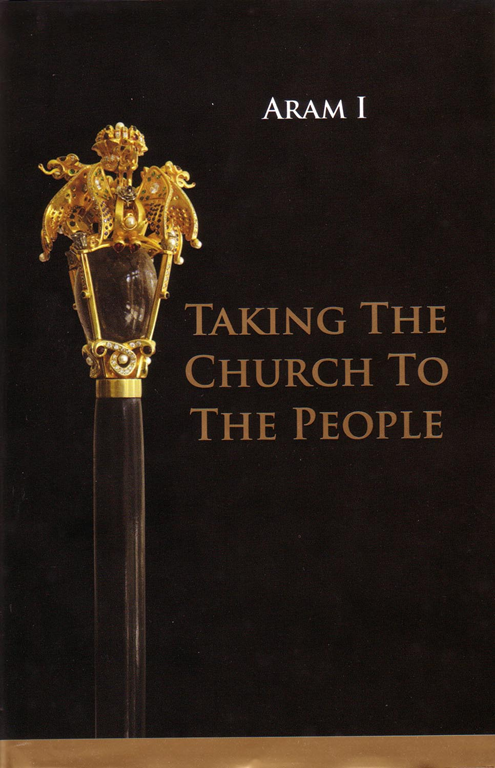
"TAKING THE CHURCH TO THE PEOPLE":
THE TITLE OF THE LATEST BOOK OF HIS HOLINESS ARAM I

      This timely book has been published through the generous contribution of the Calouste Gulbenimagekian Foundation. The book prepares the ground for the forthcoming pastoral visit of His Holiness Aram I to the United States of America. The concerns the Catholicos highlights apply both to Armenia and the Diaspora. In his introduction His Holiness Aram I writes, "I chose this title because the Church is the people."
The book consists of three parts. In the first part, Catholicos Aram I describes the nature of the church, its mission and its institutional expressions, including the parish, the dioceses and the wider Armenian community in Armenia and the diaspora. While describing the organization of each, he proposes ways in which they should be renewed.

       In the second part the Catholicos identifies the core issues that the Armenian Church is currently facing. He starts with the Bible as the foundation of Christian faith and its interpretation; he then discusses the family, the school and Christian education. At the end of this section, His Holiness Aram I explains the meaning of the term ’people of God’ and explains why Armenian women, youth and children, who have been marginalized in the Church and all community organizations, should participate in building their communities.
In the final part of the book, the Catholicos includes certain pastoral letters and messages that he has previously addressed to youth in order to prompt a meaningful dialogue with them.

      The book is a basic reader for all Armenians who want to learn about the Armenian Church and its faith, mission and organization. It is an invitation to the people in Armenia and the Diaspora to equip themselves with the legacy of the past and build Armenian communities responsive to the challenges of globalization. Finally, it is a guide to Being the Church as the people of God both in Armenia and Diaspora.

72 HOLY DISCIPLES OF CHRIST

       This Saturday, October 1, the Armenian Church commemorates the 72 Holy Disciples of Christ. The reference comes from the Gospel of Luke (Chapter 10, Verse 1): “After this the Lord appointed seventy others and sent them on ahead of him in pairs to every town and place where he himself intended to go.” (Some sources say 72 disciples, others say 70). These disciples remained true to the Lord and their calling, and spread the Gospel. They were not random choices, but rather true disciples whose labors carried the message of the Lord throughout the Roman Empire and beyond. All of the saints are remembered individually in the liturgical calendar of the church, but this day is set aside to remember them collectively.

For decades after they were discovered in a cave, the Dead Sea Scrolls were allowed to be examined closely only by fewer than a couple dozen scholars and archaeologists.

By Gali Tibbon, AFP/Getty Images

Dr. Adolfo Roitman, curator of the Dead Sea Scrolls and head of the Shrine of the Book, points at the original Isaiah scroll found in Qumaran caves in the Judean Desert and dated around 120 BC at the Israel Museum on Monday in Jerusalem.

 Now, with infrared- and computer-enhanced photography, anyone with a computer can view these 2,000-year-old relics, which include the oldest known copies of biblical text and a window on the world and times of Jesus.

 High-quality digitized images of five of the 950 manuscripts were posted for free online for the first time this week by Google and the Israel Museum in Jerusalem, where the scrolls are housed. The post includes an English translation and a search feature to one of the texts, the Great Isaiah Scroll.

 The scroll, one of seven animal skin parchments discovered in 1947 in a cave in Wadi Qumran in the West Bank, is the largest and best preserved.

 “Some of these images are appearing for the first time in Google — what no one has seen for 2,000 years and no scholar since the Dead Sea Scrolls were found,” says James Charlesworth, director and editor of the Princeton Dead Sea Scrolls Project, who is one of the few who has handled the ancient pieces of parchment. “Now images and letters that were never found are appearing in Google.”

 Charlesworth said the new images allow him to decipher in 30 minutes fragments of documents that once took 14 hours to analyze. The digital project will preserve documents that were eaten by worms and so fragile they’re turning to dust or rotting away.

Nathan Jastrum, an associate professor of theology at Concordia University in Mequon, Wis., says scholars were allowed to view scraps of some scrolls and prohibited from viewing others. The museum said allowing too many to handle the scrolls would destroy them.

With the new technology, Jastrum says, scholars and others can learn of the similarities between early Christians and Jews of the day, known as Essenes, who wrote most of the scrolls. The Essenes and other early Christians thought the ruling Jewish Pharisees had misinterpreted the Bible, Jastrum says. “Essenes help bridge the distance between the Jewish group that came to be known as Christian” and the Pharisees, he says.

Jesus and his disciples would not have been accepted by the Essenes, the separatist Jewish sect that is believed to have owned and created much of the Qumran library. Yet they shared so many customs that the Essenes help bridge a gap between Jesus’ followers and the Pharisees, whose version of Judaism became the established norm, Jastrum says.

The disciples associated with common people; the Essenes avoided people. Both had ritual washings: The disciples had baptism, and the Essenes had daily purification rites. Both shared communal meals that early Christians called the Lord’s Supper.

And both saw the world separated into two classes of people fighting a cosmic war of good vs. evil whom they called “sons of light and sons of darkness, each seeing themselves as sons of light,” Jastrum says.

The scrolls were discovered in 11 caves near Khirbet Qumran on the northwestern shores of the Dead Sea. They date from about 200 B.C. to about 68 A.D., Jastrum says.

Most were written in Hebrew, mostly on parchment, and most survived in fragments. They were found in clay pots and preserved over the centuries because of the dry desert environment, according to the Israel Museum.

The scrolls include the oldest known biblical manuscripts in existence, religious manuscripts not included in the Bible and documents that describe daily Jewish life in the land of Israel during the time of the Second Temple Period, and the birth of Christianity and Rabbinic Judaism.

The manuscripts span a time when the Holy Land was under Greek rule and then the Roman Empire, whose soldiers destroyed the Jews’ Second Temple in Jerusalem in 70 A.D. to quash a rebellion. All that remains of the temple today is the Western Wall.

Charlesworth says he was working last weekend with images of a Dead Sea document known as the Qumran Thanksgiving Hymns, some of which were illegible before the digital process, because of flaking off of the ink.

Parts of the book of hymns are believed to be written by a Jewish high priest accustomed to luxury who was exiled from Jerusalem to the desert wilderness with his followers by Greek conquerors in the second century before Christ.

“I thank you O Lord because you have placed me as the overflowing fountain in a parched land. … You have placed spring rain in my mouth,” the author writes. He describes his followers as “trees planted in Eden.”

“Even though you look out and see a horrible world the man sees people finding God through his inspiration,” Charlesworth says.

 http://www.usatoday.com/news/religion/story/2011-09-26/dead-sea-scroll/50554550/1?csp=Dailybriefing

       Next year we will be celebrating the 500th anniversary of the first Armenian printed book. In the year 1512 Hagop Meghabard became aware of the invention of printing by Gutenberg, and he went to Venice and helped create the first Armenian printed book, Ourpatakirk (The Book of Fridays), a collection of prayers. The Prelacy’s 2012 pocket diary is dedicated to this singular event.
        We call to your attention that in April 2012 the Library of Congress will open an exhibition in commemoration of the 500th anniversary of the first printed Armenian book and the first printing press dedicated to the publication of works in the Armenian script. The exhibition will also celebrate the designation by UNESCO of Yerevan as the Book Capital of the World, 2012. Accompanying the exhibit will be a book on the Armenian literary tradition, an illustrated brochure for the exhibition, Gallery Talks, and Special Tours. Dr. Levon Avdoyan, the Armenian and Georgian area specialist at the Library of Congress since 1991, is the curator of the exhibit.

       This Saturday, September 24, the Armenian Church commemorates St. George (Kevork) the Commander. St. George was a third century Roman general who challenged the Emperor’s persecution of Christians by publicly tearing up the Emperor’s decree, and he urged others to follow his example. To this day he remains a popular saint in the Armenian Church; he is considered to be the patron saint of soldiers and scouts. As in many other instances, the Armenians have given St. George an Armenian national character. The Feast of St. George is always on the Saturday before the Feast of the Holy Cross of Varak, which is preceded by a period of fasting. Although the fast is not connected to St. George, through the centuries it has been popularly identified as the Fast of St. George.