This Saturday, July 7, the Armenian Church commemorates the “Feast of the twelve apostles of Christ and Saint Paul, who is considered the thirteenth apostle.

Jesus selected twelve apostles to carry on His work and instructed them to preach and to baptize converts all over the world (Mt. 28:19-20). He gave the title “apostle” to the twelve (Luke 6:13; Mark 3:14). The word apostle derives from the Greek word apostellein (arakyal in Armenian). The apostles dedicated their lives to spreading the Word and fulfilling the sacred mission entrusted to them. Their mission was not just to transmit the message, but to put it into practice.

Paul was initially an enemy of Christians and persecuted them. He had a vision on the road to Damascus and became a fervent Christian convert and was subsequently responsible in large measure for the rapid spread of the new religion. Most of the New Testament (aside from the four Gospels) is from the writings of Paul.

The Armenian Church has its roots in the apostolic ministry and succession (Thaddeus and Bartholomew) and is therefore known as “apostolic,” (arakelagan). The apostles and their immediate successors (including the Armenian Church) defended the Orthodox faith and kept it pure.

Posted from Armenian Prelacy’s (Eastern) E-Newsletter

The Sandcastle Girls by Chris Bohjalian is a dynamic love tale seeped in historical fiction. The year is 1915 and Elizabeth Endicott has moved to Syria to aid refugees of the Armenian genocide. Once there, Elizabeth befriends Armen, a young widow, and amidst the trials of distance and war, the pair fall in love. Fast forward to the present day and to novelist Laura Petrosian, where Laura finds herself embarking on a journey of her own, back through her family’s history.

Chris Bohjalian is the critically acclaimed author of fifteen books, including the New York Times bestsellers The Double Bind,The Night Strangers, and Skeletons at the Feast. Bohjalian will appear at Books and Co. in Oconomowoc, 7 p.m., July 18.


RIGHTS – Controversial text book about Armenians sparks stir in Turkey.

Controversial text book about Armenians sparks stir in Turkey

ISTANBUL – Hürriyet Daily News

A Turkish minister defends a school book labeling Armenians ‘treacherous.’ DHA photo

The Ministry of Education has defended a school text book that includes slurs about Armenians as well as a number of Turkish writers, saying the book was “written with the sense of national reflex and humorous criticism.”

Penned by Yunus Zeyrek, the book, titled “Bu Dosyayı Kaldırıyorum: Ermeni Meselesi” (“Closing this File: The Armenian Issue”) defines Armenians as “dishonorable and treacherous” and vilifies novelists such as Nobel Prize Laureate Orhan Pamuk and writer Elif Şafak. History and literature teachers distributed the books to students of their own volition after receiving them.

Humorous criticismu

Education Minister Ömer Dinçer responded a parliamentary question proposed by Kadir Gökmen Öğüt of the opposition Republican People’s Party (CHP) about the book, saying “the examples in the book were written with the sense of national reflex and humorous criticism,” according to a report by daily Taraf.
Öğüt asked whether the ministry had approved the handing out of the book and also whether the content of the book could be considered as being a form of hate crime. In his response, Dinçer said the Ministry of Education had never recommended the book. “The Governorship of Istanbul stated that some of the books were presented to students by the District Governor of Kartal and that nobody was targeted in any chapter of the book.”

Dinçer had earlier announced that the ministry had launched a probe against a controversial book distributed by the education directorate among high schools in Istanbul’s Kartal district

June/28/2012

THIS WEEK IN ARMENIAN HISTORY
Prepared by the Armenian National Education Committee
Death of Karekin I, Catholicos of All Armenians
(June 29, 1999)

Thirteen years ago, the untimely death of Karekin I, Catholicos of All Armenians (formerly Karekin II, Catholicos of the Holy See of Cilicia) was a hard blow to the Armenian Church worldwide. Much has been said and written about the life and deeds of the Catholicos, but it is never too late to recall his memory one more time.

Born in Kessab, a piece of Armenian Cilicia which miraculously remained in Syria after the sanjak of Alexandretta (Hatay) was transferred to Turkey by the French mandate in 1939, Nishan Sarkissian entered the Theological Seminary of Antelias in 1946 and graduated six years later. In 1952, he was ordained a celibate priest and renamed Karekin, after the recently deceased Catholicos Karekin I Hovsepiants. He joined the brotherhood of the Armenian Catholicate of Cilicia.

After he defended his doctoral thesis in 1955, he received the degree of “vartabed” (doctor of the Church). He was a faculty member and then served as dean of the seminary. He studied theology for two years at Oxford University. In 1963 he became an aide to Catholicos Khoren I. The same year he was elevated to senior archimandrite and in 1964, consecrated bishop.

In the 1970s, he served in important administrative positions. From 1971-1973 he was Prelate of the Diocese of New Julfa (Iran) and in 1973 he received the rank of archbishop. He was appointed Pontifical Legate of the Eastern Prelacy from 1973-1975 and Prelate from 1975-1977. He left his position in 1977 when he was elected Catholicos Coadjutor of the Catholicate of Cilicia. He served in this position until the death of Catholicos Khoren in 1983, when he became Catholicos Karekin II of the Holy See of Cilicia.

His ecclesiastical, administrative, and intellectual activities, including his ecumenical contacts and his frequent and valuable publications in Armenian, English, and French on theological, Armenological, philosophical, ethical and other subjects, had already earned him a position of importance in the hierarchy of the Armenian Church. He bolstered his activities during his twelve-year tenure as Catholicos (1983-1995). He developed a close relationship with Catholicos of All Armenians, Vazken I (1955-1994).

Upon the death of Catholicos Vazken, Catholicos Karekin II was elected Catholicos of All Armenians in April 1995 and thereafter became known as Karekin I. These were the first years of the second independence of Armenia. The newly elected Catholicos was called to have a central role in the resurgence of the Armenian Church after the collapse of the Soviet Union. However, his health failed him and his pontificate was extremely brief. After a painful battle with cancer, he passed away on June 29, 1999.

THIS WEEK IN ARMENIAN HISTORY
Prepared by the Armenian National Education Committee (ANEC)


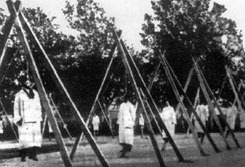
THE TWENTY HUNCHAKIAN GALLOWS (June 15, 1915)

       One of the main episodes of the repression exerted against the Armenian leadership in the initial phase of the Armenian genocide was the case of the Hunchakian Party activists who were hanged in Constantinople in 1915.

        The Social Democratic Hunchakian Party was founded in Geneva in 1887 by a group of Eastern Armenian students. It had pursued revolutionary activities with the aim of the self-defense of Armenians in the Ottoman Empire. After the 20gallows Ottoman Revolution of 1908, it maintained a certain distance from the Young Turk party. The coup d’état of early 1913 that practically concentrated the power in the hands of a triumvirate (Talaat, minister of Interior; Enver, minister of War, and Djemal, minister of Navy) was not well-received by the Hunchakian Party, which was concerned with the safety of Ottoman Armenians. The 7th General Convention of the Party, held in Constanta (Romania) in September 1913, stressed that the dictatorial government of the Young Turks would make impossible that the aim of an independent Armenia (which was the declared aim of the party in its political program) would be accomplished.

        The convention adjourned with two main objectives:

        1. The party would become again a clandestine organization.

        2. It would carry a plan to assassinate the leaders of the Young Turk party.

        An Armenian double-agent, who was also a member of the party and attended the meetings, reported these developments to the Turkish government. The Ottoman Armenian delegates to the convention were arrested as soon as they went back to Constantinople. By the end of 1913, a total of 140 members of the party had been arrested.

        Lengthy mock trials followed, while the prisoners endured terrible conditions in the Turkish prison. Finally, twenty-two members of the party were sentenced to death by hanging. The sentence was carried out for twenty of them (two were fugitives) on June 15, 1915, in the central square of Constantinople, known as Sultan Bayazid Square. As one of the prominent Hunchakian leaders, Paramaz, who was among the sentenced, said before his hanging, “You can only hang our bodies, but not our ideology.” The sacrifice of the Twenty Hunchakian gallows, also known as the “Twenty Hunchakian martyrs,” became an example and inspiration for political action of the following generations.

ST. NERSES THE GREAT AND BISHOP KHAT 

       This Saturday, June 16, the Armenian Church commemorates Catholicos Nerses the Great and Khat the Bishop. Nerses the Great was the father of Catholicos Sahak I. He succeeded two catholicoi whose reigns were unexceptional, and the people were eager to return to the line of their beloved Gregory the Illuminator. Nerses was a student of St. Basil of Caesarea, one of three great Cappadocian Fathers. Nerses’ pontificate was the beginning of a new era. He brought the church closer in service to the people, rather than to royals and nobles. He convened the Council of Ashdishad that resulted in numerous laws on issues related to marriage, worship, and customs. He built many schools, hospitals, and monasteries. He sent monks to preach the Gospel throughout the country. His bold actions resulted in great displeasure by the royal family and in 373 he was reportedly poisoned by the king. His accomplishments for the spiritual and social well-being of the common people earned him the gratitude of the entire nation and the honorific “Great.” 

       Khat the Bishop worked closely with St. Nerses the Great. Like Nerses he had great passion for social issues, especially helping the poor. Nerses entrusted most of the benevolent work of the church to Khat. He is so closely associated with St. Nerses that the church honors them on the same day.


By the light of unspeakable grace of your divine knowledge you arose on the land of Armenia, merciful heavenly Father; have compassion on us who have sinned. Saint Nerses, pure in soul, from birth you were chosen to inherit the paternal lot of shepherding righteously and lawfully. You adorned the Church with the laws of truth and established good order within it; through his prayers have mercy on us, O Christ.
(Canon to the Holy Patriarch Nerses the Great from the Liturgical Canons of the Armenian Church)

Posted from Eastern Prelacy’s Weekly E-Newsletter

Prepared by the Armenian National Education Committee (ANEC)

The fourth and final Russo-Turkish war of the nineteenth century (1877-1878) ended with a humiliating defeat for the Ottoman Empire and the signature of the Treaty of San Stefano on March 3, 1878. By this treaty, the Russian Empire tried to settle the Eastern Question and alter the balance of power in the Balkan Peninsula to its own advantage. Article 16 of the treaty established: “As the evacuation by the Russian troops of the territory which they occupy in Armenia, and which is to be restored to Turkey, might give rise to conflicts and complications detrimental to the maintenance of good relations between the two countries, the Sublime Porte engages to carry into effect, without further delay, the improvements and reforms demanded by local requirements in the provinces inhabited by Armenians, and to guarantee their security from Kurds and Circassians.” This meant that the Ottoman Empire agreed to carry reforms in Armenia under the immediate supervision of Russian troops before their evacuation.

Catholicos Nersess Varjabedian

The terms of the treaty, particularly with reference to the Balkans, alarmed the Great Powers, as well as Serbia and Greece. Russia had to agree to the organization of a congress in Berlin, where the terms of the Treaty of San Stefano would be revised. The Congress of Berlin lasted a month. An Armenian delegation was sent by Patriarch of Constantinople, Nerses Varjabedian, to present their case. Since they did not represent any country, the delegation, led by former Patriarch Meguerdich Khrimian (Khrimian Hayrig), was not allowed to participate. On July 13, the Treaty of Berlin was signed to replace the Treaty of San Stefano. Diplomatic maneuvers led by Great Britain succeeded in restoring for Turkey most of what it had lost in the war and San Stefano. Article 61 of the new treaty watered down article 16 in the following way: “The Sublime Porte undertakes to carry out, without further delay, the improvements and reforms demanded by local requirements in the provinces inhabited by the Armenians, and to guarantee their security against the Circassians and Kurds. It will periodically make known the steps taken to this effect to the Powers, who will superintend their application.” It meant that the Ottoman Empire was supposed to carry reforms with no mention of Russian supervising forces; those reforms would be guaranteed by the European powers. Besides, the term “Armenia” had been replaced by “provinces inhabited by the Armenians.”

The Armenian delegation returned with empty hands to Constantinople. Upon his return, Khrimian Hayrig pronounced his famous homily of the Iron Ladle, in which he stated that each power at Berlin had taken a share of the contents of a great soup bowl with an iron ladle, whereas he had only a “paper ladle” (a petition) and thus could bring nothing back to the Armenian people. His sermon marked a turning point in Armenian political consciousness.

The Russo-Turkish war and the Treaty of Berlin marked the internationalization of the Armenian Question. For the next four decades, until the outbreak of World War I, Armenians would claim from the European powers that they forced Turkey to execute the promised reforms. The Turkish government would carry a policy of violence until the ultimate level: genocide.

St. Nerses Shnorhali

THIS WEEK IN ARMENIAN HISTORY
Prepared by the Armenian National Education Committee (ANEC)

St. Nerses Shnorhali, born on June 4, 1102

Every time we sing “Aravod Looso” (Morning of Light) during the morning service at church or “Norahrash bsagavor” (Newly and Marvelously Crowned) at the festivity of Vartanantz, we are singing two of the most inspired sharagans written and musicalized by Nerses Shnorhali. We are also repeating his words when we recite “Havadov Khosdovanim” (In Faith I Confess) during Lent. One of the most beloved saints of the Armenian Church, he was born on June 4, 1102 (some sources say 1098 or 1101). He was a member of the Pahlavuni princely family and the grandson of the noted writer, Grigor Magistros Pahlavuni. Shnorhali (literally “filled with grace”) had been the title of several known members of the Church, but it became synonymous with Nerses after his time.

The fall of the Armenian kingdom of the Pakratunis in 1045 and the destruction of the capital Ani by the Seljukid Turks in 1064 had forced the Holy See of the Armenian Church to move from the capital in 1081. After several changes of place, Grigor III had settled the see in the fortress of Hromgla (Hrom-Gla, “Roman Fortress”), on the banks of the Euphrates River, very close to the border of the Armenian state of Cilicia, in 1149 (it remained there until 1292). His brother Nerses, whom he had ordained at the age of 18 and who was consecrated a bishop at the age of thirty, was also known as Nerses Glayetsi. He was the right hand of Krigor III during his long reign (1113-1166) and succeeded him as Catholicos Nerses IV until his death in 1173.

A prolific writer and theologian, some of Shnorhali’s best known works are his Tught Unthanragan (General Epistle), a message of guidance in the Christian faith for the Armenian people, and his poem Hisus Vorti (Jesus the Son). Both have been translated into English. Many of his songs and hymns were incorporated into the regular service of the Armenian Church. His pioneering spirit of ecumenism and his leadership have been historically recognized.

BY HARUT SASSOUNIAN

http://asbarez.com/102833/lawsuit-happy-turkish-group-loses-appeal-on-armenian-genocide/

The Turkish Coalition of America (TCA) has been on a rampage in recent years, filing lawsuits against scholars, public officials, and civic groups who support the recognition of the Armenian Genocide.

Last week, a federal appeals court put an end to TCA’s legal tirade against the University of Minnesota by unanimously upholding a federal court’s decision dismissing TCA’s baseless allegations.

The Turkish advocacy group had filed a lawsuit against Prof. Bruno Chaouat, Director of the Center for Holocaust and Genocide Studies at the University of Minnesota, for labeling TCA’s website and others as “unreliable.” The university’s webpage had posted the following stern admonition to students: “We do not recommend these sites. Warnings should be given to students writing papers that they should not use these sites because of denial, support by an unknown organization, or contents that are a strange mix of fact and opinion.”

Initially, TCA had complained that the inclusion of TCA’s website on the university’s list of “Unreliable Websites” violated the Turkish group’s freedom of speech. The university rejected TCA’s allegation, although, the Center for Holocaust and Genocide Studies revised its website on Nov. 18, 2010, removing the “Unreliable Websites” and recommending new resources for genocide research. The university asserted that the revision was not prompted by TCA’s complaint and denied any wrongdoing. On Nov. 24, 2010, Prof. Chaouat posted a statement on the Center’s website explaining that the list of “Unreliable Websites” was removed because he did not want to “promote, even negatively, sources of illegitimate information.”

TCA then filed a lawsuit against the university, its president, and Prof. Chaouat, claiming that including its website on the same list as websites denying the Jewish Holocaust, stigmatized the Turkish organization. The court dismissed the lawsuit.

A three-judge panel of the 8th circuit federal appeals court upheld the lower court’s decision on May 3, 2012, ruling that the university did not violate TCA’s First Amendment rights, since it neither blocked nor restricted access to the Turkish website.

The judges also rejected the Turkish group’s second claim that it was defamed when the university stated that TCA’s website is “unreliable,” engages in “denial,” presents “a strange mix of fact and opinion,” and is an “illegitimate source of information.” In a sinister attempt to win the lawsuit, TCA claimed that its website did not deny certain underlying historical facts, affirming that “certainly hundreds of thousands of Armenians died.” However, since the Turkish website had alleged that it is “highly unlikely that a genocide charge could be sustained against the Ottoman government or its successor,” the judges ruled in favor of the university asserting that TCA had in fact engaged in “denial.”

TCA’s malicious lawsuit disturbed many US scholars who were worried that this case would set a dangerous precedent and have a chilling effect on academic freedom. The gravity of these concerns had prompted the Middle East Studies Association to demand TCA to withdraw its lawsuit.

Although TCA failed in its bullying tactics against the University of Minnesota, there is no guarantee that this Turkish group will stop suing other academic or civic organizations for refusing to cave in to Turkey’s denialist campaign. It should be noted that TCA spent $630,000 on legal fees out of its 2010 budget of $3.6 million. Significantly, no mention was made in its annual report of the sources of TCA’s funding, except a passing remark that it is “supported entirely by private donations.” The Boston Business Journal reported that Turkish-American Yalcin Ayasli, founder of Hittite Microwave Corp., contributed $30 million to TCA in 2007.

TCA engaged in the following wide ranging activities and political objectives with its $3.6 million budget in 2010:

– Delivered 75 position papers to members of Congress and US opinion leaders; – Monitored the American media; – Took a Native American business delegation to Turkey; – Lobbied the Congress against the Armenian Genocide resolution; – Advertised in Roll Call and Washington Quarterly; – Organized Summer internships in Washington for Turkish students; – Provided scholarships to African-American, Armenian-American, Hispanic American, Native American, and Turkish-American students to study in Turkish universities; – Awarded grants for academic conferences; – Offered research fellowships to professors Michael Gunter, Justin McCarthy, Hakan Yavuz, and others; – Contributed $100,000 grants to each of the Assembly of Turkish American Associations and Federation of Turkish American Associations, and a smaller amount to the Azerbaijan Society of America; – Spent $630,000 on lawsuits against various entities that support the Armenian Genocide issue; – Funded congressional trips to Turkey, and – Filed a report with the US government accusing the Armenian National Committee of America (ANCA) of being a “hate group.”

Given TCA’s tax-exempt charitable status, the Internal Revenue Service should investigate the legality of this Turkish group’s involvement in such extensive political and lobbying activities.

http://asbarez.com/102833/lawsuit-happy-turkish-group-loses-appeal-on-armenian-genocide/