Message of His Holiness Karekin II

Supreme Patriarch and Catholicos of All Armenians

On the Feast of the Holy Nativity and Theophany of our Lord Jesus Christ

Mother See of Holy Etchmiadzin, January 6, 2013


“Behold, the virgin shall conceive and bear a Son,

and they shall call His name Immanuel,

which is translated ‘God with us’.”

Matthew 1:23 / Isaiah 7:14


Dear and Beloved Faithful,


Today, with boundless joy in our souls, we glorify and praise the Holy Nativity and Theophany of our Lord and Savior Jesus Christ, by conveying to one another the greeting: “Christ is Born and Revealed, great tidings to all”.


In the fullness of time, the words of the Prophet Isaiah came to fruition, “Behold the virgin shall conceive and bear a Son, and they shall call His name Immanuel, which is translated ‘God with us’”.


From the insurmountable heights of heaven, our beneficent Lord humbled Himself and was born as an infant in the cave; he made himself poor in order to enrich us with blessings.  The Apostle Paul says, “For you know the grace of our Lord Jesus Christ, that though He was rich, yet for your sakes He became poor, that you through His poverty might become rich.” (II Corinthians 8:9.)  God became man so that man created in the image of God would recognize his Creator and His will, become enriched with faith and the word of God, be enriched with the longing and zeal for a God-pleasing life, and having become worthy of salvation, inherit eternal life.  Truly, nothing can be compared to that wealth – to the grace of having eternal life in God’s kingdom – which was brought to us by the Savior our Lord, Jesus Christ – “the Son of man who is in heaven.” (John 3:13.)


The unapproachable Lord of glory and powers has become a child, has come to earth, and each individual may boldly approach and worship Him following the example of the shepherds and the Magi, who recognized Him and brought their gifts to the Savior Child lying in the manger.  Today, dearly beloved faithful, it is we who bow down before the cradle of the infant Jesus, but what gifts have we to offer our newborn Savior?  Our Lord does not want expensive material presents.  The honored gift for the Savior is the Christian himself, who has accepted the prophetic tiding of “God with us” with a clean heart, and who tries to live every day according to divine Will, full of faith in God, love for his fellow man and with spiritual renewal with the Savior.  The man, who is reborn with the graces of the Savior, transforms life, leading it always toward the good, toward the better and the perfect.  Before the shadowless rays of the Lord’s presence and mercy, as Saint Gregory of Narek says, sins melt away, wounds are healed, corruption is cleansed, sadness withdraws, sighs retreat, darkness flees and the all-provident kingdom of the Benevolent God reigns. (Lamentations, Prayer 41.)  Today and until the end of time, in accord with His promise, the incarnate God is with us. (Matthew 28:20.)  He is with us with the grace of His salvation and His miraculous love of mankind.  But are we with God?  Is the world progressing on that path that Christ directed?


The life of mankind, as well as our lives, dear pious sons and daughters, is full of different types of challenges, crises and troubles – fundamental social and economic issues, international and inter-religious controversies and conflicts, poverty, the fury for personal gain, the neglect of those in want, the lack of justice and humanity, as well as other deficiencies – which are all the result of paths that lead away from God.  Before the reality of the world, man often assumes that the improvement of life and the wellbeing of society are reachable, especially, through the abundance of material goods.  Whereas if God is not present in the souls of men, the material only divides society and dries up the happiness and joy of life.  The wealthy live in anxiety, the poor in restlessness, and society at large in alienation.  For the sake of material goods, men search for ways to steal, to deny, and to humiliate.  For the sake of material goods, laws are broken, offices are abused, rights are trampled, and lives are ruined; for the sake of material goods, at times, alas, even in the name of God, against God.  All which is done in the name of God is goodness for mankind; is consolation and joy.  For the man who is with God, there are different standards for life, other values and principles for the purpose of being, “Love without hypocrisy, abhor what is evil, cling to what is good; be kindly affectionate to one another with brotherly love, in honor giving preference to one another.” (Romans 12:9-10.)  With God, the position is service, human practices and abilities are the source of goodness, building the nation, and the wellbeing of life.


Dear ones, with the mystery of the Holy Nativity, we have the daily grace to ascend the mountain of transfiguration with Christ, to live in the presence of the Lord, in a God-pleasing and soul-building environment, and to keep our course steadfast on the paths of God on moral and true values.  The Holy Bible teaches us that walking with God saves us from temptations, multiplies our blessings and grants triumphs through heavenly power.  Indeed our history testifies that our people, through fidelity to the Savior, have built the victories of their creative life and the ascents of our culture.  It is with our Lord that we have overcome adversities, risen up from destruction and survived genocide.  By the power of our Lord we have sprouted again in the Diaspora and protected our identity; we have reestablished our free statehood through our dispersed unity; we have always kept on high the vision of our promised land; and moreover, the belief that the Lord shall gather us together in our Homeland.  Today, with the tiding of “God is with us”, let us bow down with bright hope and encouragement before the incarnate Savior’s cradle, to be warmed by His love and to accept His graces and blessings, so that we reform and strengthen our life in the Homeland and the Diaspora; so that we realize our national goals, create our people’s prosperous, happy and bright future, and always remain a people faithful to God.


With this appeal and wish on our lips, we greet with brotherly love and the glad tiding of the Holy Nativity, the incumbents of the hierarchal sees of our Apostolic Holy Church:  His Holiness Aram I, Catholicos of the Great House of Cilicia; His Beatitude Archbishop Mesrob Mutafian, Armenian Patriarch of Constantinople; His Eminence Archbishop Aris Shirvanian, Locum Tenens of the Armenian Patriarchate of Jerusalem; the heads of our Sister Churches; and the entire ranks of clergy of our Church, and appeal for the countless graces and strength of our Lord in their Christ-ordained mission.


With the best wishes of the Lord’s Holy Birth, we greet His Excellency Serzh Sargsian, President of the Republic of Armenia, present today for the celebration of Divine Liturgy.  We extend out greetings to President Bako Sahakian of the Artsakh Republic and all government officials of the Armenian people, appealing for success to all of their nation-building labors under the heavenly blessings of our Lord.  We greet the leaders and representatives of diplomatic missions accredited in Armenia, and wish for the friendship and cooperation between our peoples and countries to always be improved through their fruitful efforts and renewing accomplishments.


We extend our pontifical love and blessings to our beloved sons and daughters in the Homeland and the Dispersion.  We offer prayers to heaven for the incarnate Savior’s graces of love, peace and solidarity to shine throughout the world every day, and especially over those lands where there are conflicts, among them war-torn Syria and in the lives of our brothers and sisters there who are facing difficulties and pain.  May the souls of men always resound with the Christmas message of “peace on earth and goodwill to men” and be strengthened with the will to walk with God.  May the Lord keep our native land at peace and secure under His Holy Right Hand, our Holy Apostolic Church bright and unshakeable, and bless the Armenian nation throughout the world, now and always. Amen.


Christ is Born and Revealed.

Great Tidings to Us All.

ПОСЛАНИЕ

ЕГО СВЯТЕЙШЕСТВА ГАРЕГИНА ВТОРОГО,

ВЕРХОВНОГО ПАТРИАРХА И КАТОЛИКОСА ВСЕХ АРМЯН,

ПО СЛУЧАЮ ПРАЗДНИКА СВЯТОГО РОЖДЕСТВА И БОГОЯВЛЕНИЯ ГОСПОДА НАШЕГО ИИСУСА ХРИСТА

(Первопрестольный Святой Эчмиадзин, 6 января 2013 г.)

Во имя Отца и Сына и Святого Духа! Аминь.


 Се, Дева во чреве приимет и родит Сына,

и нарекут имя Ему Еммануил, что значит: с нами Бог”

(Мф. 1:23, Ис. 7.14).


Возлюбленный благоверный народ!

С безмерной радостью души сегодня прославляем и славословим Святое Рождество и Богоявление Господа нашего и Спасителя Иисуса Христа, передавая друг другу приветствие: “Христос родился и явился, вам и нам – благая весть”.

Во исполнение времени свершилось слово пророка Исаи: “Се, Дева во чреве приимет и родит Сына, и нарекут имя Ему Еммануил, что значит: с нами Бог”.

С недосягаемых небесных высот человеколюбивый Господь склонился и, родившись в яслях как младенец, обнищал, дабы обогатить нас духовными благами. Апостол Павел говорит: “Ибо вы знаете благодать Господа нашего Иисуса Христа, что Он, будучи богат, обнищал ради вас, дабы вы обогатились Его нищетою” (1 Корф. 8:9). Бог вочеловечился, дабы человек, сотворенный по образу Божию, познал своего Творца, Его волю, обогатился верою, словом Божьим, обогатился жаждою и устремлением к богоугодной жизни и, удостоившись спасения, наследовал вечную жизнь. Воистину, ничто не может сравниться с этим богатством – благодатью обладания вечной жизнью в Царствии Божием, которую принес нам Спаситель наш Господь Иисус Христос, “Сын Человеческий, сущий на небесах” (Ин. 3:13).

Непостижимый Господь славы и могущества стал младенцем, пришел в мир, и каждый может смело подойти и поклониться Ему по примеру пастухов и волхвов, которые познали Его и преподнесли свои дары младенцу Спасителю, положенному в яслях в пещере. Сегодня, возлюбленный верующий народ, мы склоняемся перед яслями младенца Иисуса, однако какие дары мы имеем преподнести нашему новорожденному Спасителю? Не материальных богатых даров ожидает Господь. Драгоценным даром для Спасителя является сам христианин, кто с чистым сердцем принял пророческое благовестие “С нами Бог” и стремится каждый день своей жизни прожить в соответствии с волею Божьей, исполненный веры в Бога, любовью к другим, в духовном обновлении со Спасителем. Человек, возродившийся милостями Спасителя, преобразует жизнь, ведя ее всегда к добру, к лучшему, к совершенному. Пред чистыми лучами присутствия Господа и Его милости, как говоритСвятой Григор Нарекаци, тают грехи, заживают раны, исчезают скверны, отступают печали и стенания, рассеивается мрак, и воцаряется всеопекающее царствие Благодетельного Бога (“Книга скорбных песнопений”, гл. 41). Сегодня и до скончания времен, согласно Его обещанию, вочеловечившийся Бог – с нами (Мф. 28:20). Он с нами Своей благодатью спасения, Своим чудодейственным человеколюбием. Но с Богом ли мы и шествует ли мир по тому пути, указанному Христом?

Жизнь человечества, в том числе и наша, возлюбленный благоверный народ, полна разнообразных вызовов, тревог и забот: фундаментальные социальные, экономические проблемы, межнациональные и межрелигиозные сложности и противостояния, нужда, исступленность собственною выгодой, пренебрежение лишенными, недостаток справедливости, человеколюбия и другие пороки, которые являются следствием отдаления от Бога. В реалиях мира человек зачастую полагает, что благоустройство жизни, благоденствие общества достижимо особенно при изобилии материального. Однако, если в душах людей нет Бога, материальное лишь разделяет их, иссушает радость и счастье жизни. Имущий живет в беспокойстве, неимущий – в досаде, общество, в целом, – в отчуждении. Ради материального люди ищут пути, как обокрасть, лишить, унизить. Ради материального люди нарушают законы, злоупотребляют должностью, попирают права, губят друг друга. Ради материального, увы,порою даже именем Бога – против Бога. То, что порождено во имя Бога, есть благо для людей, утешение и радость. С Богом для человека действуют иные критерии жизни, иные принципы и ценности смысла существования: “Любовь да будет непритворна; отвращайтесь зла, прилепляйтесь к добру; будьте братолюбивы друг к другу с нежностью; в почтительности друг друга предупреждайте” (Рим. 12:9-10). С Богом должность – это служение, человеческие способности и возможности – источник блага, процветания страны, благоденствия жизни.

С таинством Святого Рождества, дорогие, нам навсегда дана благодать взойти с Христом на гору преображения, жить в богоугодной духовной среде в присутствии Господа и хранить незыблемо ход нашей жизни на стезях Божиих, на истинных, нравственных ценностях. Святое Писание наставляет нас, что шествование с Богом спасает от испытаний, умножает блага и дарует победы силой небесной. Сама наша история свидетельствует, что упованием на Спасителя народ наш творил победы своей творческой жизни и подъем культуры. С нашим Господом мы противостояли испытаниям, воспряли из руин, пережили геноцид. Силой нашего Господа мы возродились в Диаспоре и сохранили нашу идентичность, сплоченностью рассеянной по всему свету нации мы восстановили нашу свободную государственность, сохранили всегда ярким видение нашей обетованной земли, а также веру в то, что Господь объединит нас в нашем Отечестве. “С нами Бог!” – обнадеженные и ободренные этим благовестием, преклонимся сегодня пред яслями воплотившегося Спасителя, дабы согреться Его любовью, принять Его милости и благословения, чтобы в Отечестве и Диаспоре преобразовать  и упрочить нашу жизнь, осуществить наши национальные чаяния, созидать благоденное и счастливое, светлое грядущее нашего народа и навеки остаться верным Богу народом.

С этой мольбой и пожеланием на устах, с благовестием Святого Рождества и братской любовью приветствуем глав иерархических престолов нашей Апостольской Святой Церкви: Католикоса Великого Дома Киликийского Его Святейшество Арама Первого, Блаженнейшего Патриарха Константинопольского Архиепископа Месропа Мутафяна, Местоблюстителя Иерусалимского Патриаршего Престола Архиепископа Ариса Ширваняна, духовных предстоятелей сестринских Церквей и все духовенство нашей Церкви и испрашиваем обильной милости и поддержки Господней в заповеданной Христом миссии.

С добрыми пожеланиями праздника Святого Рождества приветствуем присутствующего на Божественной литургии Президента Республики Армения господина Сержа Саргсяна, шлем Наше приветствие Президенту Нагорно-Карабахской Республики господину Бако Саакяну и всем государственным мужам, испрашивая успехов в деяниях во благо нации и Отечества при ниспосланном с небес благословении Господнем. Приветствуем глав и представителей дипломатических миссий, аккредитованных в Армении, желая, чтобы плодотворными стараниями и постоянными достижениями присно благоукрашались дружба и сотрудничество наших стран и народов.

Приносим Наше Патриаршее благословение и любовь возлюбленному нашему народу на Родине и во всем мире. Возносим молитву, чтобы милости любви, мира и солидарности вочеловечившегося Спасителя неизменно источались на мир, особенно, на страны, переживающие конфликты, в частности, на Сирию, находящуюся в состоянии войны, где и наши братья и сестры преодолевают трудности и лишения. Пусть в душах людей всегда находит отклик назидание Святого Рождества “мир на земле и благоволение в человеках” и крепнет воля к шествию с Богом. Пусть Господь под сенью Святой Длани Своей хранит в мире и безопасности наше Отечество, процветающей и незыблемой – Апостольскую нашу Святую Церковь и благословит наш армянский народ по всему миру ныне и присно и вовек. Аминь.


Христос родился и нам явился!

Вам и нам – благая весть!
 

This Saturday, December 8, the Armenian Church remembers St. Nicholas the Wonderworker, a fourth-century Bishop of Myra, Lycia in Asia Minor (modern-day Turkey) and a defender of orthodoxy. Because of many miracles attributed to his intercession he is called “the wonderworker.” He was also known as a secret gift-giver and is believed to be the model for Santa Claus.

Today,  Tuesday, December 4, the Armenian Church remembers King Apkar, considered to be the “first believing king.” His realm was in Edessa (Urfa) where many Armenians had migrated. Suffering from a debilitating skin disease, King Apkar sent a letter to Christ hoping to be cured, and received the answer that a disciple of Christ was visit the king. According to tradition, Christ sent Apkar a linen cloth (Dastarak) with His image. After Christ’s ascension Thaddeus went to see the king and cured him. King Apkar and his family became Christians and wrote to other kings urging them to accept Christianity.

Posted from the Armenian Prelacy’s (Eastern) Crossroads E-Crossroads

THIS WEEK IN ARMENIAN HISTORY
Prepared by
the Armenian National Education Committee (ANEC)


The Treaty of Alexandropol
(December 2-3, 1920)

       The Armenian-Turkish war of 1920 put the Republic of Armenia on the brink of collapse. It also brought back the very real threat of physical disappearance for the Armenian people. The secret pact signed between the Turkish Great National Assembly led by Mustafa Kemal (Ataturk) and Soviet Russia in August 1920 had ensured the support of Bolshevism to the Turkish insurgents. The latter, unlike the Ottoman legal government, were leading the so-called “war of independence” against Greece in order to overturn the partition of the Ottoman Empire that included the division of current Turkey into different zones of influence and the loss of most of its territories.

       Turkish forces commanded by General Kiazim Karabekir had already reached Alexandropol (now Gumri) at the end of November 1920 when a ceasefire was forced upon the Armenian government. On the other side, a small group of Armenian Bolsheviks had crossed the border from Soviet Azerbaijan into Armenia on November 29 and proclaimed Armenia a Soviet republic, appealing for the intervention of the Red Army. The government of the Republic of Armenia, led by Prime Minister Simon Vratsian (who had assumed power on November 25), was forced to choose the lesser of two evils: to turn away the potential annihilation of Eastern Armenians, it decided to relinquish power to the Communists. The change of regime was legalized through the signature of an agreement between the authorities of the Republic of Armenia and Boris Legran, representative of the Russian Soviet Federative Socialist Republic (RSFSR), in the morning of December 2, 1920. It was enforced on the same day at 6 pm. It established that Armenia would become an independent Soviet Socialist republic within the frontiers that had been under the jurisdiction of the government before the Turkish invasion and a revolutionary committee would take power temporarily. On its final session of the same day, the government of the Republic of Armenia decided to resign power. After more than two and half years, the first independence had come to an end.

The sovietization of Armenia did not end the Turkish menace. Karabekir threatened to resume his offensive unless his terms were accepted. The onerous terms obliged Armenia to renounce the Treaty of Sevres and all claims to Western Armenia and the province of Kars, and to accept temporary Turkish jurisdiction in Nakhichevan, among other issues. Alexander Khatisian, representative of the Republic of Armenia, signed the treaty in the wee hours of December 3.

       However, the Armenian government had already resigned and, therefore, Khatisian had no power whatsoever. On the other hand, Kiazim Karabekir represented the Great National Assembly of Turkey, with headquarters in Ankara, but the legal authority of Turkey, until November 1922, was in the hands of Sultan Mehmed VI and the Ottoman government in Constantinople. Legally, none of the signing parties had any attribution to stamp their signature under the document. Writes Richard Hovannisian: “Denounced and branded a traitor by Soviet and other non-Dashnakist authors, Khatisian justified his action as an exigency measure taken with the knowledge of the new Erevan government and intended to give time for the Red Army to enter Armenia in sufficient numbers to block a further Turkish advance. Realizing that he had not legal jurisdiction, Khatisian hoped that the new Soviet government, with the support of Russia, would repudiate his action and force the Turks to withdraw, at least to the pre-war boundaries.”

       The Treaty of Alexandropol was never ratified and was replaced by the treaties of Moscow and Kars (March and October 1921). The latter was signed by the Great National Assembly of Turkey, Soviet Russia, Soviet Armenia, Soviet Georgia, and Soviet Azerbaijan. However, these treaties cannot be recognized as valid according to international law. Mustafa Kemal had not been invested with any powers by the legally recognized Ottoman government, and Soviet Armenia was not a legally recognized state anymore.


THIS WEEK IN ARMENIAN HISTORY
Prepared by

the Armenian National Education Committee (ANEC)

INTRODUCTION OF THE “DRAM” [TRAM]

AS ARMENIA’S CURRENCY
(November 22, 1993)

The first independent Republic of Armenia (1918-1920) used Russian rubles as currency. The Armenian banknotes, which kept “rubli” (ռուբլի, ruble) as the name of the currency, were designed by painter Arshag Fetvadjian (1866-1947). They were under printing in Europe when Armenia became a Soviet republic in December 1920 and were never put into circulation. 

            After the second independence, the Central Bank of Armenia was created on March 27, 1993. The new Armenian monetary unit was called dram [Tram] (դրամ); the name, which means “money” in Armenian, was also the name of the silver coins in circulation during the Armenian kingdom of Cilicia (1199-1375). Interestingly, the word դրամ, pronounced tram, designates “money” in Western Armenian; Eastern Armenian uses the word փող (pogh) to designate “money.” Pogh was also the name of a certain type of copper coins in the Armenian state of Cilicia. 

            The devaluation of the Russian ruble (which initially continued as the currency in the former Soviet Union following the collapse of the state) prompted the replacement of old currency by new one, and a flood of worthless old Russian rubles into Armenian forced the introduction of the dram, earlier than anticipated, on November 22, 1993. The initial value was 1 dram = 200 Russian rubles, while 1 American dollar equaled 14 drams. The high inflation of the period 1993-1994 in Armenia depreciated the dram to a value of 1 U$S = 100 AMD.  It reached 420 drams per dollar in March 1995 and stabilized afterwards (450 AMD per dollar in 1997). On November 19, 2012, the exchange rate was 407 dram per American dollar. 

            The banknotes issued in 1993-1995 were put out of circulation in 2005. Their value went from 10 to 5,000 drams. This old series, which today only has a historical value, featured different national symbols:  for instance, the 10 dram note showed the Yerevan Central Train Station and the statue of David of Sassoun (across the station) on the obverse and Mount Ararat on the reverse, while the 5000 dram note exhibited the pagan temple of Garni [Karni] on the obverse and the head of goddess Anahit kept in the British Museum on the reverse.

Tram

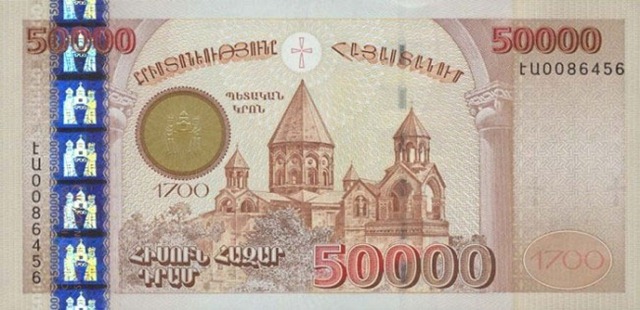
A new series of banknotes, currently in circulation, was  issued starting in 1998. The first six values, from 50 to 20,000 drams (the notes of 50, 100, and 500 were later put out of circulation and replaced by coins), featured six figures of twentieth century Armenian culture and an image related to them: Aram Khachaturian, Victor Hambardsumian, Alexander Tamanian, Yeghishe Charents, Hovhannes Tumanian, and Avetik Isahakian. The 50,000 dram banknote was issued in 2001, on the 1700th anniversary of Christianity in Armenia, and featured the cathedral of Holy Etchmiadzin. The highest value, 100,000 dram, pictured King Abgar V of Edessa, who according to tradition received the painting (portrayed alive) of Jesus Christ from St. Thaddeus.

Death of Hovhannes Masehian

THIS WEEK IN ARMENIAN HISTORY
Prepared by

the Armenian National Education Committee (ANEC)

Death of Hovhannes Masehian (November 18, 1931)  

       Hovhannes Masehian (1864-1931) was a Persian Armenian diplomat and writer, who became the foremost translator of Shakespeare into Armenian. He was born in Tehran in 1864. His father, Dzeruni Khan Masehian, was the chief jeweler of Shah Naser al-Din (1848-1896). From 1870 to 1878 he studied at the newly opened Haigazian School in Tehran. Afterwards, he went to Tabriz to continue his studies with his maternal uncle, Andon Khan Yervandian, who was the tutor of the heir prince. After three years of studies, in 1881 he went to Paris where he studied philosophy, law, political economy, and literature at the College de France.

        Masehian returned to Tehran in 1884, where he taught at the Haigazian School and was hired as a translator at the royal court. He traveled to London in 1897 as the chief translator for the Persian delegation sent to participate in the fiftieth anniversary of the coronation of Queen Victoria. Ten years later, he would be the first secretary of another delegation sent to London for the Queen’s sixtieth anniversary. Meanwhile, in 1895 he had been named head of office of the Ministry of Foreign Affairs of Persia. He managed different positions in the ministry until 1901, when he was designated counselor to the Persian ambassador in Berlin. He became chargé d’affairs in 1906 and held the position until his return to Persia in 1911.

        By that time, Masehian had also become a household name in Armenian letters. As the official translator of the Shah’s court (he knew some ten languages), he had translated around 30 books into Persian, of which there is no trace. In 1894 he published his first version of Shakespeare’s Hamlet in Tiflis. The famous Eastern Armenian poet, Hovhannes Hovhannisian, wrote, “This translation of Hamlet leaves a very beautiful impression on us; first, because . . . the translator knows his mother tongue very well and uses his knowledge with confidence, an advantage that many of our famous authors and translators may envy; second, because that language is rich and poetic, a necessary condition to translate authors such as Shakespeare.” Other translations followed: As You Like It, King Lear, Romeo and Juliet, and Merchant of Venice. Masehian was unable, however, to publish his translations of Otello, Macbeth, and The Tempest. He continued his work until 1901, when he traveled to Europe as a diplomat; by 1909, he had translated nine Shakespearean plays and had translated anew his unpublished works.

        In 1912, after spending a year in Tehran as chief of the secretariat of the Persian court, Masehian was faced with an unprecedented task. It was unheard of a Christian to represent diplomatically an Islamic country like Persia. However, disputes among the officers of young Ahmad Shah (1909-1925) ended when in 1912 the sovereign signed the decree that designated the Armenian diplomat as Ambassador of Persia in Germany. He held this position until March 1916, when he went to Paris, probably commissioned by the Shah. In 1919 he represented Persia in the Peace Conference at Versailles.

        In the meantime, in 1916 Masehian had been officially invited to London as a speaker in the festivities of the 300th anniversary of Shakespeare’s birth. Between 1921 and 1923, he was able to publish several more of his translations in the presses of the Mekhitarist Congregation, in Vienna: Hamlet, Otello, Macbeth, and Merchant of Venice. Indeed, Hamlet and The Merchant of Venice were published in new versions. In the 1910s he had also translated Antonio and Cleopatra, Much Ado about Nothing, Julius Caesar, and A Midsummer Night’s Dream. Between 1923 and 1931, the indefatigable translator finished new translations: Coriolanus, Timon of Athens, and Winter’s Tale. “I am convinced that the translation of Shakespeare’s works,” he wrote to his friend, the poet Avetik Isahakian, “will leave a deep influence on our literature. If the giants of German literature have been impacted by Shakespeare, how much more our writers need that impact? This is why I have devoted myself to that task with all my energy.” He also was a translator of works by other literary giants: Johann Wolfgang Goethe, Lord George Byron, Heinrich Heine, Omar Khayyam, and Rabindranath Tagore.

        In 1927 Masehian was elected to the Persian Parliament. In the same year, he was designated as Ambassador to London. He held the position until 1929, when Persia established diplomatic relations with Japan and Masehian became the first ambassador to that country from 1929-1931. Because of illness, in 1931 he tended his resignation to Reza Shah (1925-1941) and left Tokyo to return to Persia. However, on his way he died in Harbin (China) on November 18, 1931. The efforts of the Armenian community of China and the special permission of Reza Shah allowed for his remains to be moved from China to Persia and be buried in Tehran on April 1, 1932.

        A school of Shakespeare studies was developed in Soviet Armenia and several good translators appeared in the next decades. However, according to many specialists, Masehian’s translations remain unsurpassed.


THIS WEEK IN ARMENIAN HISTORY
Prepared by

the Armenian National Education Committee (ANEC)


First issue of the first Armenian newspaper, “Aztarar”

(October 16, 1794)

       The small community of India, which was an offspring of the famous Armenian community of New Julfa (Nor Chugha), created in the early seventeenth century near Ispahan (Persia), went into history for two main reasons: the publication of the first draft of an Armenian Constitution (1773) and the birth of the first Armenian newspaper (1794).

       Father Harutiun Shmavonian (1750-1824) was born in the city of Shiraz, in Persia. He studied at the local school and learned Armenian and Persian language and literature. Years later, he was sent to Madras, in India, to become the priest of the local church.

       After long meditations and preparations, Shmavonian founded a print shop of his own in 1789, the second Armenian printing house in Madras. His publications reflected his interest in books which were able to satisfy the requirements of the Armenian communities. For instance, he published textbooks, such as Baghdasar Tpir’s Grammar of the Mother Language; the translation of Porphyry of Tyre’s Introduction to Categories, and David the Invincible’s Book of Definitions. His collaborator and friend, Fr. Samuel Ghaytmaziants, wrote later: “He always wished the common benefit and the flourishing of the nation; he left aside the care of his family and children, lived in foreign lands, and worked to this effect.”

       Shmavonian decided to publish a monthly newspaper. The Armenian community was ripe for such a project. Despite its small size, Armenian intellectuals in Calcutta and Madras were in touch with British and French traders and officials, and read European publications. The publications of the Armenian printing house of Nor Nakhichevan, in the northern Caucasus, were regularly sold in Madras. He was also encouraged by Archbishop Yeprem, who had arrived in India as legate of the Catholicate of Etchmiadzin.

       Aztarar, unlike most of the press of the time, was not primarily coverage of commercial issues. The contents of the monthly were mostly cultural and historical. The print-run was 200 copies.

       Many Armenian merchants wrote to the monthly from Madras, Calcutta, Basra, and as far as China and the Philippines. The publication printed news from Yerevan and Shushi, in Karabagh. Most of the articles were written in Classical Armenian (krapar), but some appeared in a mix of classical and vulgar language, which reflected the dialect of New Julfa.

       Articles on political and patriotic issues were also included in the monthly, sometimes written by columnists who mostly signed with pseudonyms.

       Aztarar was published for eighteen months until it folded in March 1796 due to economic difficulties. Father Shmavonian continued his activities in community life. He was active as a book publisher until 1817. He passed away in 1824, submerged in poverty.

Shmavonian

Father Harutiun Shmavonian’s tomb at the Holy Virgin Armenian Apostolic Church in Chennai (formerly Madras), India

Remembering Crystal Night

By David Luhrssen

The persecution of Armenians and Jews has a long history, but in the 20th century, special milestones mark the road to tragedy. Much as the Armenian Genocide began with the April 24, 1915 arrest of community leaders and intellectuals, the Jewish Holocaust’s starting point is often said to have occurred on Nov. 9, 1938 with Kristallnacht (Crystal Night), so called because the smashing of windows in Jewish shops, synagogues and homes featured prominently in the pogrom.

 Milwaukee’s Jewish community will remember Kristallnacht with “An Afternoon of Remembrance and Hope,” 3:30-5 p.m. on Sunday, Nov. 4. It will begin with an outdoor ceremony at the Memorial to the Holocaust, 1360 N. Prospect Ave., and continue with an interfaith commemoration and program at the Rubenstein Pavilion of the Jewish Home and Care Center, 1414 N. Prospect Ave. Holocaust survivors Werner Richheimer and Betsy Maier Reilly will speak at the event.

Leaders of the Armenian communities of Milwaukee and Racine will be in attendance. We encourage our members to come and show solidarity with a people whose history parallels our own.

 THIS WEEK IN ARMENIAN HISTORY
Prepared by

the Armenian National Education Committee (ANEC)


Demonstration of Bab Ali (September 30, 1895)


       The three great powers (Great Britain, France, and Russia), backed by Germany, Austria, and Italy, had demanded that Sultan Abdul Hamid II introduce the reforms in the “provinces inhabited by Armenians,” as stipulated by the Treaty of Berlin (1878) in what was called the Armenian Reform Program of May 11, 1895. The refusal of the sultan to carry the reforms led the Social Democratic Hnchakian Party to stage the demonstration of Bab Ali (Great Door or Sublime Porte) in Constantinople on September 30, 1895.

        The party was represented in the Ottoman capital by the Board of Directors, that give instructions for nearly all party activity in Turkey with the approval of general headquarters at Geneva, and the Executive Committee, which directed the organization work according to the instructions of the Board of Directors.

        The Executive Committee chose three men to supervise the demonstration after receiving the order from the Board of Directors. The leader was Garo Sahakian. After various discussions, the Board of Directors decided that the demonstration should be peaceful. Months of preparations were ended on September 28, when the Hnchakian Party presented a letter in French to the foreign embassies and to the Turkish government. The letter stated that the demonstration would be “of a strictly peaceful character” and would be aimed to express Armenian wishes with regard to the reforms. It added that “the intervention of the police and military for the purpose of preventing it may have regrettable consequences, for which we disclaim beforehand all responsibility.”

        The demonstration took place two days later. The Turkish government had taken security measures; soldiers were posted on the streets around administrative buildings, and the police were alerted. Around noon, the Hnchakian leaders entered the Armenian Patriarchate, from where they led thousands of demonstrators to the palace of the Sultan.

        Garo Sahakian, head of the demonstration, was to present the petition to the Sultan on behalf of both the Armenians of Constantinople and of the six Armenian provinces. The petition, written by the Hnchakian Board of Directors, complained against massacres, unjust arrests, Kurdish injustices, corruption of tax collectors, and the massacre in Sasun (1894). It demanded: (a) equality before the law; freedom of the press; freedom of speech; and freedom of assembly; (b) right of habeas corpus to all persons under arrest, and permission to Armenians to bear arms if the Kurds could not be disarmed; (c) a redrawing of the six Armenian provinces; (d) an European governor for the provinces; and (e) financial and land reforms.

       Garo Sahakian and some demonstrators, after reaching the gates of Bab Ali, were denied entrance by the officer in charge, and Sahakian was seized by the zaptiehs (Turkish police). Brought before a Turkish official, he was imprisoned after delivering the petition. Fighting and violence had already broken out. Hundreds of demonstrators were arrested on that day and for several days ensuing. The prisons became crowded with wounded men and scores of dead bodies were collected from the streets of Constantinople.

       The rioting and bloodshed in Constantinople alarmed the Turkish government and disturbed Europe. The Ottoman Council of Ministers assembled to discuss the situation, while some of the leading European papers gave much attention to the rioting in Constantinople. Finally, pressure by European governments induced Sultan Abdul Hamid to sign the Armenian Reform Program on October 17, 1895, about a month after the bloody demonstration. The Hnchakian Revolutionary Party considered this a great victory. However, this signature did not bring peace to Ottoman Armenians. Like so many decrees by the Sultan, this one too became a dead letter.