Archive for the ‘the Armenian National Education Committee (ANEC)’ Category

THIS WEEK IN ARMENIAN HISTORY
(Prepared by the Armenian National Education Committee)

[ANEC]


Declaration of United ARMENIA
(May 28, 1919)

At the time of the independence of the first Republic of Armenia (May 1918), its population also included a mass of refugees from Western Armenia who had survived the genocide.


The first congress of Western Armenians, held in the spring of 1917, tried to establish a semblance of organization for the mass of refugees. Some of them had temporarily resettled back in their homes in 1916-1917, when part of Western Armenia had been occupied by Russia. However, the breakdown of the Caucasian front after the Russian Revolution and the advance of the Turkish Ottoman forces had displaced them once again to the east. These events had crippled the organization established in 1917.


In view of the political changes, an interparty council of Western Armenians named a special commission in December 1918 to arrange for a second general conference. The Second Conference of Western Armenians met in Yerevan from February 6-13, 1919.


The conference adopted a resolution on February 12, 1919 that read in part:

“The Second Congress of Western Armenians, having studied the current situation of the Armenian people:


1. Sincerely hails and extols the independence of Free and United Armenia; (. . .)


3. Proclaims its firm determination and will to have one political and governmental entity through the confluence of the lands and people of all Armenia;(. . .)


5. Directs the elected ‘Executive Body’ to work actively, at the same time, with the cabinet and the legislature of the Araratian [Yerevan] Republic to declare the independence of United, Free Armenia and, in order to effect the all-national union, to participate in the administrative and legislative institutions. (…).”


The nine-person Executive Body was instructed to implement the decision of the Congress and to function until the creation of a combined government of united Armenia. Its petition was approved by the coalition government of the Republic, formed by the Armenian Revolutionary Federation and the Populist Party, on February 25, 1919.


The cabinet of ministers adopted the text of the declaration on Armenia’s unification on May 26, 1919, and a day later, another cabinet resolution authorized the Executive Body of the Western Armenians to select twelve deputies to enter the Parliament of united Armenia.


On 28 May 1919, on the first anniversary of the Republic of Armenia, acting Prime Minister Alexander Khatisian read the text of the declaration in a solemn ceremony held at the Parliament:


“To restore the integrity of Armenia and to secure the complete freedom and prosperity of its people, the Government of Armenia, abiding by the solid will and desire of the entire Armenian people, declares that from this day forward the separated parts of Armenia are everlastingly combined as an independent political entity.


(. . .) Now in promulgating this act of unification and independence of the ancestral Armenian lands located in Transcaucasia and the Ottoman Empire, the Government of Armenia declares that the political system of United Armenia is a democratic republic and that it has become the Government of the United Republic of Armenia.


Thus, the people of Armenia are henceforth the supreme lord and master of their consolidated fatherland, and the Parliament and Government of Armenia stand as the supreme legislative and executive authority conjoining the free people of United Armenia. (. . .)”


After the ovation that followed the reading, Khatisian invited the twelve newly designated Western Armenian deputies to take their places within the legislature. On their behalf, Vahagn Krmoyan pledged active Western Armenian participation in the governing bodies of the Republic.


After the messages by Avetik Sahakian, president of the Parliament, and Catholicos Gevorg V, and congratulations by the representatives of Georgia, Azerbaijan, Karabagh, Armenian Americans, and others, Khatisian proceeded to the balcony of the Parliament and read again the declaration to the mass of people gathered on the street.


The declaration, intended to cement the unity of the Armenian people and establish its political will towards the restoration of the country over its historical borders, had the contrary effect. Historian Richard Hovannisian has aptly summarized it: “The proclamation that had been intended as an expression of unity actually aggravated the discord between Russian Armenians and Turkish Armenians and between Dashnakist and anti-Dashnakist leaders. A startling about-face by the Populist Party in the days following the celebration in Erevan administered the coup de grace to the coalition cabinet.”


Although the declaration of United Armenia was never carried on the ground (the Treaty of Sevres, which would become its instrument in August 1920, remained on paper), its symbolic force was an expression and an inspiration for the political dreams of the Armenian people.


Read Full Post »

THIS WEEK IN ARMENIAN HISTORY
(Prepared by the Armenian National Education Committee)

[ANEC]


Opening of the Monument of Sartarabad
(May 25, 1968)

Sartarabad, located 25 miles to the west of Yerevan, became the last Armenian stance against the advance of the invading Third Ottoman Army in May 1918. A defeat would not only open the door for their penetration to the rest of Eastern Armenia, but also the follow-up to the genocide of 1915-1916. Major General Otto von Lossow, German delegate to the Caucasus, had reported to his government on May 15, 1918 that the Ottomans intended to advance the border further to the east, monopolize the economy of the region, and bring about “the total extermination of the Armenians in Transcaucasia also.” Two days before his departure from Tiflis, on May 23, he wrote in his final report: “The aim of Turkish policy is, as I have always reiterated, the taking of possession of Armenian districts and the extermination of the Armenians.”


The Armenian victory in Sartarabad, from May 22-28, 1918, became the cornerstone of the foundation of the first Republic of Armenia. However, the victories of May 1918 and the first republic remained taboo issues in Soviet Armenia until the national awakening of the 1960s that led to the commemoration of the fiftieth anniversary of the genocide in 1965. Afterwards, there would be a historical reassessment, although within the ideological constraints imposed by the regime.

 Sartarabad

Part of that reassessment would be the construction of the monument dedicated to the battle, inaugurated on May 25, 1968. Its author was talented architect Raphael Israelian (1908-1973), who had already built popular memorials such as the arch of Charents (1957) on the road to Garni and the first monument to the genocide, built in the courtyard of Holy Echmiadzin (1965). Other projects would be completed during his lifetime and posthumously.

The entrance of the impressive complex, which extends over some 50 acres, is guarded by gigantic winged bulls, which symbolize the victory obtained by the people. The steps take the visitor to a wide square, dominated by the 115-foot high bell tower. The nine-bell structure, built from red-orange tufa stone, is the focus of the monumental complex. It reflects the critical moment that the entire country lived and that called the people to the fight. As it is well known, Catholicos Kevork V ordered all church bells in Armenia to sound day and night in the days of the three battles of Sartarabad, Gharakilise, and Pash Abaran. The bells sound every year on the day of the victory.


The bell tower square marks the beginning of the avenue, flanked by a series of eagles, leading to the 180-foot long Victory wall, which depicts the images of the battle, sculpted by Ara Harutunian and other artists. In 1978 the State Ethnographic Museum of Armenia was built on the end side of the complex, with an impressive collection. It also includes a section dedicated to the first Republic.


As the refrain of the famous song written by poet Baruyr Sevag exhorts, “Generations, know yourself in Sartarabad.” The monument to the battle is one of those mirrors that have helped know history for almost half a century.


Read Full Post »

THIS WEEK IN ARMENIAN HISTORY
(Prepared by the Armenian National Education Committee)

[ANEC]


The 50th Anniversary Demonstration of Yerevan
 (April 24, 1965)


The fiftieth anniversary of the Medz Yeghern [Great Calamity], the Armenian genocide, became a watershed in the process of commemoration, as Armenians mobilized throughout the world to demand justice. The commemoration in the Armenian diaspora, including marches and public events in different capitals, was overshadowed by the unprecedented and unexpected explosion of popular feelings in Yerevan, the capital of Soviet Armenia. 1915 had been practically a taboo subject during the long night of Stalin’s repressive regime, and only after 1955 was there a gradual opening on the issue, which was coincidental with the “thaw,” the period of Nikita Khruschev as secretary of the Communist Party of the Soviet Union.

 50TH_1

After the transition of the 1950s, the “thaw” actually reached Armenia with the designation of Yakov Zarobyan as first secretary of the local Communist Party in 1960. Gradual, but firm steps to restore public memory within the limits of what was ideologically permissible followed, including painstaking negotiations within the highest echelons of the Soviet hierarchy. The Soviet Union was disinclined to active confrontation with Turkey, and thus, in early March 1965 the party leadership in Moscow allowed very reluctantly the commemoration of the genocide.


On March 16, 1965 the Council of Ministers of Soviet Armenia passed a resolution, “On the Construction of a Monument to Perpetuate the Memory of the Victims of the Yeghern of the Year 1915.”


Commemorative activities were held in Holy Etchmiadzin, the Academy of Sciences, the Writers Union, and other venues. Several articles were published in the press. On Saturday, April 24 an editorial of the party daily Sovetakan Hayastan of Yerevan condemned the genocide and praised the Armenian rebirth in Soviet fashion:

 50th_2

“Exactly 50 years have passed from those terrible days when the Turkish rulers, guided by the fury of racism, attempted to annihilate an entire people. They did everything, deported and massacred, burned and ruined, but they were not able to annihilate the Armenian people, despite the heavy losses. …The Armenian people, wholly dedicated to the most humane ideas of peoples’ friendship and socialist internationalism, severely condemns, along with progressive humankind, the policy of genocide, one of whose first victims was the Armenian people under Ottoman Turkish rule fifty years ago, and which fascism carried with fury and disproportionately bigger magnitude during the Second World War years in Europe.”


An official event by invitation had been planned for the evening, to be held at the Opera Theater. Everything seemed under control, but it was not.


In the morning, several thousand young people gathered at Lenin Square (now Republic Square), near Lenin’s huge statue (toppled in 1991) and various speakers among them started to talk about the meaning of the day. Several leaders, such as Anton Kochinian (president of the Council of Ministers) and famous astronomer Victor Hambardzumian (president of the Academy of Sciences), also spoke to the audience.


After they left, the public, whose number had reached an estimate of no less than 30 to 40,000 people, formed an orderly caravan that walked through the streets of central Yerevan. The demonstrators marched with calls of “Our lands!” and carrying banners that said, for instance, “2,000,000” (the number of victims) and “Solve the Armenian question fairly.” Their number appears to have grown up to 100,000 people, according to some accounts. The demonstration, after stops at the Polytechnic Institute (now State University of Engineering) and Yerevan State University, walked towards the tomb of Gomidas Vartabed in the Pantheon, where several writers, scholars, and young people spoke.


The demonstration continued in the evening, and the marchers tried to force their way into the official ceremony at the Opera Theater, which was surrounded by several police lines. They were repelled by the use of the fire sprinklers of the theater. However, a hundred or two hundred young demonstrators managed to enter the building. The event, where Nagush Harutiunian (president of the Supreme Soviet) and Victor Hambardzumian, had already spoken, was disrupted. The party leadership left the stage, as well as many in the audience. Catholicos of All Armenians Vazken I took the stage to calm the demonstrators.


The failure to prevent the demonstration would lead Moscow to various punitive measures, including Zarobyan’s removal in February 1966. However, the commemoration would become a tradition year after year. The first monument was dedicated in the courtyard of Holy Etchmiadzin in October 1965, followed by the memorial on the hill of Tsitsernakaberd inaugurated on November 29, 1967. Starting in 1975, the leadership of the country would join the hundreds of thousands of mourners who every April 24 would pay their respects at the memorial. In November 1988, following the impact of the Karabagh movement, the law “On the condemnation of the genocide of the Armenians in Ottoman Turkey in 1915” would also make a provision to declare April 24 a national holiday.

Read Full Post »

THIS WEEK IN ARMENIAN HISTORY
(Prepared by the Armenian National Education Committee)

[ANEC]


Uruguay Recognizes the Armenian Genocide
(April 20, 1965)

As it is well known, the fiftieth anniversary of the Medz Yeghern, the Armenian genocide, became the event that gathered Armenians worldwide around public claim for recognition of what had happened in 1915 and for the Armenian Cause.


Believe it or not, the small community of Uruguay was at the forefront of the struggle. Around 1963 the young generation came together to commemorate the month of Armenian culture in October, and the next year it joined its voice to the campaign in neighboring Argentina against the issuance of a postal stamp by the Argentinean postal service that would commemorate the 100th anniversary of Mustafa Kemal Ataturk. These activities became the driving force behind the decision of young people in a community politically divided as elsewhere in the Diaspora to come together and organize the commemoration on April 24 in a unified way. They created the Coordinating Committee of Armenian Youth Organizations of Uruguay (Mesa Coordinadora de Organizaciones Juveniles Armenias del Uruguay), which was integrated by five organizations belonging to different political orientations of the community.


The Coordinating Committee organized the commemoration of 1964, with an imposing “March of Silence” through the streets of Montevideo, the capital of Uruguay, which was widely commented in the press and had its impact over Armenians all over the world. It invited to a general assembly of 19 organizations (the entire spectrum of the community) that in January 1965 issued a communiqué, stating that, “The Armenian Cause belongs to all Armenians and is not the domain of any faction,” and that “Political organizations, religious institutions, and all organizations existing in the community must set to work around the Armenian Cause.”


The intensive activities carried by the Coordinating Committee, including lectures, press releases, PR work with the Uruguayan press, and a competition of posters for the 50th anniversary, were crowned by its lobby efforts.


These political efforts led to a commemoration by the Municipal Council of Montevideo on April 27, 1965, which was preceded, most importantly, by the passing of a law recognizing the genocide.

The draft bill was written by Representative Enrique Martínez Moreno, and introduced on January 29, 1965 to the Constitution and Codes Committee of the House Representatives, with the signature of six co-sponsoring representatives of different political parties. The bill stated:


Article 1. The following 24th of April is declared "Day of Remembrance for the Armenian Martyrs," in honor of the members of that nationality slain in 1915.

Article 2. The stations of the Official Radio Service must on that date conduct part of their broadcast in honor of the mentioned nation.

Article 3. Armenian descendants who are public servants are authorized to miss work on the mentioned date.


The word genocide was not mentioned in the draft bill, but it appeared mentioned several times to legally qualify the extermination of 1915 as “one of the most terrible genocides that history has known,” in the introductory text of the draft, adding that “the synthesis of one of the most brutal genocides is more than a million assassinated persons.”


The draft bill was discussed by the House of Representatives on April 6, 1965. A proposal to add an article naming a school of Montevideo with the name of Armenia mustered the necessary number of votes, while another proposal to devote a school class to refer to the genocide did not. The draft bill was approved with the addition of article 4 (“The 2nd Grade School, No. 156, in the department of Montevideo, is designated with the name of ‘Armenia’”) and went to the Senate. The project was not treated on April 7 and was delayed until April 20, when it was treated with urgent character and approved with unanimous vote. The law 13,326 was signed by Washington Beltran, President of the National Council of Government (Uruguay had a collegiate executive in those years), and issued on April 22, 1965. The enthusiasm that the approval of the law created in the Uruguayan Armenian community inspired a massive assistance to the commemorative acts from April 23-28.


Petty politics caused the demise of the Coordinating Committee shortly thereafter. The Armenian community would fall into decades of new political divisions that seem to be on their way to solution on the eve of the Centennial. It is noteworthy that on March 2004, the Uruguayan Parliament passed law 17,752 that extended the commemoration to every April 24, repeating the text of 1965 without the use of the word genocide. Nevertheless, on April 7, 2015, the Postal Service of Uruguay issued a stamp on the centennial of the Armenian genocide and Foreign Minister Rodolfo Nin Novoa underscored that, “Uruguay was the first country to recognize the Armenian Genocide by law 50 years ago, a transcendental step in a struggle that continues to the present day.”


Read Full Post »

THIS WEEK IN ARMENIAN HISTORY
(Prepared by the Armenian National Education Committee)

[ANEC]


MASSACRE OF SHUSHI

MARCH 23-26, 1920

The city of Shushi, capital of Karabagh and the third Armenian center in the South Caucasus after Tiflis and Baku, had a population of 43,869 inhabitants, according to the Kavkaskii Kalendar (Caucasus Calendar) published in Tiflis in 1916. Fifty-three per cent of the population (23,396 people) was Armenian, while 44% was Tatar (later called Azerbaijani).


After the independence of Armenia, the situation of Karabagh remained in a sort of limbo due to the Azerbaijani pretentions over the region and the pro-Azerbaijani attitude of the British representatives in the region, interested in securing the oil of Baku. Clashes between Azerbaijanis and local Armenians in 1919, as well as Armenian massacres incited by Azerbaijani Governor-General Khosrov Bek-Sultanov, ended with a British-brokered temporary agreement on August 22, 1919 that lasted a few months.


Sultanov broke the terms of the agreement in the beginning of 1920 and tightened the Azerbaijani blockade around Karabagh. He gathered armed forces in strategically important locations and armed the local Turkish population. Well-aware that the Armenian population was much less armed, he made preparations for “the final resolution of the Nagorno Karabagh issue,” as he wrote in one dispatch to the Azerbaijani government. On February 19, 1920, Sultanov issued a demand to the Armenian National Council of Karabagh “to solve urgently the question of the final incorporation of Karabagh into Azerbaijan.” At their eighth congress held from 23 February to 4 March, the Armenians responded that Azerbaijan’s demand violated the terms of the temporary agreement of August 1919 and warned that “repetition of the events will compel the Armenians of Nagorno-Karabagh to turn to appropriate means for defense.”

Shushi

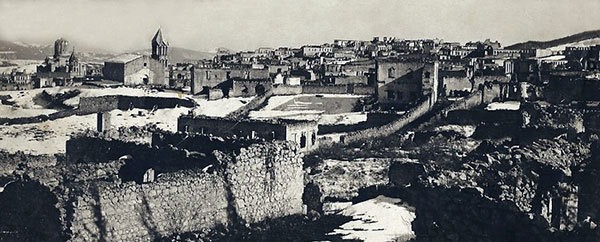
The Armenian quarters of city of Shusha destroyed by Azerbaijani armed forces in 1920 with the defiled Cathedral of the Holy Savior in the background.


The commanders of the Armenian self-defense tried to anticipate Sultanov’s movements. A small Armenian detachment entered Shushi in the early morning of March 23, 1920, when the Turkish population was celebrating the festivity of Novruz, and tried to take over the barrack, according to an uprising plan previously developed. The exchange of fire served as a signal for Shushi’s armed Turkish population, the Azeri army soldiers, and Kurdish gangs abounding in the town to attack the Armenian district, plunder and set everything on fire, and start a horrible massacre of the Armenian population. According to historian Richard Hovannisian, “Azerbajani troops, joined by the city’s Azerbaijani inhabitants, turned Armenian Shushi into an inferno. From March 23 to 26, some 2,000 structures were consumed in the flames, including the churches and consistory, cultural institutions, schools, libraries, the business section, and the grand homes of the merchant class. Bishop Vahan (Ter-Grigorian), long an advocate of accommodation with the Azerbaijani authorities, paid the price of retribution, as his tongue was torn out before his head was cut off and paraded through the streets on a spike. The chief of police, Avetis Ter-Ghukasian, was turned into a human torch, and many intellectuals, including Bolshevik Alexander Tsaturyan, were among the 500 Armenian victims.”


Much of the population fled, and the Armenian section of the city was completely destroyed. According to data of 1921, some 8,000 Azerbaijanis lived in Shushi, and the number of Armenians was about 300. The Armenian section remained in ruins for several decades.


The historical Armenian city became an Azerbaijani city during the Soviet period, until the Armenian forces of self-defense liberated Shushi on May 9, 1992, in one of the most crucial moments of the Karabagh war.

Read Full Post »

THIS WEEK IN ARMENIAN HISTORY
(Prepared by the Armenian National Education Committee)

[ANEC]


Birth of Alan Hovhaness
(March 8, 1911)


Armenian American composer Alan Hovhaness is said to be one of the most prolific composers of the 20th century.

He was born Alan Vaness Chakmakjian in Somerville (Massachusetts), on March 8, 1911. His father, Haroutioun Chakmakjian (1878-1973), was a professor of chemistry at Tufts College and author of a popular English-Armenian dictionary, as well as onetime editor of Hairenik. His mother, Madeleine Scott, was of Scottish ancestry, and did not especially approve that he learned about Armenian culture from his father. Until her death in 1931, the composer would sign his earliest music as Alan Scott Vaness.

AlanHovaness

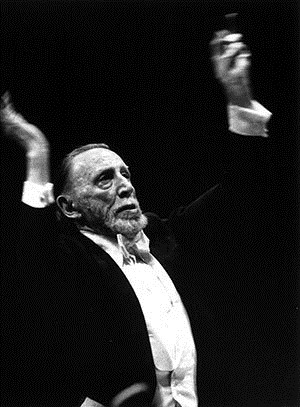
Alan Hovhaness conducts the Ani Symphony at the Metropolitan Museum of Art in New York City on April 21, 1989, in one of several events sponsored by the Prelacy on the occasion of the 1000th anniversary of the Great Cathedral of Ani.

Alan Hovhaness was a precocious composer who already penned operas by age 14. After initial studies at Tufts College, he studied composition at the New England Conservatory of Music, in Boston. In the 1930s, he composed mostly chamber music in Western modes of expression.

He would shift to a fusion of Western and Eastern music in the 1940s, starting with his job as organist at St. James Armenian Church in Watertown, where he was exposed to the Armenian liturgy and the works of Komitas Vartabed. “It was through Komitas that I got the idea of saying as much as possible with the fewest possible notes,” he would write later. He got rid of most of his earliest music, and started anew to seek out his Armenian heritage. His “Armenian period” lasted from 1943 to 1951, and was benefited from the performances of important works and rave reviews in the mainstream press. The Friends of Armenian Music, a committee headed by pianist Maro Ajemian and her sister, violinist Anahid Ajemian, were instrumental in supporting him in various capacities. Maro Ajemian performed and recorded many of his works.

After a three-year stint at the Boston Music Conservatory (1948-1951), while he had married for the third time, Hovhaness gradually acquired considerable reputation. He received academic honors and a steady flow of commissions. He embarked on a more Western phase of writing and devoted himself to full-time composing. His Symphony No. 2 (Mysterious Mountain ) that premiered in 1955, brought him national recognition. MGM Records released 8 long-plays of all-Hovhaness records from 1955-1957. “Mysterious Mountain” was recorded in 1958 by Fritz Reiner and the Chicago Symphony Orchestra, and became his most famous recording and most-performed orchestral work. To this day it is considered to be one of the best recordings ever made.

After a Fulbright research scholarship in India (1959-1960), Alan Hovhaness also visited and studied in Japan and Korea. He also visited the former Soviet Union in 1965, including Soviet Armenia. He shared his time between New York and Switzerland in the mid-1960s, while steadily maintaining his prolific output. He settled in Seattle, Washington, in the early 1970s. At this time, his music veered towards a more Western neo-romantic expression. In 1977 he married his sixth wife, Japanese soprano Hinako Fujihara. In the same year, he was elected to the American Academy of Arts and Letters.

In 1991 the American Composers Society and the Eastern Prelacy, by initiative of Archbishop Mesrob Ashjian, celebrated the 80th birthday of Alan Hovhaness at Carnegie Hall. He directed his own works, including the premiere of his symphony No. 65 “Artsakh,” dedicated to the heroic fighters for the liberation of Karabagh and commissioned by the Prelacy.

The composer continued to be active until his 85th birthday. In 1996 his health suffered a marked decline. He passed away on June 21, 2000 at the age of 89. His official catalogue includes 67 symphonies and 434 works.

Read Full Post »

THIS WEEK IN ARMENIAN HISTORY
(Prepared by the Armenian National Education Committee)

[ANEC]


Armenia becomes a member of the United Nations
(March 2, 1992)


The Supreme Council of the Republic of Armenia declared the independence of Armenia by 213 votes to 0 on September 23, after the popular referendum of September 21 had answered with an overwhelming “Yes” to the question whether Armenians wanted independence.


The three Baltic republics (Estonia, Latvia, and Lithuania) had been incorporated into the United Nations in September 1991, and thus, Lithuania recognized the independence of Armenia in November. However, international recognition essentially started after December 10, 1991, the date when the former Union of Soviet Socialist Republics (USSR) was officially dissolved. Ironically, Turkey was among the first countries to recognize Armenian independence on December 24, 1991, one day before the United States, but has refused to establish diplomatic relations until the present.


The Republic of Armenia officially applied for membership in the United Nations on January 23, 1992. Six days later, the U.N. Security Council discussed the application of Armenia in its session 3035 and advised the U.N. General Assembly to incorporate the newly independent Republic as a member (resolution 735, January 29, 1992).


On March 2, 1992, Ambassador Samir S. Shihabi of Saudi Arabia opened the meeting of the U.N. General Assembly as its president. Secretary General Boutros Boutros-Ghali placed on the agenda the application of nine countries, eight of them former Soviet republics (Armenia, Azerbaijan, Kazakhstan, Kirguizia, Moldova, Tajikistan, Turkmenistan, and Uzbekistan), as well as San Marino, which previously had enjoyed observer status. The Republic of Armenia was represented by Foreign Minister Raffi Hovannisian; Armenian ambassador to the United Nations, Alexander Arzumanian, and Armenian ambassador to the United Kingdom, Armen Sargsyan. Some 30 representatives of the Armenian American community were also attending, including Archbishop Mesrob Ashjian, Prelate of the Eastern Prelacy of the Armenian Apostolic Church, of blessed memory.


The need to find a solution to the ongoing crisis of Karabagh was noted by the representatives of the United States, the Organization for Security and Cooperation in Europe (OSCE), the Russian Federation, and the European Community. Foreign Minister Hovannisian spoke and, after greeting those present in Armenian, continued speaking in English and declared that Armenia wanted a peaceful resolution of the issue.


The resolution 46/227 of the General Assembly was approved on the same day. Due to the civil war, the membership of Georgia was to be approved in July 1992.


The representatives of the invited countries, led by Boutros-Ghali, were invited to the ceremony of the raising of the flags at 1:30 p.m. Thousands of Armenians had gathered outside the United Nations headquarters and their overwhelming applause greeted Raffi Hovannisian while he raised the Armenian flag. The tricolor floating in front of the United Nations became a symbol of Armenia’s membership in the international community.


In remembrance of this historic date, the government of the Republic of Armenia issued a resolution on March 23, 2012, which established March 2 as the day of the diplomat of the Republic of Armenia.


Read Full Post »

THIS WEEK IN ARMENIAN HISTORY
(Prepared by the Armenian National Education Committee)

[ANEC]


Declaration of Secession of Nagorno Karabagh from Azerbaijan

(February 20, 1988)


The question of Karabagh started in the years of the first independent Republic of Armenia and was not solved after the South Caucasus became part of the Soviet Union. The arbitrary decision of the Caucasian Bureau of the Soviet Communist Party (July 5, 1921) to attach Karabagh to Azerbaijan only contributed to open a new Pandora’s box. Throughout the decades, the Azerbaijani discriminatory policy had the other historical Armenian region, the Autonomous Republic of Nakhichevan, as poster child: due to continuous emigration, its Armenian population went from 40% in 1926 to 2% in 1988.          

It is not surprising then, that the Armenians of Mountainous Karabagh, who constituted 90% of its population in 1926, took every opportunity to address Moscow and ask for a fair solution of the issue. Various letters were sent in 1945, 1965, and 1977. The petition of 1965 was signed by 45,000 people. On its grounds, the Secretariat of the Central Committee of the Communist Party of the Soviet Union assigned to the Central Committees of the party in Armenia and Azerbaijan the mission of preparing a proposal for the solution of the problem of Karabagh in 1966. However, Azerbaijan was able to put the brakes on any possible solution. The Azerbaijani KGB, led by Heydar Aliyev (future president in post-Soviet times) stimulated interethnic conflict. As a result, more than 150 Armenians were sent to prison, where 20 people were killed and ten others disappeared. More than a hundred families, after two years of persecution, were forced to leave Karabagh. The issue was again treated in 1977 during the discussions of the draft Soviet Constitution, but never went through.

After the proclamation of the policies of restructuring (perestroika) and transparency (glasnost) by the last Soviet leader, Mikhail Gorbachev, the movement for Karabagh entered a new phase in mid-1987. There were demonstrations and meetings, and the representatives of the autonomous region sent petitions to the party and state organs of the Soviet Union. A petition that asked for the reattachment of the autonomous region to Soviet Armenia was signed by 80,000 people.

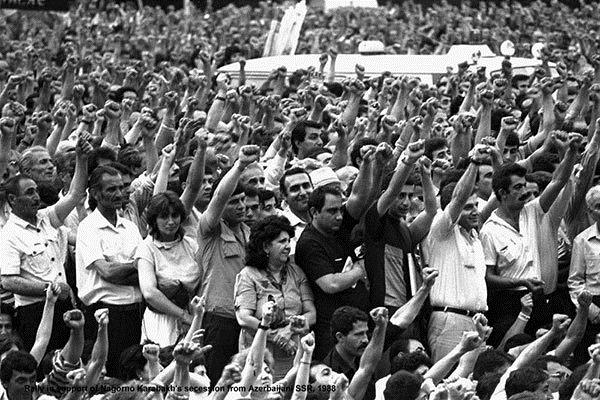
This phase found its climax on February 20, 1988. The first secretary of the Central Committee of Azerbaijan, Kamran Baghirov; members of the Bureau of the Central Committee, and the instructor of the Soviet Communist Party, V. Yashin, arrived in Stepanakert, the capital of Mountainous Karabagh, with the intention of thwarting the extraordinary session of the Regional Council of the Nagorno (Mountainous) Karabagh Autonomous Region (NKAR), intended to pass a resolution on the issue. The visitors called for a session of the party regional committee, and the local party structure was held responsible the organization for the situation. Despite the pressure of representatives from Baku and of the first secretary of the Communist Party in Karabagh, Boris Kevorkov, the session was held on the same day and the Regional Council passed the following resolution, entitled “On a Petition to the Supreme Councils of the Azerbaijani SSR and the Armenian SSR on the NKAR’s Secession from Soviet Azerbaijan and Its Transfer to Soviet Armenia”:

“After hearings and debates on a petition to the Supreme Councils of the Azerbaijani SSR and the Armenian SSR on the secession of the Nagorno Karabagh Autonomous Region from Soviet Azerbaijan and its transfer to Soviet Armenia, the special session of the Nagorno Karabagh Autonomous Oblast Regional Council of People’s Deputies have decided:  “Meeting the requests of the NKAR workers, to appeal to the Supreme Councils of the Azerbaijani SSR and the Armenian SSR to show a profound understanding of the expectations of the Armenian population of Nagorno Karabagh and to resolve the issue of NKAR’s secession from the Azerbaijani SSR and its transfer to the Armenian SSR, and at the same time to submit a petition to the Supreme Council of the USSR on a positive resolution of the issue on NKAR’s secession from the Azerbaijani SSR and its transfer to the Armenian SSR.”

This document followed the legal procedures established by Soviet law and was backed by peaceful demonstrations held in Stepanakert and Yerevan in the same day. The Karabagh Movement, the “test of the perestroika,” had started. Three years later, it would end in the independence of the Republics of Armenia and Nagorno Karabagh.


Read Full Post »

THIS WEEK IN ARMENIAN HISTORY
(Prepared by the Armenian National Education Committee)

[ANEC]


Death of Hagop Oshagan
(February 17, 1948)


His writing has remained unknown by the general public. However, Hagop Oshagan was one of the most important novelists and literary critics in twentieth-century Armenian literature.


He was born Hagop Kufejian on December 9, 1883 in Sölöz, a village near Brusa, in western Turkey. He lost his father at the age of five and endured much hardship during his childhood. He studied for a short while in the seminary of Armash, but he was essentially an autodidact. His voracious reading was the main source for his learning.

Hagop Oshagan

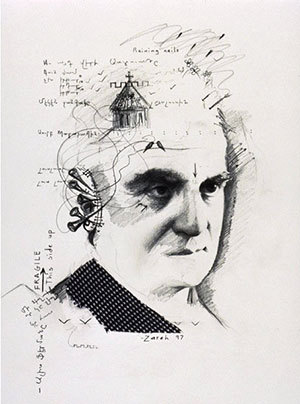
Illustration by Zareh Meguerditchian


He became a teacher at the age of 19, when his first short story appeared in the newspaper Arevelk of Constantinople. He started to make a name for himself in the short period of literary renaissance that followed the Ottoman Revolution of 1908, both as a short story writer and a critic. He joined with Gostan Zarian, Taniel Varoujan, Kegham Parseghian, and Aharon Dadourian to create the short-lived literary group “Mehyan,” which published the journal of the same name from January-July 1914 and attempted a literary renovation.


Hagop Kufejian was on the April 24 lists of the Turkish government, but was able to elude persecution for the next three years, despite being arrested several times. In early 1918, disguised as a German officer, he managed to flee to Bulgaria, where he remained until 1920. He married and would have three children. His elder son, Vahe Oshagan (1921-2000), a poet and literary critic, would become one of the leading names of Armenian literature in the Diaspora during the second half of the twentieth century.


Hagop Kufejian adopted the last name Oshagan in 1919 and returned to Constantinople, where he worked as a teacher and was active in literary life. He published his first book, a collection of short stories, The Humble Ones, in 1921. In 1922, together with Gostan Zarian, Vahan Tekeyan, Shahan Berberian, and Kegham Kavafian, published Partzravank, a literary journal that tried to be a qualified literary voice.


The occupation of Constantinople by the troops of Mustafa Kemal in 1922 provoked the escape of many Armenians from the city. Oshagan also left and, after living in Bulgaria from 1922-1924, he became a teacher in Egypt (1924-1928), at the Melkonian Institute of Cyprus (1928-1935), and at the Seminary of Jerusalem (1935-1948).


In the last twenty-five years of his life, Oshagan put together a prodigious amount of literary production, including several lengthy novels. Particularly important was the eighteen hundred-page novel The Remnants (1932-1933), which he left unfinished and was intended to be a novel about the Armenian catastrophe of 1915. Barely read at its time, it became an object of cult followers during the past thirty years, as well as the subject for important literary studies.


Aside from his fiction, including also plays and many literary essays, Hagop Oshagan wrote the ten-volume Panorama of Western Armenian Literature (1939-1944), a collection of monographs about the most important literary figures of the period 1850-1915, which he intended to be the “novel” of that period in Western Armenian culture. He only saw the publication of the first volume in 1945. The remaining nine volumes were published between 1951 and 1982. This cemented his fame as the most important name in Armenian literary criticism.


Oshagan passed away in Aleppo, where he had gone to visit the areas that had been the scene of the Armenian deportation and killing in 1915. He died from a heart attack on February 17, 1948, and was buried in the local Armenian cemetery. He had not been a writer for the masses in his lifetime; nevertheless, twenty thousand people attended his funeral. Every year (until the recent Syrian civil war), the students of the Karen Jeppe College of Aleppo went to the Armenian cemetery at the beginning of the school year to pay their respect at his tomb.


Read Full Post »


THIS WEEK IN ARMENIAN HISTORY
(Prepared by the Armenian National Education Committee)

[ANEC]


Birth of Gostan Zarian
(February 8, 1885)


The life span of Gostan Zarian, one of the foremost names of twentieth century Armenian literature, covered eight crucial decades. He was active in Constantinople with the Western Armenian generation before the genocide, then lived forty years in the Diaspora, and finally went to die in Soviet Armenia. He was a sort of “wandering Armenian,” not only physically, but also spiritually. His literature was at the crossroads of many influences.

Gostan Zarian

Gostan Zarian

Zarian was born in Shamakhi (Azerbaijan) on February 8, 1885. His father, a general in the Russian army, died when he was four, and he was sent to Baku, where he attended a Russian school. In 1895 he moved to France, where he continued his studies in Asnieres and Saint-Germain-en-Laye, two suburbs of Paris. After finishing high school, he went to the Université Libre of Brussels and obtained a doctorate in literature and philosophy in 1909.

Zarian initially wrote poetry and essays in Russian and French, until the famous Belgian poet Emile Verhaeren advised him to write in his mother tongue. The Armenian poet, who already spoke Armenian, went to Constantinople in 1910, where he started to participate in the renewal of literary life. In mid-1911 he left the Ottoman capital and went to Venice, where he studied Armenian with the Mekhitarist Fathers until the end of 1912. He married Rachel (Takuhi) Shahnazarian in December 1912, from whom he would have three children, and the newlyweds moved back to Constantinople. Zarian would actively participate in Western Armenian literary life until the beginning of the war. He was one of the leading voices of the group “Mehian,” together with Hagop Kufejian (Oshagan), Kegham Parseghian, Taniel Varoujan, and Aharon (Dadourian), and editor-in-chief of the homonymous journal Mehian, which was published from January-July 1914.

Zarian escaped with his family to Bulgaria in late October 1914, the day before Turkey declared war and joined the Central Powers, and thus he avoided the genocide. After living for a year in Bulgaria, he moved to Italy, where he lived for the next six years in Rome and Florence. In 1916 he published his poem “Three Songs,” translated from Armenian into Italian, which was widely critiqued. His literary activities were matched with an active engagement for the Armenian Cause. In 1919 he went to the Caucasus as a special reporter for several Italian newspapers.

Zarian moved back to Constantinople in late 1921, when the remnants of the Western Armenian intelligentsia were starting again a cultural and literary movement. He published the monthly Partzravank, together with Oshagan, Vahan Tekeyan, Shahan Berberian, and Kegham Kavafian, which lasted from January-July 1922. He also published his first book in Armenian, a collection of poems entitled The Crown of the Days. At the end of the year, when the Kemalist forces were about to occupy Constantinople, the writer accepted an invitation of the Soviet Armenian government and moved to Yerevan. For the next two years, he taught European literature at Yerevan University. However, he returned to Europe in June 1924 and would spend the next four decades on the move. He lived in Paris, Venice, Milan, Corfu, Florence, New York (1942-1947), Amsterdam, Ischia, Beirut, Aix-en-Provence, Vienna, Rapallo, Oakland, California (1960-1962), and in 1963 he repatriated to Soviet Armenia.

In the 1920s and 1930s, Zarian published his major works of prose in the monthly Hairenik of Boston, such as The Traveller and His Road, Bancoop and the Bones of the Mammoth, and Countries and Gods, among others. He also published as a book his poems The Bride of Dadrakom in 1930 and Three Songs (1931), and his masterpiece, the novel The Ship on the Mountain (1943). He contributed prose, poetry, essays, and commentary to a variety of Armenian and non-Armenian publications, writing in Armenian, French, Italian, and, later, English. He published two short-lived journals, the literary monthly La Tour de Babel in French (1925), and the pioneering journal of Armenian Studies in New York, Armenian Quarterly (1946). He was friends with various noted European writers, such as English novelist Lawrence Durrell and others. He taught at the American University of Beirut and at the University of California at Berkeley.

His return to Armenia was somewhat controversial, because he had criticized the Soviet regime in several works. His novel The Ship on the Mountain was about the period of the first independence. It was reissued in a heavily censored way (1963) and this created a heated polemics. In any case, Zarian was almost ignored in the last years of his life. He died on December 15, 1969 and was almost totally forgotten by literary circles in Armenia until the end of the regime. Several of his works were printed in book form in the 1970s and 1980s in the Diaspora. His rediscovery in Armenia started with the twenty-first book century, and several works scattered in the press and also unpublished have also been published.

Read Full Post »

« Newer Posts - Older Posts »