Archive for the ‘the Armenian National Education Committee (ANEC)’ Category

THIS WEEK IN ARMENIAN HISTORY
(Prepared by the Armenian National Education Committee)

[ANEC]


The Treaty of Kars
(October 13, 1921)


As a result of the Russo-Turkish war of 1877-1878, the regions of Kars, Ardahan, Artvin, and Batum, at the time in the Ottoman Empire, went to Russia.


The next conflict between Russia and the Ottoman Empire was during World War I. The Caucasian expedition of Enver Pasha in late 1914-1915 was soundly defeated in the battle of Sarikamish. Enver covered his defeat by accusing the Armenians of treason. As a result, the Armenian soldiers in the Ottoman Empire were disarmed and killed en masse, and the subsequent massacres and deportation of Armenians would soon turn into genocide. The Russian forces occupied an important section of Western Armenia (Van, Erzerum, Bitlis and Mush, Trebizond, and Erzinga) in 1915-1916.
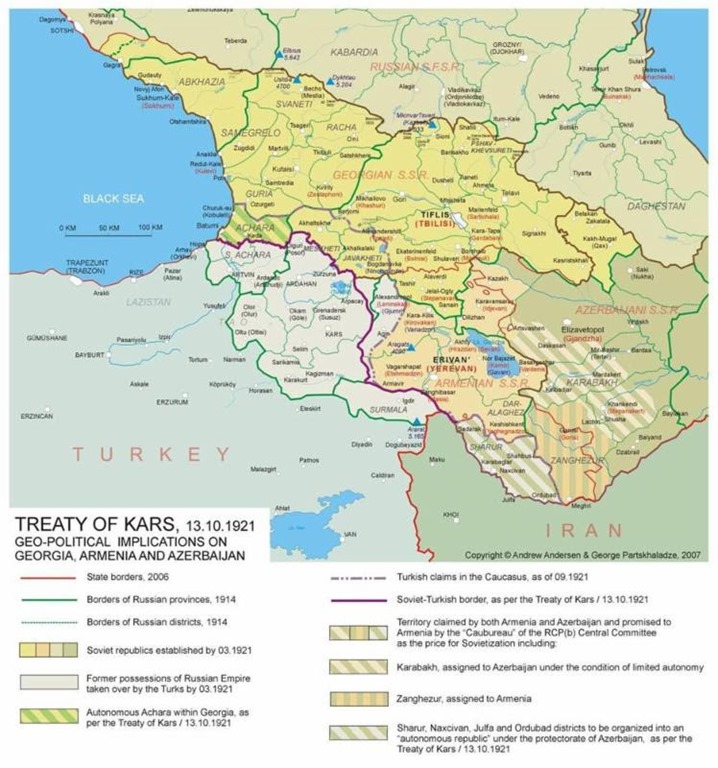
 TreatyofKars

After the October Revolution, the Russian forces abandoned the front. The Armenian battalions formed in a hurry were insufficient to stop the Ottoman advance and the territories of Western Armenia were lost between February and April 1918. The Treaty of Brest Litovsk (March 3, 1918) between Soviet Russia and the Ottoman Empire recognized the transfer of Kars, Ardahan, and Batum to the latter. After the armistice of Mudros (October 30, 1918), the Republic of Armenia established its sovereignty over most of the region of Kars, and the Treaty of Sevres recognized the region of Kars and most of Western Armenia as part of Armenia (August 1920).


However, as a result of the Armeno-Turkish war of September-November 1920, the region of Kars and Alexandropol (nowadays Gumri) was occupied by the Turkish forces, which threatened once again the existence of Armenia. The invasion of the XI Red Army on November 29 forced the government of the Republic of Armenia to transfer the authority to the Communists on December 2, which turned the country into a Soviet republic.


Meanwhile, the representatives of the Republic signed the Treaty of Alexandropol with the Turks on the night of December 2 to 3. This treaty recognized the occupation of the region of Kars by Turkey. However, its legal validity was dubious, because it had been signed on behalf of a government that was already out of office. The next step was the signature of the Treaty of Moscow between Kemalist Turkey and Soviet Russia on March 16, 1921. Turkey received the region of Kars, and the southern portion of the region of Batum. Probably as a compensation for the north of the region of Batum, the Bolsheviks transferred the Armenian province of Surmalu to the Turks.


At the time, the February rebellion had expelled the Communist government from Armenia, while Georgia was still an independent republic. After Armenia and Georgia were finally occupied by the Red Army, the signature of the Treaty of Kars was meant to confirm the terms of the Treaty of Moscow by the representatives of Armenia, Georgia, and Azerbaijan.


The treaty was signed on October 13, 1921, and ratified in Yerevan on September 11, 1922. Signatories included four Turkish representatives, Russian ambassador Yakov Ganetsky, and two representatives from Armenia, Azerbaijan, and Georgia. Minister of Foreign Affairs Askanaz Mravian and Minister of Interior Poghos Makintsian signed it on behalf of Armenia.


The treaty confirmed the division of the region of Batum, with the north ceded by Turkey to Georgia and the south, with the city of Artvin, annexed by Turkey, which was also guaranteed free transit through the port of Batum.


It also created a new boundary between Turkey and Armenia, defined by the Akhurian and Arax rivers. Turkey annexed most of the region of Kars, including Surmalu, with Mount Ararat and the cities of Igdir and Koghb, the cities of Kars, Ardahan, and Olti, and the ruins of Ani.


The region of Nakhichevan became an autonomous territory under the protection of Azerbaijan, which was turned into the Autonomous Soviet Socialist Republic of Nakhichevan in 1924, as an exclave subordinate to Soviet Azerbaijan and sharing a fifteen-kilometer boundary with Turkey.


The Soviet Union attempted to annul the Treaty of Kars and regain the lost territories of Kars, Ardahan, and Artvin after World War II on behalf of Armenia and Georgia. However, British Prime Minister Winston Churchill objected to those territorial claims, and in 1947 the Soviet Union gave up its claims from Turkey.


The validity of the Treaty of Kars has been questioned on the basis that the sides that signed it did not have authority. The Turkish Grand National Assembly, which was represented by the Turkish signatories, had no authority to sign international treaties, which still rested with the legal ruler of the Ottoman Empire, the Sultan, as established by its Constitution. The Republic of Turkey was proclaimed in 1923. On the other hand, the Soviet republics were under strict control of Moscow and the Soviet Union was established in December 1922.


After the dissolution of the Soviet Union in 1991, the Treaty of Kars was accepted by Turkey, Georgia, and Azerbaijan. However, the government of Armenia has made no such ratification.


Read Full Post »

THIS WEEK IN ARMENIAN HISTORY
(Prepared by the Armenian National Education Committee)

[ANEC]


THE OTTOMAN REVOLUTION
(July 23, 1908)


1908 was a break it or make it year for the Ottoman Empire, which was on the brink of collapse. Its interrupted process of modernizations was to be resumed.


The process of internal reform initiated with the imperial edicts of 1839 and 1856 led to the promulgation of the Constitution of 1876, which ushered the First Constitutional Era. Sultan Abdul Hamid II (1876-1908), who had sanctioned the Constitution, suspended it in 1878 and launched his thirty-year long tyrannical rule.

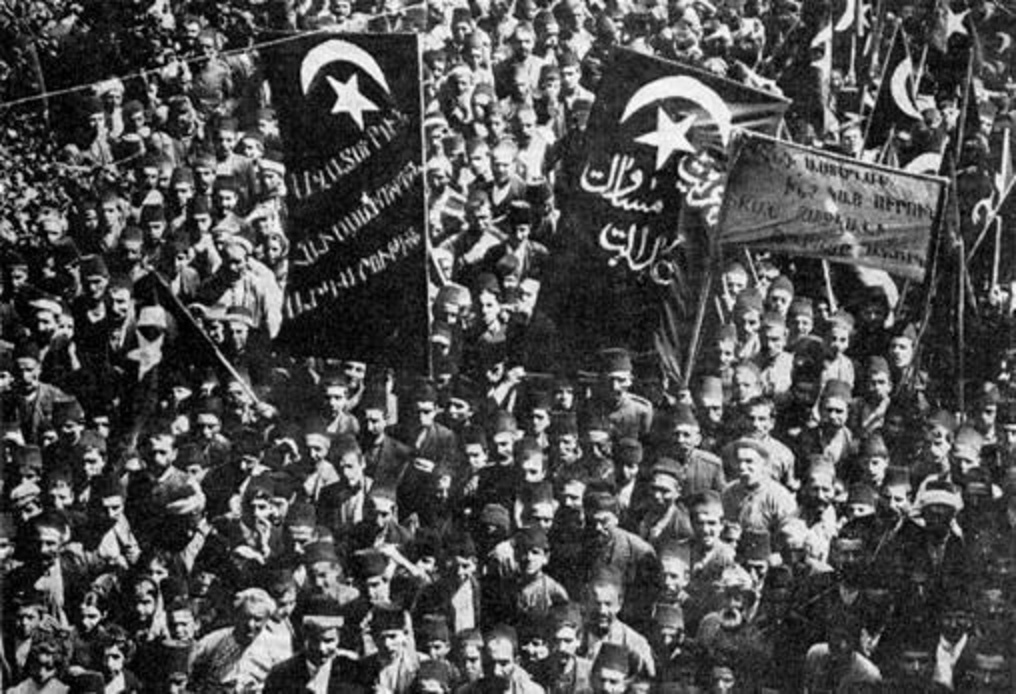
 OttomanRevolution

The conservative politics of Abdul Hamid went against the current of social reform and more liberal environment. His tightened rule dismissed all claims by minorities. His repressive policies peaked with the massacre of Armenians in 1894-1896, which cost the life of some 300,000 people.


The Committee of Union and Progress (CUP), an underground organization founded in 1889, functioned as an umbrella party for the movement of the Young Turks, which sought to end with the rule of Abdul Hamid and to prevent the collapse of the empire. To this goal, they looked forward to an alliance with the revolutionary forces that functioned within the ethnic minorities, including the Armenians, in two opposition congresses convened in 1902 and 1907. The Hunchakian party rejected to cooperate on the grounds that the CUP tried to impose its Ottomanist plan and leave aside any particular concern or demand from the minorities. On the other hand, the Armenian Revolutionary Federation accepted the offer, considering a priority the overthrow of Abdul Hamid’s regime. Different methods of civil disobedience were anticipated, with an armed rebellion anticipated for October 1908.


The CUP had moved its headquarters to Salonica (Thessalonika in Macedonia, now part of Greece) in 1906. Military officers gained to the cause of the Young Turks accelerated the revolt after a meeting of King Edward VII of England and Czar Nicholas II of Russia in the Baltic port of Reval (now Tallinn, the capital of Estonia) in June 1908. During the meeting, new reforms were drafted for the region of Macedonia, which in the end would be detached from the Ottoman Empire after the Balkan War of 1912.

The fear that the meeting was a prologue to the separation of Macedonia led to the mutiny against the sultan, which was initiated by major Ahmed Niyazi on July 3 with a demand to restore the constitution. The movement spread rapidly throughout Macedonia. The attempt by Abdul Hamid to suppress the uprising failed, with the garrisons of Constantinople and Asia Minor being also favorable to the rebels. The sultan capitulated and on the night of July 23-24 the restoration of the Ottoman Constitution of 1876 was announced. Abdul Hamid II became a nominal ruler and the power went to the revolutionaries. Decrees establishing freedom of speech and press, and a general amnesty were soon issued.

General elections were held in November and December 1908, and the CUP won a majority in the Parliament. The election was marred with fraud and threats in places where Armenian candidates were on the ballot. As a result, only 12 Armenian deputies were elected out of a total of 230.  The Senate reconvened on December 17, 1908, and the Chamber of Deputies held its first session on January 30, 1909.

Armenian hopes that the motto of “equality, fraternity, freedom, justice” carried by the revolution would turn into real change were soon dashed.


In April 1909 Abdul Hamid attempted to seize his power back with promises to restore the sharia-based system and eliminate secular policies. He attracted the support of masses of theological students and clerics, as well as army units, which revolted on April 13, 1909. The Liberation Army coming from Macedonia and commanded by Mahmud Shevket Pasha restored the status quo and quashed the counterrevolutionary movement on April 24, 1909. However, in the meantime, the double massacre of Adana and surroundings, with its catastrophic sequel, was carried both by representatives of the “ancien regime” and the local Young Turks on April 13-15 and April 25-27, 1909, with an outcome of up to 30,000 Armenians, as well as Assyrians and Greeks massacred. The failure of the Ottoman government to prosecute and thoroughly punish the culprits of the massacre created profound disillusionment among Armenians. By 1910-1911 the revolutionary movement, caught in the conflict within the CUP among conservatives and liberals, was finished. The Libya war of 1911 and the Balkan War of 1912 essentially threw the empire out of Africa and Europe, and led to the coup d’état of January 1913 and the establishment of the government headed by the triumvirate of Talaat, Enver, and Jemal. World War I and the Armenian Genocide were not very far ahead.


Read Full Post »

THIS WEEK IN ARMENIAN HISTORY
(Prepared by the Armenian National Education Committee)

[ANEC]

The Council of Adana
(July 18, 1316)

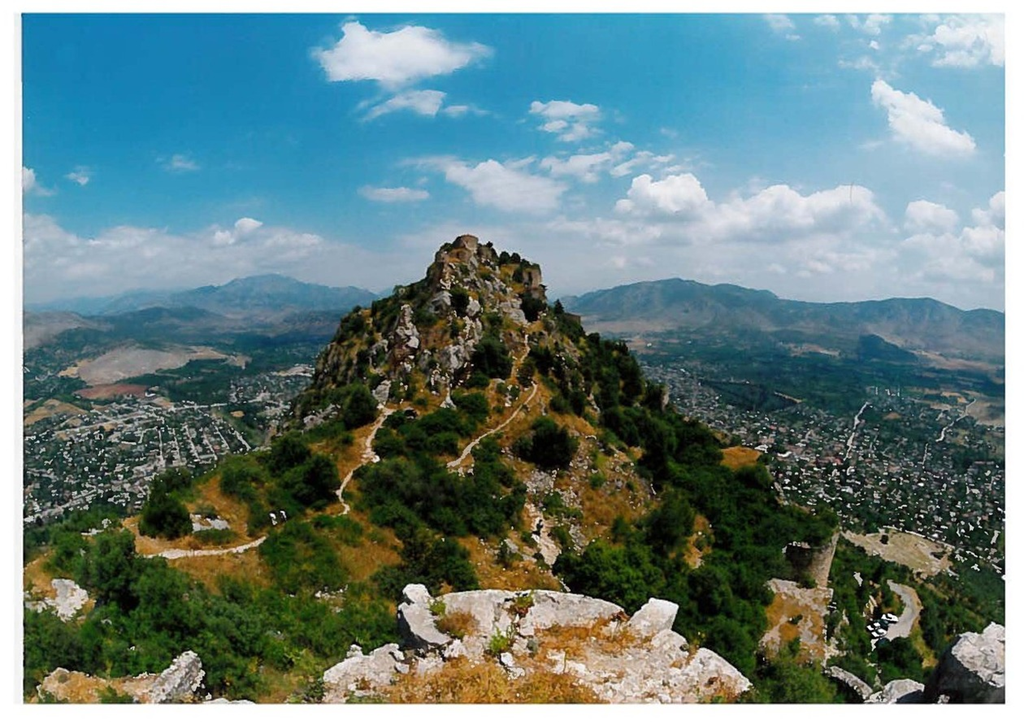
Sis in Cilicia - photo by Hrair Hawk Khatcherian

Sis in Cilicia – photo by Hrair Hawk Khatcherian

The Armenian state of Cilicia (1080-1375), which had become a kingdom in 1198, started a process of decline in the fourteenth century. The end of the Crusades in 1270 and the fall of the last Crusader bulwark in 1291 were combined with the rise of the Mamluks of Egypt and the Turkmens in Konia, as well as the end of the alliance with the Mongol Empire. As a result, the kingdom looked to the West for help, which was fueled by the pro-Catholic trends of part of the nobility and the ecclesiastics.

The fifth council of Sis (1307) examined the request of Pope Clement V (1305-1314), the beginner of the period of the Avignon Papacy (1307-1377). The Pope demanded that the Armenians adopted Catholicism in exchange for military help from Europe. The pressure exerted by King Levon IV (1301-1307), his father Hetum (the former King Hetum II), and the recently elected Catholicos Gosdantin III (1307-1322) forced the members of the council to adopt the doctrine and the ritual of the Catholic Church, as well as the sovereignty of the Pope. The new rules established, in practice, the union of the Armenian Church and the Catholic Church.

The strongly negative reaction of the public and the ecclesiastics from Greater Armenia led to the councils of Adana (1308) and the sixth council of Sis (1309), which declared null and void the resolutions of 1307.

However, the new King Oshin I (1308-1320) started persecutions against the participants in those councils, and many of them were jailed or exiled. Some 500 ecclesiastics were exiled to Cyprus, where most of them died.

In 1316 Pope John XXII asked Oshin I to restore the resolution of 1307. To that end, the king and the Catholicos called upon the second council of Adana on July 18, 1316, with the participation of 18 bishops, 7 archimandrites, and 10 princes, mostly from the dioceses of Cilicia. The participants confirmed the resolution of 1307, which was again refused by the people and the ecclesiastics of Greater Armenia. The court tried to impose the measures by force and met with an obstinate rejection, particularly in Armenia, and its attempts to do the same in Armenia only deepened the internal division and weakened the resistance against the external enemies.

The help from the West never came, and the eighth council of Sis (1361) declared definitively null and void the resolutions of 1307 and 1316. It was too late. The kingdom of Cilicia, reduced practically to Sis and its surroundings, would fall to the Mamluks in 1375. The last period of Armenian independence before the twentieth came to an end.

Read Full Post »

THIS WEEK IN ARMENIAN HISTORY
(Prepared by the Armenian National Education Committee)

[ANEC]


Meher Mekerchyan

Photo: I like to tell people serious things with a smile on my face…

Birth of Mher Mkrtchyan
(July 4, 1930)

Mher Mkrtchyan was one of the greatest Armenian actors of the Soviet period.

Son of survivors of the Armenian Genocide, he was born in Leninakan (nowadays Gumri) on July 4, 1930. His actual given name was Frunze, for which he was also known as “Frunzik,” but he later took the name Mher. His father wanted him to become a painter, but he started playing in the theatrical group of the textile factory of the town, which was next door to their home. He studied in the Art College and Theatre Studio of the city from 1945-1946, and then he played in the permanent group of the Mravian Theatre. He performed in a dozen of plays, and showed his maturity despite his young age.

He then moved to Yerevan, where he was accepted straight into the second year of the Acting Department of the Institute of Fine Arts and Theatre. He graduated in 1953 and he immediately started performing in the Sundukyan Academic Drama Theatre of Yerevan. He also directed many successful productions.

His film career began in 1955, and he played in 49 films until 1987. Mkrtchyan earned a reputation as one of the leading comedy actors of the Soviet Union thanks to his celebrated roles in Aybolit-66 (Rolan Bykov, 1966), Kidnapping, Caucasian Style (Leonid Gaidai, 1966), and Mimino (Georgi Daneliya, 1977). However, his acting talent and emotional depth were best displayed in several classic films of Armenian cinema: Triangle (1967), We Are Our Mountains (1969), Father (1973), Nahapet (1977), The Song of the Old Days (1982), Tango of Our Childhood (1985). In his posthumously published memoirs, Mkrtchyan wrote that his godfather in cinema was filmmaker Henrik Malyan:

“He was the first to notice me and trusted me to perform in his films, from Arsen (The Boys of the Orchestra), Gaspar (Triangle), Ishkhan (We Are Our Mountains), to Daddy (Father), Apro (Nahapet) and Grigor agha (A Piece of Sky), which all had the characteristic fate of the Armenian man: they are ingenious, hardworking, wistful, and dreamers.”

Among other honors, the actor won the USSR State Prize in 1978 and was also honored with the title of People’s Artist of the Armenian SSR.

Mher Mkrtchyan passed away at the age of 63 on December 29, 1993 in Yerevan. Thousands of people attended the funeral of their beloved actor. He was buried at the Komitas Pantheon. A museum remembers him in his birthplace Gumri and the Tekeyan Cultural Association of New York-New Jersey named its theater group after him.

Read Full Post »

THIS WEEK IN ARMENIAN HISTORY
(Prepared by the Armenian National Education Committee)

[ANEC]


Recognition of the Armenian Genocide by the European Parliament
(June 18, 1987)

Turkey has been in a dialogue with Europe since the 1940s. In 1948 Turkey was one of the founding members of the European Organization of Economic Cooperation, predecessor of the Organization for Economic Cooperation and Development (OECD). It adhered to the Council of Europe in 1949 and to NATO in 1951. During the Cold War, the country positioned itself along Western Europe and the United States. The European Economic Community (EEC), predecessor to the current European Union, was founded in 1957, and Turkey became an associate member in 1963. By then, the preamble of the agreement of association signed between both sides recognized that “the aid contributed by the EEC to the efforts of the Turkish people to improve their level of life will ultimately facilitate the adhesion of Turkey to the Community.” The final goal, therefore, was well known to both sides.


Bilateral relations were quite cold in the 1970s and 1980s, particularly after the September 1980 coup d’état in Turkey. Following a formal return to democracy after the end of the military regime in 1983, Turkey presented its demand of official adhesion to the European Community on April 14, 1987.


Armenian political violence had winded down, and in August 1985, the report on genocide by Benjamin Whitaker had been approved by the U.N. Sub-Commission of Human Rights, with mention of the Armenian genocide as one of the first in the twentieth century. The European Parliament, the legislative body of the European Community, resisted enormous pressure from Turkey and its hired guns, and set the record straight. The courageous actions of a group of Parliament members, led by French Henri Saby (1933-2011), on the basis of a detailed report introduced by Belgian Jaak Vandemeulebroucke in April 1987, were instrumental to deliver the historic decision. The “Resolution on a political solution to the Armenian question” was voted in Strasbourg during the plenary session of June 18, 1987, and the European Parliament became the first major international body to recognize the Armenian Genocide.


The resolution established that “the tragic events in 1915-1917 involving the Armenians living in the territory of the Ottoman Empire constitute genocide within the meaning of the convention on the prevention and the punishment of the crime of genocide adopted by the UN General Assembly on 9 December 1948,” although it denied that the Republic of Turkey could be held responsible and stressed that no claims against Turkey could be derived from the recognition. It called for a fair treatment of the Armenian minority in Turkey and made “an emphatic plea for improvements in the care of monuments and for the maintenance and conservation of the Armenian religious architectural heritage in Turkey.” Most importantly, it stated that “the refusal by the present Turkish Government to acknowledge the genocide against the Armenian people committed by the Young Turk government, its reluctance to apply the principles of international law to its differences of opinion with Greece, the maintenance of Turkish occupation forces in Cyprus and the denial of existence of the Kurdish question, together with the lack of true parliamentary democracy and the failure to respect individual and collective freedoms, in particular freedom of religion, in that country are insurmountable obstacles to consideration of the possibility of Turkey’s accession to the [European] Community.”


The resolution was repeated many times afterwards. A resolution of November 12, 2000, on “The progress made by Turkey on the path of adhesion” reminded, on point 10, that Turkey had been invited to recognize publicly the Armenian genocide. The February 28, 2002 resolution about “The relations of the European Union with the South Caucasus” reproduced textually the position of June 18, 1987, and asked Turkey to create the conditions for reconciliation. After a recommendation of 2004 about “The policy of the European Union towards the South Caucasus” repeated the positions of 1987, two resolutions of December 15, 2004, and September 28, 2005, reaffirmed the existence of the Armenian genocide. The last declaration in this regard was the resolution of April 15, 2015, passed on the centennial of the genocide. 


The government of the Republic of Armenia bestowed upon Henri Saby the medal “Mkhitar Gosh” in March 2011 for his services to the Armenian Cause. The former member of the European Parliament passed away in August of the same year. According to his last will, his ashes were buried in France, Armenia (cemetery of Tokhmakh, in Yerevan), and Artsakh (cemetery of Stepanakert).


Read Full Post »

THIS WEEK IN ARMENIAN HISTORY
(Prepared by the Armenian National Education Committee)

[ANEC]

Birth of Yeghishe Charents

(March 13, 1897)

The most famous names of Armenian poetry in the twentieth century were victims either of genocide (Taniel Varoujan and Siamanto), political repression (Yeghishe Charents), or car accident (Paruyr Sevak). Among them, Charents was probably the brightest star in the Armenian literary sky.

Portrait of Yeghishe Charents by Martiros Saryan

Portrait of Yeghishe Charents by Martiros Saryan

Yeghishe Soghomonian, the future poet, was born in Kars, on March 13, 1897. His parents had moved there from Maku, in Iran, and had seven children. After his elementary studies at the Russian or Armenian parochial school, he studied in the royal school of the city from 1908-1912, but he did not graduate. The young Yeghishe published his first poem in 1912 and his first book, Three Songs to the Sad Girl, dedicated to his girlfriend Astghik Kondakjian, in 1914. Here he adopted the pseudonym of Charents (Armenian char “bad”), for which there are various contradictory explanations.

In August 1915, at the age of eighteen, Charents enrolled himself in the Armenian volunteer corps of the Russian army, and fought in the Caucasian battlefront against the Ottoman army until the end of the year. His war experiences gave birth to his first relevant work, the poem Dante-esque legend, published in 1916.

In 1916-1917 Charents was in Moscow, where he studied at the Shaniavski Popular University. After the October Revolution, he returned to the Caucasus and first participated in the civil fights in the Northern Caucasus. His experiences were the basis for one of his most important poems, The Frenzied Masses, published in 1918. After the liberation of Kars from Turkish occupation, he became a teacher in one of the villages of the Kars district in 1919.

Nikol Aghbalian, Minister of Education of the first Republic of Armenia and a well-known literary critic, lectured in October 1919 on Charents with a very positive outlook. In January 1920 he became an official at the ministry until June, when he left after participating in the Bolshevik demonstrations of May 1. After the establishment of the Soviet regime, he entered the Communist Party and was designated head of the Art section of the Commissariat of Education. During the February 1921 rebellion, he fought as a soldier in the Red Army.

In June 1921 he married Arpenik Ter Astvatzatrian and they departed together for Moscow, where they studied at the University for Workers of the Orient. In 1922 he published his collected works in two volumes and returned to Yerevan, where he would become a leading name in the efforts to modernize Armenian poetry and in the different literary movements, while publishing poems and collections of poetry. From 1921-1924 he also wrote his novel Land of Nayiri, first published serially and then as a book (1926). In 1924-1925 he traveled abroad and visited Istanbul, Rome, Venice, Paris, and Berlin.

A memorial sculpture to Charents in central Yerevan.

A memorial sculpture to Charents in central Yerevan.

In September 1926 Charents was involved in a criminal incident when he shot and slightly wounded a young girl whom he had fallen in love with. In November he was sentenced to eight years of imprisonment, later reduced to three, in the House of Correction (prison) of Yerevan, and previously he was expelled from the Communist Party. This situation coincided with the death of his wife Arpenik on January 2, 1927, at the age of twenty-eight, due to an extra-uterine pregnancy. Charents was freed on humanitarian grounds, given his extremely fragile psychological condition, and sent to mandatory treatment at a sanatorium.

From 1928-1935 the poet worked at the Armenian State Publishing House and developed a prolific editorial program, including the publication of new writers and Armenian classics, as well as translations. After a kidney surgery in Moscow (1929), he developed the use of morphine, which he would continue until the end of his life.

In 1931 he married Isabela Niazova, and they would have two daughters, Arpenik and Anahit. Literary and political pressure over him, as well as on the best representatives of the Armenian intelligentsia was mounting. In 1933 Charents’ most important collection of poetry, The Book of the Road, was forbidden before publication. It was released in 1934 only after the poet excluded several works that had been questioned. In this year, he participated in the First Congress of Soviet Writers, held in Moscow.

His downfall started in 1935, when he was fired from his job, expelled from the Writers Union of Armenia, and interrogated several times at the Ministry of Internal Affairs on trumped-up charges of being a terrorist. The assassination of Aghasi Khanjian, First Secretary of the Armenian Communist Party and his friend and protector, on July 9, 1936, covered up by Joseph Stalin’s henchman Laurenti Beria, First Secretary of the Party in Transcaucasia, as a “suicide,” unleashed the political persecution against Armenian intellectuals. Many writers and intellectuals were arrested on July and August 1936, and they would be shot, exiled to Siberia, or sentenced to years in a wave of terror that continued until 1938-1939. Charents was subjected to house arrest in September 1936, his books were retired from libraries and bookstores, and the publication of his works was stopped.

The poet was finally imprisoned on July 1937. His wife would follow the same fate (she was deported to Kazakhstan for five years in 1938), and their children would be placed in an orphanage as “enemies of the people.” Charents, gravely ill, passed away in the hospital of the Yerevan prison on November 27, 1937. His body was buried in an unmarked grave and the exact place of his tomb remains unknown.

Charents was rehabilitated after the death of Stalin, and his name became extremely popular among youngsters and adults. His works have been published many times, and statues, streets and a museum perpetuate his name in Armenia.

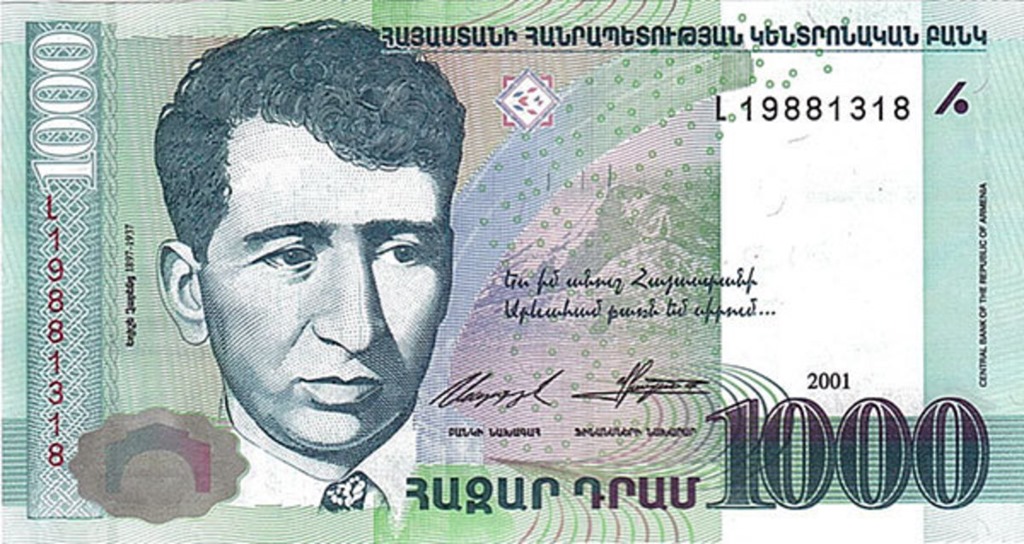
Charents is featured on the 1000 dram bill of the Republic of Armenia's currency

Charents is featured on the 1000 dram bill of the Republic of Armenia’s currency

Read Full Post »

THIS WEEK IN ARMENIAN HISTORY
(Prepared by the Armenian National Education Committee)

[ANEC]


Death of Toros Toramanian

(March 1, 1934)


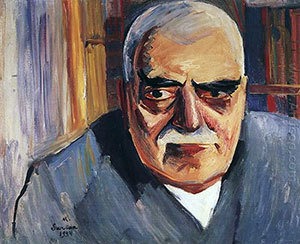
A portrait of Toramanian by Martiros Sarian.

A portrait of Toramanian by Martiros Sarian.

The scientific study of Armenian architecture has reached important milestones since the early twentieth century. One name is to be remembered as its pioneer: Toros Toramanian.


Toramanian was born on March 18, 1864 in the city of Shabin-Karahisar, in Western Armenia. (One year later, another famous Armenian would be born there: General Antranig.) He attended the local Armenian schools, and at the age of fourteen, he lost his parents. In 1884 he left for Constantinople to pursue higher education. After working for two years as a mason and stone worker, he approved the entrance exam of the School of Fine Arts and studied architecture from 1886 to 1893.


He graduated in 1893, but he had not begun his career yet, when he was forced to leave the city due to the massacres ordained by Sultan Abdul Hamid II. After going to Belgium, he then moved to Sofia and Varna, in Bulgaria, where he built several public and residential buildings. He went to Romania in 1900, and then visited Egypt, Italy, and Greece.


Toramanian settled in Paris in 1902, where he deepened his knowledge on history of architecture at the Sorbonne. There he met Garabed Basmajian, director of the journal Banaser, whom he already knew from Constantinople. They put together the project of a mission to Ani in order to study the monuments of the capital of the Bagratuni Kingdom. They traveled in 1903, and discovered that the task was immense, and their means were very limited. Basmadjian returned to Paris to collect the necessary funds, and Toramanian remained alone in Ani, but he never obtained any financial assistance.

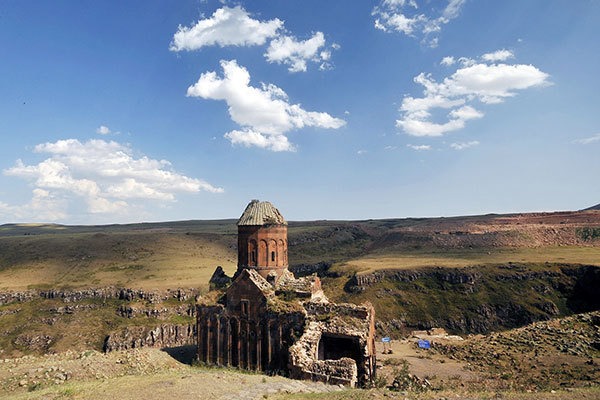
The ruins of a church in Ani.

The ruins of a church in Ani.


He wintered in Ani, in extremely difficult conditions. In an article on the church of Zvartnots published in 1905, he wrote: “I decided to stay and work in Ani to save from oblivion the remnants of the glorious past of our great people in order to be able to show them to the whole world.”


Toramanian had meanwhile participated in the excavations of Zvartnots, near Etchmiadzin, in the spring of 1904. He made a detailed study of the remaining pieces of the church, destroyed by an earthquake in the ninth century, and examined one by one all of them. This archaeological approach, quite unusual for the time, allowed him to propose the model of reconstruction of the circular church of Zvartnots that we know today.

The remains of Zvartnots Cathedral near the airport named after it in Armenia.

The remains of Zvartnots Cathedral near the airport named after it in Armenia.


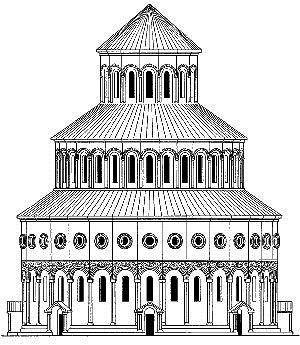
In 1904 Professor Nicolas Marr, from the Imperial Academy of St. Petersburg, made his second campaign of excavations in Ani. Toramanian joined his team, and had the opportunity to study many monuments of the former Armenian capital, as well as of the surroundings, including the monasteries of Horomos, Tekor, and Bagnayr. In 1905-1906 the team of Marr discovered the remnants of the church of Gagikashen in Ani. Moreover, the finding of the statue of its builder, King Gagik I of Ani, holding the model of the church, confirmed Toramanian’s reconstruction of the circular church of Zvartnotz with three floors.


An image of what Zvartnots Cathedral would have looked like befor its destruction drawn by Toramanian.

An image of what Zvartnots Cathedral would have looked like befor its destruction drawn by Toramanian.

The architect continued his association with Marr at Ani and made various publications in Armenian journals, and became well-known in scholarly circles. In 1913 he was invited to Vienna by the famous Austrian art historian Josef Strzygowski (1862-1941) to give lectures on Armenian art, particularly about Ani. They had projected a joint work on the subject, based on the documents and materials that Toramanian had gathered. Afterwards, Toramanian accompanied Strzygowski on a brief trip in Armenia, and promised to complete the documentation for the joint publication.


The beginning of World War I made it impossible for Toramanian to travel back to Austria to continue work on the publication. In 1918, however, the cover of the two-volume Die Baukunst die Armenier und Europa (The Art of the Armenians and Europe), which would engage specialists of European medieval art in heated debates, only had Strzygowski’s name on it, with Toramanian reduced to the role of an informant. Besides, he had lost most of his archives and unpublished works during the Ottoman invasion of Armenia in 1918, followed by the flee of his family from Alexandropol to Tiflis, including a dictionary of Armenian architecture, a comparative study of Byzantine and Armenian architecture, and a study on the history of Armenian funerary monuments.


After the establishment of the Soviet regime in Armenia, Toramanian became one of the founding members of the Committee for the Maintenance of Monuments. He created the Department of Architecture of the State Museum of Armenia, which he directed for two years. He passed away on March 1,1934, and his archives provided the material for the two-volume Materials for the History of Armenian Architecture, posthumously published in 1942 and 1948.


Read Full Post »

THIS WEEK IN ARMENIAN HISTORY
(Prepared by the Armenian National Education Committee)

[ANEC]


The Fall of Erzerum

(February 16, 1916)


In 1915-1916 Western Armenia was mostly emptied of its native population, massacred and deported during the execution of the genocide planned by the Ottoman government. There was a moment during the war, when Armenians felt that the gigantic sacrifice of human lives had not been in vain. That moment came in February 1916 with the battle for Erzerum.

A general scene of Erzerum in the early 1900's.

A general scene of Erzerum in the early 1900’s.

The Ottoman Empire had entered World War I in November 1914 on the side of the Central Powers (Germany and Austria-Hungary, later joined by Bulgaria), which considered it a valuable ally for two reasons: first, it could threaten British interests in the Middle East, and second, it could divert Russian troops from the front in Europe to the Caucasus.

The Turkish offensive in the winter of December 1914-January 1915 had ended with the disastrous battle of Sarikamish, where the Armenian volunteer units had also had a share in the victory of the Russian army. It became the pretext for disarming the Armenian soldiers in the Ottoman army and turning them into labor battalions, to be later massacred. The subsequent invasion of the Russian army in May 1915, when the Armenian Genocide had already started, was able to save the population of the city of Van, but the Russian troops retreated in July. The annihilation of the Armenian population disrupted the supplying of the Ottoman forces. However, the front remained quiet until the end of the year.

The end of the Gallipoli campaign and the retreat of the Allied forces from the surroundings of Constantinople would free up considerable Turkish soldiers. General Nikolai Yudenich, one of the most successful and distinguished Russian commanders of the war and commander of the Caucasus army, was aware of this and prepared to launch an offensive. His aim was to take the strategic fortress of Erzerum, followed by Trebizond. It would be a difficult campaign, since Erzerum was protected by a number of forts in the mountains and was considered the second best defended town in the Ottoman Empire. Its fortress was defended by 235 pieces of artillery and the fortifications covered the city on a 180 degree arc in two rings. There were eleven forts and batteries covering the central area.

The Russians had 130,000 infantry and 35,000 cavalry. Further, they had 160,000 troops in reserve, 150 supply trucks, and 20 planes of the Siberian Air Squadron. On the other side, Ottoman forces were 126,000 men as of January 1916, only 50,539 being combat soldiers, with inadequate armament and food. They were big on paper, but not on the ground.

It seems that after the disastrous end of the Turkish winter offensive of 1914-1915, the Ottoman High Command did not expect the Russians to make operations during winter. Ottoman High Command did not expect any Russian operations during winter. Mahmut Kamil Pasha, commander of the Third Army, was in Constantinople, and his chief of staff, Colonel Felix Guse, was in Germany. General Yudenich launched a major winter offensive. In the middle of January, there was heavy snow, which often came up to four feet.

The Russian plan was to break through a weak part of the line. The initial offensive managed to break through the XI Ottoman Corps, which suffered high losses after a four-day engagement from January 10-14. The Ottoman defensive formation was dissolved within one week, by January 23.

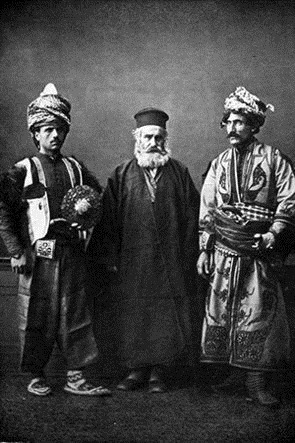
Citizens of Erzerum in their national costume.

Citizens of Erzerum in their national costume.

 Erzerum2

Mahmut Kamil returned from Istanbul on January 29. He could feel that the Russians would not only attack Erzerum, but also renew the offensive on the southern flank around Lake Van. Khnus, located further south, was taken on February 7 to prevent reinforcements from Mush from coming in. Turkish reserves were diverted from the northern front, but Russian forces captured Mush, seventy miles from Erzerum.


The attack on Erzerum started on February 11 from the south. Once the Russian forces broke through the Turkish lines to the south and began to attack other Turkish positions, the fall of the city seemed inevitable. In three days, the Russians managed to reach the heights overlooking the plain of Erzerum. The Turkish units began to retreat from the fortified zones at the front and also evacuate the city. On February 14 the Russians penetrated through both rings of Erzerum defenses and the remaining forts surrounding the city were evacuated the next day, avoiding encirclement. Russian Cossacks were among the first to enter the city in the early morning of February 16, 1916.

The Ottoman army lost a total of 17,000 soldiers during the campaign, including 5,000 prisoners. The Russians had 1,000 casualties, 4,000 wounded soldiers, and another 4,000 affected with frostbite.

The Russians gained the upper hand in the battle for control on the Caucasus front with the capture of Erzerum. This one victory, followed by the occupation of Trebizond in April 1916, enabled them to capture or control all the roads leading to Mesopotamia and Tabriz (Iran), and in essence, to control most of Western Armenia. The Russian victory allowed Armenian refugees and survivors from the Caucasus to return to their homes, and for the next year and a half, until the Bolshevik Revolution of November 1917, the liberation of Western Armenian from Ottoman yoke was a reality.

In the wake of the Bolshevik Revolution and the subsequent armistice between Russia and the Central Powers, Erzerum was returned to Turkish control. The transfer of power was made official under the terms of the Treaty of Brest-Litovsk in March 1918, when an Ottoman offensive on the Caucasus, against Eastern Armenia, was already on its way.


Read Full Post »

THIS WEEK IN ARMENIAN HISTORY
(Prepared by the Armenian National Education Committee)

[ANEC]


Birth of Armen Dorian (January 28, 1892)


Anyone may probably cite a dozen major or less major names in Armenian literature who became victims of the genocide of 1915. Even among scholars, however, the name of Armen Dorian probably does not ring a bell. At the age of 23, he was one of the youngest writers to be caught in the roundup of April 23-24 and sent to death.


He was born Hrachia Surenian on January 28, 1892 in the city of Skopje, the current capital of the Republic of Macedonia. At the time, his birthplace was still part of the Ottoman Empire. His father was a contractor of roads and bridges.


There was no Armenian community and no school there. Hrachia first studied at a local Greek school and then at the French school of Manastir (current Bitola, also in Macedonia). The family later moved to Constantinople, where the future poet received his higher education at the Mekhitarist School of Pangalti, which belonged to the Viennese branch of the congregation. He graduated in 1911 and traveled to France, where he continued his studies at the Sorbonne.


It is not clear why and when he took his literary name. When in Paris, he joined the French literary scene and founded the French newspaper L’Arène in 1912. Filled with dynamic and progressive ideas in poetry, he followed the current known as “paroxyste,” first proposed by poet Nicolas Beaudoin (1881-1960) in 1911, which was a French correlative to another avant-garde movement, futurism. He also published poetry booklets.


As immersed as he was in French literature, Dorian did not leave aside his Armenian roots. He wrote and published both in French and in Armenian, and did not sever his links with the Armenian literary life in Constantinople.


Immediately after his graduation in 1914, he received an invitation to return to Constantinople as headmaster in his alma mater, the Mekhitarist School of Pangalti. He also taught in four other schools, and contributed to local journals with Armenian and French poems. He was arrested at the Modern School in the night of April 24, 1915.


Armen Dorian, together with some 150 people, including poets Taniel Varoujan and Roupen Sevag, among others, was initially sent to Çankırı. Thirty exiles were able to return to Constantinople in one way or another. From the remaining hundred and twenty, in June 1915 a first caravan of 52 people was dispatched with destination to Deir-er-Zor. One of the fifteen survivors of the entire group of 120, Mikayel Shamdanjian, wrote: “At the time, we were not familiar with that name. From the first caravan, only the Protestant bookseller Baronian, as the result of petitions, was excluded and returned to Constantinople. All the other comrades, including the promising and pleasant Armen Dorian, went to become the victims of the roads of Elbistan. . . . Armen Dorian became part of the first caravan because, as someone who had absorbed French humor, was dazzling and had always a song in his lips.”


Dorian’s poetry has remained dispersed in the Armenian and French journals of the time. Other poems were posthumously published in the Armenian press. His brother Zenob Surenian, who had settled in Austria, in 1931 published a small collection of poetry entitled Un poète français d’origine arménienne (A French Poet of Armenian Origin).


Read Full Post »

THIS WEEK IN ARMENIAN HISTORY
(Prepared by the Armenian National Education Committee)

[ANEC]


Birth of Ivan Galamian
(January 23, 1903)

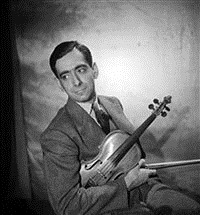
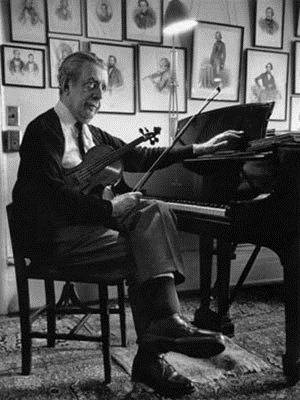
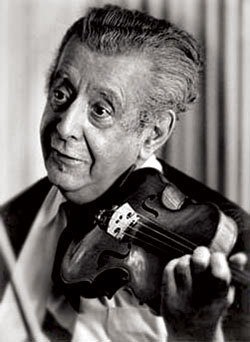
Galamian1Musicians would not develop their innate talents without their teachers. In the second half of the twentieth century, Ivan Galamian was a world-known violin teacher who taught many of the best-known violinists at the time, such as Itzhak Perlman and Pinchas Zukerman.

Ivan Alexander Galamian was born of Armenian parents in the city of Tabriz (Iran) on January 23, 1903. Soon after his birth, his family migrated to Moscow. He studied violin at the School of the Philharmonic Society of Moscow with Konstantin Mostras until he graduated in 1919. Still a teenager, the newly installed Bolshevik government threw him in jail. The opera manager at the Bolshoi Theater rescued Galamian; he argued that he was a necessary part of the opera orchestra, and the government allowed him to go free. Soon thereafter, he moved to Paris, where he studied with Lucien Capet in 1922-1923. He debuted in the French capital in 1924. After performing throughout Europe as a recitalist and soloist with orchestras, he eventually gave up the stage in order to teach full-time, due to a combination of nerves, health, and a fondness for teaching. Cellist Leonard Rose, later his colleague at the Juilliard School in New York, noted: “He told me that he had all the ambitions to be a great concert artist, but his nerves would bother him so much he would have backaches for weeks after concerts. So he said the hell with it.”Galamian2

He became a faculty member of the Conservatoire Rachmaninoff, where he taught from 1925-1937. He moved to the United States in 1937, where he married Judith Johnson in 1941, and became a citizen in 1944. In this period of time, his teaching abilities made him known everywhere. He was appointed to the Curtis Institute of Music in Philadelphia in 1944, and became the head of the violin department at the Juilliard School in 1946. He was also director of the Meadowmount Summer School of Music in Westport, N.Y., which he founded in 1944 and continues to be in operation today. He wrote two violin method books, Principles of Violin Playing and Teaching (1962) and Contemporary Violin Technique (1962). Almost anyone who wanted to be a violinist knew there was time to be spent under his tutelage. Parents would fly to New York with their would-be prodigies, and teachers from all over the world sent him their most gifted students.

Galamian3Galamian incorporated aspects of both the Russian and French schools of violin technique in his approach, which was described in the New Grove Dictionary of Music as “’analytical and rational, with minute attention to every technical detail.” “However,” the dictionary continues, “he rejects the enforcement of rigid rules and develops the individuality of each student. Mental control over physical movement is, in his opinion, the key to technical mastery.”

The teacher for generations of world-class violinists passed away on April 14, 1981. As Judith Karp wrote in The New York Times, “It was not entirely unexpected; at 78, the legendary Armenian pedagogue had been in less than perfect health for some time. But there was always a burning force in Mr. Galamian that almost made one believe he could defy nature’s rules; it was the force of his own wry conviction that ‘I cannot die as long as there are students around who want to learn to play the violin.’”

Read Full Post »

« Newer Posts - Older Posts »