Archive for the ‘the Armenian National Education Committee (ANEC)’ Category

THIS WEEK IN ARMENIAN HISTORY
(Prepared by the Armenian National Education Committee)

[ANEC]


Treaty of Batum (June 4, 1918)


In the early months of 1918, two parallel processes developed in the Southern Caucasus: on the one hand, Ottoman military actions, and on the other, diplomatic efforts. The signature of the Treaty of Batum marked a temporary end to both processes.
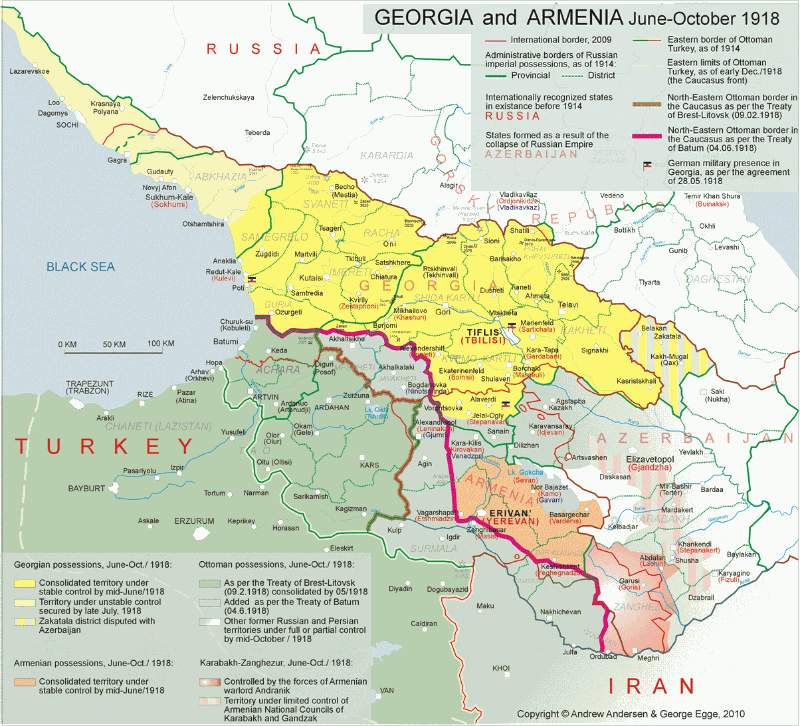
map
After the second Russian Revolution (November 7, 1917, according to the Gregorian calendar) and the seizure of power by the Bolsheviks headed by Lenin, Soviet Russia took measures to sign a separate peace with the Central Powers. Russians and Ottomans signed the armistice of Erzinga on December 5, 1917, ending the armed conflicts between both sides. The armistice was followed by the Treaty of Brest Litovsk (March 3, 1918), which marked Russia’s departure from World War I. The Ottoman Empire and the delegation of the Seim (Parliament) of Transcaucasia, formed by Georgians, Armenians, and Tatars (not yet named Azerbaijanis), held the peace conference of Trebizonda between March 14 and April 5. The Ottomans offered to surrender any ambition in the Caucasus in return for the recognition of the conditions of the Treaty of Brest Litovsk, which delivered Western Armenia, Kars, and Ardahan to the Ottoman Empire. Akaki Chkhenkeli, head of the Transcaucasian delegation, accepted the treaty as a basis for further negotiation. However, Armenians refused to accept the situation and hostilities resumed. The Ottoman army advanced further to the east, despite Armenian resistance.


A new peace conference between the Ottoman Empire and the newly-independent Republic of Trancaucasia (proclaimed on April 22) opened at Batum on May 11. The Ottomans left aside the Treaty of Brest-Litovsk and increased their demands to include Alexandropol (nowadays Gumri), Surmalu (including Mount Ararat), Akhalkalak, and Akhaltskha. They also requested the construction of a railroad that connected Kars and Julfa (in Nakhichevan) with Baku. The transport corridor would run through Armenia, which was to give free right of passage. The Armenian and Georgian members of the Republic’s delegation began to stall the negotiations. The Ottoman army moved ahead and occupied Alexandropol on May 14. Between May 21 and 28, the fate of Armenia and Armenians was decided in the historic battles of Sardarabad, Gharakilise, and Bash Abaran. After the dissolution of the Republic of Transcaucasia on May 26-27 with the declaration of independence of Georgia and Azerbaijan, on May 30 the Armenian National Council of Tiflis (nowadays Tbilisi) assumed the authority of the Armenian provinces, retroactive to May 28.


Despite its defeat at the three battles, the Third Ottoman Army held positions 4 miles from Yerevan and 6 miles from Etchmiadzin. Armenians had exhausted their possibilities of resistance and had no choice but to make peace with Turkey and sign a treaty that, despite its humiliating conditions, would give them a minimum respite, hoping that the world war would end soon and the Allied victory would bring justice to their cause.


Three separate treaties were signed in Batum between the Ottoman Empire and the three Transcaucasian republics on June 4-5. The treaty of “peace and friendship” signed with the Republic of Armenia, represented by Alexander Khatisian, Hovhannes Kajaznuni, and Mikayel Babajanian, tacitly recognized its independence, ironically, three years after the genocide had started. The treaty left to Armenia Yerevan, Etchmiadzin, and the district of Nor Bayazid (now Gavar), around Lake Sevan. Parts of the districts of Sharur, Yerevan, Etchmiadzin, and Alexandropol were seized by the Ottoman Empire, as well as Akhalkalak and Akhaltskha, with a total of almost 18,000 square miles and a population of around 1,25 million people. Armenia was left with a landlocked territory of around 4,250 square miles (half of the extension of New Jersey), fifty kilometers of railway in the north and six kilometers extending west from Yerevan.


As historian Richard Hovannisian wrote in 1967: “Thus, the Republic was created under conditions so tragic as to defy adequate description. Yet, there was an Armenia. In mid-1918, even that was a remarkable accomplishment.” The situation would change by the end of 1918.
 

Read Full Post »

THIS WEEK IN ARMENIAN HISTORY
(Prepared by the Armenian National Education Committee)

[ANEC]

Death of Kevork Chavoush
(May 27, 1907)


Kevork Chavush Graphics

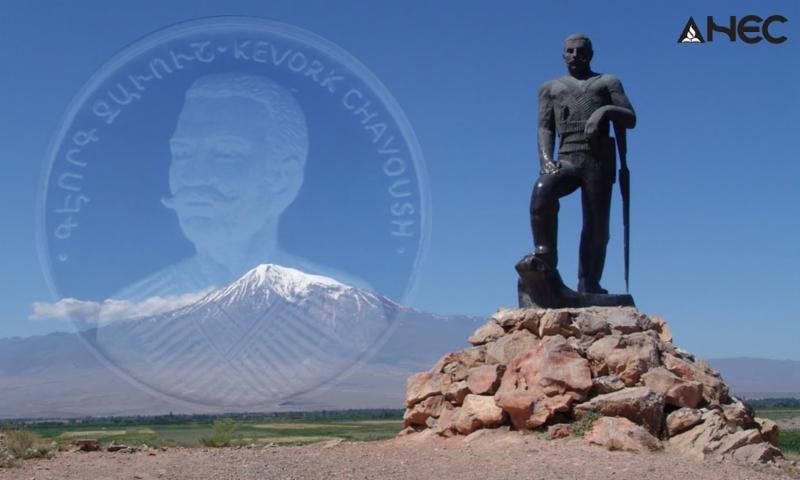
There were names that rose to legendary proportions at the end of the nineteenth and beginning of the twentieth century, when Turkish and Kurdish marauding of Armenian peasantry was met with armed resistance by fedayees (freedom fighters). Kevork Chavoush was among the most prominent figures leading that struggle.


He was born Kevork Atamian in 1870, in the village of Megtink, district of Psanats (Sasoun). In 1886 his family sent him to the school of the monastery of the Holy Apostles (Arakelots) in Moush. At school, he heard about Arabo (Arakel Mkhitarian, 1863-1893), one of the founders of the fedayee movement. He decided to join the movement in 1888. He left for Aleppo, where he spent two years working to buy a gun. In 1890 he returned to Sasoun. 


In 1892 Gurbo, the head of the neighbor village of Alizernani, betrayed Arabo and reported his location in the village of Pertag to the Turks, who managed to capture him despite heavy casualties. Kevork Chavoush punished Gurbo’s treason by killing him in his own home. 


After Arabo was killed in 1893, Kevork Chavoush participated actively in the first rebellion of Sasoun in 1893-1894. He was captured and condemned to 15 years of prison. However, he was able to escape from the prison of Bitlis in April 1896 and return to Sasoun, where he met legendary freedom fighter Antranig (1865-1927) and entered the ranks of the Armenian Revolutionary Federation.


Serop Aghpiur (1864-1899), another famous fighter, was forced to leave his home in Khlat and move to Sasoun. Kevork Chavoush and Antranig, joined him with their own groups. Serop established certain rules among the fedayees. The first rule was that the fedayee was married to his weapon. He noticed that the Armenian villages were in enmity, since men from one village stole women from another, and declared that anyone doing such a thing would be severely punished. Kevork’s uncle, Ave, kidnapped a housekeeper at the monastery of the Holy Apostles. Serop left it to Kevork to decide the punishment. He was forced to kill his uncle, but depression led him to leave Serop’s battalion and isolate himself for a few days.


In his absence, Serop was betrayed by a villager from Keghashen, also called Ave, who let the Turks know about Serop’s position and poisoned him. A troop of 2,000 Turks and Kurds soldiers surrounded the village of Gelieguzan. Aghpiur Serop, his son, and his brothers fell during the unequal battle. His wife Sose continued the fight, but was wounded and taken prisoner by Turkish chief Khalil bey, who beheaded Serop. His death did not go unpunished. In April 1900 Kevork Chavoush liquidated Ave and all other people implicated in the betrayal. In November a group of 30 fedayees, headed by Antranig and Kevork, ambushed Khalil bey and his 40 horsemen. They took Khalil prisoner and beheaded him.


On November 1, 1901, Antranig and Kevork Chavoush, together with a group of 25 to 27 fighters, occupied the Holy Apostles monastery. The operation had been carefully planned to attract the attention of the foreign powers. A few days later, 3,000 Turkish soldiers besieged the monastery. During the siege, typhus declared among the Turks, who started negotiations on November 18. However, on the night of November 27 the fedayees managed to cut through the siege and disappear in the dark.


After the defeat of the second rebellion of Sasoun in 1904, Kevork Chavoush fought heroically in the plain of Moush with Antranig and other fedayees, and later he went to the region of Vaspurakan (Van). The meeting of local leaders of the Armenian Revolutionary Federation, held at the island of Aghtamar in September 1904, decided that a group of fighters return to Sasoun and continued the struggle against the Turkish authorities. Kevork became the A.R.F. representative in the region of Moush and Sasoun, and the leader of Armenian freedom fighters in the region from 1905-1907.


Kevork Chavoush had left his sweetheart, Yeghso (Heghine), when he had entered the cause of freedom. However, she never ceased to love him, even after she was forced to get married. In 1905 she escaped her home and tried to see Kevork for the last time before taking her own life. He first rejected, but then his comrades of arms convinced him. They married the same day, breaking the rule of fedayee etiquette, and had a son called Vartkes.


On May 25, 1907, an unequal fight broke in the village of Souloukh, in the plain of Moush. Eighty fedayees fought against a 2000-strong Turkish troop. The Turkish troops gave 120 dead and 110 wounded. The Armenian losses were seven dead and 21 wounded. Most importantly, however, Kevork Chavoush was mortally wounded in the fight. He passed away on May 27. After his death, the Turks tried to kill his wife and son, but his comrades saved their lives.


Kevork Chavoush’s life and exploits became the material for songs and novels. Like the rest of the fedayee movement, his name was banned for many years in Soviet Armenia. In the 1960s his relative Kevork Melkonian managed to install his statue in the village of Ashnag, whose population had its roots in Sasoun, complemented by a museum he inaugurated in the 1980s. After the independence of Armenia, other statues were inaugurated in Yerevan, Artashat, Jermuk, and the village of Lousarat.

Read Full Post »


THIS WEEK IN ARMENIAN HISTORY
(Prepared by the Armenian National Education Committee)

[ANEC]


Birth of Lydia Durnovo
(May 1, 1885)


Lydia Durnovo was a Soviet Russian art historian and restorer, considered one of the founders of the school of art historians in Armenia.


She was born in Smolensk (Russia) on May 1, 1885. She first attended a local gymnasium, where she studied drawing. She moved to St. Petersburg in 1904 and entered A. V. Makovsky’s art workshop. However, she only studied for a year. The Russo-Japanese war of 1904-1905 had started, and she left for the front to serve as a nurse. She returned to St. Petersburg in 1906 and she graduated from the school of the Society for the Encouragement of Arts in 1915. She would subsequently complete her postgraduate studies at the State Institute of Art History and the Archaeology Institute between 1920 and 1923. In the 1920s Durnovo worked as a research fellow at the Institute, specializing in early Russian art. She was also the assistant curator of the Russian Museum and headed its copy shop, gathering and training a group of enthusiasts, who became the core of a school of restorers and copyists.


In an early wave of repression, she was arrested in October 1933 for allegedly being an “active member of a counterrevolutionary fascist organization.” She was deported to Siberia and eventually freed three years later, in November 1936. In 1937 Ruben Drampian (founder and first director of the National Gallery of Armenia from 1935-1951), invited Durnovo to move to Armenia. The Gallery had created a department of Medieval Art, and it was necessary to establish the gathering and storage of manuscripts on a scholarly basis, as well as to organize the systematic copying of art works. She gathered again young students and taught them how to restore and copy works of art. After two years of contract work, she became a permanent employee of the Gallery in 1939.


Coming into contact with the architecture, frescoes, and miniatures of Armenia, Durnovo was among the first to look at them from the standpoint of an art historian. Scholars like Garegin Hovsepian, Toros Toramanian, Josef Strzygowski, and Nikolai Marr had contributed valuable historical and philological studies to the field, but Armenian medieval art was looking for a researcher who offered an aesthetic response.


The study of Armenian monumental painting, namely, frescoes, was Lydia Durnovo’s significant contribution. She discovered and studied unknown frescoes, and refuted Austrian art scholar Strzygowski’s view that medieval Armenia did not know them. She dated, organized, and copied Armenian frescoes, as well as miniatures. She also made an important contribution to the study and copying of drapery.


By the mid-1950s, Durnovo had earned authoritative reputation in the field of Armenian medieval art. In 1952 she published the album Armenian Ancient Miniature, which became a landmark in the scholarly life of Armenia and was published in eight languages from 1952 to 1969 (English edition, Armenian Miniatures, New York, 1961). Three years later, she left her work at the National Gallery and became a researcher at the Art Institute of the Armenian Academy of Sciences. She supervised the restoration of the frescoes of the Cathedral of Holy Etchmiadzin. Three years after Stalin’s death, she was rehabilitated by the Soviet government and the charges leveled at her in the 1930s were suppressed. In 1957 she published a second book, A Brief History of Old Armenian Painting.

After a prolific career and contribution to the study of Armenian art during a quarter of a century, Lydia Durnovo passed away in Yerevan on January 7, 1963. 


Portrait of Lydia Durnovo, by Martiros Sarian (1958)

Portrait of Lydia Durnovo, by Martiros Sarian (1958)


Read Full Post »

THIS WEEK IN ARMENIAN HISTORY
(Prepared by the Armenian National Education Committee)

[ANEC]

Birth of Henry Morgenthau, Sr.
(April 26, 1856)


Righteous men were a plenty during the years of the Armenian Genocide, and Henry Morgenthau, Sr., Ambassador of the United States to the Ottoman Empire, was the prominent American name among them.

 240px-Henry_Morgenthau__Jr.1947Morgenthau was born in Mannheim (Germany) on April 26, 1856. He was the ninth of eleven children to a Jewish family. His father, Lazarus Morgenthau, was a prosperous manufacturer and merchant, who bought tobacco from the United States and sold it back as cigars. However, the American Civil War hit him severely: German cigar exports ceased after a tariff on tobacco imports was set in 1862. Four years later, the family migrated to New York. Despite his father’s unsuccessful attempts to re-establish himself in business, Henry Morgenthau—who knew no English on his arrival at the age of ten—graduated from City College in 1874 and from Columbia Law School in 1876. Beginning a career as a successful lawyer, he would later make a substantial fortune in real estate investments. He married Josephine Sykes in 1882 and had four children. He served as a leader of the Reform Jewish community in New York.

In 1911 Morgenthau, then 55, left business to enter public service. He became an early supporter of President Woodrow Wilson’s election campaign in 1912. He had hoped for a cabinet post, but Wilson offered him the position of ambassador to the Ottoman Empire, with the assurance that it “was the point at which the interest of American Jews in the welfare of the Jews of Palestine is focused, and it is almost indispensable that I have a Jew in that post.” The encouragement of his friend, Rabbi Stephen Wise, led him to reconsider his decision and accept the offer, although Morgenthau was no Zionist himself.

The United States remained neutral after the beginning of World War I, and since the Allies had withdrawn their diplomatic missions following the outbreak of hostilities, both the American embassy and Morgenthau himself additionally represented their interests in Constantinople. American consuls in different parts of the Empire, from Trebizond to Aleppo, reported abundantly about the Armenian plight and documented the entire process of the Armenian Genocide. Morgenthau continuously kept the U.S. government informed of the ongoing annihilation and asked for its intervention. His telegram to the State Department, on July 16, 1915, described the massacres as a “campaign of race extermination.” He intervened upon the Young Turk leaders to stop the mass killings, although unsuccessfully. His friendship with Adolph Ochs, publisher of The New York Times, ensured a wide coverage of the Armenian atrocities throughout 1915.

Morgenthau reached out to his friend Cleveland H. Dodge, a prominent American businessman, who was instrumental in the foundation of the American Committee for Armenian and Syrian Relief in 1915 that would later become Near East Relief (nowadays the Near East Foundation). Finding “intolerable” his “further daily association with men . . . who were still reeking with the blood of nearly a million human beings,” as he wrote in his memoirs, he returned to the United States in February 1916 and campaigned to raise awareness and funds for the survivors, resigning from his position as ambassador two months later. In 1918 he published his memoirs, including his account of the genocide, as Ambassador Morgenthau’s Story (published in Great Britain as The Secrets of the Bosphorus).

He attended the Paris Peace Conference in 1919, and worked with various war-related charitable bodies. He also headed the American fact-finding mission to Poland in 1919 and was the American representative at the Geneva Conference in 1933. He died on November 25, 1946, in New York City, at the age of 90, following a cerebral hemorrhage, and was buried in Hawthorne, New York. Morgenthau was the father of Henry Morgenthau, Jr., Secretary of the Treasury during the administration of Franklin Roosevelt, and the grandfather of Robert Morgenthau, long-time District Attorney in Manhattan, and historian Barbara Tuchman. He appeared in “Ravished Armenia,” the film based on the memoirs of survivor Aurora Mardiganian, commissioned by the Near East Relief. One of his dialogues with Talaat is portrayed in the forthcoming film The Promise.


Read Full Post »

THIS WEEK IN ARMENIAN HISTORY
(Prepared by the Armenian National Education Committee)

[ANEC]


Birth of Levon Shant

(April 6, 1869)


Levon Shant was perhaps the most important playwright in the history of Armenian theater, but he was primarily a seasoned and accomplished educator. He was also an active participant in the Armenian liberation movement.

 LevonShant

Shant was born Levon Nahashbedian on April 6, 1869, in Constantinople. He lost his parents at an early age and adopted the last name Seghposian after his father Seghpos. He attended the Armenian school of Scutari (now Uskudar) until 1884, and then the Gevorgian seminary at Holy Etchmiadzin for the next seven years. He returned to Constantinople in 1891, where he worked as a teacher. He published his first literary piece in the local daily Hairenik in the same year. In 1893 he departed to Germany, where he studied science, child psychology, education, literature, and history in the universities of Leipzig, Jena, and Munich. Meanwhile, he started his literary career with the poem The Mountain Girl (1892), published under the pen name Levon Shant (shant/շանթ means “lightning”), but soon shifted to a series of novellas (Dreamlike Days and The Outsiders, 1894; Vergine, 1896; The Return, 1896, and The Actress, 1898). After finishing his university studies in 1899, he taught for more than a decade at the Gayanian Girls School in Tiflis and the Diocesan School of Yerevan. He became a member of the Armenian Revolutionary Federation in the 1890s.


The turn of the century brought in him a different literary persona: the playwright. He wrote his first play, The Egoist, in 1901, followed by For Someone Else (1903), and On the Road (1904). After this string of plays inspired in contemporary life, he turned to the historical past and wrote his masterpiece Ancient Gods (1909), published in 1912, which made a huge impact on the Armenian literary world when it was premiered in Tiflis (1913). This was the first of several successful historical dramas he would write over the next two decades: The Emperor (1916), The Enchained One (1918-1921), The Princess of the Fallen Fortress (1922), Oshin the Bailiff (1932).

In Tiflis, Shant participated actively in the gatherings of the literary circle “Vernadun” (Վերնատուն), held at the attic of poet Hovhannes Tumanian’s home, and was in close contact with other writers of the group, like Ghazaros Aghayan, Avetik Isahakian, and Derenik Demirjian. In 1909 he published, together with Hovhannes Tumanian and Stepan Lisitsian, the series of Armenian textbooks Lusaber.


In 1911 he returned to his birthplace, Constantinople, and taught at the Central (Getronagan) and Esayan schools until 1914. By that time he was already married and moved with his family to Lausanne in Switzerland. He returned to the Caucasus in 1915 to supervise the publication of textbooks, but was unable to go back to Europe and remained in Tiflis until 1917, when he returned to Switzerland. However, after the independence of Armenia, he returned to Yerevan, where he became a vice-president of the Parliament of the first Republic. In April 1920 he led a delegation to Moscow to carry out negotiations with the Soviet regime, which would fail in the end. He was imprisoned by the new government after the Soviet takeover, but freed following the uprising of February 1921. In April 1921, after the end of the uprising, he left Armenia.

For the next thirty years of his life, Shant would live abroad, first in Paris, then in Cairo, and finally in Beirut. He wrote political essays, like Nationhood as the Basis of Human Society (1922) and Our Independence (1925). In 1928, together with educator and literary critic Nikol Aghbalian, theater director Kaspar Ipekian, and former prime minister of the Republic, Dr. Hamo Ohanjanian, as well as a group of less known A.R.F. members, he was one of the main founders of the Hamazkayin Armenian Cultural and Educational Society in Cairo. In 1930, together with Nikol Aghbalian, he settled in Beirut, where they founded the Armenian Lyceum (Jemaran) of Hamazkayin in 1930, later known as the Nishan Palanjian Lyceum and currently as Haig and Melanchton Arslanian Lyceum. Shant was the school principal for the next twenty years, while at the same time he taught pedagogy and psychology. He created a unique pedagogical atmosphere in the Jemaran, focused on his belief that the school should educate a humanistic education also linked to the preservation and development of national identity.


Engaged as he was in education and school management, Shant continued with the task of preparing school textbooks. He did not leave literature. In 1945 he published the novel The Thirsty Souls, and from 1946-1951 he published an edition of works in eight volumes, which included a yet unpublished history of Armenian literature. He passed away on November 29, 1951.

His name was banned in Soviet Armenia, as were many other writers who were A.R.F. members or sympathizers. Nevertheless, a monograph about him was published there in 1930, and a collection of his plays appeared in 1968. After the second independence, a school in Yerevan was renamed after him in 1994.

Read Full Post »

THIS WEEK IN ARMENIAN HISTORY
(Prepared by the Armenian National Education Committee)
[ANEC]


Death of Arshavir Shahkhatouni

(April 4, 1957)


Arshavir (Asho) Shahkhatouni went down in history as both a star of Russian and French silent films in the 1910s and 1920s, and as the military commander of Yerevan during the first Republic of Armenia. 

One would say that it was a genetic trait: his father Vagharshak Shahkhatuni (1843-1892) was a colonel in the Russian army, and also the founder of the theater hall of Alexandropol (nowadays Gumri). Arshavir was born in Alexandropol on February 19, 1885. He spent his childhood in Alexandropol, Nor Bayazed (Gavar), Gandzak (Ganja), and Yerevan. He studied at the Mikhailov military school of Tiflis (Tbilisi) and served in Baku in 1905. After the Armeno-Tatar clashes of 1905, he was expelled from the army for refusing to fire over Armenians who had found refuge in a church, as it had been ordered to the battalion he commanded. He went to work in an office and started developing his love for theater as an amateur actor in the local Armenian groups. Over the next seven years (1905-1912), he would gradually become a sought-after name in Armenian theater, both in Baku and in Tiflis. The first Romeo on the Armenian stage, Shahkhatouni was considered, together with Hovhannes Abelian, the preeminent representative of realism in Armenian acting.

In 1913 Shahkhatouni was offered an important role in “Bela,” a movie by Alexander Gromov. For the next five years, he would live in Moscow, where he studied at the Artistic Theater and followed the classes of famous theater theoretician Konstantin Stanislavski. Meanwhile, he continued his cinematographic career, starring mostly in films with Caucasian themes, such as Alexander Volkov’s “The Conquest of the Caucasus,” “The Fugitive,” “Khaz bulad,” as well as others like “Jealousy,” “Storm,” “Venus’ Fur,” etcetera. He was highlighted as one of the well-regarded names of pre-Soviet cinema, becoming also one of the first Armenian actors to appear in Russian cinematography, along with Hamo Bek-Nazarian and Vahram Papazian. 

In the crucial year 1918, Shahkhatouni left Moscow and returned to the Caucasus. His former military experience would lead him to participate in the battles of Sardarabad and Pash-Abaran, and after the foundation of the Republic of Armenia, he was designated military commander of Yerevan, receiving the rank of colonel.

After two years of service, in 1920 Shahkhatouni left Armenia and returned to his old love, theater, this time in Constantinople. He became one of the prominent names in local Armenian theater, until he left the city in late 1922, following the nearing occupation by Kemalist forces. He went to Bulgaria, where he played Hamlet and Othello in Russian with Bulgarian companies in Sofia and Varna. After a year, in 1924 he moved to Paris with America in his sight, but he eventually stayed in the City of Lights, where he became one of the stars of local Armenian theater during the 1920s and 1930s.

Meanwhile, Shahkhatouni developed the second phase of his cinematographic career. In 1926 he was cast in “Michael Strogoff,” a movie by Russian emigré filmmaker Vsevolod Turzhansky, who knew Shahkhatouni from Moscow. A more important achievement was his participation in Abel Gance’s monumental film, “Napoleon” (1927), where he played the role of Napoleon’s childhood friend and later mortal enemy Pozzo di Borgo. He would become friends with such famous names as French filmmaker René Clair and British actor Sir Laurence Olivier. He also participated in five films from 1927-1929.

Armenian national hero Antranig passed away in Fresno in August 1928. In the same year, Shahkhatouni directed and played in “Antranig,” the first Armenian feature movie filmed in the Diaspora with Armenian subject and by an Armenian studio (“Armena-Film”). The film was distributed in several European countries, from Portugal to Sweden, with Turkey protesting against its exhibition. For this reason, it was never shown in the United States, except for one showing in Philadelphia in 1938, in a sound version. 

After sound movies made their appearance, Shahkhatouni’s movie career took a radical turn. Although he participated in a few films at the beginning, he could not continue acting, due to his insufficient knowledge of French. He continued appearing in Russian and Armenian theatrical performances, and wrote two plays, which were performed in the 1940s. However, he did not want to sever his relations with cinematography. He became a make-up expert, and he was credited in many movies of the 1930s, to the point that he was named “a leading professional cosmetician in the world” by the French Journal de la femme (1939). By 1953, forty out of sixty make-up experts working in French cinema had been Shahkhatouni’s students. 

Shahkhatouni, who always lived with nostalgia for his faraway homeland (he would have probably shared the fate of so many people who were victims of the Stalin purges for their participation in the first Republic of Armenia), suffered a fatal blow after the death of his wife Nina in 1950. He had a stroke, and for the next seven years he lived in poverty, practically confined to his home. The fiftieth anniversary of his theatrical career was commemorated in New York, in 1956. He passed away on April 4, 1957.

Arshavir (Asho) Shahkhatouni

Arshavir (Asho) Shahkhatouni

Read Full Post »


THIS WEEK IN ARMENIAN HISTORY
(Prepared by the Armenian National Education Committee)

[ANEC]


Birth of Catholicos Sahag II Khabayan

(March 25, 1849)


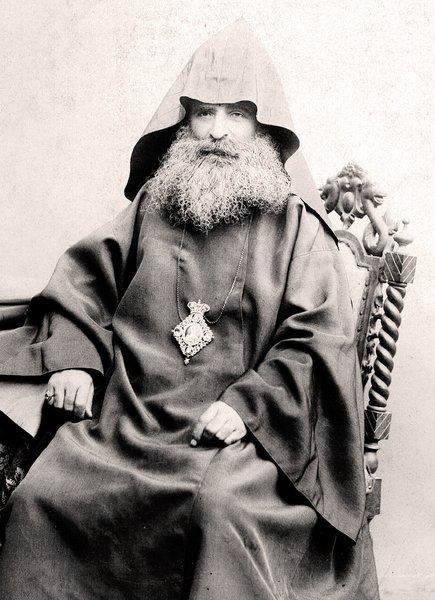
Catholicos Sahag II Khabayan

Catholicos Sahag II Khabayan

During his more than three decades of tenure, Catholicos Sahag II endured and witnessed the Armenian Genocide and the final catastrophe that deprived the Catholicosate of the Great House of Cilicia of its seat of Sis.


He was born Kapriel Khabayan in the village of Yeghek, in the plain of Kharpert, on March 25, 1849. In 1867, at the age of eighteen, he entered the seminary of the Armenian monastery of St. James and was ordained deacon in 1869. He was sent to Constantinople to further his studies, and returned in 1871, becoming a teacher at the seminary. Patriarch Yesayi ordained him celibate priest on July 3, 1877 with the name Sahag. He later became editor in chief of Sion, the monthly publication of the Armenian Patriarchate of Jerusalem, and head of the printing house. For a time, he was a member of the Board of Directors and chairman of the General Assembly of the congregation.


Very Rev. Sahag Khabayan was sent as legate to the Caucasus in 1881. He worked there as a preacher and collected money. On January 10, 1885, he was elected sacristan of Holy Etchmiadzin and on November 24, Makar I, Catholicos of All Armenians, consecrated him bishop.


The See of Cilicia remained vacant after the death of Catholicos Mgrdich I Kefsezian (1871-1894) in November 1894. The interregnum lasted eight years. Catholicos of All Armenians Mgrdich I (1892-1907), best known as Khrimian Hayrig, favored the candidacy of Bishop Sahag Khabayan. On October 12, 1902, 62 delegates from the fifteen dioceses under the jurisdiction of the Catholicosate elected Catholicos Sahag II by unanimity. The ceremony of consecration was held on April 23, 1903, in the monastery of Sis. He would be the last Catholicos consecrated in Cilician lands.


The relations between Etchmiadzin and Sis grew closer during Sahag II’s years, who established the preferential mention of the name of the Catholicos of All Armenians in the Holy Mass with an encyclical. He worked actively to renovate and improve the monastery, which had fallen into disrepair and inactivity. He reopened the seminary of Sis in 1906.


Years of turmoil and destruction loomed ahead. He first witnessed the massacre of Adana in 1909, and, in the first months of the Armenian Genocide, he was exiled to Aleppo, where he witnessed and reported extensively on the misery of the deportees, and then to Jerusalem. Another exile followed in 1917, this time to Damascus. After the end of World War I, he returned to Cilicia, now put under French mandate, with the survivors in 1919.


A second set of catastrophes unleashed in 1920 with the attacks of the Kemalist forces and the passive stance of the French. After the massacre of Marash in February, Sis was evacuated in June, and Hadjin fell to another massacre after an eight-month heroic resistance in October. Catholicos Sahag went to Paris to defend the cause of Cilicia, but in vain. In 1921 the last Armenian remnants left Cilicia and the Catholicos was the leader of his flock. For the next eight years, the historical See of Cilicia would have a wandering life, from Aleppo to Damascus to Beirut to Cyprus. The pastoral letter written by Sahag II in Damascus on February 28, 1922, was highly eloquent in its opening statement: “Greetings to the Armenians of Cilicia, now emigrated and spread throughout the world, greetings to the suffering from the suffering Shepherd, from Catholicos Sahag II of the once Great and now Ruined House of Cilicia.” The document emphasized:


“Make your voice heard, dear children, where are you? I want to follow the trail of your crucifixion, if not to materially and morally help you, at least to share your grief and lighten your yoke and burden. I wish the yoke and burden belonged to Christ. The yoke put by the world and implacable men is asphyxiating, and their burden is heaviest and bitterest.


“(. . .) This lionhearted people, although famished, naked, and homeless in foreign lands, do not beg. They wait for any moral or material help from their families, who remained free of any calamity, terror, and suffering in free countries, although they cried over the unknown tombs of their dearest ones. You cried and gave abundantly to relieve, make live, and defend the overlooked rights of those left alive.”


In 1929 Sahag II appealed for help to the Near East Relief that managed an orphanage in Antelias, then a suburban area of Beirut. The charitable organization leased the property to the Catholicosate for the symbolic price of a dollar per year. Cilicia was reborn in Antelias. In 1930, due to the advanced age of the Catholicos, Archbishop Papken Guleserian, aged 62, was designated Coadjutor Catholicos as Papken I. He was supposed to succeed Sahag II, then aged 81, but this did not happen. Both Church leaders worked together to strengthen the Catholicosate until the premature death of Coadjutor Catholicos Papken I in 1936.


The Armenian community of Lebanon celebrated the thirtieth anniversary of the enthronement of Sahag II on June 18, 1933. President Charles Debbas decorated the Catholicos with the order of the Republic of Lebanon in the first degree.


Sahag II closed a life of continuous service to the Church and his people on October 8, 1939, in Antelias, at the age of 90.


Read Full Post »

THIS WEEK IN ARMENIAN HISTORY
(Prepared by the Armenian National Education Committee)

[ANEC]

Birth of Aram Haigaz
(March 22, 1900)


Aram Haigaz

Aram Haigaz

Aram Haigaz was a familiar name in the Armenian literary scene of New York and a popular writer in the Diaspora for more than six decades.

Born Aram Chekenian in Shabin Karahisar on March 22, 1900, he studied at the elementary school of his hometown. He would eventually become a survivor of the Armenian Genocide. In the summer of 1915, the Armenian population of Shabin Karahisar, some 5,000 people, rejected the order of deportation, set fire to their homes and fields, and climbed up the mountain that shadowed the town, where the remains of an old Roman fort served as their protection. They had taken food and animals with them. However, after a desperate resistance of almost a month, they were forced to surrender by famine. Only a handful survived, including Aram Haigaz, whose brothers, father and other relatives perished. He survived by converting to Islam and living as a Muslim, as many other young boys in those days, until he escaped to freedom. His memoir Four Years in the Mountains of Kurdistan (1972; translated into English by his daughter Iris Chekenian in 2015) described his life and servant, and how he grew from boyhood to youth among Kurdish tribesmen and chieftains.

After the end of World War I, the young survivor escaped to Constantinople in 1919. He was reunited with an aunt and spent some time in an orphanage run by American missionaries. He later attended the Getronagan High School for a year and a half. His literary essays attracted the attention of his teacher, the famed writer and critic Hagop Oshagan. He sailed for the United States in 1921 and settled in New York. He worked as an apprentice photo-engraver at The Daily Mirror newspaper and studied English at night, voraciously reading world literature. He started contributing to Armenian publications in 1922 and took the pen name Aram Haigaz, after the name of one of his elder brothers who had died in 1915. He married and had two children.

He would publish ten books in his lifetime, as well as scores of essays and reviews for Armenian newspapers and magazines throughout the Diaspora. His first book, however, would be H. Baghdoyan’s English translation of his memoir on the resistance of Shabin Karahisar, The Fall of the Aerie (1935, reprinted in 2010). He would continue working on the history of the self-defense and collecting testimonies, which he condensed in a book, Shabin Karahisar and Its Heroic Struggle (1957).

Other than stories from the old country and his years of tribulations, from the very beginning he started writing humorous short stories and vignettes of contemporary life during his time in Constantinople and then in the United States. His natural, conversational style made him a sought-after author. He collected his stories in several volumes: The Call of the Race (vol. I, 1949; vol. II, 1954), Four Worlds (1962), Hotel (1967), Yearning (1971), Live, Children! (1973), and Happiness (1978).

Aram Haigaz received various literary awards, and his literary jubilee was marked in 1972 in the United States, Canada, and Lebanon. He lived in Rego Park (New York), and passed away in Manhattan on March 10, 1986, a few days before his eighty-sixth birthday, from complications of pneumonia. The Soviet regime did not allow the publication of his work in Armenia during his lifetime for political reasons. In the past decade, several books of stories and articles scattered in the press have been posthumously published in Yerevan, as well as an anthology of his short stories and a collection of letters.


Read Full Post »

THIS WEEK IN ARMENIAN HISTORY
(Prepared by the Armenian National Education Committee)

[ANEC]


Death of Hetum I
(October 28, 1270)

Hetum I was the founder of the Hetumian dynasty (1226-1342), the second in the history of the Armenian kingdom of Cilicia. He excelled as a seasoned diplomat who achieved crucial results both in internal and foreign policy.

Hetum was born in 1215, the son of Prince Constantine of Baberon, who had a leading position among the Armenian princes of Cilicia and became regent in 1219, shortly after the death of King Levon I, due to the minority of his daughter Zabel (1216-1252), who was three-years-old. In order to end the rivalry between Cilicia and the principality of Antioch (Syria), Constantine arranged for the marriage of Zabel to Philip, a son of Bohemond IV of Antioch, in 1222. However, Philip’s disdain for Armenian ritual and his favoritism for Latin noblemen alienated the Armenian nobility. After a revolt headed by Constantine in late 1224, Philip was imprisoned and deprived of the throne with the agreement of the council of Armenian princes. He died in prison.
1a3f1263-c8c4-4e74-beaa-494e10ffccd5

Constantine moved forward and, despite the opposition of ten-year-old Zabel, he married her to his son Hetum, who was proclaimed king on June 14, 1226. In this way, the two most powerful families of Cilicia, the Rubinians (the royal dynasty) and the princes of Lambron, established an alliance.

Hetum I ascended to the throne in a difficult international conjuncture. He confronted Antioch on one hand, where he established a protectorate of sorts after the death of Bohemond IV. On the other hand, he had to face the power of the Sultanate of Rum, ruled by a Seljuq Turkish dynasty, but was able to come to terms with it. Over the years, Hetum I was able to overcome the internal dissensions and offer a united front to external pressure. At the same time, he centralized the monarchy and strengthened the army, while economic life and culture flourished.

In the 1240s a new and dangerous player appeared in the international scene, the Mongols. After occupying Persia and Armenia, the Mongols entered the Middle East and reached the borders of Cilicia by 1243. Instead of confrontation, Hetum chose to sign a treaty of peace and mutual cooperation with the Mongols. He first sent his brother, the Constable Smpad, in a diplomatic mission to Karakorum, the capital of the Mongol Empire, in 1248. Afterwards, the king himself made the hard and long journey to Central Asia and visited Karakorum in 1254, signing a new treaty of alliance with emperor Mangu Khan. This treaty established, among other conditions, friendship between Christians and Mongols, who were still pagan at the time; tax exemption for the Armenian Church; the liberation of Jerusalem; the destruction of the caliphate of Baghdad; assistance to Cilicia by all Mongol commanders; devolution to Cilicia of Armenian territories occupied by the Muslims.

This diplomatic success, at a time when the Mongols were confronted by all forces from China to Eastern Europe, strengthened the position of Cilicia. Thanks to the Armeno-Mongol alliance, between 1256-1259 Hetum I was able to stop the attacks of the emirate of Aleppo and the invasions of the Sultanates of Rum and Egypt. He also liberated several cities, like Marash and Aintab, and annexed the southern portion of Cappadocia, as well as part of northern Syria to his kingdom.

The Sultanate of Egypt took advantage of the divisions among the Mongols and invaded Cilicia in 1266, taking Hetum’s son and heir apparent Levon as prisoner. The invasion devastated some parts of the country. In June 1268 Hetum signed peace with Egypt by the cession of several border fortresses and was able to free his son. A year later, he resigned and Levon II was crowned king. Hetum retired to the monastery of Akner, where he became a monk with the name of Magar, and passed away on October 28, 1270.


Read Full Post »

THIS WEEK IN ARMENIAN HISTORY
(Prepared by the Armenian National Education Committee)

[ANEC]

Death of Patriarch Nerses Varjabedian
(October 26, 1884)


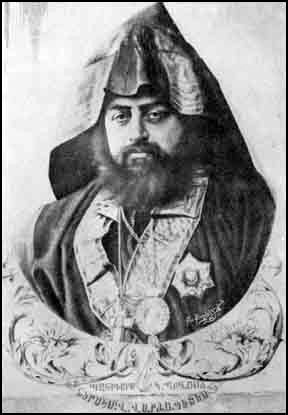
Patriarch Nerses Varjabedian

Patriarch Nerses Varjabedian

The Armenian Patriarchate of Constantinople went through turbulent times in the mid-nineteenth century, when there were heated disputes over the democratization of the Armenian society and the Church. The name of Patriarch Nerses Varjabedian emerged in the 1870s-1880s as a guiding light.

The future ecclesiastic was born Boghos Varjabedian in the district of Haskeuy (Constantinople) on January 28, 1837. He studied at the Nersessian School, in his neighborhood. At the age of fifteen he lost his father and became, as the eldest son, the main support of the family. 


He was sixteen in 1853, when he returned to his alma mater as a teacher. He moved to Adrianople (now Edirne) two years later. The local prelate, Bishop Aristakes Raphaelian, took the young teacher under his wings and in 1858 ordained him as a celibate priest (vartabed) with the name Nerses.


A year later, he returned to Haskeuy as pastor, becoming the standard bearer of a spiritual and intellectual renaissance in his birthplace. In 1861, on recommendation from the Patriarchate, he was sent as a preacher first to Romania and then to Transylvania (presently in Hungary). He was ordained a bishop in 1862. He participated actively in the struggle that led to the adoption of the National Constitution (Ազգային Սահմանադրութիւն/Azkayin Sahmanatrootyoon) in 1860 and the approval of its modified version by Sultan Abdul Aziz in 1863. In 1866 he participated in the election of Catholicos of All Armenians Gevorg IV in Holy Etchmiadzin. In 1862 he was elected prelate of Nicomedia (Ismid). Two years later, he published his first book, The Holy Church of Christ and Her Opponents.


Patriarch Megerdich Khrimian (Khrimian Hayrig) resigned his position after a five-year tenure (1869-1874). Despite his youth (he was thirty-seven at the time), Bishop Nerses Varjabedian, enjoyed general respect and authority, and was elected Patriarch on April 26, 1874.


In 1875 he published his second book, Teaching of the Concordance of the Gospel of Our Lord. The latter was a combination of the four Gospels, with explanations and reflections in both Classical and Modern Armenian. It was used for a long time as a school textbook. 


During his ten-year tenure, the Religious Council normalized its activities and established a minimum age to confer religious degrees. Patriarch Nerses participated in the activities of the Armenian United Society, an educational organization that worked towards the education of Armenians in the interior of Turkey. In the 1880s he would be the driving force behind the foundation of the Getronagan School in Constantinople (founded after his death, in 1886).


After the victory of Russia in the Russo-Turkish war of 1877-1878 and the favorable conditions created for the Armenian Question, the Patriarch presented a petition to Czar Alexander II, asking him to protect the Western Armenians.


He worked together with the National Council of Constantinople to enter article 16 in the Treaty of San Stefano, which established the need of reforms for the Armenians in the Ottoman Empire under the guarantee of Russian occupation, as well as the cession of Western Armenian territories to Russia. He also organized and sent an Armenian delegation led by Khrimian to the Congress of Berlin. In 1879 he unsuccessfully addressed the European representatives to carry out reforms in Armenia and the British ambassador to have the Ottoman Empire comply with article 61 of the Treaty of Berlin. His memoranda to the Sublime Porte (the name of the Ottoman court) also remained unanswered.

In 1884 Varjabedian was elected Catholicos of All Armenians, but he resigned due to his poor health. He died on October 26, 1884, in Constantinople, at the age of 47, victim of diabetes.


Read Full Post »

« Newer Posts - Older Posts »