Archive for the ‘News’ Category

By David Luhrssen

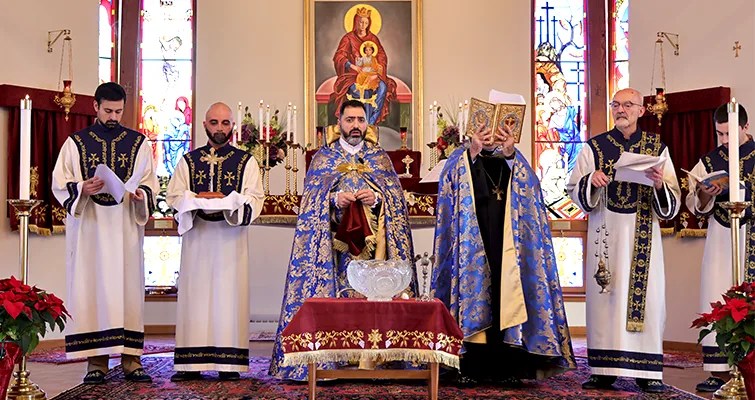
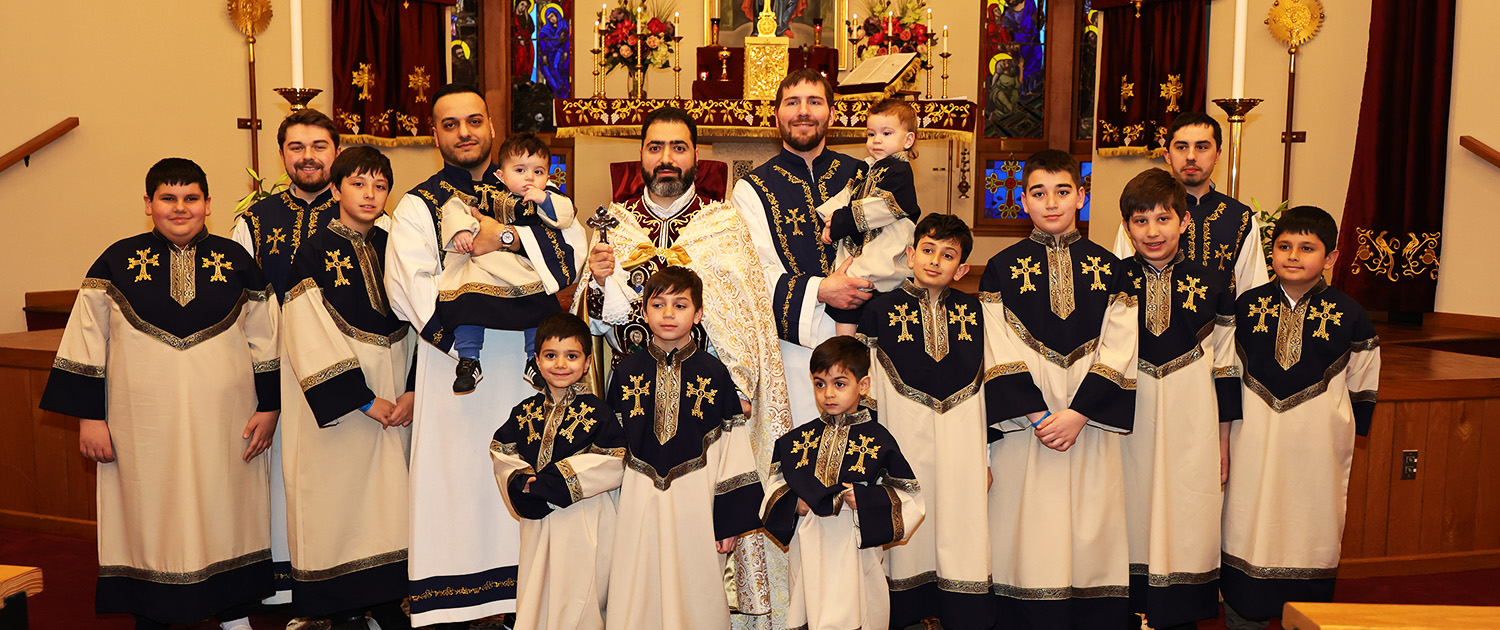
On Sunday, November 9, 2025, Bishop Mesrop Parsamyan, Primate of the Eastern Diocese, visited Milwaukee to celebrate the 83rd anniversary of St. John the Baptist Armenian Orthodox Church. During the Divine Liturgy (Badarak), Bishop Mesrop—assisted by Rev. Fr. Guregh Hambardzumyan, pastor; Fr. Nareg, former pastor; and Deacon Sarkis Ginosyan, a seminarian from St. Nersess Seminary—ordained Arek Kashian, Michael Kashian, and David Luhrssen to the diaconate, and conferred the rank of t’bir (Acolyte) upon Eric Kashian—a milestone in the parish’s ongoing efforts to prepare and strengthen its future leaders.

In his sermon, Bishop Mesrop reflected on the vital importance of community, contrasting the biblical model of shared faith and the common good with the self-focused, often unfulfilling “spirituality” of contemporary society. He drew an analogy to the redwood trees of California, noting that these towering giants have endured for centuries not because they stand alone, but because their roots are deeply intertwined, supporting and sustaining one another. Similarly, he emphasized, the Church thrives when its members are united in faith, love, and service.

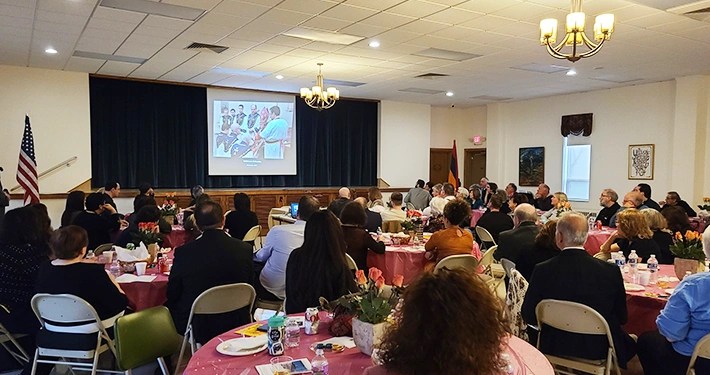
The celebration continued in the church’s Cultural Hall, beautifully redesigned for the occasion by Sandy and Jim Densmore. The program began with the singing of “Mer Hairenik,” the Armenian national anthem, and “God Bless America,” followed by the Primate’s invocation. Parish Council Chairman Lyle Dadian emceed a program featuring a rich array of presentations and performances. Highlights included a slide show (featuring photos by Don Rask) capturing memorable moments from the parish’s past five years, a video presentation of St. John and Milwaukee that premiered at the 2025 Diocesan Assembly, and a spirited performance by the Hamazkayin Sardarabad Dance Ensemble of Chicago.

The newly ordained deacon David Luhrssen offered a heartfelt toast during the anniversary luncheon, wishing the St. John community continued success for many years to come. When asked what first brought him to the parish and what inspired him to remain active—serving at the altar, on the parish council, as a parish delegate, and in many other leadership roles—he shared his story with the nearly 150 guests attending the program.

He recalled that it was after the 1988 earthquake in Armenia that he first attended a service at St. John—just two years after the consecration of the new sanctuary in 1986. Having never been to an Armenian church before, he was deeply moved by the service led by Father Tateos Abdalian, with Father Nareg (then a deacon) and the late Deacon Samuel Avakian serving at the altar, accompanied by a full and beautiful choir and an accomplished organist, Jan Avakian Kopatich. Most importantly, he emphasized that it was the genuine warmth, welcome, and friendship of the St. John community that inspired him to return, get involved, and ultimately become an integral part of the parish family.

This year’s Diane Blinka Service Award for devoted service to the St. John community was presented to Gail Gabrelian and Deann Kokott. The late Diane Blinka exemplified true selflessness, devotion, commitment, and many years of dedicated service to the parish. The day’s most joyful surprise came with the reading of an encyclical from His Holiness Karekin II, Catholicos of All Armenians, awarding the St. Nersess the Graceful Medal to Nancy and Dr. Gary Seabrook in recognition of their outstanding devotion and faithful service to the Church.

St. John’s parish priest, Rev. Fr. Guregh Hambardzumyan, likened the parish to the “good heart” of Milwaukee’s Armenian community—kept beating and strong through the dedication and contributions of all its members. Bishop Mesrop also shared reflections from his childhood in Soviet Armenia, recalling his first encounter with the Badarak at the historic Khor Virap Monastery at age 13. “The beauty caught my spirit,” he said. “Understanding the theology came later. The beauty is what stayed with me.” He honored the parish’s founders—survivors of the Armenian Genocide—who established St. John as a new home for their legacy in the New World. Looking ahead, Bishop Mesrop expressed his anticipation of returning when the parish hosts the Diocesan Assembly in May 2026.

Many honored guests attended the anniversary, including Oscar Tatosian, Honorary Consul of the Republic of Armenia, as well as the former pastor and other Armenian clergmen. The program concluded with the audience joining in the singing of the “Der Getso,” led by Fr. Nareg and accompanied on the piano throughout the Liturgy and program by Jan, followed by the Primate’s benediction.

The 83rd anniversary of St. John the Baptist Armenian Orthodox Church was not only a celebration of its rich history and enduring faith, but also a testament to the vibrant, close-knit community that has sustained it through generations. With a renewed commitment to service, fellowship, and Armenian heritage, the parish looks forward to many more years of spiritual growth, shared joy, and continued contributions to the life of Milwaukee’s Armenian community.

Read Full Post »
St. John Armenian Church of Milwaukee to Host 2026 Armenian Church Diocesan Assembly

St. John the Baptist Armenian Church of Milwaukee is honored to announce that it will serve as the host parish for the 2026 Diocesan Assembly of the Eastern Diocese of the Armenian Church of America. The Assembly will bring together clergy, delegates, and lay leaders from Armenian parishes across the Eastern United States for several days of worship, governance, and fellowship.

The 2026 Diocesan Assembly will take place in Spring 2026, with dates, program details, and registration information to be made available in December 2025.

“We are deeply honored to welcome our brothers and sisters in Christ to Milwaukee,” said Fr. Guregh, pastor of St. John Armenian Church. “This is an opportunity for our parish and the greater Wisconsin Armenian community to serve the wider Diocese and reflect the spirit of unity that defines our Church.”

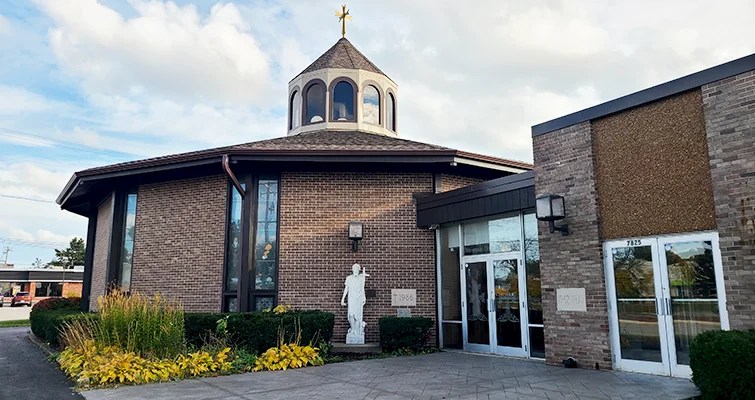
St. John the Baptist Armenian Church, located in Greenfield, Wisconsin, is one of the most active Armenian parishes in the Midwest. Founded in 1940, it has long served as a spiritual, cultural, and community hub for Armenian-Americans in the region.

The Diocesan Assembly is the annual representative gathering of the Eastern Diocese, responsible for discussing and determining matters of church life, finances, mission work, and long-term planning. Delegates include clergy and elected lay leaders from each parish across the Diocese.

The 2026 Assembly will include liturgical services, formal sessions, ministry presentations, and opportunities for fellowship among parish representatives and guests.

For more information, please visit www.stjohnarmenianchurch.org or contact the parish office at (414) 282-1670.

Read Full Post »

By David Luhrssen

“It’s good to be back home,” said Rev. Fr. Tateos Abdalian, the celebrant and guest speaker for the 82nd anniversary celebration at St. John the Baptist Armenian Church, Greenfield. The November 10 event was a special occasion for Der Tateos and Milwaukee’s Armenian community. St. John was his first parish, the beginning of four decades of service in the Eastern Diocese. His years in Milwaukee were also a turning point for St. John, with Der Tateos taking the lead role in building the sanctuary that continues to be central to Armenian spiritual life in Milwaukee.

Der Tateos’ sermon was a reminder to parishioners who knew him in the ‘80s of his penetrating intelligence grounded in faith. He spoke of the power of silence, referencing the Book of Ecclesiastes 3:7, as a way to hear the voice of God in a world of noise and distraction. It’s a voice, he said, that we can hear “only if we learn to be quiet.” He encouraged the congregation to “Arrive early, before Liturgy, or stay afterward, sit quietly in the sanctuary, away from all noises and distractions, and hear God’s voice speak to you”.

After Badarak, a requiem service was conducted for all of St. John’s deceased priests, the godfathers of the parish and everyone instrumental in building the sanctuary in the ‘80s.

Parish Council Chairman Lyle Dadian was master of ceremonies in the program that followed. Among the highlights was a slide show assembled by Don and Donny Rask from photo albums that provided a visual tour of St. John’s 82 years. The presentation began with black and white photos from St. John’s original home in West Allis and moved swiftly to Greenfield in 1970. Photos from the ‘70s and ‘80s were a reminder that the Badarak was celebrated in those years on the stage of the Culture Hall. There was no church building until the ‘80s when Der Tateos pushed for its construction.

The slide show included many pictures of breaking ground, construction and the consecration by Archbishop Torkom Manoogian in 1986. Photos from the decades since display the continued activity in the church and the hall, including weddings, the annual Armenian Fest and the 2021 ordination of St. John’s current parish priest, Rev. Fr. Guregh Hambardzumyan.

Representing women of the community, Ramelann Kalagian presented Diane Blinka Award to Mary Rask and Dr. Sue Oneson for their many years of devoted service. Both women served in Sunday School as teachers, volunteers at Milwaukee Armenian Fest, choir members and as Parish Council members.

In his inspiring remarks, referring to the church, Fr. Guregh pointed out “Though this structure may appear to be a collection of bricks and stone, within its walls we encounter the living God, who nourishes us with His grace and invites us into deeper communion with Him.” And addressing Fr. Tateos, he said, “Der Hayr, it is through your steadfast leadership, and unwavering commitment of our beloved community that this Church has come to life—a place where we are continually drawn closer to the Source of all Good Things—our Creator and Sustainer.”

Also included in the program a rousing toast by Russell Kashian and a moving performance of Der Getso by Rev. Fr. Nareg Keutelian, St. John’s previous priest, accompanied on the piano by Jan Avakian Kopatich.

The weekend festivities concluded with assurances by Fr. Tateos returning to Milwaukee for the 2026 Diocesan Assembly (April 30- May 2, 2026) and celebrating the 40th anniversary of the construction and consecration of St. John’s current sanctuary on Sunday, May 3, 2026.

Read Full Post »

By David Luhrssen

Several visitors to this year’s Milwaukee Armenian Fest commented on how professionally organized it was. From parking cars to ordering food, the event benefitted from many years of experience in handling an audience that has only grown in number. Most importantly, Armenian Fest gave returning visitors and first-time guests the same essentials that the festival has offered over the years—good food and hospitality.

Milwaukee Armenian Fest drew more than 1,000 visitors to the grounds and culture hall of St. John the Baptist Armenian Church in suburban Greenfield on Sunday, July 21. It was a joyful get-together for Armenian families from southeast Wisconsin. However, many visitors had never been to Armenian Fest and had no knowledge of Armenia. They were drawn to the event by social and other media publicity as well as prominent signage in front of the church.

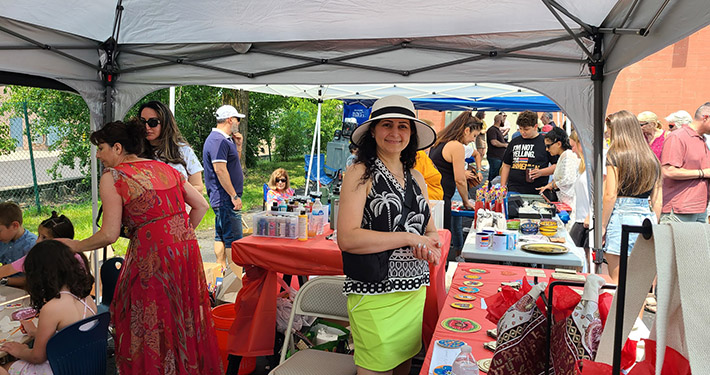
The main attraction of Milwaukee Armenian Fest has always been the food, including familiar Armenian dishes such as beef and chicken shish-kabob, pilaf, sarma, paklava and more. But this year, more than in the past, an array of activities kept attendees entertained and informed. Contemporary and traditional music were provided outdoors by Racine, Wisconsin musicians Stepan and Mid-East Beat as well as performances by Chicago’s Siragan Dance Company. There were local Armenian vendors, children’s games and artmaking, an antiquities booth, church tours explaining the history and beliefs of the Armenian Church and a flourishing business in Armenian wine, preserves, T-shirts and jewelry at the culture booth.

A journalist from VOA (Voice of America) was on hand, interviewing members of St. John about the festival’s growth and about Milwaukee, where the 2026 Assembly of the Eastern Diocese of the Armenian Church will be held.

Read Full Post »

Easter Sunday, March 31, 2024

By David Luhrssen

(Milwaukee, WI) The Milwaukee Armenian community began its celebration of Holy Week on Sunday, March 24, 2024, with the Opening of the Doors (Turun-Patsek), marking the end of the Lenten closed curtain season in the church sanctuary. Following the Palm Sunday liturgy, parishioners gathered in the church hall for St. John’s annual Palm Sunday brunch, a fundraiser prepared by Sunday School teachers and parents.

For the first time in memory, St. John observed the full Holy Week schedule, including the Commemoration of the Ten Maidens on Tuesday, March 26. Ten young girls from the community took part in the evening service. As Rev. Fr. Guregh Hambardzumyan explained in his short homily, the ancient rite is a unique treasure of the Armenian Church commemorating Jesus’ parable of the five wise and the five foolish bridesmaids; the wise women came with oil in their lamps, the oil symbolizing the Holy Spirit and the love and mercy enacted in their lives that prepared them to enter the Kingdom of Heaven. The Commemoration of the Ten Maidens occurs during Holy Week to remind the faithful that only the bridesmaids who showed love and mercy were ready to meet the parable’s bridegroom, meaning Jesus.

On Thursday, March 28, as in previous years, Der Guregh conducted the Washing of the Feet. Twelve boys came forward to the altar to have their feet washed in a rite, observed by Orthodox and Roman Catholic churches, that reenacts an event from the first Holy Week when Jesus, the Son of God, went to his knees and washed the feet of his disciples. As Der Guregh said in remarks afterward, it was not only a gesture of humility from God Himself, but a reminder that an essential aspect of Christianity is service—to God and each other. Following the Washing of the Feet, the Vigil (Khavaroom), commemorating Jesus’s betrayal in the Garden of Gethsemane, was conducted with Rev. Fr. Sahag Kashian assisting.

The Rite of Burial (Gark Taghman) was performed on Holy Friday, March 29, with the Tomb of Christ (Kerezman) covered in flowers, representing life. On the evening of Saturday, March 30, the Prophesies were read, followed by Badarak.

The ceremonies of Holy Week are meant to remind the faithful of the final days of Jesus and His death on the Cross before his Resurrection on the first Easter Sunday. The Resurrection was commemorated with Easter Badarak performed by Der Guregh on Sunday, March 31, with St. John’s former pastor, Rev. Fr. Nareg Keutelian, conducting the choir.

In his sermon, Der Guregh quoted from an article on the restoration of St. Patrick’s Cathedral in New York, a project that involved repairing the building’s cracked facade and also entirely updating the hidden systems heating and cooling the structure. Dirty stained-glass windows through which sunlight struggled to penetrate were cleaned, allowing light to fill the church once again. Der Guregh compared the work of Jesus in the lives of believers to that renovation. Through the example of his life and sacrifice, humans can be restored to our original likeness with God and are given the possibility of partaking in a New Creation.

Afterward, the St. John community gathered in the culture hall for an Easter lunch prepared by members of the congregation.

Read Full Post »

MILWAUKEE ARMENIAN FEST 2023

Milwaukee Armenian Fest is hosted by St. John the Baptist Armenian Orthodox Church of Metro Milwaukee, on Sunday, July 16, 2023. The Fest celebrates the Armenian Culture in the Greater Milwaukee Area, through traditional authentic Armenian Food, Music, Dance, Church tour and products sold through the Armenian cultural booth. Join us with your family and friends for a day of great food, live music and dancing for the entire family.

www.armenianfest.com

Read Full Post »

To celebrate Armenian Cultural Month, St. John Armenian Church of Milwaukee, WI, will host An Evening of Classical Opera and Armenian Folk Songs, featuring Yeghishe Manucharyan (Tenor, Metropolitan Opera) and Victoria Avetisyan (Mezzo – Soprano, Boston Opera)

Repertoire Includes

Verdi
Mozart
Puccini

Komitas
Yegmalian
Ganatchian

Metropolitan Opera tenor Yeghishe Manucharyan and Boston Opera mezzo-soprano Victoria Avetisyan will sing together for the first time in Milwaukee. The married couple will perform words and melodies familiar to opera lovers, including work by Verdi, Mozart and Puccini. But they will also take their Milwaukee audience to a less familiar place by singing folk songs from their native Armenia.

The young performers have already made an impression in the U.S. with concerts at the Kennedy Center, the San Diego Opera and Carnegie Hall, among many other venues adding South Milwaukee Performing Arts Center to their resumes with this performance.

Tickets: general admission $25.

For reservations click here

For Address & Directions click here

Read Full Post »

Milwaukee Armenian Fest 2022

A scene from Armenian Dance Company of Chicago’s performance at Taste of Armenia in Evanston, IL

The celebration has been a Milwaukee tradition since the 1930s. Each summer Milwaukee Armenian Fest brings its heritage and its fun to those who want to learn about the culture and food of the Armenian Community.

Armenian Fest returns on Sunday, July 17, 2022, from 11 a.m. to 5 p.m. on the grounds of St. John the Baptist Armenian Orthodox church, 7825 W. Layton Ave, Greenfield, WI.

Our community invites you to sample the food and music and leave with part of Armenia in your heart.


Read Full Post »

MILWAUKEE’S ST. JOHN ARMENIAN CHURCH CELEBRATES ANNIVERSARY

By David Luhrssen

(Milwaukee, Wis.) On Sunday, November 7, St. John the Baptist Armenian Church celebrated its 79th anniversary with Divine Liturgy followed by a banquet and program. The Diocesan Vicar of the Eastern Diocese, Very Rev. Fr. Simeon Odabashian, was the guest celebrant. Assisting in the services was the parish’s current pastor, Rev. Fr. Guregh Hambardzumyan and his predecessor, Rev. Fr. Nareg Keutelian.

St. John was founded in 1942 in nearby West Allis, Wis., one of several industrial cities in the Midwest where Armenians found work and new lives after the massacres of the 1890s and the Armenian Genocide that followed. In 1970 the parish moved to the Milwaukee suburb of Greenfield and conducted worship and other activities in a newly constructed cultural hall. In 1986 St. John’s sanctuary, designed by architect Harold Baylerian according to Armenian tradition, was consecrated by Archbishop Torkom Manoogian, assisted by the parish’s pastor, Rev. Fr. Tateos Abdalian.

At the November 7 program, Fr. Simeon recalled his long association with St. John, which began with a visit as a teenager in the 1970s. At that time, liturgy was conducted on the stage in the cultural hall by the late Very Rev. Fr. Shnork Kasparian. Fr. Simeon was present at the 1986 consecration and as a seminarian, assisted Fr. Tateos with Holy Week services.

The program’s keynote address by Fr. Guregh stressed the challenges that the founders of St. John had to overcome in “a place that bore no relation or resemblance to the land they came from.” The Armenian immigrants found work for themselves and bright prospects for their children but felt a void “that could only be filled by the construction of a new church.” In the decades since the parish was established, St. John has been “a safe haven and a gathering place” for Armenians, a place for spiritual and emotional regeneration, an extension of the Motherland, “a living breathing structure” where people worshiped, mourned, rejoiced and remembered who they were and from where they came, Fr. Guregh said.

In appreciation for his years of service at St. John as a deacon and later a priest, Fr. Nareg was presented with a clay khatchkar from Armenia. He recalled a conversation at the 1986 consecration with a skeptic who said in 25 years, there would be no Armenian community in the Milwaukee area. Thirty-five years later, St. John’s culture hall was crowded for the anniversary celebration and included many participants who weren’t born when the church was consecrated.

Read Full Post »

By David Luhrssen

(Milwaukee, Wis.) The physicians gave photographer Hrair Hawk Khatcherian only 10 days to live. As Khatcherian told the audience at his Oct. 24 slide show and talk at St. John the Baptist Armenian Church, he made a vow: if he survived lung cancer, he would travel to every country in the world with at least one Armenian church and take pictures. “I wish I had just offered madagh,” he joked. Although keeping his promise proved to be a larger than anticipated investment in time and money, the Canadian Armenian traveled to 48 nations for the photos he chose to include in his 2013 book, One Church, One Nation.

Genocide Memorial Courtyard at St. John Armenian Church of Milwaukee

Khatcherian devoted most of his presentation as part of Armenian Cultural Month observance at St. John in Milwaukee, to his latest book, Khatchkar. Beautifully produced and photographed, the 500-page coffee table book an impressive document of Armenian religious stone carvings. Included are not only the khachkars that dot the Armenian countryside but bas-reliefs in churches and monasteries displaying events from the life of Christ and iconic images of Jesus and Mary the Mother of God.

With many visual juxtapositions, Khatchkar is designed to reveal common themes across different media by contrasting images of stone carvings with illuminated manuscripts, metalwork and fabric. Many of the khachkars he photographed were difficult to access. He clambered along slippery cliffs, stepped carefully through a Soviet-era minefield, braved the threat of Azeri snipers and ventured into the vicinity of Mount Ararat without alerting soldiers at a nearby Turkish army base. Several khachkars he photographed rise to 16 feet in height. Another difficulty involved photographing khachkars with natural light sufficient to reveal their detailed carvings. Because they face east, the best time of day for capturing the standing stones is between noon and 2 p.m.

Khatcherian photographed khachkars in Armenia, Artsakh, the Crimea, Iran, Lebanon, Georgia, Turkey and the Holy Land. “It took 26 years and 100 trips to Armenia and Artsakh,” he said, describing a search that revealed khachkars in their diversity was well as commonality and their fate. They remain objects of reverence in Armenia. However, in Kurdish regions khachkars were used as building materials, many have been deliberately defaced in Turkey and others were bulldozed by the Azeris. Several khachkars photographed by Khatcherian were evacuated from Artsakh to Etchmiadzin at the close of the 2020 war.

Read Full Post »

Older Posts »