Archive for the ‘History’ Category

THIS WEEK IN ARMENIAN HISTORY

 Prepared by the Armenian National Education Committee
(ANEC)

 Birth of Kourken Mahari

 (August 1, 1903)

 Modern Armenian literature had three major enemies: tuberculosis, Turkish genocide, and Stalinist repression. The so-called “second April 24” harvested the lives of many remarkable Armenian intellectuals and public figures between 1936 and 1938, who were shot, died in prison, or in exile. Many others suffered short or long years in prison, labor camps, internal exile, and were fortunate enough to survive until the death of the Soviet dictator Joseph Stalin when they returned.

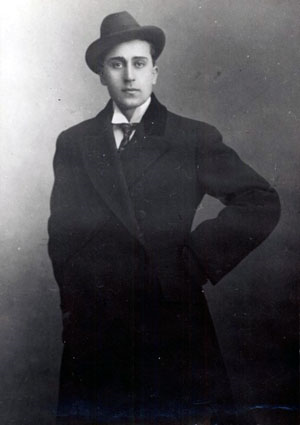
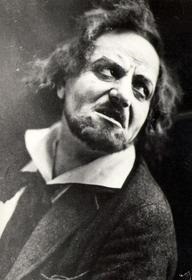
 Poet and novelist Kourken Mahari (Ajemian) was born in Van. His father, Krikor Ajemian, was an important member of the Armenagan Party (the first Armenian political party, founded in Van in 1885). Mahari became an orphan in 1907, when his father was shot by his brother-in-law, an A.R.F. member, in a confusing incident. In 1915, after the heroic self-defense of Van during the genocide, the future writer migrated to Eastern Armenia with his family. They lost each other on the road of exile, and Mahari lived in orphanages in Dilijan and Yerevan until he found his family again.

 He published his first poems in the press during the first republic, and later, in the Soviet period, he studied at Yerevan State University. He published five collections of poetry and short stories between 1924 and 1931, but his fame in the 1930s was cemented by the first two books of his biographical trilogy, “Childhood” and “Adolescence” (1930). Meanwhile, he had married and had a son. He became a member of the Writers Union of Armenia in 1934.

 The wave of repression unleashed in Armenia after the assassination of Aghasi Khanjian in 1936 reached Mahari too. Trumped-up charges were brought against him and he was condemned to a ten-year exile from 1936-1946 in Siberia. After returning to Yerevan, in 1948 he was condemned, through new trumped-up charges, to life exile. In Siberia, he met Lithuanian student Antonina Povilaitite, who had also been condemned to life exile. They married and lived with the hope of change. Stalin died in 1953, and Mahari and his wife, together with their newly-born daughter, managed to return to Yerevan in 1954. Their daughter would die shortly thereafter, and they would later have a son.

 After seventeen years of exile, the writer returned to his homeland in bad health, but with the inner strength to continue his writing. He became one of the leading voices in the literary life of Armenia during the 1950s and 1960s. He published the third part of his trilogy, “On the Eve of Youth” (1956), a volume of poetry in 1959 and a collection of short stories, “The Voice of Silence” (1962), where he reflected the Siberian years.  Another Siberian memoir, “Barbed Wire in Flower,” was first published posthumously in the weekly “Nayiri” of Beirut (1971); it was published in Yerevan only in 1988. He received the title of Emeritus Cultural Activist of Armenia in 1965.

 Mahari published his most important book, the novel “Burning Orchards,” in 1966 (there is a translation in English), an account of Armenian life in Van before World War I, during the self-defense of the city, and afterwards. It created a lively controversy because of some of his views, and he was forced to rewrite it; the second version was published in 1979 in a curtailed form. The final edition was only published in 2004, edited by Grigor Achemyan, Mahari’s eldest son, who has published several unpublished volumes and has prepared an edition of unpublished works in thirteen volumes.

 Kourken Mahari passed away in Palanga (Lithuania), on June 17, 1969, and was buried in Yerevan. He concluded one of his autobiographical works with a characteristic paragraph: “[If] the terrible and omnipotent Jehovah entered this moment, sat in front of me, lit a cigarette and said: ‘I’m giving you a second life; trace the path of your second life from cradle to tomb, as you wish, and your wish will be accomplished . . . How would you like to live?,’ I would answer him, without hesitation: ‘Exactly as I lived it.’


Read Full Post »

THIS WEEK IN ARMENIAN HISTORY

Prepared by the Armenian National Education Committee
(ANEC)

July 24, 1923: Signature of the Treaty of Lausanne


It has been frequently said that the Treaty of Lausanne marked the burial of the Armenian Cause, even though neither Armenia nor Armenians were mentioned there.

This peace treaty signed in the Swiss city officially ended the state of war that had existed between Turkey and Great Britain, France, Italy, Japan, Greece, Romania, and Serbia (which had become the Kingdom of Yugoslavia after 1918) since the onset of World War I. It replaced the Treaty of Sèvres (August 10, 1920), which had been signed between all those parties and the Ottoman Empire but had been rejected by the Turkish national movement led by Mustafa Kemal (Atatürk), as a reaction to the defeat of Turkey and the significant loss of territories. After defeating the Republic of Armenia in the September-November 1920 war and provoking the loss of its independence under a Soviet regime, crushing Greece in the so-called “war of independence,” achieving the ethnic cleansing of Greeks and Armenians from Asia Minor and Cilicia, and abolishing the sultanate in November 1922, the forthcoming Republic of Turkey—proclaimed in October 1923—was able to dictate favorable terms to the Allies.

The Treaty of Lausanne was signed as an outcome to the Conference of Lausanne (November 1922-February 1923, April-July 1923). It ended the conflict and defined the borders of the modern Turkish state except for its border with Iraq. Turkey gave up all claims to the remainder of the Ottoman Empire and in return the Allies recognized Turkish sovereignty within its new borders. The treaty came into force in August 1924. Interestingly, the U.S. Senate refused to ratify it in 1927.

The treaty, composed of 143 articles, led to the international recognition of the sovereignty of the new Republic of Turkey as the successor state of the defunct Ottoman Empire. From a legal standpoint, it only partially replaced the Treaty of Sevres with new clauses regarding Eastern Tracia (the area of European Turkey) and the Greek-Turkish frontiers. The lobby of both the Delegation of the Republic of Armenia, chaired by Avetis Aharonian, and the Armenian National Delegation, presided by Boghos Nubar pasha, was unable to maintain the clauses of the Treaty of Sevres relative to Armenia. However, the Treaty of Lausanne stayed silent about the section on Armenia of the Treaty of Sèvres, which was regulated by the arbitral award of U.S. President Woodrow Wilson in November 1920. Article 16 of the Treaty of Lausanne established:

“Turkey hereby renounces all rights and title whatsoever over or respecting the territories situated outside the frontiers laid down in the present Treaty and the islands other than those over which her sovereignty is recognised by the said Treaty, the future of these territories and islands being settled or to be settled by the parties concerned.

“The provisions of the present Article do not prejudice any special arrangements arising from neighbourly relations which have been or may be concluded between Turkey and any limitrophe countries.”

The Treaty of Lausanne also contained a section (articles 37 to 45) about the protection of the rights of minorities (Moslem and non-Moslem) in the Republic of Turkey. Their continuous and documented violation over the decades became a highlight of modern Turkey and led to the migration of most remaining members of those minorities, particularly Greeks and Armenians among others.

Read Full Post »

THIS WEEK IN ARMENIAN HISTORY

Prepared by the Armenian National Education Committee (ANEC)


Death of Hovhannes Abelian (July 1, 1936)

The three Abelian brothers, originally from Shamakha (current Azerbaijan), became noteworthy personalities in different aspects of Armenian culture and history in the nineteenth and twentieth centuries. The elder brother, Nerses (1855-1933), an engineer by trade, was among the students who founded the Union of Patriots (1882) in Moscow, one of the first Armenian political groups in the Russian Empire. The middle brother, Alexander (1858-1940), was a prolific playwright, and the younger one, Hovhannes, turned to be one of the stars of Armenian theater for more than fifty years.

Hovhannes Abelian was born in 1865 in Shamakha. After the violent earthquake of 1872, most of the Armenian population of the city started to move to Baku, which was coincidental to the development of this city as a world-known oil center.  The young Hovhannes gave his first steps on the stage in 1882, in a Russian group. He moved to Tiflis (Tbilisi), the main Armenian cultural center of the Caucasus, in 1886 and entered the playgroup of the Armenian DramaHovhannes Abeliantic Club. He lived and played between Tiflis and Baku for the next two decades, and became an unsurpassed interpreter of the works of famous playwright Shirvazante (Alexander Movsisian, 1858-1935), who incidentally was his cousin. He played some 300 roles in his long career, including plays by Gabriel Sundukian, Levon Shant, and Hagop Baronian, but also works by Russian and European playwrights, from Nikolai Gogol to William Shakespeare.

In 1908 Abelian joined forces with another famous Armenian actor, Armen Armenian (1871-1965), brother of theater director and playwright Kaspar Ipekian (the founder of the Hamazkayin theater group in Lebanon, 1883-1952). The Abelian-Armenian Theater Group, with several very important names in the cast, started a three-year long tour of Armenian cities and communities in Eastern Armenia, the Caucasus, Western Armenia, Iran, and Turkey. In 1909 it went to Constantinople and another famous actor, Hovhannes Zarifian (1879-1936), joined them.  After several performances in the Ottoman capital, following the cultural revival brought by the restoration of the Ottoman Constitution in 1908, the Abelian-Armenian-Zarifian Theater Group divided into three branches, which performed in Smyrna (Izmir), Anatolia, and the third one, led by Abelian and Zarifian, in Izmit, Bardizag, Adapazar, Eskishehir, and Rodosto (Tekirdag). They ended their run in 1911, with performances in Baku, Nor Nakhichevan, and Moscow.

During the 1910s, Abelian—who was equally qualified to play in Armenian and Russian productions—continued his professional activities and performed in the Caucasus, but also in Moscow and Petersburg, as well as Iran and Central Asia. He left the Caucasus in September 1920 and moved abroad with his family. For the next three years, he performed in Constantinople, Smyrna, Cairo, Alexandria, Berlin, (where he played “Othello” with a German group, performing his signature role of Othello in Armenian), Paris, Brussels, and London. He arrived in the United States in 1923 and performed in many communities on the East Coast and the Midwest (New York, Boston, Philadelphia, Detroit, and Chicago) for the next two years.

However, Abelian’s aim was not to stay abroad. In 1925 he accepted an invitation of the government of Soviet Armenia and settled in Yerevan. He was conferred with the title of Popular Artist of the Republic in 1925 and entered the First Theater (now the Sundukian Theater). He would continue to play with the same enthusiasm and talent of his younger years until his death on the stage, in Yerevan, at the age of 71. The dramatic theater of Vanadzor, the third city of Armenia, bears his name.


Read Full Post »

THIS WEEK IN ARMENIAN HISTORY

Prepared by the Armenian National Education Committee (ANEC)


BIRTH OF ARTEM ALIKHANIAN (June 24, 1908)

Artem (Russian Artyom) Alikhanian, regarded as the father of Armenian physics, was born in the historical Armenian city of Gandzak (Elizavetpol during the Russian Empire, and now Ganja, in Azerbaijan). He did not attend school regularly, but was mostly schooled at home. Later, he received an external degree from school Nr. 100 of Tiflis.

In 1930, before he graduated from Leningrad State University, he became a staff member at the Physico-Technical Institute of Leningrad (nowadays St. Petersburg), working together with his elder brother Abraham Alikhanov (Alikhanian, 1904-1970). The Alikhanian brothers, together with Piotr Kapitsa, Lev Landau, Igor Kurchatov, and others, have been credited with laying the foundations of nuclear physics in the Soviet Union.

During the siege of Leningrad by the German army in World War II, Artem Alikhanian and some of his colleagues were excused from full-time defense tasks in order to work on the design of a synchrocyclotron, the accelerator of particles eventually constructed in 1955. The Alikhanian brothers, who were not members of the Communist Party, received the USSR State Prize in 1943. They started a scientific mission on Mount Arakadz, the highest peak of the Republic of Armenia, and researched the third (proton) component of cosmic rays. They founded a cosmic ray station at an altitude of 3250 meters, and participated both in the foundation of the Armenian SSR Academy of Sciences (now National Academy of Sciences of the Republic of Armenia) and the Yerevan Physics Institute in 1943. Abraham Alikhanov—who founded the first nuclear reactor of the USSR in 1949—went on to found and direct the Institute for Theoretical and Experimental Physics in Moscow, which he headed until 1968.

The brothers’ findings deserved them the USSR State Prize for the second time in 1948 (Alikhanov would win it alone for the third time in 1953). They initiated the creation of the Yerevan Synchrotron in 1956, together with astrophysicist Victor Hampartsumian.

Artem Alikhanian promoted the training of young physicists and from 1961 to 1975 organized and directed the International Schools of High Energy Physics at Nor-Ampert. A staunch supporter of the international co-operation of scientists, his fidelity to science, his personality, and his great erudition captivated everyone. In 1965 he was invited by Harvard University to give the Loeb and Lee lectures in Physics, and he became the first Loeb professor of Harvard University from Europe. He founded the chair of Nuclear Physics in the Moscow Engineering Physics Institute and was a professor at Yerevan State University. He received the Lenin Prize in 1970, together with his colleagues, for the work on wide-gap track spark chambers.

In 1966, director Frunze Dovlatian filmed “Hello, It’s Me!” (Բարեւ, ես եմ, Parev, Yes Em), a drama based on the life of Alikhanian (the main character is a physicist called Artyom Manvelian who has founded a cosmology laboratory at Mount Arakads). The film was nominated to the Golden Palm of the Cannes Film Festival of 1966 and awarded the State Prize of Armenia in 1967, the same year when Alikhanian obtained the title of Honored Scientist of the Armenian SSR in recognition of his scientific achievements and contributions.

Alikhanian resigned from his position at Yerevan Physics Institute in 1973 and left Yerevan, after conflicts with very high level Soviet statesmen. He passed away in Moscow on February 25, 1978. The Physics Institute was named after him, and a street in Yerevan has been named after the Alikhanian brothers. In 2010 the government of Armenia decided to rename the Institute as Artem Alikhanian National Scientific Laboratory.

Read Full Post »

THIS WEEK IN ARMENIAN HISTORY

Prepared by the Armenian National Education Committee (ANEC)


Birth of Yervant Kochar (June 15, 1899)

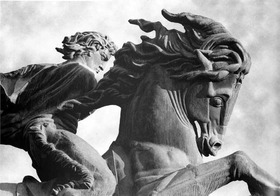
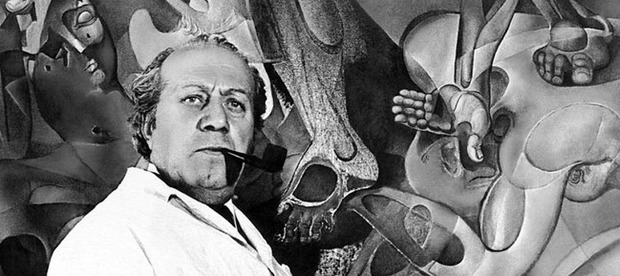
          Either in photographs or personally, every Armenian has seen at least once the statues of David of Sassoun and Vartan Mamigonian in Yerevan. These are among the most recognizable symbols of the city—the David of Sassoun statue has transcended to become a national symbol—and are the work of one of the most remarkable Armenian artists of the twentieth century: Yervant Kochar. Kochar

Yervant Kochar (Kocharian) was born in Tiflis (Tbilisi, Georgia) in 1899. He graduated from the Nersisian Lyceum in 1918 and in the meantime (1915-1918) studied in the O. Schmerling School (Art School of the Caucasus Association for the Promotion of Fine Arts).  After a year at the State Free Art Studio of Moscow, he returned to Tiflis in 1919 and participated in his first exhibition, the second fall show of Georgian painters in the same year. He received a diploma of professor of fine arts and technical studies from the Soviet Georgian government in 1921, and in 1922 he left to study abroad. He first sojourned in Constantinople and then in Venice; he had exhibitions in both cities. He settled in Paris by 1923, where his art enjoyed a good reception. His participation in the Salon of the Independents in 1928 was accompanied with scandal: two of his works were vandalized, and the press printed sympathetic echoes. Those works were the first examples of his new direction, “Painting in Space,” also called tri-dimensional painting. He gave his first solo exhibition in the same year. In an international exhibition, “Panorama of Contemporary Art,” also held in Paris (1929), Kochar presented his works, along with avant-garde artists such as Pablo Picasso, Marc Chagall, Robert Delaunay, Georges Braque, Joan Miró, and others. He participated in exhibitions of French painters in Prague, Brno, Bratislava, New York, and Brussels (1935), and London (1936). Polish-French art critic Waldemar-George (1893-1970) defined his painting in the following terms: “The dimensional painting of Kochar is one of the conquests of modern art, as significant as the pure forms of Brâncuşi and the structures of Picasso and Braque . . . The dimensional painting has crushed the boundaries of sculpture and one-dimensional painting. It has reformed the visual laws, opening a third way before painters and sculptors. It is about time to tribute honors to Kochar the creator, which he truly deserves.”SasountsiTavit

Kochar was a well-known artist in French circles in 1936 when he decided, surprisingly, to repatriate to Soviet Armenia for good. However, his innovative art was not well-received by the regime, particularly in Stalinist times. He was charged with formalism, which was something tantamount to “enemy of the people,” the standard accusation that cost prison and exile to Siberia for many. He even was imprisoned on politically motivated charges between 1941 and 1943, but was eventually freed thanks to the intervention of two of his school friends, Anastas Migoyan and architect Garo Halabian. He married scholar Manig Mkrtchyan (1913-1984) and had two sons. Over the years, Kochar created graphic works, plaster busts, statues, and designs for theatrical plays. The political “thaw” after the denunciation of Stalin’s crimes in 1956 by Soviet strongman Nikita Khruschev helped him to achieve actual recognition. He created the statue of David of Sassoun in 1959, which was placed at the square of the Yerevan railway station, and won the State Prize of Armenia in 1967. He said: “Whatever you have seen at the studio, I do it myself. And this [the statue of David of Sassoun] is for Caesar. However, I pay Caesar with pure gold.”
VArtanMamigonian

            His first solo exhibition in Yerevan, after thirty years, was held in 1965; other solo exhibitions followed in 1971 and 1978. His works were also exhibited in Moscow (1973) and Baku and Tbilisi (1974). He never traveled outside the Soviet Union, but his collected works were exhibited in Paris (1945 and 1966). He earned recognitions such as Emeritus Artist of Armenia (1956), People’s Artist of Armenia (1965), Soviet Order of Red Banner (1971), and People’s Artist of the Soviet Union in 1976. He created “The Eagle of Zvartnotz” (1955), the obelisk-type monument set at the entrance of the ruins of the church of Zvartnotz, near Holy Etchmiadzin. Some of his most important paintings of his last years were “Extasis” (1960), “The Disaster of War” (1962), and “The Muse of Cybernetics” (1972). His major last work, the statue of Vartan Mamigonian, was inaugurated in 1975 on Khanjian Street, near the actual location of the open-market Vernissage.

Yervant Kochar passed away in Yerevan on January 22, 1979. Five years later, a museum dedicated to his art opened near Yerevan’s Cascade. A street in the city bears his name, as well as the art school of the city of Hraztan.

Read Full Post »

THIS WEEK IN ARMENIAN HISTORY

Prepared by
the Armenian National Education Committee (ANEC)


Birth of Aram Khachaturian (June 6, 1903)

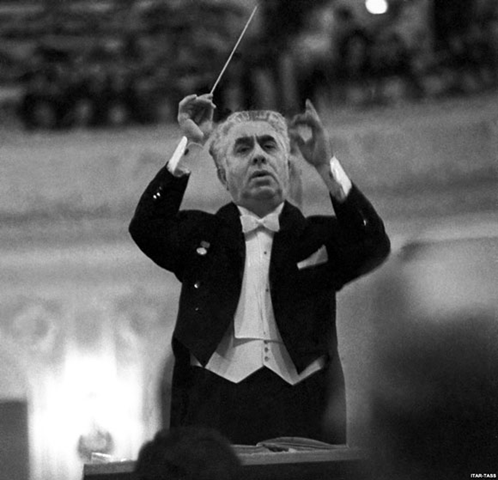
            Thirty-five years after his death, Aram Khachaturian remains the most widely known Armenian classical composer of all times. His “Sabre Dance,” the electrifying dance of the final act of the ballet “Gayane,” made him known on a popular level worldwide. A few years ago, the first notes of the “Sabre Dance” were even the score for an advertisement of hair shampoo in American TV, while some music of his other world-famous ballet, “Spartacus,” appeared most recently in the animated film “Ice Age: The Meltdown.” 

            Khachaturian was born in Kojori, near Tiflis (Georgia), on June 6, 1903, the youngest of five children. Young Aram was admitted to the Commerce School in Tiflis in 1913, but he preferred music. He learned to play woodwind instruments and became a member of a woodwind orchestra. 

            His elder brother, Suren, who was the stage director of the Second Moscow Art Theatre, took him to Moscow in 1921, where he entered the Gnessin Musical College. The future composer did not even know how to read music at the time. He quickly showed his talent for composition and in 1925 Mikhail Gnessin suggested he join his newly-opened composition class. Four years later, Khachaturian transferred to the Moscow Conservatory. He graduated with highest grades and composed his first big work, the First Symphony, in 1934, after marrying his classmate, composer Nina Makarova, the year before. In 1937 he became deputy chairman of the Moscow branch of the Composers’ Union, and then was appointed chairman of the Organizing Committee of Soviet Composers in 1939. The first ballet also came out that year. It was initially called “Happiness,” but Khachaturian later reworked it into the ballet “Gayane.”

AramKhatchadourian

            The years 1936-1947 were the most prolific in Khachaturian’s life. He wrote music for dramatic performances and movies, songs, and religious music, including the Concerto for Violin (1941), the Concerto for Cello (1943), the Second Symphony (1946), the Third Symphony (1946), and the Symphonic Poem, later entitled the Third Symphony (1947).

The composer joined the Communist Party of the Soviet Union in 1943. In 1944 he composed the music of the anthem of Soviet Armenia. However, he temporarily fell from official favor in 1948. The Symphonic Poem, ironically written as a tribute to communism, earned Khachaturian the wrath of the Party. Andrei Zhdanov, secretary of the party’s Central Committee, delivered the so-called Zhdanov decree in 1948. The decree condemned composers Dimitri Shostakovich, Sergei Prokofiev, Khachaturian, and others as "formalist" and "anti-popular." The three named composers had already become established as the so-called "titans" of Soviet music, enjoying worldwide reputation as some of the leading composers of the 20th century. Nonetheless, all three were forced to apologize publicly. 

            Despite this episode, Khachaturian returned to official favor. He received numerous state awards both before and after the decree: for example, four Stalin prizes (1941, 1943, 1946 and 1950), one Lenin prize (1959), a USSR State Prize (1971), and the title of Hero of Socialist Labor (1973). Khachaturian went on to serve again as Secretary of the Board of the Composers’ Union, starting in 1957 and was also a deputy in the fifth Supreme Soviet of the Soviet Union (1958–1962). In 1951 he became professor at the Gnessin State Musical and Pedagogical Institute (Moscow) and the Moscow Conservatory.

            Although Khachaturian lived outside Armenia, he has been an iconic figure for generations of Armenian composers, and many important names, such as Arno Babajanian, Alexander Harutiunian, Edgar Hovhannisian, and Tigran Mansurian, among others, were particularly influence by him. Most of his works are saturated with centuries-old motifs of Armenian culture. Khachaturian encouraged young composers to experiment with new sounds and find their own voices. His colorful orchestration technique is still noted for its freshness and vitality.

            Khachaturian’s ballet “Spartacus” premiered in December 1956, and its music was featured in various series and films in the West. His seventieth anniversary was officially celebrated in Moscow and Yerevan. He passed away in Moscow on May 1, 1978, and was buried in the “Gomidas” Pantheon in Yerevan, together with other great Armenian personalities. 

            The composer’s picture is featured on the 50 dram Armenian banknote, as well as in various Soviet, Armenian, and Russian stamps. Various streets in Armenia, Russia, Ukraine, and Kazakhstan are named after him. His house-museum was opened in Yerevan in 1982.


Read Full Post »

THIS WEEK IN ARMENIAN HISTORY

Prepared by
the Armenian National Education Committee (ANEC)

Tro (Trasdamad Ganayan) was a freedom fighter, a military leader of the first Republic of Armenia, and a political activist in the Diaspora.  He was born in the town of Igdir, in the province of Surmalu (Eastern ArmeniaTrasdamad, then part of the Russian Empire).

            His father sent him to the parish school, but the young Trasdamad did not show any interest in books. He would skip school and wander about near the military headquarters of Igdir; his interest in military art developed from these youthful wanderings. He did not do much better in high school in Yerevan. His enthusiasm for the feats of freedom fighters (fedayees) and his interest in the national ideas of the Armenian Revolutionary Federation (A.R.F.) prompted him to create a secret youth movement at school. He became a member of the A.R.F. at a very young age.

            The Russian government issued a decree on June 12, 1903, to confiscate the properties of the Armenian Church. This created a widespread feeling of ire among the Armenian of the Russian Empire. The A.R.F. created armed groups that acted as guardians of the church property and organized massive demonstrations. Tro Ganayan joined these groups. He later engaged in the clandestine transportation of weapons from Surmalu to Western Armenia.

            In 1905 he participated actively in the Armenian self-defense against the Tatar attacks in Baku and other cities of the Caucasus. Following the decision of the party, 21-year-old Tro killed Prince M. A. Nakashidze, governor of Baku, regarded as the main driving force behind the massacres of Armenians. Tro was also active in many battles in the regions of Nakhichevan and Zangezur, and distinguished himself with his talent as a military organizer and strategist.

            Tro moved to Tiflis during World War I and became commander of the second battalion of Armenian volunteers, which advanced in the direction of Igdir-Bayazet-Berkri-Van. He was gravely wounded in battle. After recovery in Tiflis, he returned to the command of his troops and entered Van.

Three years later, in March 1918, the Armenian National Council of Tiflis, the supreme authority of Caucasian Armenians, designated him military commissar of the Armenian army corpus. In this capacity, he led the Armenian army in the battle of Bash-Aparan from May 23-27, 1918, which became one of the decisive battles that achieved the independence of Armenia.

            In the years of the Republic, Tro was among the organizers of the Armenian army, and he also was charged with the maintenance of political stability in the country. He fought victoriously in the brief Armeno-Georgian war, and then in Zangezur and Karabagh against the Azerbaijani encroachment in late 1919 and early 1920. He became Minister of Defense in the short-lived cabinet of Simon Vratzian, who was prime minister between November 24 and December 2, 1920. The catastrophic situation of Armenia, defeated in the Armeno-Turkish war started in September, and on the verge of being overrun by the invading Turkish army, prompted Tro to adopt a pro-Russian position. He found that the only alternative, as the lesser of two evils, was the establishment of the Soviet regime in Armenia, which would guarantee the survival of the country.

               By an agreement signed on December 2, the government of the Republic of Armenia resigned and transferred power to the Communists. Tro and a Soviet representative, Silin, were charged with the transition government until the arrival of the Bolshevik Revolutionary Committee (Revkom) on December 6.

            In the wave of repression that followed the establishment of the Soviet regime, Tro and some 1,200 officers of the former Armenian army were exiled to Russia. Tro stayed in Moscow for the next four years. In 1925 he managed to leave for France and then he settled in Romania. He was elected member of the Bureau of the A.R.F. in 1933 and held this position until his death.

            During World War II, Tro and a small group of A.R.F. members living in the Balkans, cut off from the headquarters of the party in Cairo (Egypt), decided to establish some sort of cooperation with the Nazi German regime in order to save the lives of tens of thousands of Armenian prisoners of the Soviet army and avoid any kind of danger to the Armenian population in occupied Europe. He left his comfortable life in Romania and moved to Germany. When the German army started the organization of the “Eastern Legions,” enrolling Soviet prisoners of war according to their nationality, he encouraged Armenian prisoners to enter military service, because the alternative was death in the camps. An “Armenian Legion” was formed, with some 11,000 soldiers. Tro was also engaged in military counterintelligence missions in Crimea and the Northern Caucasus, but he was never the commander of the Armenian Legion or had any military position, as it has been frequently written.

            After the war, Tro settled first in the United States and then in Lebanon, while he continued his political activities. He passed away in Boston on March 8, 1956. His remnants were reburied in Armenia, in a section of the memorial complex of the Battle of Bash-Aparan, in 2000. The government of Armenia founded the General Tro National Institute of Strategic Studies, while the Ministry of Defense established a medal in his name to decorate military personnel, freedom-fighters, and civilians who excelled in military teaching.

TroGanayanFamily

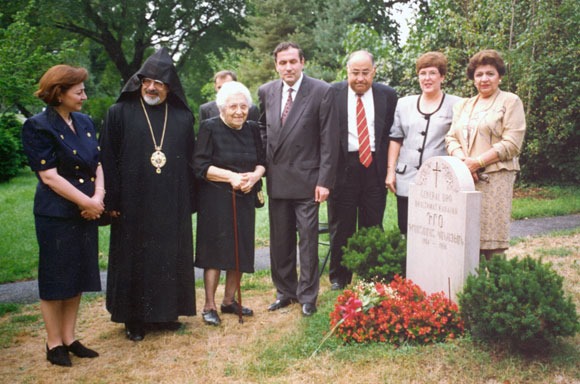
The grave site of General Tro in Boston was visited several years before the transfer of his remains to Armenia. President Levon Ter-Petrossian joined General Tro’s family to pay respects to the hero. From left: Mrs. Lucia Ter-Petrossian, Archbishop Mesrob Ashjian, Mrs. Kayane Ganayan, Levon Ter-Petrossian, Mr. & Mrs. Mardig Ganayan, and Mrs. Olga Ganayan Proudian [Proodian].

Read Full Post »

THIS WEEK IN ARMENIAN HISTORY

Prepared by
the Armenian National Education Committee (ANEC)

Hamo (Hampartsum) Bek-Nazarian was one of the pioneers of Armenian cinema. Born in Yerevan in 1892, he moved with his family to Tashkent (currently the capital of Uzbekistan). He first became a cyclist, and then a wrestler. He participated in competitions outside the Russian Empire and even wrestled in the circus with the pseudonym of Maroni.

In 1914 he started his career in Russian cinema. His first role was a minor one in a film, significantly titled Enver-pasha – predatel’ Turtsii (“Enver Pasha, Traitor of Turkey”), released in 1915. He appeared with the artistic name of Hamo Bek in more than 70 Russian silent movies, where he met his future wife, the actress Sofya Volkhovskaya (1888-1956).

He graduated from the Commerce Institute of Moscow in 1918. In 1921 he headed the movies section of the film studios of Georgia and then became a film director of the State Film of Georgia. In 1923 he moved to Armenia following an invitation by the government and founded the Armenfilm (Haifilm)studios. This was a real challenge, as there were no grounds for cinema in Armenia and Bek-Nazarian had to start everything from scratch. Two years later, he directed the first Armenian feature film, Namus (The Honor), based on the homonymous play by Shirvanzade (1858-1935). He also directed other important films, such as Zare (the first movie on Kurdish life) and the first Armenian comedy, Shor and Shor Shor, in 1926. He wrote the scenario of Shor and Shor Shor in one night and filmed it in eleven days. He also filmed three Georgian movies in 1924-1925, and would later film two Azerbaijani movies (1927 and 1941).Hamo

By 1935 Bek-Nazarian had written (alone or in collaboration) and directed sixteen films, both features and documentaries. He achieved another feat in that year: he directed the first Armenian sound film (“talkie”), Pepo, also based on a classical play by Gabriel Sundukian (1825-1912). This was four years after the release of the first Soviet sound film, at a time when less than one out of a hundred film projectors in the Soviet Union were equipped for sound. Pepo became his masterpiece, as well as one of the masterworks of the Armenian movie industry. He earned the title of Popular Artist of Soviet Armenia in the same year.

He produced two other important films among his works: Zangezur (1938), which received the Stalin Prize of second degree in 1941, and David Bek (1943). The latter was based on the Armenian rebellion against Persian domination in the eighteenth century. However, he suffered a very big disappointment with his film Yerrort karavan (Third Caravan), dedicated to the subject of the repatriation to Armenia in 1946-1948, which was probably set to become his masterpiece. The filming of the movie, which was halfway, was forbidden and the production was shut down in 1951, probably as part of the change of heart of the Soviet regime with regards to repatriation and repatriates. Bek-Nazarian, deeply upset and disillusioned, abandoned both Armenfilm and Armenia, and went to work in the Central Asian republics, such as Uzbekistan and Tajikistan. He passed away on April 27, 1965, and was buried at the Armenian cemetery of Moscow beside his wife. His work was posthumously acknowledged and the movie studios of Armenfilm were named after him.

Read Full Post »

(Armenpress) – The Vicar General of the Armenian Patriarchate of Constantinople, Archbishop Aram Ateshian, gave an interview to the Turkish Bugun TV channel, where he discussed the existence of hidden Armenians living in Turkey.Ateshian explained that these individuals were forced to conceal their nationality and convert to Islam during World War I because of persecution in Ottoman Turkey.

Ateshian said, "There are about 100,000 people in the present generation in Turkey whose parents are Armenians and they are Muslims. They speak Armenian and wear a cross secretly… They do not want to attend church, as it will reveal their identity. The liturgy held in the Saint Kirakos Church in Diyarbakir was attended by more than 400 people, half of which had Armenian roots. My family as well lives in Diyarbakir as Muslims. The sons of my elder sister also live in Diyarbakir. They accepted Islam under pressure in 1950."

"I was born in 1954. When I was 4 or 5, my sister became a Muslim. Their children became Muslims as well. My sister wore her cross secretly and spoke Armenian. I lost them, as they did not attend our church and I could not christen them. Many of the concealed Armenians talked about their being Armenians only before the death," he continued.

Ateshian also shared other first-hand experiences, saying, "A 30-year-old man came to me and asked [me] to christen him. I told him to prove his being Armenian and he could not. Then his father called me and asked to accept his son. He said that he worked in the municipality and when he retires, he will return to his roots. According to his son, 90 percent of the population of Tunceli are Armenians and now he is a member of our church."

Read Full Post »

     Prepared by

the Armenian National Education Committee (ANEC)


          Shushi had historically been the capital of Karabagh and the third most important Armenian cultural center in the Southern Caucasus (after Tiflis and Baku) until 1920, when the pogrom executed by Azerbaijani forces ended in the destruction of the Armenian quarters and the extermination of the Armenian population of the city.

          During Soviet times, the capital of the autonomous region of Mountainous Karabagh was moved to Stepanakert, while Shushi, located four miles to the south, became an Azerbaijani center.

          In the years of the Karabagh war (1989-1994), the strategic importance of Shushi, situated on a mountaintop overlooking Stepanakert, acquired more relevance for Azerbaijani forces in Karabagh after the occupation of Khojalu by Armenians in February 1992. The town became the main base for the indiscriminate shelling of Stepanakert with Soviet-built GRAD multiple rocket launchers. These launchers were capable of shelling 40 rockets at the same time and cause enormous damage to the civilian population. Over 2,000 people were killed in Stepanakert as a result of Azerbaijani shelling in the first months of 1992.

          The capture of Shushi became imperative to end the relentless bombing of Stepanakert and the suffering of its population. The plan was finalized on April 28 and the order of attack was given on May 4, 1992.  However, various reasons caused a delay of four days.

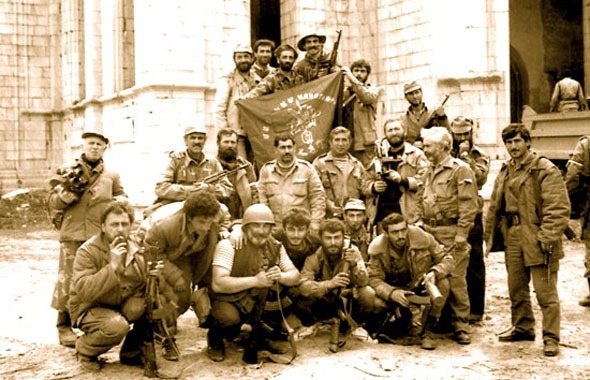
 LiberationofShushi
Members of the ARF battalion celebrating the liberation of Shushi in front of the Ghazanchetsots Cathedral in 1992.

The military operation was directed by Commander Arkadi Ter-Tadevosyan, who had a force of 1,200 members of the Self-Defense Forces of Karabagh, divided into five companies. The Armenian forces were complemented by four tanks and two attack helicopters. The Azerbaijani defending forces counted 1,200 people in Shushi, where the civilian population had been already evacuated, and some 800 around the town. A Chechen volunteer contingent led by guerrilla warlord Shamil Basayev (who was among the last to leave the city and was killed in 2006 in Chechnya) had reinforced the Azerbaijanis.

          Shushi was attacked by the flanks and the rears in the twilight hours of May 8, as the ridge facing Stepanakert was easier to defend. There was a full engagement by midday, and the ending to the battle was envisioned in the evening, when Armenians, occupying favorable positions around Shushi, allowed the enemy forces a corridor for retreat.

          The ancient Armenian capital was occupied on May 9. Azerbaijani military plane and helicopters shelled the Armenian ranks, as well as Shushi and Stepanakert during midday. Later, it was discovered that the air offensive was aimed at exploding the weapon deposits abandoned in Shushi with the hope of destroying the entire city. However, the plan did not succeed, and the “clean up” of the city ended in the evening of the same day. It has been estimated that the Armenians lost 60 people, while Azerbaijanis had a total of 150 to 200 casualties.

          The victory at Shushi had a crucial importance in the Karabagh war. The Armenian forces immediately launched an offensive over the corridor of Lachin, which was central to the connection between Armenia (Goris) and Karabagh (Stepanakert), and occupied Lachin (nowadays Berdzor) on May 18. The consequent falls of Shushi and Lachin triggered the deposition of Azerbaijani president Ayaz Mutalibov.

          The liberation of Shushi was of enormous symbolical value, as it represented the recovery of a city that had been abandoned for more than seventy years to Azerbaijanis. In the last twenty years, Shushi has been slowly recovering its Armenian profile and population, with the white and imposing silhouette of the nineteenth-century Ghazanchetsots Cathedral (which had been converted by Azerbaijanis into a deposit of GRAD launchers) standing completely renovated as a symbol of resilience and faith in the future.

Read Full Post »

« Newer Posts - Older Posts »