Archive for the ‘History’ Category

THIS WEEK IN ARMENIAN HISTORY

Prepared by the Armenian National Education Committee (ANEC)


Birth of Stepan Shahumian
(
October 13, 1878)

After the independence of Armenia and Karabagh, neither the city of Stepanavan, in the northern region of Lori, which was severely damaged during the earthquake of 1988, nor Stepanakert, the capital of the Republic of Mountainous (Nagorno) Karabagh, changed their names, even though they had been renamed after a famous communist revolutionary.

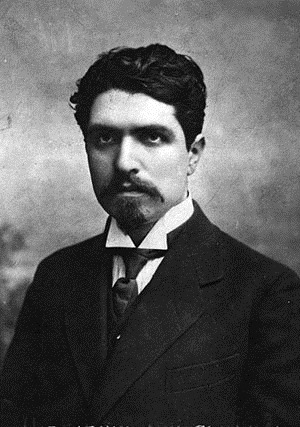
Stepan Shahumian was born in Tiflis to a working family. He studied at the Royal School in his hometown and then followed with university studies in St. Petersburg and Riga (1898-1902). He was attracted by Marxism in early 1900. He graduated from the philosophy department of Alexander Humboldt University in Germany in 1905, while being actively involved in politics following Shahoumianthe line of Vladimir Lenin, the leader of the Bolshevik fraction of the Russian Social Democratic Party.

Shahumian returned to the Caucasus in 1905 and became a leader first in Tiflis and then in Baku from 1907, both actively in the field and as an editor and polemicist. After being exiled to Astrakhan in 1912, he returned to Baku in 1914. He was arrested in March 1916 and exiled to Saratov, and liberated only after the February Revolution of 1917.

He returned to Baku once again, and led the Soviet of Workers and  Villagers, which in November 1917 took control of the city. Shahumian was designated Extraordinary Commissar for the Caucasus in December. The Turkish army expanded its military campaign on the Caucasian front in late March 1918; encouraged, the Azerbaijani Musavat Party stepped up its anti-Soviet work and attempted to seize Baku to establish its own regime. After the crushing of the revolt, the Soviets took full control of the city government and established an alliance of Bolsheviks, Left Socialist Revolutionaries, Mensheviks (Social Democrats), and Armenian Revolutionary Federation members, chaired by Shahumian, which was known as the Baku Commune.

The Bolsheviks clashed with the A.R.F. and the Mensheviks over the involvement of British forces, which the latter two welcomed. In either case, Shahumian was under direct orders from Moscow to refuse any and all aid offered by the British. However, in July the alliance broke and a new government replaced the Commune by the Central Caspian Dictatorship, with an alliance of Right Socialist Revolutionaries, Mensheviks, and A.R.F. members; British forces temporarily entered Baku to abandon it later.

On July 31, the 26 commissars attempted the evacuation of Bolshevik armed forces by sailing over to Astrakhan, but the ships were captured by the military vessels of the Dictatorship two weeks later. They were arrested and placed in Baku prison. The city fell to Turkish forces, despite the heroic resistance of the Armenian population, which executed the massacre of 15,000 to 20,000 Armenians.

Amidst the confusion, Shahumian and his fellow commissars either escaped or were released on September 14. They boarded a ship to Krasnovodsk, where upon arrival they were arrested by anti-Bolshevik elements. In the end, on the night of September 20, Stepan Shahumian and the other 25 Baku commissars were executed by a firing squad on a remote location on the Trans-Caspian railway. Together with Shahumian and various Azerbaijanis, Georgians, and Russians, six other Armenians perished: Arsen Amirian, Suren Hovsepian, Armenak Borian, Baghdasar Avakian, Aram Kostandian, and Tateos Amirian.

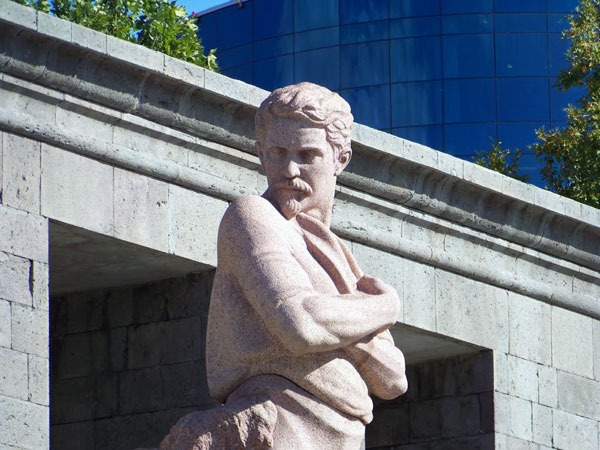
 ShahoumianStatue

A statue of Stepan Shahumyan located in central Yerevan.

Read Full Post »

Message of His Holiness Karekin II
On the Occasion of the Synod of Bishops

Mother See of Holy Etchmiadzin, Information Services 24 September, 2013

The Message of His Holiness KAREKIN II
Supreme Patriarch and Catholicos of All Armenians
On the Occasion of the Synod of Bishops
Mother See of Holy Etchmiadzin
September 24, 2013

Your Excellency the President of the Republic of Armenia,
Your Holiness my dear brother in Christ,
Your Eminences,
Your Graces,

With a joyful spirit I welcome you in the Mother See of Holy Etchmiadzin. Today is a significant day for all of us. For the first time, a Synod of the bishops of the Armenian Apostolic Church is convening with the participation of the colleges of bishops of both the Catholicosate of All Armenians and the Catholicosate of the Great House of Cilicia. We believe that this gathering will be a new phase in the course towards the fruitful realization of the mission of our Church.

Giving thanks and glory to the Lord, for with the convening of this Synod, He is granting us the grace to work in a fraternal spirit with ARAM I, Catholicos of the Great House of Cilicia, and the entire Episcopal college of our Church, for the sake of strengthening and enlightening the horizons of our ecclesial life. We are pleased that His Excellency Mr. Serj Sargsyan, President of the Republic of Armenia, honors the Synod of Bishops with his presence, assuring once again his willingness to assist the mission of the Armenian Church and the fruitful task of cultivating church-state relations. We also welcome the participation at this Synod of His Eminence Archbishop Aram Ateshian, vicar of the Armenian Patriarchate of Constantinople.

Dear fathers, today we have gathered in one place having as our vision a reformation in our spiritual-ecclesial life. This Synod of Bishops plays an important role in the realization of this goal, particularly in the task of the study and formulation of definitions and guidelines for ritualistic, canonical and doctrinal issues. The bishop is the steward of God, says the holy Apostle Paul (Titus 1:7), and “he cares for the Church, which is the city of God,” adds the great theologian St. Gregory of Datev.  With this sense of responsibility this Bishops Synod will discuss and present decisions with regard to the chief agenda items: the ritual of the sacrament of Baptism, the canonization of saints, and in this context, the canonization of the victims of the Armenian Genocide. Joint committees of the Catholicosate of All Armenians and of the Great House of Cilicia have conducted ongoing work with the intent of creating uniformity in the rite of Baptism and in the establishment of rules for the canonization of saints. In an official status they have studied the historical foundations, the present circumstances and demands of the times, as well as the expectations of our faithful flock. We express our deep appreciation to the chairmen and members of the Canonical, Canonization of Saints, and Liturgical Committees for their ardent work. The Synod will also address other troubling problems and challenges facing our Holy Church.

The Church being the mystical body of Christ and the gathering of the faithful is also a structure operating in time. In the carrying out of its mission from time to time the Church feels the need for reform and improvement. Historically, the various difficult situations created for our people, including the partitioning of our Homeland, complicated political circumstances, catastrophes, massacres, the Genocide, and the atheistic Soviet period, did not allow the necessary opportunities for dealing with issues of ecclesial reform. Our Church’s Hierarchical Sees, being geographically located within different governmental frameworks, were often ruled by different and sometimes compulsory constitutions. The Catholicosate of the Great House of Cilicia and the Patriarchates of Jerusalem and Constantinople, falling under Ottoman domination, were ruled by the provisions of the National Constitution, while the Catholicosate of All Armenians, under the authority of the Russian Empire, was governed by the Polozhenia. The life and administrative activity of our Church was influenced by these conditions, which often gave way to divergences and confusion. In such an unfavorable state of affairs plans for reform, which were imperative for our Church for more than a century, were either postponed or addressed only in part. During the years of Soviet rule the strained relations created between the Catholicosate of All Armenians and the Great House of Cilicia, which resulted in division and administrative split, likewise brought about a delay on the road to reform. Today our Homeland is independent and the Church has great possibilities to operate freely and make improvements in order to overcome the deep-rooted problems of the entire church.

Thanks be to God that today our Holy Apostolic Church in the Diaspora is experiencing a renaissance. Our people’s spiritual-ecclesial life is budding once again and is blossoming with the light of the Gospel, being securely anchored on the faith of the Fathers, the sacred tradition, religious understanding and knowledge. We have made achievements in the mission of preparing a new generation of learned clergy, the building of churches, the strengthening of the preaching of the Gospel, Christian education and instruction. Alongside these successes we have many unresolved issues and questions in our internal ecclesial life, which are the consequence of the absence of laws and constitutions based on ecclesial rights and the canonical principles of our Church, which often give way to outward expressions of misunderstandings and arbitrariness, rendering the desired progress of our ecclesial life more difficult and complicated. In order to regulate the activity and life of our Holy Church, it is necessary to canonically activate the pan ecclesial – synodical bodies, and to create a constitution to define the activity and mutual relationship of the ecclesial structures and the rights of the Hierarchical Sees. Reforms in the liturgical ritualistic area, in the fields of spiritual education and Christian instruction, the utilization of successful pedagogical methods, the dissemination of the works of our fathers, the producing of new theological works, which take a modern approach while remaining authentic to the teachings of our Church, will raise our Church’s life to a new height. In order for our Church to keep pace with the times and to secure a clear direction for our people, it is necessary to cultivate and to establish a social doctrine to address social issues, ethical questions, geopolitical developments, scientific advancements, globalization and other related phenomena. We announce that with this purpose in mind months ago we established a separate department of social doctrine in the Mother See. To the list of issues challenging the Church we want to also mention that there continues to be a serious demand for the preparation of a new generation of clergy, the building of churches, the restoration of our most ancient monasteries and churches, and the organizing of monastic life. In order to accomplish all of this the united efforts of our nation are required, from the believer and the pastor, all the way to the chief shepherd.

With its mission of the salvation of souls and preservation of the nation, the role of our Holy Apostolic Church has been exceptional in the life of our people. This has been witnessed to by history and today is justifiably spelled out in the Constitution of the Republic of Armenia. The divinely imparted and internally secure calling of our Church, tested throughout the centuries, has kept alive in the hearts of our people the love of freedom and the vision of nationhood for the homeland in the face of many dangers and troubles. “For the faith” and “for the homeland” have defined our identity and perseverance. With this knowledge and spirit, as in the past, likewise today as well, our Church in every possible way participates in the sacred work of nation building. Today together with the processes of reform, there are still concerns and difficulties in the homeland. Our people living in Armenia continue to live in conditions of blockade and fragile peace. They have not yet overcome poverty and unemployment, and emigration is worrisome. In the face of these imperatives we have our responsibility and obligation, to gather our people together and support the government in its difficult task of solving the nation’s problems. With the greater organization of our ecclesial structures and united efforts our Church life will become stronger and we will be able to fortify our people living in Armenia and in Diaspora, for the sake of our land’s progress and development, for the overcoming of economic and social difficulties and in facing the imperatives raised in the Diaspora. With a united Armenia-Diaspora, our Homeland will be strong, secure, and invulnerable, and there will be a better defended, self-confident and alive Armenian Diaspora. With a united Armenia-Diaspora, our efforts in the international arena will be fruitful for the recognition of the Republic of Nagorno Karabagh and the condemnation of the Armenian Genocide.  On the occasion of the 100th anniversary commemoration of the Armenian Genocide we will make a powerful call to the entire world for justice and reparations. With a united Armenia-Diaspora we will be empowered to face the temptations, difficulties and troubles plaguing our nation, such as exist today in the life of our people in the Middle East, particularly in Syria. As a consequence of the continuing conflict, the Armenians of Syria are experiencing great suffering and heavy losses. We again pray to the Lord for peace and exhort our diocesan primates together with our faithful to support and assist by every possible means our brothers and sisters in Syria, and encourage them in the overcoming of their difficulties.

With the good fruits of our unity we will keep prosperous and vibrant the life of the Armenian diaspora, whose problems many of you are well aware of and which are a source of personal worry. Today we often speak about the weakening of the Armenian school, the decrease in the knowledge of the Armenian language, the decreasing involvement of the youth in spiritual and national life, all of which are frightening signs of the path to assimilation. Today we have the encouraging realities of our independent nationhood on one hand, and on the other hand the example of the children of the genocide survivors in the Diaspora, who as respected and trustworthy citizens, have created spiritual and national structures and institutions with their hard work. We will attempt to make our national-ecclesial life to be a more familiar place for our children. Our Church with greater success will utilize those possibilities in the work of keeping our people alive with faith, national understanding and zeal for the mother tongue. Having spiritual values well integrated into the national life, our people, especially the youth, will find the answers to their questions, their sure faithful path to God, their happiness, and they will continue to live with a sense of national identity, multiplying their strengths and dreams with the power derived from our free Homeland.

The twenty-first century with its scientific technological progress and achievements also brings with it a decline of moral values, a destruction of the true understanding of human rights, a deterioration of national identity and family values, from which, unfortunately, our national life has not been spared, both in the Homeland as well as in the Diaspora. We must be able to address with our people this century’s lack of spirituality, the dangers of secularism and conformity, and we must especially keep alive in our youth a love and confidence towards our Holy Church, and a zeal towards the holy faith of our fathers and our national traditions. Our Church, as the abundant fountain of God’s graces must irrigate the fields of our life with a spiritual life, renew and brighten the pious souls of our people and keep firm the values of justice, truth, and philanthropy, by which our entire Armenian life will prosper and will fill our land with every good thing and blessing. Our mission is one: to shepherd and lead our people toward salvation, keeping them in the love of God and nation, so that we may live and persevere as the Lord’s own, chosen people and Church.

Dear fathers, consider those problems and priorities in the ecclesial area and national life, which we tried to single out, and the related decisions and actions will lead our Church with God’s blessing in its fully inspired and fruitful mission. Our people are with us with their unswerving devotion toward the Armenian Church and their sincere hopes for the strengthening of the Church. Our efforts will echo in the souls of our faithful children and they will have an eager readiness to cooperate.

We pray to God for the leadership of the Holy Spirit upon the work of the Synod of Bishops and share with you the apostle’s exhortation, “Finally, beloved, whatever is true, whatever is honorable, whatever is just, whatever is pure, whatever is pleasing, whatever is commendable… think about these things…and the God of peace will be with you.”  (Philippians 4:8-9)

May the Lord grant peace to the world and to the peoples who bear the pain and suffering of war; may He keep undisturbed under His good watchful eye Armenia and Artsakh and our people in Diaspora, and keep unshaken our Holy Apostolic Church with its Hierarchical Sees and clergy, granting spiritual growth and blessings.

May our labors be crowned with progress and might.

Read Full Post »
THIS WEEK IN ARMENIAN HISTORY

Prepared by the Armenian National Education Committee (ANEC)


Foundation of the Armenian Democratic Liberal Party
(October 1, 1921)

The Armenian Democratic Liberal Party (ADL; in Armenian, Ramgavar Azadagan Goosagtsootioon) was founded in Constantinople on October 1, 1921. It is considered the continuation of the first Armenian party, the Armenagan Organization, which was created in 1885 in Van.

The DeRamgavarmocratic Liberal Party was the result of the alliance of four liberal and conservative parties from Western and Eastern Armenia: the Armenagan Organization, which had lost its headquarters in Van after the genocide; the Armenian Constitutional Democratic Party (1907-1921), which had acted within the frame of constitutionalism in the Ottoman Empire after the Ottoman Revolution of 1908; the Reorganized Hunchakian Party, a right-wing split of the Social Democrat Hunchakian Party after 1896; and the Armenian Popular Party, founded in 1917 in Tiflis (Tbilisi) after the model of the Russian Constitutional Democratic (Kadet) party.

The party advocated liberalism and capitalism, while the other two political parties, the Armenian Revolutionary Federation and the Hunchakian Party, had a left-leaning platform. For the next seventy years, the action of the Democratic Liberal Party, as well as of the other two, was limited to the Diaspora, since Armenian political parties were banned by the Communist regime in Soviet Armenia. Its position, nevertheless, has consistently been one of support for Armenia, regardless of the regime or government in charge.

The party established its main headquarters in the Middle East (Egypt and later Lebanon), with branches in various communities, particularly Syria, Greece, France, the United States, Canada, and Argentina, publishing newspapers and magazines in some of them. Nowadays, it has the following media in the Diaspora: Zartonk (Beirut), Arev (Cairo), Nor Ashkharh (Athens), Abaka (Montreal), Nor Or (Pasadena), The Armenian Mirror-Spectator (Boston), Sardarabad (Buenos Aires). It has had representation in the Lebanese Parliament since 2000 as a member of the Future Movement chaired by the late prime minister Rafik Hariri (now called March 14 Alliance).

After the independence of Armenia and the disappearance of the one-party system, the Democratic Liberal Party of Armenia was founded in 1991 as a local counterpart to the Diasporan party. Various rifts within the party caused the formation of a second party, the Armenakan-Democratic Liberal Party, in 2009. Both parties were unified in 2012 under the name “Democratic Liberal Party (Armenia).” The newspaper Azg, one of the most respected press organs in Armenia, was founded by the party in 1992, but in the last few years became an independent, non-partisan newspaper.


Read Full Post »

THIS WEEK IN ARMENIAN HISTORY

Prepared by the Armenian National Education Committee (ANEC)


Death of Manuk Abeghian

(September 25, 1944)

Manuk Abeghian was one of the most important scholars of Armenian Studies in the first half of the twentieth century. At the conclusion of his remarkable career, he became one of the founding members of the Academy of Sciences of the Republic of Armenia in 1943.

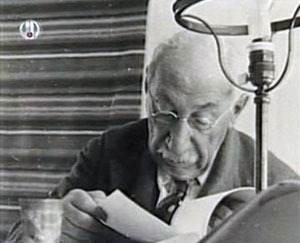
Abeghian was born on March 17, apeghian 1865 in the village of Astapat, in the historical Armenian province of Nakhichevan (today in territory of Azerbaijan). He was the son of an agriculturist. After his initial studies in the school of the monastery of Karmir Vank, in 1876 he entered the Kevorkian Seminary of Etchmiadzin and graduated in 1885. He taught for many years in schools of Shushi (Karabagh) and Tiflis. In 1893 he went to Europe and became an auditor at the German universities of Jena, Leipzig, and Berlin, as well as in the University of Paris. In 1898 he was awarded his doctorate at the University of Jena, where he defended a dissertation on the ancient Armenian beliefs.

He returned to the Caucasus and was a teacher in his alma mater, the Kevorkian Seminary, until 1914. Then, he moved to Tiflis, where he taught at the Nersisian Lyceum until 1918.

He moved to Armenia in 1921 and became a professor at Yerevan State University; he also was the dean of the Faculty of History and Literature from 1923-1925. In 1935 he earned a second doctorate, this time in Armenian philology.

Abeghian was a foremost scholar in a variety of disciplines of Armenian Studies. He was a pioneering figure in the study of Armenian mythology. Besides recording several variants of the Armenian national epics David of Sassoun, he was the author of its first specialized study (1889). Together with his colleague Garo Melik-Ohanjanian, they both prepared a three-volume edition of all available variants of the epics (published between 1936 and 1951). Abeghian was also one of the authors of an integral version of the epics, which condensed all the variants into one single text (1939). He also published critical editions of Armenian popular songs and medieval poetry.

Among his major works was the two-volume History of Ancient Armenian Literature (1944-1945), which was left unfinished because of his death. Many of his studies were published in a collection of eight volumes between 1966 and 1985.

Abeghian’s name was linked to the reform of Armenian orthography in 1922. After the sovietization of Armenia, the new regime started a policy aimed at the simplification of Armenian orthography, whose ultimate purpose was to eliminate the Armenian alphabet and replace it with Latin script. In 1921, Abeghian presented his personal views as a report in a conference organized by the Commissariat (Ministry) of Education. The same report was used a year later by the Commissariat, without consulting with Abeghian, to decree, on March 4, 1922, the reform of the orthography. For this reason, it is common to call the reformed orthography with the name of “Abeghian spelling.” The excesses in this reform motivated a new change in the Soviet Armenian orthography—used today in Armenia, the former Soviet Union, and among the “new diaspora” formed after the migration of the past 25 years—in 1940, which made it closer to classical orthography (used today by the Diaspora, both speakers of Western Armenian and of Eastern Armenian, in the case of Iran).

Manuk Abeghian passed away in 1944. The Institute of Literature of the Armenian National of Academy carries his name.

Read Full Post »

THIS WEEK IN ARMENIAN HISTORY

Prepared by the Armenian National Education Committee (ANEC)


Birth of Victor Hampartsoumian

(September 18, 1908)

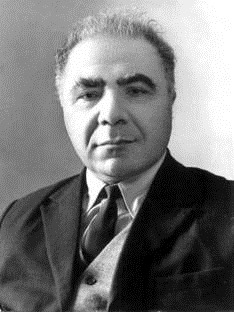
It is hard to say that any Armenian was thinking of reaching the stars, theoretically speaking, during the childhood of Victor Hampartsoumian. However, he was able to do it and to become the pioneer of Armenian astronomy in the twentieth century, following the path opened by such a predeVictorHampartsoumiancessor as seventh century astronomer Anania Shiragatsi.

Hampartsoumian was born in Tiflis (Tbilisi), the capital of Georgia. His father Hamazasp (1880-1965) was a lawyer, graduated from the University of St. Petersburg (1908), a writer, and a scholar of Classical philology; he would later teach classical literature at Yerevan State University, become a Ph.D. at the age of 73, and publish his translation of Homer’s Iliad into Armenian in 1956.

         Young Victor went to study to Leningrad (now St. Petersburg) in 1924, where he attended the department of Physics and Mathematics of Leningrad State Pedagogical Institute and then of Leningrad State University. He published his first scientific article at the age of 18, in 1926, and another article published in 1929, coauthored with physicist Dmitri Ivanenko (1904-1994), brought his work into prominence; it demonstrated that atomic nuclei could not be made from protons and electrons. Three years later, the discovery of neutrons (the other component of atoms, together with protons) confirmed the theory.
          Hampartsoumian married in 1930 and taught at his alma mater, Leningrad University, since his graduation in 1931. He founded and headed the first astrophysics chair in 1934, and directed the astronomic observatory from 1939-1941. During the war, the scientific laboratories were evacuated in 1941 to the autonomous republic of Tatarstan, where Hampartsoumian (a correspondent member of the Academy of Sciences of the Soviet Union at the age of 31, in 1939) directed them for the next four years. In 1943 the Armenian Academy of Sciences was founded, and Hampartsoumian was appointed vice president. He became its president in 1947 and was re-elected successively until 1993, when he became honorary president.puragan

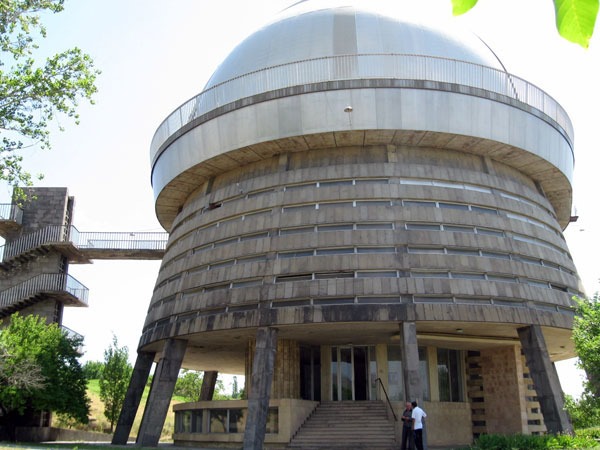
The astrophysical observatory of Puragan

By the 1950s, Hampartsoumian had already become one of the founders of theoretical astrophysics. He made several important contributions to science throughout his career, such as quantum field theory, the idea of active galactic nuclei, stellar evolution, and many others.

The astrophysical observatory of Byurakan [Puragan] was founded in 1946. Hampartsoumian became its first director from 1946-1988. In 1953 he became a full member of the Soviet Academy of Sciences, and in the 1960s he was president of the International Astronomical Union (1961-1964) and the International Council of Scientific Unions (1966-1972). He was member of several foreign science societies and won various state awards in the Soviet Union. His textbook “Theoretical Astrophysics” (1952) was translated into many languages, including English. “There can be no more than two or three astronomers in this century who can look back on a life so worthily devoted to the progress of astronomy,” wrote Nobel Laureate Subrahmanyan Chandrasekhar (Physics 1983), on the 80th anniversary of Hampartsoumian’s birthday.

A member of the Communist Party since 1940, the astronomer was a member of the Central Committee of the Armenian party and a delegate to the Soviet Supreme of the USSR for almost fifty years. In 1989 he was elected to the USSR Congress of the People’s Deputies, which existed between 1989 and 1991. In September 1990, together with several Armenian intellectuals, he was on a hunger strike for two weeks to support the claims in the Karabagh movement.

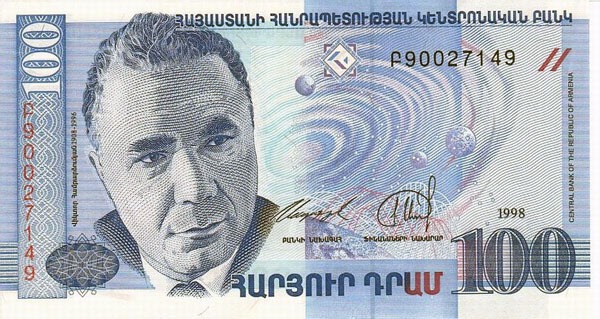
100tram

Victor Hambardzumyan is featured on the 100 dram bill of the Republic of Armenia

A worldwide known personality of science, Hampartsoumian was also deeply attached to his national roots. In the last years of his life, he wrote as a testament of sorts (August 29, 1994):

“My will to the following generations, to my grandchildren and great grandchildren, is to master the Armenian language. Everyone has to make his/her duty to study the Armenian language and be proficient in it. We don’t transmit blood to the generations, but ideas, and the most valuable among those ideas is the Armenian language for me. Each generation has the obligation of teaching the Armenian language to the next one.”

Hampartsoumian passed away on August 12, 1996, in Byurakan [Puragan] and is buried next to the Grand Telescope Tower. The astronomic observatory has been named after him, as was an asteroid discovered in 1972.


Read Full Post »

THIS WEEK IN ARMENIAN HISTORY

Prepared by the Armenian National Education Committee (ANEC)


Death of St. Sahag Bartev

(September 7, 439)


Sahag Bartev was the tenth Catholicos of the Armenian Church for a period of almost fifty years, with interruptions, but this was not the main reason he was sanctified by the Armenian Church.

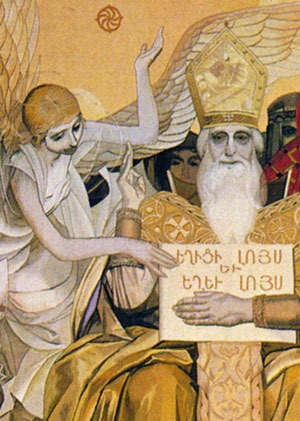
He was born on September 29, 348, and was the son of another important Catholicos, Nerses the Great (353-373); his mother belonged to the Mamigonian family. The first Catholicoi were all descendantsSahagBartev of St. Gregory the Illuminator. Some of the Catholicoi had been married and had children before consecrating to religious life; their wives would leave world life afterwards and become nuns.

The future head of the Church was educated in schools in Caesarea, Alexandria, and Constantinople. He knew Greek, Syriac, and Persian. He was elected Catholicos in 387 and worked actively with king Khosrov IV to restore the unity of Greater Armenia, which had divided between the Persian and Byzantine empires in the same year. After the dethronement and exile of Khosrov III (388) by the Persian king, Sahag I was also deprived of the patriarchal throne in 389. The efforts of the next king, Vramshabouh (388-414), who was Khosrov’s brother, made it possible to restore the Catholicos in his position.

Sahag Bartev had a fundamental role, together with Vramshabouh, in supporting the work of St. Mesrob Mashdots that led to the invention of the Armenian alphabet at the beginning of the fifth century, as well as to the creation of a school network to teach the new alphabet and the cultural work that created the Golden Age of Armenian literature in that century.

Historian Ghazar Barpetsi wrote that Mesrob Mashdots and the other translators, whenever needed to make any phonetic comparisons between the Armenian and Greek languages, took their questions to Sahag I, because he had received a classical education and had a comprehensive knowledge of phonetics and rhetorical commentary, and was also well versed in philosophy.

Sahag I worked to arrange and organize the Armenian calendar of religious festivities. He wrote many rules related to the ecclesiastic and secular classes, the officials, marriage, and other issues. He composed various liturgical hymns and prayers, and he played a significant role in the translation of the Bible, which was completed in 435.

The Catholicos wrote polemical letters against various sects, as well as letters to the Byzantine emperor Thedosius II, the Patriarch Proclus of Constantinople, bishops, and a Byzantine governor. In these letters, the Catholicos, together with Mashdots, presented the orthodox position of the Armenian Church after the Ecumenical Council of Ephesus (431). The letter to Proclus, in particular, was read at the Council of Constantinople (553), after the letter of Cyril of Alexandria, as proof of orthodoxy.

Sahag Bartev passed away on September 7, 439, in the village of Pelrots, in the province of Pagrevant, and was buried in the city of Ashtishat, in the region of Daron. With his death the line of St. Gregory the Illuminator came to an end.

The Armenian Church remembers Sahag Bartev’s memory twice a year. The first on the Saturday eight days before the Great Carnival (Paregentan), between January 24 and February 28, and the second on the Thursday following the fourth Sunday of Pentecost (between June 1 and July 16), when he is remembered along with Mesrob Mashdots as the Holy Translators.


Read Full Post »

THIS WEEK IN ARMENIAN HISTORY

Prepared by the Armenian National Education Committee (ANEC)


Birth of William Saroyan (August 31, 1908)

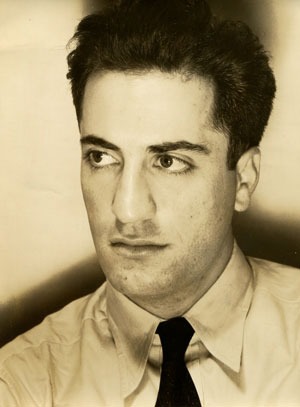
William Saroyan was, without discussion, the most important name of Armenian origin in American literature and, in the 1930s and 1940s, one of its dominant names. For this reason, he became an indisputable name of iconic stature among Armenians in America and throughout theWilliamSaroyan world.

His parents, Armenag and Takoohi Saroyan, had come to New York in 1905 and after a short stint in Paterson, New Jersey, they settled in Fresno, California, where William was born. His father died in 1911, and Saroyan, along with his brother and sister, was placed in an orphanage in Oakland. In 1916 the family reunited in Fresno, where his mother Takoohi had already secured work at a cannery. He continued his education on his own, supporting himself with various odd jobs.

Saroyan’s first stories appeared in the 1930s, in the English page of Hairenik Daily and then in the Hairenik Weekly (today The Armenian Weekly). He made his breakthrough with the story “The Daring Young Man on the Flying Trapeze” in Story magazine (1934), which lent its title to his first book in 1935. Several collections followed; by 1939 he had published seven books and the optimist strain of his “Saroyanesque” prose, among the tribulations and trials of the Depression age, had established himself as a leading writer. Many of Saroyan’s stories were based on his childhood experiences among the Armenian American fruit growers of the San Joaquin Valley. My Name is Aram (1940) became an international bestseller and was translated into many languages. His play “The Time of His Life” won him the New York Drama Critics’ Circle award, which he accepted, and the Pulitzer Prize, which he rejected on the grounds that commerce should not judge the arts. It was adapted into a movie in 1948, starring James Cagney.

He had worked on the screenplay for the film “The Human Comedy,” but he was dismissed from the project. He then turned the script into a novel, which he published before the movie’s release, in 1943. The movie won him an Academy Award for Best Story in the same year. It turns out, then, that the movie was the source for the novel and not vice versa. The novel was the source for the homonymous musical of 1983.

Saroyan served in the Army during World War II and was posted to London in 1942. He narrowly avoided a court martial when his novel, The Adventures of Wesley Jackson, was seen as advocating pacifism.

Saroyan worked rapidly, hardly editing his text, and drinking and gambling away much of his earnings. This took a toll on his marriage with actress Carol Marcus (1924–2003), whom he married twice, from 1943-1949 and 1951-1952. They had two children, writer Aram Saroyan (1943) and actress Lucy Saroyan (1946-2003). After their divorce, Carol Marcus married actor Walter Matthau.

Interest in Saroyan’s novels declined after the war; their sentimentalism was harshly criticized. From 1958 onwards, Saroyan mainly resided in Paris. Since the 1950s he mainly published several volumes of memoirs and continued writing plays.

He visited Soviet Armenia for the first time in 1934. His interest for his roots never ceased, as evidenced in his writing. He visited Armenia two more times, in 1960 and 1978, and even visited the birthplace of his parents, Bitlis, in Western Armenia (1964).

Saroyan died in Fresno, of cancer, on May 18, 1981. Half of his ashes were buried in California and the other half was taken to Armenia, according to his will, and buried at Gomidas Pantheon in Yerevan. To celebrate his 100th anniversary, a statue of Saroyan was placed in downtown Yerevan.


Read Full Post »

THIS WEEK IN ARMENIAN HISTORY
Prepared by

the Armenian National Education Committee (ANEC)


Adolf Hitler’s Armenian Phrase:
“Who, After All, Speaks Today . . .”

(August 22, 1939)

Nazi leader Adolf Hitler had an early awareness of the Armenian Genocide. One of his closest friends and advisors had been Max Erwin von Scheubner-Richter (1884-1923), who was German consul in Erzerum in 1915 and had documented the annihilation in several diplomatic reports. He would be killed literally at Hitler’s side during the Beer Hall putsch in Munich (October 1923).

Hitler’s first documented reference to Armenians as a people that had “degenerated” came a year before the ill-fated coup, in November 1922, in a secret meeting with Eduard Scharrer, a former consul-general from Stuttgart and publisher of the newspaper Münchner Neuest Nachrichten. According to Scharrer’s notes, Hitler said:

“A solution for the Jewish question must come. If it is solved reasonably, it will be best for both sides. But if it is not solved reasonably, there are only two possibilities: either the German Volk will degenerate to the level of the Armenians or the Levantines, or a bloody struggle will break out.”

Nine years later, Hitler gave two confidential interviews to Richard Breiting, editor of the Leipziger Neuester Nachrichten, a conservative newspaper, in May and June 1931. (Breiting, who was allowed to take short-hand notes, died in unclear circumstances, probably by the hand of the Gestapo, in 1937.) In the second interview, Hitler announced:

“We intend to introduce a great resettlement policy; we do not wish to go on treading on each other’s toes in Germany. In 1923 little Greece could resettle a million men. Think of the Biblical deportations and the massacres of the Middle Ages (Rosenberg refers to them) and remember the extermination of the Armenians. One eventually reaches the conclusion that masses of men are mere biological plasticine."

The third and most famous reference came on August 22, 1939, one week before the invasion in Poland and the beginning of World War II. Hitler gave two speeches to the supreme commanders and commanding generals at Obersalzberg, which lasted several hours. Admiral Wilhelm Canaris, chief of the German Abwehr (military intelligence), surreptitiously took notes. The paragraph, included in the second speech, said (Lochner’s translation):

“Our strength consists in our speed and in our brutality. Genghis Khan led millions of women and children to slaughter—with premeditation and a happy heart. History sees in him solely the founder of a state. It’s a matter of indifference to me what a weak western European civilization will say about me. I have issued the command—and I’ll have anybody who utters but one word of criticism executed by a firing squad—that our war aim does not consist in reaching certain lines, but in the physical destruction of the enemy. Accordingly, I have placed my death-head formation in readiness—for the present only in the East—with orders to them to send to death mercilessly and without compassion, men, women, and children of Polish derivation and language. Only thus shall we gain the living space [Lebensraum] which we need. Who, after all, speaks today of the annihilation of the Armenians?"

A copy of the speech was transmitted to American journalist Louis P. Lochner, who published the English version in his book What About Germany? (1942), while the German original was published for the first time in an émigré German newspaper in Santiago de Chile, Deutsche Blätter, in 1944.

Doubts about the authenticity of this copy (two other sets of notes surfaced, which were introduced by the prosecution at the Nuremberg Trials, but did not contain the Armenian reference) have been frequently raised. The consistency of Hitler’s thinking between 1931 and 1939 and the logical deduction that there was no particular reason to manufacture the Armenian reference (Hitler’s thought and intent were clear, even if he had not used it) are enough evidence that the phrase was authentic. It remains a testament to the impunity of the Armenian Genocide in World War I that led to the Jewish Genocide in World War II.


Read Full Post »

THIS WEEK IN ARMENIAN HISTORY
Prepared by

the Armenian National Education Committee (ANEC)

Megerdich Beshigtashlian

(August 18, 1828)

Megerdich Beshigtashlian was a pioneering writer and public figure of Western Armenian society, considered the founder of modern lyric poetry among Armenians. He was born in Constantinople, and received his primary education at the school of the Mekhitarist Congregation in the suburb of Pera (today Beyoglu) from 1834-1839. He continued his studies at the Samuel-Moorat school of Padua, in Italy, until 1845. The atmosphere of the Italian liberation movement would greatly impact over his intellectual formation.

He returned to Constantinople and became a widely-sought teacher. He taught Armenian language and literature, as well as French in the Tarkmanchats, Loosavorchian, and Hripsimiants Schools. He was particularly successful in teaching the language to Armenian children who spoke foreign languages. For instance, since the late 1850s he was the Armenian teacher of Serpouhi Vahanian (1842-1901), who at first disdained the language, as she had grown speaking French. However, Beshigtashlian’s patient work engaged her student, who later would become a pioneering feminist writer in Armenian literature, Serpouhi Dussape (after marrying her French music teacher, Paul Dussape, in 1870).

Beshigtashlian is considered the founder of Western Armenian theater on a permanent basis. He organized a theater group in 1856, which started to stage plays in ashkharhapar (Modern Armenian). This was an important advance, as plays were performed in krapar (Classical Armenian), becoming an obstacle for popular success. He wrote various plays with historical subjects, seeking to awaken national feelings among the public. He also translated various pieces from French and Italian with similar subjects. He also wrote musical comedies.

Beshigtashlian was particularly active in the public sphere in the 1860s, with an important role in the preparation and approval of the National Constitution (1863). The writer also participated in the foundation of the Abnegated Society (Antznever Engerootioon), which functioned from 1860-1863 and was devoted to education, but also helped financially and morally the rebels of Zeytoon in 1862. He was also the driving force behind the Alumni Association of the Moorat-Raphaelian school between 1858 and 1868.

However, Beshigtashlian’s main contribution to Armenian literature was his poetry. His output was not very big, some 60 poems, but it was quite varied. His poetry, in Classical and Modern Armenian, touched subjects such as love, nature, and homeland. He wrote children’s poems, elegies, etcetera. He published his first poem in 1849. His two most famous poems, “We Are Brothers” and “Spring,” were later set to music. The first was a call of unity to Western Armenians, while the second was a romantic love song to the homeland. He wrote several poems dedicated to the rebellion of Zeytoon.

Beshigtashlian passed away at the age of 40, on November 29, 1868. He inaugurated a list of famous Armenian poets who died from the “romantic disease”: tuberculosis.

Read Full Post »

THIS WEEK IN ARMENIAN HISTORY


Prepared by
 the Armenian National Education Committee (ANEC)

Signature of the Treaty of Sèvres
 (August 10, 1920)


The victory of the Allies in World War I imposed the signature of a series of treaties to end the war and legalize the defeat of the Central Powers (Germany, Austria-Hungary, the Ottoman Empire, and Bulgaria). The Peace Conference of Paris, which opened in January 1919, prepared a package of treaties. Four treaties were signed with Germany (Versailles, June 1919), Austria (Saint-Germain, September 1919), Bulgaria (Neuilly, November 1919), and Hungary (Trianon, June 1920). The fifth and last was with the Ottoman Empire.

Negotiations about the terms of the treaty with Turkey dragged on until mid-1920. They started at the Peace Conference, continued at the Conference of London (February 1920), and took definite shape only after the Prime Minister’s meeting at the San Remo Conference (April 1920). The delay was the result of the inability of the triumphant powers to come to an agreement, and in turn, this allowed the beginning and development of the Turkish national movement, which by the time of the signature of the Treaty of Sevres was seriously challenging the authority of the Ottoman government.

The treaty was signed in an exhibition room at the famous porcelain factory in Sèvres, outside Paris. It was signed by Great Britain, France, Italy, Japan, Belgium, Greece, Poland, Portugal, Romania, Armenia, Czechoslovakia, Yugoslavia, and Hejaz, on one side, and the Ottoman Empire on the other. Avetis Aharonian, as President of the Delegation of the Republic, signed on behalf of Armenia.

The treaty liquidated the Ottoman Empire. In Asia, Turkey renounced sovereignty over Mesopotamia (Iraq) and Palestine (including Jordan), which became British mandates; Syria (including Lebanon), which became a French mandate; and the kingdom of Hejaz (now Saudi Arabia). Turkey retained Anatolia but was to grant autonomy to Kurdistan. Armenia became a separate republic, and Smyrna (modern Izmir) and its environs were placed under Greek administration pending a plebiscite to determine its permanent status.

In Europe, Turkey ceded parts of Eastern Thrace and certain Aegean islands to Greece, and the Dodecanese and Rhodes to Italy, retaining only Constantinople (modern Istanbul) and its environs, including the Zone of the Straits (Dardanelles and Bosphorus), which was neutralized and internationalized.

Armenia was recognized de jure as an independent republic by Turkey. Both countries agreed to leave the delimitation of the borders in the provinces of Erzerum, Trabizond, Van, and Bitlis to the arbitral award of U.S. President Woodrow Wilson, including his proposals for an outlet to the Black Sea for Armenia and the demilitarization of the border. (The award was presented to the Allied powers on November 22, 1920, and left to Armenia a territory of 90,000 square kilometers, which, including the actual territory of the independent republic, would become a total of 161,730 square kilometers.) The Armenian borders with Azerbaijan and Georgia would be resolved through direct negotiations among the sides. The Ottoman law of 1915 on abandoned property was declared illegal, while the Ottoman government ensured its cooperation to deliver war criminals, including people responsible for massacres, to military courts and to find and rescue people who had disappeared or been deprived of their liberty after November 1914.

The treaty was accepted by the government of Sultan Mehmed VI at Istanbul but was rejected by the rival nationalist government of Kemal Atatürk at Ankara. Atatürk’s separate treaty with the USSR and his subsequent victory over Greece during the “war of independence” forced the Allies to negotiate a new treaty in 1923 (Treaty of Lausanne), where the Treaty of Sevres was superseded. Nevertheless, Wilson’s award became law of the land, while the U.S. Congress never ratified the Treaty of Lausanne.

The Treaty of Sevres, despite having never been put into practice, remains grounds for Armenian territorial reclamations.

Read Full Post »

« Newer Posts - Older Posts »